
HEALTH EMERGENCY | AFRICA
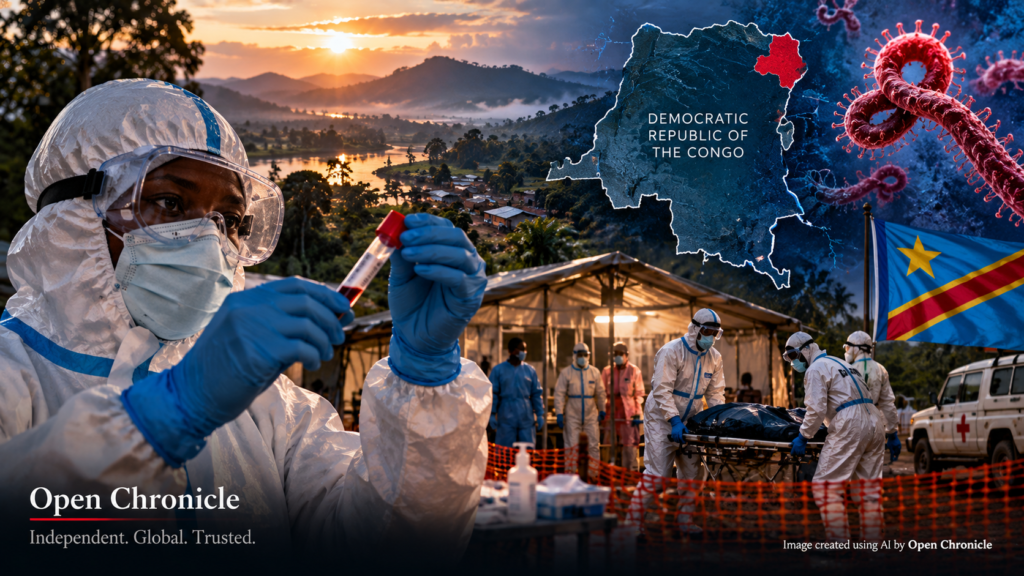
A reported Ebola outbreak involving the rare Bundibugyo virus has spread to another province in the Democratic Republic of the Congo, raising concerns about disease surveillance, contact tracing and the ability of health authorities to contain further transmission. No approved vaccine or virus-specific treatment is available for this Ebola virus variant.
By Open Chronicle News Desk with Agencies
KINSHASA, DEMOCRATIC REPUBLIC OF THE CONGO | October 18, 2026
A fast-moving Ebola outbreak has reportedly spread to another province in the Democratic Republic of the Congo (DR Congo), raising concerns about the potential expansion of a highly dangerous infectious disease emergency.
According to the initial information provided, the outbreak involves Bundibugyo virus, one of the viruses capable of causing Ebola disease in humans.
Unlike the Zaire ebolavirus responsible for several major outbreaks in Central Africa, Bundibugyo virus has no approved vaccine or virus-specific treatment.
The reported geographical expansion is particularly concerning because identifying infected people, tracing their contacts and isolating suspected cases are essential to controlling Ebola transmission.
However, the available information does not identify the affected provinces, the number of confirmed cases, the death toll or the date on which transmission was detected in the additional province.
Those details require confirmation from Congolese health authorities and international public health organisations.
A Rare Ebola Virus Presents a Difficult Public Health Challenge
Bundibugyo virus is a relatively rare cause of Ebola disease.
It belongs to the group of viruses associated with severe illness that can include fever, weakness, vomiting, diarrhoea and, in some patients, bleeding complications.
Ebola disease can be fatal, particularly when patients do not receive timely supportive medical care.
The Bundibugyo virus was first identified during an outbreak in western Uganda in 2007.
It has also caused outbreaks in the Democratic Republic of the Congo.
Although less frequently reported than Zaire ebolavirus, Bundibugyo virus remains a serious public health threat because it can spread through direct contact with infected bodily fluids.
Its rarity also creates additional challenges for outbreak preparedness, as medical countermeasures developed for other Ebola virus species cannot automatically be assumed to provide protection against it.
No Approved Vaccine for Bundibugyo Ebola
One of the most important concerns surrounding a Bundibugyo outbreak is the absence of an approved vaccine specifically protecting against this virus.
Vaccines used against Zaire ebolavirus have represented a major advance in controlling outbreaks caused by that species.
However, those vaccines are not approved for preventing disease caused by Bundibugyo virus.
This distinction is critical.
The term Ebola covers diseases caused by several related viruses, but vaccines and treatments developed for one species are not necessarily effective against another.
As a result, controlling a Bundibugyo outbreak relies heavily on established public health measures.
These include early diagnosis, rapid isolation, contact tracing, infection prevention in healthcare facilities and safe management of deceased patients.
Research into vaccines and treatments for other Ebola virus species continues, but experimental approaches should not be confused with approved medical countermeasures.
Supportive Medical Care Remains Essential
Although there is no approved Bundibugyo-specific antiviral treatment, patients can still benefit significantly from medical care.
Supportive treatment may include intravenous or oral fluids, correction of electrolyte imbalances, oxygen when necessary and management of complications.
Early clinical assessment is important because Ebola can cause dehydration, organ dysfunction and other life-threatening complications.
Healthcare workers must also use appropriate infection prevention procedures to reduce the risk of transmission within medical facilities.
The absence of an approved virus-specific treatment does not mean that medical intervention is ineffective or unnecessary.
Prompt supportive care remains an essential part of the response.
Spread Across Provincial Boundaries Raises Surveillance Concerns
The reported movement of the outbreak into another province suggests that health authorities may need to expand surveillance beyond the area where cases were initially detected.
Ebola transmission can occur when infected individuals travel while symptomatic or when people come into contact with infected bodily fluids.
However, geographical spread does not automatically establish sustained community transmission in every affected location.
Public health investigators must determine whether cases are linked to known transmission chains or represent previously undetected infections.
Contact tracing is particularly important because individuals exposed to an infected person may develop symptoms days after the initial encounter.
Health authorities generally monitor identified contacts for 21 days after their last possible exposure.
Effective surveillance requires cooperation among hospitals, laboratories, local health officials and community leaders.
How Ebola Spreads
Ebola does not spread through ordinary airborne transmission in the same manner as measles.
Human-to-human transmission occurs primarily through direct contact with the blood or other bodily fluids of someone who is infected and symptomatic, or through contaminated materials.
Transmission can also occur during burial practices involving direct contact with the body of someone who died from Ebola.
The disease has an incubation period of approximately two to 21 days.
People are not generally considered infectious before symptoms develop.
Common early symptoms include fever, fatigue, muscle pain, headache and sore throat.
Vomiting, diarrhoea and other complications may develop as the illness progresses.
Because these symptoms can resemble those of other infectious diseases, laboratory testing is essential for accurate diagnosis.
The Importance of Community Trust
Ebola outbreaks require more than clinical intervention.
Community participation is essential to identifying cases early and preventing transmission.
Public health teams must communicate clearly about symptoms, testing, isolation and the reasons for protective measures.
Misinformation and fear can discourage people from seeking medical attention or cooperating with contact tracing.
Local health workers and community leaders therefore play an important role in building trust.
Clear communication is especially important when an outbreak spreads to areas where residents may have limited previous experience with Ebola.
Authorities must balance urgent infection-control measures with respect for affected communities and their social and cultural practices.
DR Congo’s Experience With Ebola
The Democratic Republic of the Congo has extensive experience responding to Ebola outbreaks.
The country has experienced multiple outbreaks since the virus was first identified in 1976.
Congolese health authorities have developed considerable expertise in laboratory diagnosis, case investigation, emergency coordination and infection prevention.
International organisations have also supported surveillance, clinical care and research during previous emergencies.
Nevertheless, each outbreak presents different challenges depending on the virus involved, the geographical setting and the availability of healthcare resources.
A Bundibugyo outbreak requires particular attention because medical countermeasures approved for Zaire ebolavirus cannot simply be transferred to this virus.
The effectiveness of the response will depend on how quickly cases are identified and transmission chains are interrupted.
Regional and International Health Implications
A confirmed expansion into another province would increase the geographical scope of the response.
Neighbouring provinces and border regions may need enhanced surveillance, depending on the locations of cases and patterns of population movement.
The World Health Organization and regional public health institutions can support national authorities through technical guidance, laboratory coordination and emergency response expertise.
However, the available reporting does not establish whether the outbreak has crossed an international border.
Nor does it provide sufficient information to assess the likelihood of wider regional or global spread.
Any such assessment would require verified epidemiological data, including case numbers, transmission chains and the effectiveness of containment measures.
What Remains Unconfirmed
Several essential details have not been established in the initial report.
The identities of the affected provinces, the number of confirmed infections, the number of deaths and the precise timeline of the outbreak remain unspecified.
There is also no information about whether the reported spread involves a single imported case or additional local transmission.
Without those details, it is not possible to calculate a case-fatality ratio, determine the speed of transmission or assess whether the outbreak is accelerating.
Official epidemiological updates will be necessary before drawing conclusions about the scale of the emergency.
The Big Picture: Containment Depends on Speed and Trust
The reported spread of Bundibugyo Ebola to another province in DR Congo highlights the continuing threat posed by rare but potentially deadly infectious diseases.
The absence of an approved vaccine or virus-specific treatment makes early detection, supportive clinical care and infection prevention particularly important.
The Democratic Republic of the Congo has considerable institutional experience responding to Ebola, but containing an outbreak still depends on rapid surveillance, effective laboratory testing and cooperation with affected communities.
The immediate priority is establishing the geographical extent of the outbreak and identifying every known chain of transmission.
Until health authorities release verified case figures and detailed epidemiological information, the scale of the reported expansion remains uncertain. What is clear is that an outbreak involving Bundibugyo virus requires a rapid, coordinated and carefully communicated public health response.
Verified Update — October 18, 2026
Recent reporting provides important figures that can strengthen the article before publication.
Figures reported by Reuters on October 18, citing Congolese public health authorities.
Outbreak Context
The outbreak was declared in May 2026 and has also resulted in confirmed cases in Uganda and Kenya. The WHO confirms that no licensed Bundibugyo-specific vaccine or treatment is available, although clinical research is underway.
Sources and Further Reading
The following references provide international reporting and public health information concerning the Ebola outbreak in the Democratic Republic of the Congo, its reported geographical expansion and the medical challenges associated with Bundibugyo virus.
1. Reuters — Congo Confirms Ebola Outbreak Has Spread to Eighth Province
October 18, 2026
International reporting on the expansion of the Ebola outbreak to an eighth Congolese province, including case figures and information attributed to national public health authorities.
2. Associated Press — Congo’s Fast-Moving Ebola Outbreak Spreads to Eighth Province
October 18, 2026
International news coverage examining the reported spread of the outbreak, its geographical reach and the challenges facing health authorities in controlling further transmission.
3. World Health Organization — Ebola Disease Caused by Bundibugyo Virus, DR Congo
October 8, 2026
Public health information concerning Bundibugyo virus, outbreak surveillance, prevention measures and the availability of vaccines and treatments.
Editorial Note
The article above is based on the brief information supplied, with medical background added for context. The subsequently verified figures provide a more complete picture and should be incorporated into the publication version, with their reporting dates clearly identified.
Open Chronicle | Independent. Global. Trusted.