
BREAKING NEWS | FRANCE
French President Emmanuel Macron has condemned widespread rioting, looting and arson following nationwide demonstrations over living costs and student grievances. With more than 2,000 arrests and over 600 emergency personnel reportedly injured, the violence is intensifying political divisions ahead of France’s 2027 presidential election.
By Open Chronicle News Desk with Agencies
PARIS, FRANCE | October 18, 2026
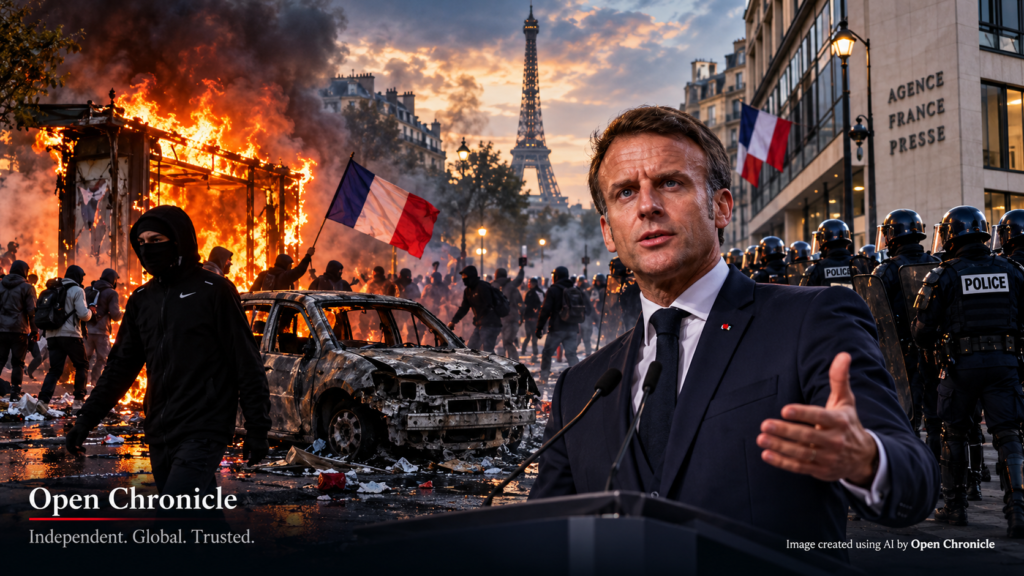
French President Emmanuel Macron has pledged to hold those responsible for widespread violence across France accountable, accusing groups involved in Saturday’s riots of attempting to undermine the Republic as the country confronts one of its most serious episodes of civil unrest in recent years.
In a televised address on Sunday, Macron condemned the looting of businesses, attacks on public buildings and fires that swept through several French cities after demonstrations over the cost of living and student conditions descended into violent confrontations.
The president said that while many demonstrators had legitimate grievances, there could be no justification for the destruction witnessed across the country.
“Those who looted will have to pay for the damage, and those who sought to bring down the Republic will be held accountable,” Macron declared.
His intervention followed a night of extensive damage in Paris and other major cities, including Limoges, where a historic town hall was engulfed in flames.
According to official figures cited in the supplied reporting, more than 2,000 people were arrested and over 600 police officers, gendarmes and firefighters were injured during the unrest.
The scale of the violence has placed the French government under intense scrutiny, with opposition parties questioning both its handling of the demonstrations and the police response.
Macron’s address comes as France approaches a politically charged presidential election scheduled for 2027, with disputes over purchasing power, public services and national security increasingly dominating the political debate.
Macron Condemns Attacks on the Republic
The French president adopted a firm tone in his televised remarks, describing the destruction as an attack on the country’s institutions and public order.
Macron said “nothing justified” the scenes of violence witnessed across France.
He accused what he described as “insurrectionist elements from the radical far left, joined by numerous criminals” of exploiting demonstrations to provoke disorder.
The accusation reflects the government’s interpretation of the violence rather than an independently established account of responsibility for every incident.
Macron called on political leaders across the ideological spectrum to condemn the attacks without ambiguity.
His remarks sought to establish a clear distinction between the right to demonstrate and criminal acts committed during protests.
The president argued that democratic disagreement must not become a justification for attacking public institutions, destroying property or threatening emergency personnel.
His message was intended both for those involved in the unrest and for political opponents who have criticised the government’s response.
A Distinction Between Peaceful Protest and Violence
Macron acknowledged that many French citizens were expressing genuine frustration over their economic and social circumstances.
He referred to the concerns raised by peaceful demonstrators as “legitimate demands”, while insisting that these grievances must not be confused with the actions of groups responsible for violence.
The distinction is central to the government’s political challenge.
Saturday’s demonstrations brought together people protesting against rising living costs, deteriorating public services and conditions affecting students.
Many participants marched peacefully, carrying French flags and calling for changes in government policy.
Other groups became involved in confrontations with police, property destruction and looting.
Macron urged the public not to equate the peaceful majority with those who used the protests as an opportunity to destroy shops and public infrastructure.
The president’s position reflects a longstanding tension in French politics between protecting the constitutional right to protest and maintaining public order during large demonstrations.
More Than 2,000 Arrested and Hundreds of Emergency Personnel Injured
The latest official figures cited in the supplied account indicate that more than 2,000 people were arrested during the unrest.
Authorities also reported injuries to more than 600 police officers, gendarmes and firefighters.
The figures suggest a substantial escalation compared with earlier reports issued while the demonstrations were still unfolding.
However, the breakdown of arrests by city, the severity of injuries and the number of civilians injured have not been independently verified for this article.
Police and emergency services faced difficult conditions as demonstrations in several cities developed into violent clashes.
Officers confronted groups throwing objects, while firefighters responded to burning vehicles, damaged commercial premises and fires affecting public buildings.
The authorities have not provided a comprehensive assessment of the total economic damage in the supplied reporting.
The number of people facing criminal charges, as distinct from those arrested, also remains unclear.
Historic Town Hall in Limoges Engulfed in Flames
One of the most striking incidents occurred in Limoges, where the city’s historic town hall was reportedly engulfed in flames during the unrest.
The fire became a powerful symbol of the destruction and intensified concerns about attacks on public institutions.
Town halls occupy a particularly important place in French civic life.
They represent local government, public administration and the institutional presence of the Republic in communities throughout the country.
Damage to such a building therefore carries significance beyond the physical destruction itself.
The incident has raised questions about the security of public buildings during large-scale demonstrations.
The supplied reporting does not establish the full extent of the damage, the cause of the fire or whether investigators have identified those responsible.
Any determination of criminal responsibility will depend on the findings of the relevant authorities.
Paris Faces Aftermath of Looting and Riots
In Paris, the unrest left damaged shops, burned vehicles and debris across parts of the capital.
The violence followed large demonstrations that initially focused on economic hardship and student grievances.
Some protesters reportedly attacked commercial premises and engaged in confrontations with police.
The looting of businesses has become a particularly contentious aspect of the crisis.
Shopkeepers face potential financial losses, damaged property and interruptions to their activities.
Macron’s pledge that those responsible would pay for the damage raises questions about how authorities will identify offenders and pursue compensation.
Criminal investigations, prosecutions and civil liability procedures may all become part of the response.
However, the president did not announce a specific compensation programme or new legal mechanism in the supplied address.
Government Faces Questions Over Police Response
Macron’s intervention came amid growing scrutiny of the government’s handling of the demonstrations.
The president, the interior minister and the prime minister have faced criticism over the scale of the violence and the tactics used by security forces.
Opposition parties have approached the crisis from sharply different perspectives.
Conservative and far-right figures have accused the government of failing to prevent widespread destruction.
Progressive and environmentalist groups have raised concerns about what they describe as excessive police force against demonstrators.
These competing criticisms have created a difficult political environment for the government.
Authorities must demonstrate that they can prevent further violence while ensuring that policing remains proportionate and consistent with the right to peaceful assembly.
The allegations concerning excessive force require investigation and should not be treated as established findings without supporting evidence.
Marine Le Pen Accuses Macron of Being Too Soft
Far-right leader Marine Le Pen has criticised Macron’s response, accusing him of laxisme, a French political term commonly used to describe excessive leniency or a failure to enforce the law firmly.
According to the supplied reporting, Le Pen is leading opinion polls ahead of the presidential election expected next April.
Her criticism reflects a broader political argument that the government has failed to maintain public order.
Security and immigration have long been central themes in the French far right’s political messaging.
The latest unrest could reinforce the importance of public safety in the election campaign.
However, the political consequences remain uncertain.
Voter reactions may depend not only on the government’s response to the violence but also on the underlying economic and social grievances that brought demonstrators into the streets.
The supplied account does not provide polling figures, methodology or dates sufficient to independently assess the current electoral standings.
Jean-Luc Mélenchon Faces Criticism From Political Opponents
Jean-Luc Mélenchon, a leading figure of the left-wing La France Insoumise (LFI), has also become a focus of political controversy.
Critics have accused him of encouraging an atmosphere of confrontation and contributing to the escalation of tensions.
Those allegations are political accusations and do not establish that Mélenchon organised or directed acts of violence.
LFI has supported student mobilisation and broader opposition to government policies.
The party’s involvement in the protest movement has intensified disagreements over the responsibilities of political leaders during periods of civil unrest.
Macron’s call for all politicians to condemn the violence appears designed to challenge opposition figures across the political spectrum.
The confrontation illustrates how the protests have become intertwined with the broader struggle over France’s political future.
Cost-of-Living Pressures Remain at the Centre of the Crisis
Although the violence has dominated the headlines, the demonstrations emerged from wider economic and social dissatisfaction.
Protesters have expressed anger over rising living costs, pressure on household budgets and concerns about the deterioration of public services.
Fuel, energy and food prices have been particularly sensitive issues in French political life.
For lower-income households, increases in essential expenses can have a disproportionate impact.
The protests have also drawn attention to the situation of students, including concerns about educational conditions and the resources available to public institutions.
The combination of economic frustration and student mobilisation has broadened the demonstrations beyond any single social group.
This makes the crisis more difficult to address through security measures alone.
Even if authorities succeed in preventing further violence, the underlying grievances may continue to fuel demonstrations.
Student Mobilisation Adds a New Dimension
Student protests have played an important role in the latest wave of unrest.
High school students have reportedly organised demonstrations and blockades in recent weeks, raising concerns about educational conditions and wider government policy.
Their participation has helped transform the protests into a broader national movement.
France has a long history of student activism influencing political debates and national demonstrations.
Young people’s involvement can also create particular challenges for police operations, especially when confrontations occur near schools or involve minors.
The government faces pressure to protect students’ right to peaceful protest while preventing violence and ensuring public safety.
The latest developments suggest that student grievances are becoming increasingly connected to wider dissatisfaction with the country’s political and economic direction.
Echoes of the Yellow Vest Movement
The demonstrations have also revived comparisons with the Yellow Vest movement that emerged in 2018.
That movement began as a protest against fuel taxes before developing into a broader expression of anger over inequality, purchasing power and political representation.
The yellow vest became a symbol of frustration among people who believed that government policies disproportionately affected working- and lower-middle-class households.
The latest demonstrations share some of those themes.
Economic hardship, distrust of political institutions and anger over public services have once again brought diverse groups into the streets.
However, the current movement also includes a significant student component and is unfolding in a different political environment.
The comparisons are therefore relevant but do not establish that the latest protests are a direct continuation of the 2018 movement.
Macron Announces No Additional Security Measures
Despite the scale of the violence, Macron did not announce new nationwide emergency security measures in his televised address.
Instead, he said local authorities would work directly with police to protect public spaces and businesses.
The president referred specifically to the need to safeguard “our cities, our public buildings and our stores”.
The approach suggests an emphasis on coordinated enforcement and local protection rather than an immediate announcement of extraordinary national restrictions.
It remains unclear whether additional operational measures will be introduced by the Interior Ministry or regional authorities.
The effectiveness of the response will be judged in part by whether further demonstrations can proceed peacefully and whether security forces can prevent renewed attacks on businesses and public institutions.
Presidential Election Raises Political Stakes
The unrest is unfolding as France prepares for its next presidential election in 2027.
Macron, who is serving his second consecutive presidential term, cannot seek a third consecutive term under the current constitutional framework.
The election will therefore determine his successor at a time of significant political polarisation.
Questions about economic inequality, public services, political representation and public security are likely to feature prominently in the campaign.
The recent violence has intensified these debates.
Right-wing opponents are focusing on the government’s ability to maintain order, while left-wing and progressive groups are emphasising economic grievances and concerns about policing.
Macron warned against allowing violence to define the country’s democratic future.
He said France deserved a “beautiful election” driven by political debate rather than destruction.
His appeal reflects concern that escalating confrontations could further weaken public confidence in democratic institutions.
Macron’s Planned Kuwait Visit
The president is scheduled to travel to Kuwait on Monday, according to the supplied reporting.
The visit comes at a sensitive moment, with the government facing domestic pressure over the unrest.
Macron did not announce a change to his travel plans during the address.
His ability to maintain an international diplomatic agenda while responding to the domestic crisis may become another subject of political scrutiny.
The supplied account does not establish whether the trip will proceed as planned or whether additional security consultations are scheduled before his departure.
What Happens Next?
France now faces several immediate challenges.
Authorities must investigate the violence, establish responsibility for attacks on public buildings and businesses, and determine whether further arrests or prosecutions are warranted.
Emergency services and local governments must assess damage and restore affected areas.
The government must also respond to questions about the conduct of police operations.
At the same time, the economic and social grievances that motivated peaceful protesters remain unresolved.
Further demonstrations could place renewed pressure on the authorities.
The political consequences may become clearer as parties respond to Macron’s address and the presidential campaign develops.
For now, the president has attempted to establish a central message: the Republic must protect the right to protest while holding those responsible for violence accountable.
The Big Picture: France’s Political Crisis Deepens
Macron’s televised address marks an important moment in France’s response to the latest wave of unrest.
By condemning what he described as an attack on the Republic, the president sought to demonstrate that the government would not tolerate violence against public institutions, businesses or emergency personnel.
At the same time, his acknowledgement of legitimate grievances reflects the political difficulty of treating the crisis solely as a public-order emergency.
The demonstrations have exposed tensions involving purchasing power, public services, student conditions and confidence in political leadership.
The violence has also sharpened divisions between the government, the far right and the left as the country approaches a presidential election that could significantly reshape French politics.
The immediate priority is restoring public safety and establishing accountability for criminal acts.
The longer-term challenge is addressing the grievances that brought large numbers of citizens into the streets.
Macron has promised that those responsible for the destruction will face consequences. Whether his government can restore public confidence while protecting the right to peaceful protest may prove equally important for France’s political future.
Sources and Further Reading
The following sources provide official presidential communications, information on public security and international reporting concerning the demonstrations, violent unrest and political developments in France.
1. Élysée Palace — Presidency of the French Republic
Official presidential statements, speeches and communications concerning national security, public order and government policy.
2. French Ministry of the Interior — Public Security
Official information concerning policing, public safety, demonstrations and statements by French authorities.
3. Associated Press — France News
International reporting on French politics, demonstrations, police operations and the wider social and political consequences of the unrest.
Editorial Note
This article is an original Open Chronicle news synthesis based on the supplied reporting concerning President Emmanuel Macron’s televised address on October 18, 2026, following nationwide protests and violent unrest in France.
The president’s statements, the reported arrest and injury figures, the fire at Limoges Town Hall and the reactions attributed to political leaders are drawn from the supplied account and have not been independently verified for this article.
The article distinguishes peaceful demonstrations over economic and student grievances from acts of rioting, looting and property destruction. Political accusations concerning responsibility for the violence are attributed to the individuals or groups making them.
The institutional and journalistic sources listed above provide relevant background and potential updates rather than direct confirmation of every development described.
Open Chronicle | Independent. Global. Trusted.