
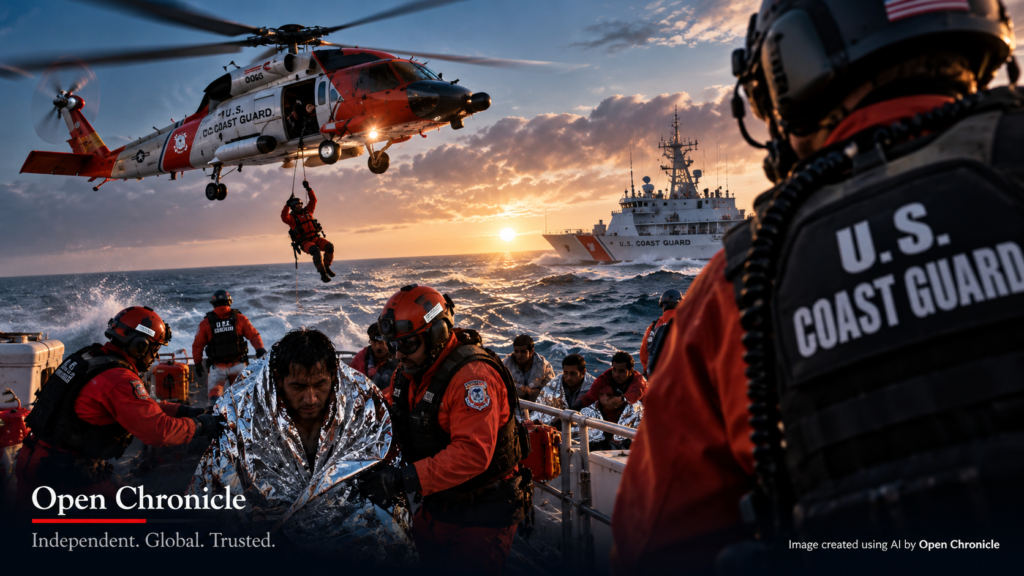
Sixteen Mexican nationals were rescued from the Pacific Ocean after a vessel carrying 27 people capsized off Mexico’s Baja California coast. Several survivors sustained severe injuries consistent with shark bites, while US and Mexican rescue teams continued searching for those still missing.
By Open Chronicle News Desk with Agencies
SAN DIEGO, UNITED STATES / BAJA CALIFORNIA, MEXICO | October 18, 2026
An extensive international search-and-rescue operation continued off Mexico’s Baja California coast after a boat carrying 27 people capsized in the Pacific Ocean, leaving 11 people missing and several survivors with serious injuries consistent with shark bites.
The United States Coast Guard confirmed that 16 Mexican nationals were rescued on Friday, October 16, after the vessel went down approximately 140 miles (225 kilometres) west of Ensenada, Mexico.
The incident occurred outside US territorial waters, according to American authorities.
Rescuers encountered a particularly difficult emergency as some of those pulled from the ocean required immediate treatment for injuries believed to have been caused by sharks.
“Several of the individuals rescued were suffering from severe injuries consistent with shark bites, and the Coast Guard provided life-saving first aid while en route (to) San Diego,” the agency said in a statement released Saturday.
The Coast Guard, US Navy and Mexican Navy have deployed aircraft and vessels to search for the remaining passengers.
The fate of the 11 missing people remains unknown.
Emergency Rescue After Mayday Call in the Pacific
The rescue operation began after authorities received a mayday call from someone aboard the vessel at approximately 1 a.m. on Friday, according to Coast Guard Lieutenant Santiago Tamburini.
The distress signal prompted an immediate response, with a rescue helicopter reaching the reported location approximately two hours later.
By the time rescuers arrived, the vessel had capsized and its passengers were in the water.
The helicopter crew, which included a rescue swimmer, spent approximately 90 minutes recovering survivors.
Sixteen people were eventually pulled from the ocean.
The rescue required coordinated operations in open water, where distance from the coastline and the condition of those awaiting assistance complicated the emergency response.
According to survivors interviewed by authorities, 27 people had been aboard the vessel before it overturned.
That account established the initial number of missing passengers at 11.
Officials have not provided a confirmed explanation for the capsize.
Survivors Treated for Severe Injuries Consistent With Shark Bites
The discovery that several survivors had sustained injuries consistent with shark bites added an unusual and potentially life-threatening dimension to the rescue.
The Coast Guard said its personnel provided emergency medical treatment while transporting the survivors toward San Diego.
The injuries were described as severe, although authorities did not specify how many people were affected or release details about their medical conditions.
The available information also does not establish the species of shark involved or the circumstances in which the injuries occurred.
The Coast Guard’s description indicates that the wounds were consistent with shark bites; it does not amount to a publicly documented forensic determination of each injury.
For those rescued, the immediate priorities were treatment for their wounds, stabilisation and safe transportation to medical facilities.
Extended exposure to open water can also create serious medical risks, including hypothermia, dehydration, exhaustion and drowning.
No confirmed deaths have been reported in the supplied account, but the continuing disappearance of 11 passengers has heightened concern about the outcome.
US Coast Guard, Navy and Mexican Forces Coordinate Search
The search has involved a substantial deployment of American maritime and aviation resources, supported by Mexican naval authorities.
According to the Coast Guard, rescuers were operating helicopters, a fixed-wing aircraft, a Coast Guard cutter and a US Navy combat ship.
An additional helicopter was scheduled to join the operation on Saturday.
The search area lies far offshore, requiring aircraft and vessels capable of operating over significant distances.
The Coast Guard said the response was launched because people were in immediate danger, notwithstanding the fact that the incident occurred outside American territorial waters.
“We were able to help, and that’s why we launched our assets,” Coast Guard Petty Officer Charlie Valor said Saturday.
The involvement of the Mexican Navy reflects the cross-border nature of maritime emergencies along the Pacific coastline shared by Mexico and the United States.
Rescue teams continued searching for the missing passengers as authorities worked to establish their possible location.
What Happened to the Vessel?
The cause of the capsize has not been established.
Authorities have not disclosed the boat’s size, type, registration, departure point or intended destination.
Nor have they confirmed whether the vessel experienced mechanical difficulties, adverse weather or another emergency before sinking.
The mayday call indicates that someone aboard was able to alert rescuers, but the available account does not describe the vessel’s condition at that moment.
Investigators will likely seek to establish the sequence of events through interviews with survivors and an examination of any available communications or physical evidence.
The testimony of those rescued may prove particularly important because the vessel went down in open water, far from shore.
For now, officials have provided no definitive explanation for the disaster.
Authorities Investigate Possible Maritime Smuggling Connection
The Coast Guard said the boat capsized in an area known to be used by maritime smugglers.
However, the agency has not established in the supplied reporting that the vessel was involved in human smuggling.
US Customs and Border Protection is investigating the circumstances and interviewing survivors.
The agency did not immediately provide further information in response to requests for updates.
The Mexican consulate in San Diego confirmed that all 16 rescued passengers were Mexican nationals.
The investigation may examine the vessel’s route, the circumstances of its departure and whether any criminal activity was involved.
The nationality of the passengers and the location of the incident do not, by themselves, establish that the journey was an attempted unauthorised border crossing.
Authorities have not announced charges or identified suspected smugglers in connection with the incident.
Could Survivors Qualify for Humanitarian Protection?
The investigation could also have implications for the legal status of survivors brought into the United States.
Under certain circumstances, individuals who are victims of or witnesses to criminal activity may be considered for temporary immigration protections.
The supplied reporting identifies humanitarian parole as one possible avenue.
Such arrangements can allow eligible individuals to remain in the United States temporarily, depending on the circumstances and decisions made by immigration authorities.
However, eligibility is not automatic.
Any protection would depend on applicable law, the individual’s circumstances and the outcome of official assessments.
The Coast Guard and Customs and Border Protection have not announced whether any of the survivors have received such authorisation.
The immediate humanitarian priority remains medical care and the continuing search for those missing.
Baja California’s Coastline Has a History of Deadly Maritime Crossings
The waters between Baja California and Southern California are used by fishing vessels, recreational boats and commercial maritime traffic.
They have also been the scene of dangerous attempts to transport migrants from Mexico into the United States.
Maritime routes can expose passengers to significant risks, particularly when vessels are overcrowded, inadequately equipped or operated in difficult conditions.
The distance from shore can complicate rescue efforts, while cold water, waves and poor visibility may increase the danger following a capsize.
The latest emergency is not the first fatal or potentially fatal maritime incident reported in the region.
May 2025: At least three killed in boat capsize
In May 2025, at least three people died when a boat overturned off the Southern California coast.
The incident occurred approximately 35 miles (56 kilometres) north of the US-Mexico border.
The disaster renewed concerns about dangerous maritime journeys along the Pacific coastline.
March 2023: Eight killed near San Diego
In 2023, eight people died in one of the deadliest maritime smuggling incidents reported off the US coast.
Two boats approached a beach near San Diego during heavy fog.
One of the vessels capsized in the surf, leaving multiple people dead.
The incident demonstrated the danger of attempting coastal landings in poor visibility and hazardous sea conditions.
Together, these tragedies underline the risks faced by passengers aboard vessels travelling along the border region.
A Difficult Search in Open Water
Finding people missing at sea is especially challenging when a vessel sinks far offshore.
Search teams must account for ocean currents, wind, weather conditions and the time elapsed since the emergency.
The location of the last confirmed sighting can become less reliable as drifting objects and people move away from the original incident site.
Aircraft provide a wide field of observation, while ships can conduct closer searches and recover survivors or evidence.
Coordination between rescue agencies is essential when operations involve multiple vessels and aircraft from different countries.
In the Baja California incident, the approximately 140-mile distance from Ensenada adds to the logistical demands.
The reported injuries among survivors also illustrate the dangers that can arise when people remain in the water awaiting rescue.
The supplied reporting does not specify how long the missing passengers may have been in the ocean or whether they had access to life jackets or other flotation equipment.
Those uncertainties make it difficult to assess their chances of survival.
Families Await News as Search Continues
For relatives of the missing passengers, the continuing operation represents a period of uncertainty.
Authorities have not publicly identified the 11 people believed to be missing in the supplied reporting.
The Mexican consulate’s involvement provides a channel for coordination between US agencies and Mexican authorities.
Consular assistance may be important for identifying survivors, contacting families and helping relatives obtain information about the rescue.
Officials have not indicated when the search might conclude.
The operation remained active in the latest account, with additional aviation resources being deployed.
The Big Picture: A Maritime Emergency With Cross-Border Implications
The Baja California disaster illustrates the human consequences of emergencies at sea and the importance of international search-and-rescue cooperation.
Sixteen people were rescued through the efforts of American maritime personnel, while Mexican authorities joined the search for those still missing.
The reported shark-related injuries made an already dangerous situation even more severe.
At the same time, the investigation raises questions about the vessel’s purpose, its route and whether criminal activity contributed to the tragedy.
Those questions must remain separate from the immediate humanitarian facts: a boat capsized, passengers were left in the Pacific Ocean and rescue teams worked to save their lives.
The incident also recalls earlier disasters involving maritime crossings along the US-Mexico border, where distance, weather and unsafe vessels can turn journeys into deadly emergencies.
As search operations continue, the central concern remains the fate of the 11 people who have not been found.
For their families, the rescue mission is far from over.
Sources and Further Reading
The following institutional sources provide information on maritime search-and-rescue operations, border security investigations and naval emergency response in the United States and Mexico.
1. United States Coast Guard — Search and Rescue Operations
Official information on maritime emergencies, rescue operations and Coast Guard activities.
2. US Customs and Border Protection — Maritime Security
Institutional information concerning border enforcement, maritime investigations and cross-border security.
3. Secretaría de Marina — Mexican Navy
Official information about Mexico’s naval operations, maritime safety and search-and-rescue responsibilities.
Editorial Note
This article is an original Open Chronicle news synthesis based on the supplied reporting concerning a boat that capsized off Baja California on October 16, 2026, and the continuing search for missing passengers.
The figures of 16 rescued Mexican nationals and 11 missing people, the reported injuries consistent with shark bites, and the description of the rescue operation are attributed to the United States Coast Guard and statements identified in the supplied account.
The circumstances of the capsize, the cause of the reported injuries and any possible connection to maritime smuggling have not been independently established for this article.
The sources listed above provide institutional information and background rather than direct confirmation of every development described.
Open Chronicle | Independent. Global. Trusted.