
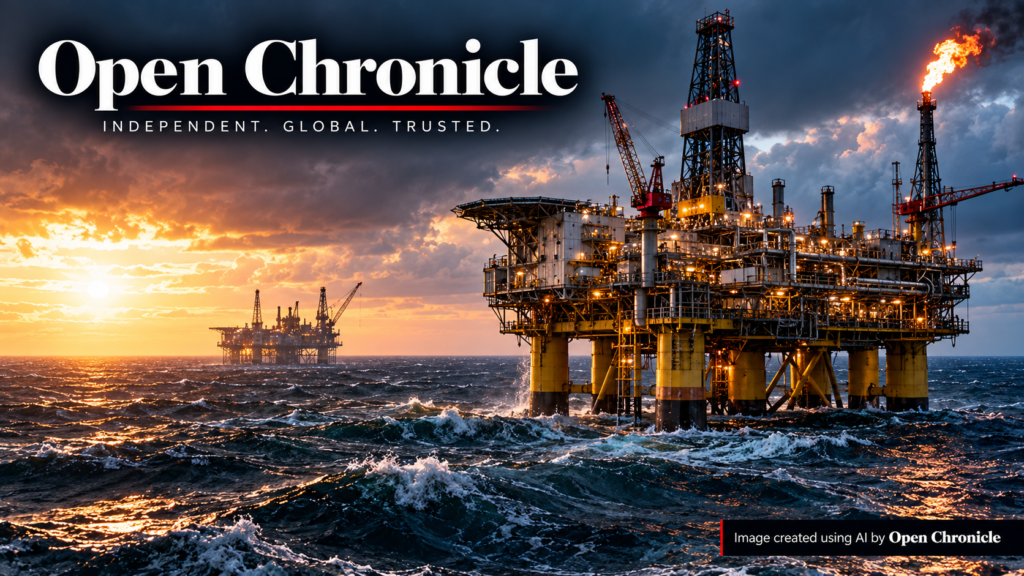
The British government has approved gas production at the Jackdaw field, promising greater energy security, investment and support for North Sea jobs. But ministers acknowledge that the project will not reduce household energy bills this winter, while a separate decision on the controversial Rosebank development remains outstanding.
By Open Chronicle News Desk with Agencies
LONDON — October 21, 2026
The British government has approved gas production at the Jackdaw field in the North Sea, opening the way for a significant expansion of domestic supply as Prime Minister Andy Burnham’s administration seeks to balance energy security, economic growth and its commitments to tackling climate change.
Energy Security Secretary Miatta Fahnbulleh announced the decision on Wednesday, allowing the relevant regulator to grant consent for production at the offshore development, approximately 150 miles from Aberdeen.
Gas from Jackdaw is expected to begin flowing within weeks, according to the reported project timetable.
At peak production, the field could increase Britain’s domestic gas output by approximately 6 per cent, while supporting employment and generating an estimated £2.9 billion in wider economic benefits.
The approval represents an important political decision for a Labour government attempting to reconcile its opposition to new oil and gas exploration licences with the continued development of previously authorised North Sea projects.
However, the government has acknowledged that additional domestic production will not automatically translate into lower household energy prices.
Speaking to BBC Radio Scotland, Fahnbulleh said Jackdaw “won’t lower energy bills this winter”, emphasising instead the project’s contribution to energy security and reduced dependence on imported gas.
Attention is now turning to Rosebank, a larger and more controversial oil and gas development west of Shetland, where ministers have yet to announce a final decision.
Jackdaw and Rosebank: Two Projects, Different Energy Implications
Jackdaw and Rosebank are among the most politically significant offshore energy projects awaiting final government decisions in recent years.
Although both are located in British waters, their resources and expected contributions to the UK economy differ.
Jackdaw is primarily a natural gas development situated approximately 150 miles offshore from Aberdeen.
Its output is expected to contribute to Britain’s domestic gas supply, potentially reducing the volume of gas the country needs to import.
Rosebank, approximately 80 miles north-west of Shetland, is predominantly an oil development.
Much of its oil production is expected to be sold internationally, meaning its contribution to domestic energy consumption would be less direct.
The distinction has become central to the government’s approach.
Fahnbulleh described Rosebank as a “different proposition”, noting that its oil would largely be exported rather than retained for domestic use.
She confirmed that no decision had yet been taken on the project.
Both developments had previously received government approvals, but their legal position changed following a ruling by Scotland’s Court of Session in January 2025.
The court found that the earlier approvals were unlawful because the environmental assessments had failed to consider adequately the emissions generated when the extracted oil and gas were eventually burned.
The judgment required more comprehensive climate assessments and fresh decisions before production could proceed.
That legal requirement has placed the projects at the centre of a wider debate over the future of Britain’s offshore energy industry.
Why the Government Approved Jackdaw
Announcing the decision, Fahnbulleh said she had considered the relevant factors before allowing the regulator to proceed with consent for gas production.
She maintained that the decision was compatible with Britain’s legally binding climate commitments.
At the same time, she reaffirmed the government’s policy of ending new exploration licences for oil and gas.
This distinction is politically important.
Labour’s 2024 general election manifesto promised not to issue new oil and gas exploration licences, but also committed to respecting licences already granted.
Jackdaw and Rosebank fall into the latter category, having received their original approvals in 2022 and 2023 respectively.
The government therefore argues that allowing Jackdaw to proceed does not amount to abandoning its wider policy against new exploration licences.
The decision also reflects a shift in political emphasis under Prime Minister Burnham, whose approach to North Sea production has been presented as more supportive than that of his predecessor, Sir Keir Starmer, and former Energy Security Secretary Ed Miliband.
While the administration continues to support the transition toward renewable energy and nuclear power, it is also seeking to demonstrate that domestic oil and gas production can remain part of Britain’s energy strategy during that transition.
Will Jackdaw Reduce Household Energy Bills?
For households facing high electricity and gas costs, the most important question is whether additional North Sea production will make energy cheaper.
The short-term answer is unlikely.
Although Jackdaw will increase Britain’s domestic gas production, the UK does not operate an isolated gas market.
Natural gas and oil are traded through international and regional markets, where prices are influenced by global supply, demand, storage levels, geopolitical events and transportation costs.
Producing additional gas in British waters does not automatically mean that consumers will pay less for it.
Domestic producers generally sell their output at prevailing market prices rather than at a discounted rate for British households.
The North Sea is also a mature producing basin.
Many of its largest and most accessible reserves have already been developed, limiting Britain’s ability to expand production sufficiently to influence international prices.
Even an increase of approximately 6 per cent in domestic gas output at Jackdaw’s peak would be too small to determine the broader market price of gas.
Fahnbulleh acknowledged this limitation when she said the project would not lower energy bills during the coming winter.
The government’s argument instead focuses on supply security and the potential economic benefits of domestic production.
Could North Sea Drilling Lower Bills Indirectly?
Supporters of additional drilling argue that the benefits should not be measured solely through immediate changes in wholesale energy prices.
One potential advantage is increased government revenue.
Oil and gas production generates tax receipts that ministers can use to finance public services, infrastructure and other policy priorities.
In principle, additional revenue could help fund household energy support or investments designed to reduce energy consumption.
Such measures might include home insulation, more efficient heating systems and improvements to electricity infrastructure.
However, any reduction in household bills would depend on government spending decisions rather than the automatic effects of North Sea production.
On the day Jackdaw received approval, Chancellor John Healey announced an Energy Wealth Fund intended to direct tax revenue from North Sea oil and gas into renewable and low-carbon energy projects.
The government argues that reinvesting fossil fuel revenues into cleaner energy infrastructure could help reduce costs over the longer term.
Burnham has presented the initiative as part of a broader strategy designed to improve energy security and, ultimately, bring down bills.
The economic logic is that investment in domestic renewable electricity, infrastructure and energy efficiency could reduce Britain’s exposure to volatile fossil fuel markets.
Nevertheless, the financial benefits would depend on the scale of the revenue collected, the investments selected and the effectiveness of their implementation.
There is no guarantee that approving Jackdaw alone will produce a measurable reduction in household energy costs.
Jobs and Investment: The Economic Case for North Sea Production
Employment is one of the strongest arguments advanced by supporters of Jackdaw and Rosebank.
Developers estimate that the two projects combined could support approximately 3,500 jobs during peak construction, alongside additional employment in supply chains and related services.
The economic benefits extend beyond workers directly employed on offshore platforms.
Oil and gas developments support engineering companies, marine transport operators, maintenance contractors, equipment suppliers, logistics providers and processing facilities.
For communities in north-east Scotland and other areas with established offshore industries, continued investment is closely connected to employment and local economic activity.
However, the number of permanent jobs created by individual projects remains contested.
Greenpeace UK’s head of politics, Ami McCarthy, has argued that Jackdaw would create only 27 full-time jobs.
Adura chief executive Neil McCulloch disputed the implication that this figure represented the project’s entire employment contribution.
Speaking to BBC Radio 4’s Today programme, he said the figure referred to personnel working directly on the offshore platform.
According to McCulloch, the development would also support just under 300 jobs associated with a nearby gas-processing facility.
The disagreement illustrates the importance of distinguishing between permanent offshore positions, construction employment, indirect jobs and wider supply-chain activity.
A project can support substantial economic activity without creating an equivalent number of long-term jobs at the production site itself.
Could Domestic Gas Improve Britain’s Energy Security?
The government’s central justification for approving Jackdaw is that producing more gas domestically could reduce Britain’s reliance on imports.
The UK continues to consume significant quantities of natural gas, particularly for residential heating, electricity generation and industrial processes.
As production from existing North Sea fields declines, the country faces growing pressure to import gas from international suppliers.
Imports can arrive through pipelines or as liquefied natural gas, commonly known as LNG.
Although international energy markets provide access to multiple suppliers, imported fuels can expose consumers and governments to disruptions beyond their control.
Military conflicts, shipping restrictions, infrastructure failures and diplomatic tensions can affect supply routes and increase prices.
Supporters of North Sea production argue that domestic gas offers greater operational certainty because it does not depend on the same international transportation arrangements.
There may also be benefits for Britain’s balance of payments if increased domestic production reduces expenditure on imported fuels.
Some economists argue that a lower import bill could provide modest support for the pound and reduce external economic pressures.
However, these potential benefits do not remove the UK’s exposure to international gas prices.
Even when gas is produced domestically, its commercial value remains closely linked to the wider market.
Fahnbulleh has argued that Jackdaw will help minimise Britain’s reliance on imported fuels with potentially higher production and transportation emissions while the country expands renewable and nuclear energy.
The Climate Debate: Domestic Gas Versus Imported LNG
Environmental campaigners strongly oppose the development of additional North Sea oil and gas fields.
Their central argument is that expanding fossil fuel production risks prolonging dependence on fuels responsible for greenhouse gas emissions.
Doug Parr, Greenpeace UK’s chief scientist, has argued that approving new oil and gas developments is incompatible with limiting global warming to 1.5°C above pre-industrial levels.
Campaigners also question whether the claimed energy security benefits justify the long-term emissions associated with extracting and burning additional fossil fuels.
The industry presents a different argument.
Because Britain will continue using oil and gas during its transition to cleaner energy, supporters contend that domestically produced supplies may have a smaller emissions footprint than certain imported alternatives.
In its updated environmental assessment, Adura argued that gas from Jackdaw would be less carbon-intensive than liquefied natural gas imported from the United States.
The company’s assessment estimated that American LNG produced from shale gas could generate approximately 20 per cent more emissions than domestically produced gas.
This comparison reflects factors such as extraction methods, liquefaction, transportation and processing.
However, the environmental implications depend on the boundaries of the comparison.
Emissions associated with production and transportation are different from the carbon dioxide released when gas is burned.
A comprehensive assessment must consider both the supply-chain emissions and the eventual combustion of the fuel.
Environmental groups also argue that additional domestic production may delay investment in alternatives capable of reducing fossil fuel demand altogether.
Rosebank: A Much Bigger Climate and Political Test
The outstanding decision on Rosebank could prove more consequential than the approval of Jackdaw.
Unlike Jackdaw, which is predominantly a gas development, Rosebank contains substantial oil reserves.
Its production would be largely directed toward international markets.
Critics argue that this weakens the case for approving the project on domestic energy security grounds.
Uplift, a campaign organisation opposing new oil and gas developments, has argued that Jackdaw would supply only a relatively small share of Britain’s overall gas needs.
Its executive director, Tessa Khan, has described Rosebank as the defining test of the government’s climate commitments.
According to figures attributed to Equinor’s assessment, burning the oil and gas produced by Rosebank could release up to 250 million tonnes of carbon dioxide over approximately 25 years.
The scale of those projected emissions has made the development a central target for environmental campaigners.
Supporters, meanwhile, emphasise the potential investment, tax revenues, employment and continued use of Britain’s offshore industrial capabilities.
For ministers, the Rosebank decision therefore involves a more difficult balance between economic arguments and climate policy.
Fahnbulleh has declined to indicate the outcome, stressing that the decision remains outstanding.
Labour Divided Over the Future of the North Sea
Jackdaw’s approval has exposed competing priorities within the Labour Party and the wider trade union movement.
Some Labour MPs and environmental campaigners believe the government should move more rapidly away from fossil fuel extraction.
Others argue that an abrupt reduction in North Sea activity could damage employment, industrial communities and Britain’s domestic energy capabilities.
Labour-supporting trade unions have welcomed the Jackdaw decision.
GMB general secretary Gary Smith said Burnham’s government deserved credit for supporting the project.
Unite general secretary Sharon Graham suggested that the approval would provide additional time to plan alternative employment opportunities for workers currently dependent on North Sea production.
Their position reflects concerns about the pace of the energy transition.
Trade unions have repeatedly argued that climate policy must be accompanied by credible industrial investment and secure employment opportunities.
Workers in oil and gas possess technical expertise that could be valuable in offshore wind, carbon capture, hydrogen infrastructure and other emerging industries.
However, the availability, location and quality of replacement jobs remain important concerns.
Environmental campaigners and some Labour parliamentarians argue that continued investment in fossil fuel extraction risks delaying that transition.
According to Uplift, more than 80 MPs and members of the Scottish Parliament have expressed opposition to Rosebank.
The government therefore faces pressure from both sides.
Some Labour representatives want ministers to go further by removing restrictions on new oil and gas exploration licences.
Others want the government to reject Rosebank and strengthen its commitment to reducing fossil fuel production.
Fahnbulleh has so far maintained that the policy against issuing new licences remains in place.
The Energy Wealth Fund and Britain’s Longer-Term Strategy
The newly announced Energy Wealth Fund is intended to connect revenues from existing fossil fuel production with investment in the energy systems that will eventually replace it.
The government argues that this approach offers a practical way to manage the transition.
Rather than immediately abandoning domestic oil and gas production, ministers want to use part of its economic value to finance renewable electricity and low-carbon infrastructure.
The strategy could potentially support investment in offshore wind, electricity networks, industrial decarbonisation and other technologies.
However, its success will depend on the amount of funding available and how effectively that money is deployed.
North Sea tax revenues can fluctuate significantly with international oil and gas prices, production levels and the structure of the tax system.
As existing fields decline, the revenue base may also shrink.
The fund therefore raises a broader question about whether fossil fuel revenues can provide a reliable foundation for long-term energy investment.
For households, the decisive factor will be whether the resulting projects reduce the cost of producing, transporting and consuming energy.
What the Decision Means for British Households
The immediate consequences of Jackdaw’s approval are likely to be more visible in industrial investment and domestic gas supply than in household energy bills.
Consumers should not expect a direct reduction in their gas or electricity tariffs simply because production begins at the field.
Household bills are influenced by wholesale energy prices, network charges, supplier costs, government policy and regulatory arrangements.
A relatively modest increase in domestic gas production is unlikely to change those factors substantially.
However, supporters argue that additional domestic production could improve supply resilience, support employment and generate tax revenues that can be reinvested in the energy transition.
Environmental groups counter that the same policy objectives could be pursued through faster deployment of renewable energy, greater energy efficiency and reduced dependence on fossil fuels.
The debate therefore extends beyond the economics of one offshore field.
It concerns the future structure of Britain’s energy system and the relative importance assigned to affordability, energy security, employment and emissions reductions.
The Big Picture: Energy Security, Climate Commitments and the Cost of Living
The approval of Jackdaw marks a significant decision for Britain’s energy policy, but it does not resolve the underlying tensions between domestic fossil fuel production and the transition to a low-carbon economy.
The Burnham government is attempting to present North Sea production as a temporary but useful component of a broader energy strategy.
Its argument is that Britain will continue to require gas during the transition and that domestic supplies can provide economic and security advantages over certain imported alternatives.
Opponents believe the approval risks encouraging further fossil fuel development at a time when the country should be accelerating investment in cleaner energy.
The unresolved Rosebank decision will test how far ministers are prepared to extend their support for existing offshore projects.
For consumers, however, the central distinction remains clear.
More North Sea gas may improve Britain’s domestic supply position, but it will not automatically produce cheaper household energy.
Any sustained reduction in bills is more likely to depend on broader changes to energy markets, electricity generation, infrastructure investment and the efficiency of homes and businesses.
Jackdaw may strengthen the government’s argument that domestic production still has a role in Britain’s energy transition.
Whether that role is economically worthwhile, environmentally compatible and politically sustainable will remain the subject of intense debate.
Sources and Further Reading
The following references provide reporting and institutional background relevant to the Jackdaw approval, the outstanding Rosebank decision and Britain’s energy policy.
1. The i Paper — North Sea Drilling Has Been Approved: What It Means for Energy Bills
Reporting on the Jackdaw decision, the government’s economic arguments, the outstanding Rosebank application and the debate over household energy prices.
2. UK Government — Department for Energy Security and Net Zero
Official government information concerning North Sea production, energy security, domestic energy policy and climate commitments.
3. North Sea Transition Authority — Offshore Oil and Gas Regulation
Regulatory information concerning UK offshore production, licensing, development consents and the future of the North Sea basin.
4. Climate Change Committee — UK Climate Targets and Energy Transition
Independent advice concerning the UK’s legally binding climate objectives, emissions reductions and the transition away from fossil fuels.
5. Greenpeace UK — Climate and Energy Policy
Environmental perspectives on fossil fuel extraction, new oil and gas developments and Britain’s energy transition.
6. Equinor — Rosebank Development
Project information and the developer’s perspective on Rosebank, including its offshore development plans and economic implications.
Editorial Note
This article is an original Open Chronicle news synthesis based on supplied reporting concerning the UK government’s reported approval of the Jackdaw gas field on October 21, 2026, and the continuing debate over the Rosebank development.
The political appointments, ministerial statements, project estimates and economic figures are presented according to the supplied source material. Open Chronicle has not independently verified the reported approval decision, the precise timetable for production or the full details of the announced Energy Wealth Fund.
Employment estimates, economic benefits and emissions comparisons are attributed to the relevant developers, campaign organisations and other stakeholders. Such assessments may use different methodologies and should not be treated as directly equivalent.
The article distinguishes between the potential economic and energy security benefits of domestic production and the separate question of whether increased North Sea output can reduce household energy prices. The latter depends on wider market conditions and government policy.
The institutional references provide additional background and do not independently confirm every event or statement described in the supplied reporting.
Open Chronicle | Independent. Global. Trusted.