
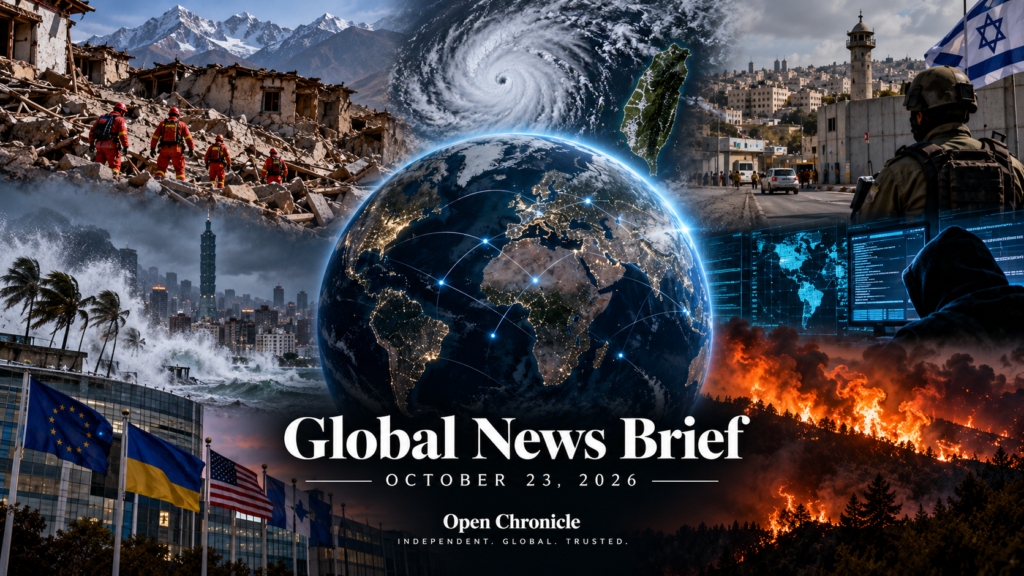
A deadly earthquake in Tibet, a powerful typhoon disrupting Taiwan, renewed tensions in the Middle East and fresh diplomatic initiatives on the Korean Peninsula lead a day of major international developments. Meanwhile, the war in Ukraine, cybersecurity threats, European protests and extreme weather continue to shape the global agenda.
By Open Chronicle News Desk with Agencies
WORLD NEWS | FRIDAY, OCTOBER 23, 2026
The international news agenda on Friday was dominated by a combination of natural disasters, military tensions, diplomatic initiatives and political uncertainty.
A magnitude 7.0 earthquake in Tibet killed at least 16 people and forced thousands to evacuate, while Typhoon Champi brought widespread disruption to Taiwan, grounding hundreds of flights and closing schools and businesses.
In the Middle East, a shooting near an Israeli checkpoint left five people injured and two suspected attackers dead, prompting Israeli authorities to announce sweeping security measures in the occupied West Bank. Reports of possible renewed US-Israeli military action against Iran also added to regional uncertainty.
The war in Ukraine remained a major international concern, with renewed questions about satellite communications, additional European military assistance and the protection of civilians from Russian attacks.
Elsewhere, South Korea proposed military talks with North Korea, Austria expelled four Russian diplomats, and new research highlighted the deadly consequences of extreme summer heat across Europe.
These are the principal international developments reported on October 23, 2026.
ASIA-PACIFIC
Magnitude 7.0 Earthquake Kills at Least 16 in Tibet
A powerful magnitude 7.0 earthquake struck China’s Tibet Autonomous Region, killing at least 16 people and injuring dozens more, according to reports citing Chinese authorities.
The earthquake affected the Nagqu area, where hundreds of homes were reportedly damaged or destroyed.
Early reports placed the number of injured between 32 and 65 as emergency services continued assessing the disaster’s impact.
Authorities reported that 12,489 people had been evacuated from affected communities.
Rescue teams were deployed to search damaged buildings, assist survivors and provide emergency shelter to displaced residents.
The high-altitude region presents significant logistical challenges for emergency operations, particularly where roads, communications and access to remote settlements have been disrupted.
The full extent of the destruction remains under assessment.
The disaster highlights the vulnerability of communities in the Himalayan region, where major earthquakes can affect isolated settlements and complicate the delivery of humanitarian assistance.
Typhoon Champi Brings Taiwan to a Standstill
Taiwan faced widespread disruption as Typhoon Champi approached the island, bringing dangerous weather conditions and prompting authorities to suspend transportation and public activities.
Hundreds of flights were cancelled, with some reports indicating that cancellations approached 1,000 across affected airports.
Schools and businesses were ordered to close in several areas as officials prepared for heavy rainfall, strong winds and possible flooding.
Reports also indicated at least one death and dozens of injuries associated with the storm.
The severe weather disrupted domestic and international travel, affecting passengers and commercial operations.
Taiwan’s mountainous geography makes the island particularly vulnerable to landslides and flash flooding during intense tropical storms.
Emergency authorities urged residents to follow official warnings and avoid unnecessary travel.
South Korea Proposes Military Talks With North Korea
South Korea has invited North Korea to hold military discussions aimed at reducing tensions along their heavily fortified border.
The proposal includes efforts to clarify border demarcation and restore communication mechanisms between the two countries.
Relations remain strained following years of military confrontation, weapons development and the deterioration of inter-Korean dialogue.
Reports indicate that North Korea has installed extensive new defensive infrastructure along the border, including a substantial number of landmines.
South Korean authorities have expressed concern that these developments increase the risk of accidental confrontations.
The proposed talks represent a diplomatic opening, although there is no indication that Pyongyang has accepted the invitation.
A resumption of military communication could help reduce the possibility of misunderstandings in one of the world’s most heavily militarised border regions.
Japan Prepares Cyberattack Simulations Amid Global Security Concerns
Japan is preparing cybersecurity exercises as newly discovered vulnerabilities in PHP software raise concerns about the security of websites and online services worldwide.
PHP is widely used in web development, including by major content management systems and business applications.
Reports indicate that recently identified flaws have triggered significant hacking activity and attempts to exploit vulnerable systems.
Japanese authorities and cybersecurity specialists are examining the potential consequences for critical infrastructure, businesses and public services.
The planned exercises are intended to test defensive capabilities and improve preparedness against sophisticated cyberattacks.
The developments underline the growing international challenge of protecting interconnected digital systems.
China Prepares for Communist Party Plenum
China’s political leadership is preparing for a Communist Party plenum scheduled for October 26–29.
The meeting is expected to address political discipline, governance and strategic priorities under President Xi Jinping.
Such gatherings play an important role in defining the party’s direction and coordinating major policy decisions.
The discussions come as China faces economic pressures, geopolitical competition and continuing tensions with the United States over technology and trade.
The outcome will be closely watched for indications of Beijing’s domestic and international priorities.
EUROPE AND THE WAR IN UKRAINE
Trump Reportedly Pressed Musk Over Ukraine’s Starlink Restrictions
US President Donald Trump reportedly urged Elon Musk to restore satellite internet capabilities used by Ukraine, amid concerns that restrictions were affecting Ukrainian military operations.
The reports concern Starlink and associated satellite communications services that have become important to Ukraine’s wartime communications.
Trump indicated that restrictions had been lifted, but Ukrainian accounts suggested that some operational limitations remained.
The dispute has renewed questions about the dependence of military communications on privately operated satellite infrastructure.
Reliable satellite connectivity is particularly important for Ukrainian units operating in areas where conventional telecommunications networks have been damaged or disrupted.
The available reports do not establish that all restrictions have been removed.
The controversy also illustrates the strategic influence of private technology companies in modern warfare.
Finland and Ukraine Seek Additional Funding for Civilian Shelters
Ukraine and Finland have agreed to pursue additional financing for the construction of protective shelters in Ukraine.
The initiative is intended to strengthen civilian protection as Russian missile and drone attacks continue to threaten urban areas.
Shelters have become an essential component of Ukraine’s civil defence system, particularly in cities exposed to frequent air raids.
The cooperation reflects Finland’s continued support for Ukraine’s resilience and reconstruction.
Separately, Finland is preparing its 36th military assistance package for Ukraine, with a decision expected before the end of the year.
The two initiatives demonstrate the continuing combination of military and humanitarian assistance provided by European partners.
Austria Expels Four Russian Diplomats
Austria has announced the expulsion of four Russian diplomats on security grounds, according to reports citing the Austrian Foreign Ministry.
The decision adds to a series of diplomatic disputes between European governments and Moscow since Russia’s full-scale invasion of Ukraine.
European authorities have repeatedly raised concerns about espionage, foreign interference and intelligence activities linked to Russian diplomatic missions.
The specific allegations underlying Austria’s latest decision were not detailed in the supplied reports.
The expulsions are likely to contribute to the deterioration of relations between Vienna and Moscow.
European Parliament Calls for Black Sea Naval Operation
The European Parliament has called on the European Union to consider a naval operation in the Black Sea amid growing concern about maritime security.
The proposal comes as reports describe attacks on vessels, threats to commercial shipping and continued military activity across the region.
A separate incident involving a vessel reportedly struck by a drone off Romania left one person dead and three others missing.
The circumstances of that incident remain subject to investigation.
The Black Sea has become a strategically important theatre of the Russia–Ukraine war, affecting grain exports, commercial navigation and regional security.
Any European naval initiative would require further political and operational decisions.
France Faces Another Weekend of Protest Tensions
French authorities are preparing for renewed demonstrations after a period of widespread unrest.
Reports indicate that museums and cultural venues in Paris, including the Louvre, are expected to close on Saturday amid fears of further violence.
Security measures are being reinforced, and additional police personnel are being prepared for deployment.
The protests have highlighted wider tensions over public services, economic conditions and political leadership.
Reports also describe disruptions to schools and businesses.
The authorities face the challenge of maintaining public order while protecting the right to peaceful assembly.
Storms Disrupt Britain and France
Severe weather is affecting parts of Western Europe.
In the United Kingdom, thousands of households have reportedly lost electricity as Storm Boelo approaches.
France is also dealing with the consequences of recent storms, including reports that Storm Austen left more than 160,000 households without power.
The disruptions have renewed concerns about the resilience of electricity networks and transport systems during extreme weather.
Emergency services and infrastructure operators are working to restore services and prepare for additional adverse conditions.
MIDDLE EAST
Five Israelis Wounded in West Bank Shooting
Five Israelis were injured in a shooting near a checkpoint in the occupied West Bank, according to Israeli officials.
The Israeli military said two suspected Palestinian attackers were killed following the incident.
Israeli authorities described the shooting as a potentially major attack that had been thwarted.
Prime Minister Benjamin Netanyahu subsequently ordered or prepared extensive security restrictions in parts of the West Bank, including measures affecting the Hebron area.
The incident comes amid heightened political tensions ahead of Israel’s elections.
The circumstances of the shooting and the subsequent security operations require further independent verification.
The latest developments have intensified concerns about additional violence in the occupied Palestinian territories.
Israeli Election Debate Offers Limited Prospects for Palestinian Statehood
Israel’s election campaign is taking place against a backdrop of continued conflict and disagreement over the future of the Palestinian territories.
Political reporting suggests that the election may offer limited prospects for a significant change in Israeli policy toward Palestinian statehood.
Security policy, military service and the political influence of religious parties remain central campaign issues.
The question of military conscription for ultra-Orthodox Jewish men has also become a prominent political dispute.
The election’s outcome could affect Israel’s domestic political balance, but major differences over Palestinian sovereignty are likely to persist.
Reports Suggest Possible Renewed US-Israeli Strikes on Iran
Reports circulating on Friday suggested that the United States and Israel were examining options for renewed military action against Iran following the American midterm elections.
The reports describe possible operations against strategic targets, but no new military campaign has been officially confirmed in the information available.
Regional tensions remain elevated following recent confrontations involving Iran, Israel and US forces.
The possibility of further military action has implications for Gulf security, oil markets and maritime transportation.
Any operational planning should be distinguished from a confirmed decision to launch attacks.
Oil Spill Reported Along UAE Coast
Authorities in the United Arab Emirates are investigating an oil spill affecting beaches in Umm Al Quwain.
The incident comes amid heightened concern about tanker security and maritime attacks near the Strait of Hormuz.
The source and full extent of the pollution have not been established in the supplied reports.
The Strait of Hormuz is one of the world’s most important energy transportation routes.
Disruptions to shipping or environmental damage in nearby waters can have consequences for coastal communities, commercial activity and regional energy security.
Indian Nationals Reported Safe After Yacht Incident Near Yemen
Indian diplomatic authorities said all 14 Indian nationals involved in a yacht incident off Yemen’s coast were safe.
Earlier reports had raised concerns about the vessel’s situation amid continuing insecurity in the surrounding maritime region.
The Indian embassy confirmed that the nationals had been accounted for, according to the supplied news reports.
The incident occurred against the backdrop of threats to shipping in the Red Sea and nearby waters.
The region remains sensitive because of Houthi military activity and the wider conflict involving Yemen and neighbouring states.
Egypt Rejects Any Fragmentation of Sudan
Egypt has reiterated its opposition to the division or fragmentation of Sudan as international diplomatic efforts continue to seek an end to the country’s war.
The conflict has created one of the world’s most severe humanitarian emergencies, displacing millions of people and damaging essential infrastructure.
Regional and international representatives have emphasised the need for a political settlement rather than a purely military solution.
Egypt’s position reflects the strategic importance of Sudan’s stability for neighbouring countries and the wider Nile region.
AFRICA
Health Officials Warn of Wider Ebola Threat
Health authorities have raised concerns about the risk of further Ebola transmission in Africa following reports of cases and possible cross-border exposure.
The reports include developments involving Nigeria, Kenya and other countries in the region.
Some accounts refer to investigations into possible travel connections between patients.
The available information does not establish a continent-wide outbreak.
Public health authorities are examining transmission risks and coordinating surveillance measures.
Ebola outbreaks require rapid identification of cases, contact tracing, infection prevention and community engagement to prevent wider transmission.
The latest warnings highlight the importance of regional cooperation and reliable public health reporting.
Malawi Opposition Questions President’s Extended Stay Abroad
Opposition figures in Malawi are demanding explanations concerning the president’s prolonged absence from the country.
The dispute has raised questions about government transparency and the handling of official responsibilities during extended overseas travel.
The supplied reports do not establish the reasons for the president’s stay abroad.
The controversy reflects broader political tensions surrounding accountability and public communication.
Kenya Mobilises Assistance for People Fleeing Ethiopia
Kenyan humanitarian organisations are responding to the arrival of people fleeing violence in neighbouring Ethiopia.
The Kenya Red Cross has reportedly mobilised emergency assistance for affected communities.
Cross-border displacement can place immediate pressure on food supplies, shelter, healthcare and local infrastructure.
The latest movements highlight the humanitarian consequences of continuing insecurity in parts of the Horn of Africa.
AMERICAS
New York City Votes to Ban Central Park Horse-Drawn Carriages
New York City has voted to ban horse-drawn carriages in Central Park, bringing a long-running political and animal welfare debate to a decisive stage.
Supporters of the measure argue that horse-drawn carriage operations are incompatible with modern urban conditions and raise animal welfare concerns.
Carriage drivers and businesses warn that the ban threatens livelihoods and a longstanding part of the city’s tourism industry.
The decision follows years of disagreement involving elected officials, animal welfare organisations and workers.
The transition away from carriage operations is expected to raise questions about employment, compensation and alternative uses of the park’s transportation services.
Brazil Approaches High-Stakes Presidential Runoff
Brazil’s presidential runoff campaign is intensifying amid political polarisation and renewed debate over the country’s economic and security policies.
Reports describe a contest shaped by the legacy of President Luiz Inácio Lula da Silva and the political movement associated with former President Jair Bolsonaro.
Crime, economic conditions and the country’s international direction are among the issues influencing the campaign.
Diplomats are reportedly discussing the importance of promptly recognising the eventual election winner.
The outcome will have consequences for Latin America’s largest economy and Brazil’s international relationships.
Trump Faces New Political Controversies Ahead of Midterms
The United States is entering the final phase of its midterm election campaign amid renewed controversy surrounding President Donald Trump and Republican candidates.
Reports include criticism of a campaign advertisement involving Vivek Ramaswamy and Ohio Democratic politician Amy Acton.
Trump has also attracted attention after suggesting that he has the right to seek a third presidential term.
The US Constitution’s 22nd Amendment prohibits any person from being elected president more than twice.
Other campaign debates involve fuel prices, political donations, election advertising and the administration’s foreign policy.
The developments reflect the increasingly contentious political atmosphere ahead of the November elections.
CLIMATE, ENVIRONMENT AND GLOBAL HEALTH
Study Links Europe’s Deadly Summer Heat to Climate Change
New research has attributed a substantial proportion of Europe’s summer heat-related deaths to human-driven climate change.
Reports citing the study indicate that approximately 50,000 people died in connection with extreme summer heat, with climate change estimated to have contributed to roughly two-thirds of those deaths.
The figures are research estimates rather than a count of individually confirmed deaths.
The findings reinforce warnings that rising temperatures are creating increasingly serious public health risks across Europe.
Older adults, people with existing medical conditions and those living in poorly insulated housing are particularly vulnerable.
Researchers and public health specialists have called for stronger heat-warning systems, urban adaptation measures and better protection for vulnerable populations.
The study adds to growing evidence that climate change is already affecting mortality, healthcare systems and economic productivity.
Climate Fund Announces $20 Million for Nepal
An international climate fund has reportedly allocated $20 million to support Nepal following devastating flooding.
The announcement comes as Nepal faces major recovery and reconstruction needs after extreme weather events.
The funding represents an initial contribution rather than a complete solution to the country’s financial requirements.
Nepal’s mountainous terrain and exposure to intense rainfall create significant risks from floods, landslides and infrastructure damage.
International assistance remains important for strengthening resilience and supporting affected communities.
Indonesian Wildfires Threaten Ancient Cave Paintings
Wildfires in Indonesia are reportedly threatening some of the world’s oldest known cave paintings.
The archaeological sites contain prehistoric artworks of exceptional scientific and cultural importance.
Smoke, heat and environmental changes can damage fragile rock surfaces and pigments.
The reports have renewed concerns about the protection of archaeological heritage from climate-related disasters and environmental degradation.
Preservation specialists face the challenge of protecting sites that cannot easily be moved or reconstructed.
TECHNOLOGY AND CYBERSECURITY
Newly Discovered PHP Vulnerabilities Trigger Global Concern
Cybersecurity specialists are warning that newly discovered software vulnerabilities could expose large numbers of websites to exploitation.
Reports indicate that attackers have already launched extensive attempts to take advantage of flaws affecting PHP-based systems.
PHP is a widely used programming language supporting websites, online applications and content management platforms.
Security experts have warned that vulnerabilities in broadly deployed software can create risks across multiple industries simultaneously.
The latest developments underline the importance of timely security updates, monitoring and incident-response planning.
The precise number of vulnerable systems and confirmed compromises remains uncertain in the supplied reporting.
United States Plans Restrictions on High-Tech Investment
Washington is preparing or considering additional restrictions on certain high-technology investments involving China and Russia, according to reports.
The measures reflect growing concern about the national security implications of advanced technologies.
Artificial intelligence, semiconductors and other strategically important sectors have become central to international economic competition.
Further restrictions could affect cross-border investment and technology cooperation.
The scope and implementation of the reported measures will determine their practical consequences.
THE BIG PICTURE: A WORLD CONFRONTING OVERLAPPING CRISES
The developments of October 23 illustrate how natural disasters, military confrontation, political instability and technological risks increasingly overlap.
In Asia, the Tibet earthquake and Typhoon Champi have created immediate humanitarian and infrastructure challenges.
In Europe, the war in Ukraine continues to shape military assistance, diplomatic relations and security planning.
In the Middle East, violence in the West Bank and renewed concerns about Iran have added to uncertainty across an already volatile region.
Climate research is also drawing attention to the human cost of extreme heat, while new cybersecurity vulnerabilities demonstrate the risks associated with the world’s dependence on interconnected digital infrastructure.
Several developments deserve particular attention in the days ahead.
The humanitarian response in Tibet and Taiwan will depend on the scale of damage, access to affected communities and the capacity of emergency services.
The diplomatic situation surrounding Ukraine remains uncertain, with military operations continuing despite renewed international efforts to facilitate negotiations.
The security situation in the Middle East could be influenced by developments in the occupied West Bank, Iranian regional tensions and the protection of maritime routes.
Political developments in the United States, Brazil and Israel may also affect regional and international policy decisions.
Finally, the combination of climate-related disasters and cyber threats highlights vulnerabilities that extend beyond national borders.
Taken together, Friday’s news reflects a global environment in which governments must respond simultaneously to immediate emergencies and longer-term strategic challenges.
Open Chronicle will continue following these developments as further information becomes available.
Editorial Note
This global news briefing is an original Open Chronicle editorial synthesis based on the international headlines and news updates supplied for October 23, 2026. The source material consists primarily of headlines and brief descriptions rather than complete articles. Some developments, including casualty figures, evacuation totals, military claims, election-related statements and cybersecurity assessments, may require additional confirmation before publication. Reports concerning proposed military operations, diplomatic negotiations and security incidents are presented as reported developments, not independently verified conclusions. The individual headlines should be checked against their original publishers and relevant official statements before the briefing is published as a fully verified news edition.