
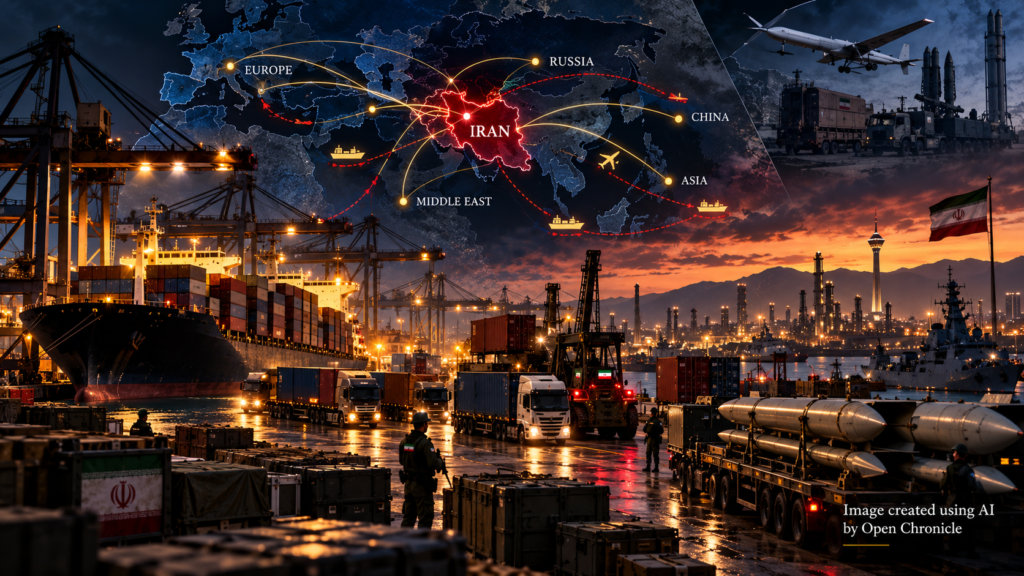
An investigation has exposed a vast procurement and financial network linked to Iran’s defence establishment, revealing how billions of dollars in equipment, industrial materials and military components have continued reaching the country despite sanctions, war and maritime restrictions.
WARFARE JOURNAL | SPECIAL REPORT | MILITARY LOGISTICS & INTELLIGENCE
30 October 2026 | By Open Chronicle Warfare Journal
The hidden infrastructure behind Iran’s military resilience
Iran has maintained an extensive international procurement network capable of obtaining military equipment, industrial machinery and strategically important components despite Western sanctions and an American naval blockade, according to a major Reuters investigation published on 29 October 2026.
The investigation identified more than 5,000 entities associated with Iran’s Ministry of Defense and Armed Forces Logistics, known as MODAFL, that collectively form an extensive financial and procurement infrastructure.
The entities are connected through registration details, banking records and international trade documentation. Some have links to the Islamic Revolutionary Guard Corps, or IRGC, and powerful economic foundations associated with Iran’s political establishment.
Working with the Israeli-American risk consultancy 240 Analytics, Reuters examined thousands of government and banking documents, corporate records and approximately 19,000 import entries.
The findings reveal how Iran’s defence establishment has continued obtaining materials relevant to missile production, unmanned aircraft, military transport and other industrial activities despite efforts to restrict its access to international markets.
One organisation, identified as MOD 346428, was associated with approximately $2.3 billion in imports between January 2025 and June 2026.
The significance extends beyond the value of the transactions.
The investigation offers an unusually detailed picture of the financial and industrial infrastructure that supports Iran’s military capabilities during an extended period of conflict and international economic pressure.
More than 5,000 entities linked to one defence establishment
At the centre of the investigation is a collection of Iranian entities whose registered names begin with the letters MOD, followed by numerical identifiers.
The naming convention refers to the Ministry of Defense.
According to Reuters, the entities share a registered address in Tehran associated with MODAFL.
Their corporate records contain unusual similarities, including a common registration date of 11 February 1979, the date associated with the victory of Iran’s Islamic Revolution.
However, Reuters found that most were actually established in 2013, during a period of particularly severe economic pressure on Iran.
The investigators identified the organisations through their registration numbers, financial records and shipping documentation.
These records enabled connections to be established between entities that might otherwise appear to be separate commercial organisations.
The investigation also identified relationships with foreign intermediaries and companies involved in international trade.
Some entities were associated with Iran’s powerful bonyads, foundations that control substantial commercial and industrial assets.
Others were linked through financial records to individuals associated with the IRGC.
These findings suggest that the network extends across multiple areas of Iran’s political, military and economic establishment.
However, the existence of a connection does not necessarily establish that every organisation or individual involved knowingly participated in prohibited transactions.
That distinction is particularly important when examining international suppliers and manufacturers.
MOD 346428: A window into the scale of procurement
Among the thousands of entities identified, MOD 346428 emerged as one of the most significant.
According to import records reviewed by Reuters, the organisation was associated with approximately $2.3 billion in purchases between January 2025 and June 2026.
The recorded shipments included industrial chemicals, explosive materials, aircraft components, precision machinery and heavy commercial vehicles.
Some of these products have civilian applications.
Others are relevant to military manufacturing, including missile propulsion, unmanned aircraft production and the maintenance of defence equipment.
The investigation also identified substantial imports of heavy trucks.
Such vehicles are important because modern military logistics depends heavily on commercial transport platforms.
Military organisations can use adapted trucks for moving equipment, transporting supplies and supporting mobile weapons systems.
However, the presence of a particular truck model in import records does not, by itself, establish that the vehicle was converted for military use.
Reuters examined satellite imagery and other material to trace some imported vehicles.
The investigation also compared commercially available vehicle characteristics with footage of Iranian military equipment.
These findings provide evidence of procurement patterns, but they do not establish the ultimate operational use of every imported vehicle.
The wider importance of MOD 346428 is therefore its apparent position within a large and sustained industrial supply system.
Why missile and drone production depends on international trade
Iran has invested heavily in ballistic missiles and unmanned aircraft as central elements of its military strategy.
These systems have particular importance because Iran’s conventional air force has historically faced limitations in acquiring modern combat aircraft.
Missiles and drones provide alternative means of delivering military effects over considerable distances.
They also support Iran’s broader strategy of maintaining deterrence against regional adversaries.
However, manufacturing such systems requires more than domestic engineering expertise.
Complex weapons programmes depend on industrial materials, electronics, precision manufacturing equipment and reliable production facilities.
Even when the final weapon is assembled domestically, elements of its supply chain may originate abroad.
This creates vulnerabilities when governments impose export controls or financial sanctions.
The Reuters investigation suggests that Iran has developed an extensive procurement structure intended to maintain access to international markets despite those restrictions.
Some of the recorded imports were identified as originating in China, Russia, Germany and other European countries.
This does not establish that the governments of those countries authorised military exports to Iran.
Nor does it prove that manufacturers necessarily knew the final destination or intended use of their products.
International trade frequently involves distributors, brokers and multiple commercial intermediaries.
Establishing legal responsibility requires evidence concerning the specific transaction, applicable export controls, knowledge of the parties and ultimate destination of the goods.
Nevertheless, the presence of internationally sourced industrial equipment within the records illustrates the difficulty of completely isolating a sophisticated defence industry from global supply chains.
The financial dimension: Oil revenue and overseas intermediaries
One of the investigation’s most important findings concerns the financial structure supporting the procurement network.
Reuters reported that approximately 97 percent of the shipments it reviewed were recorded as settled without a currency transfer.
This accounting classification does not mean that the goods were obtained without payment.
Instead, the investigation linked the transactions to arrangements involving overseas intermediaries and funds associated with Iranian oil sales.
The broader role of such financial structures has previously been documented by the United States Department of the Treasury.
American sanctions authorities have described how Iranian military-linked organisations use foreign companies and financial facilitators to access revenue generated outside Iran.
The Treasury has repeatedly identified networks associated with MODAFL and the IRGC that it says support military procurement and weapons development.
In September 2025, for example, the Treasury announced sanctions against individuals and companies accused of facilitating financial transfers benefiting Iranian military organisations.
Further actions followed in 2026.
The financial dimension is essential because industrial procurement depends on reliable access to capital as well as physical equipment.
A country may possess domestic manufacturing facilities but still face significant difficulties if it cannot pay foreign suppliers or access specialised components.
Iran’s procurement system therefore represents both an industrial and a financial challenge for sanctions enforcement.
The role of Bank Sepah and leaked financial records
Banking documentation formed another important part of the investigation.
Reuters and 240 Analytics examined records associated with Bank Sepah, an Iranian financial institution that has longstanding connections to military-related financial activities.
The documents included account information and registration details that helped researchers identify relationships between numbered entities.
According to the investigation, some accounts held substantial foreign currency balances.
The records also revealed connections between certain entities and individuals associated with the IRGC.
The information was reportedly obtained from previously leaked datasets, including material published through WikiIran.
Reuters reviewed the documentation alongside other records, including corporate registrations and shipping information.
The use of multiple categories of evidence was important because leaked banking material can contain inaccuracies, incomplete records or information that is difficult to authenticate independently.
The resulting investigation nevertheless illustrates how financial documents can reveal relationships that are not apparent from public company names alone.
For intelligence analysts, the significance lies in the ability to compare financial, corporate and trade records to understand the structure of complex economic networks.
Military procurement during the 2026 war
The investigation is particularly significant because some of the recorded imports continued during the 2026 conflict involving Iran, the United States and Israel.
Military operations have placed considerable pressure on Iran’s defence infrastructure.
Attacks against military installations, industrial facilities and weapons systems have increased the importance of replacing equipment and sustaining production.
According to Reuters, recorded imports associated with MOD 346428 declined sharply in March 2026 before recovering in subsequent months.
The agency reported a monthly decline of approximately 47 percent, followed by an increase in the value of recorded imports by May.
This pattern suggests that the procurement system retained some ability to function despite disruption.
However, it does not establish that Iran fully replaced its battlefield losses or restored all damaged production facilities.
Import values alone cannot measure military readiness.
Some materials may remain in storage, require additional processing or be unsuitable for immediate operational use.
Others may support civilian or industrial activities rather than weapons production.
The data therefore provides evidence of continuing procurement, not a comprehensive assessment of Iran’s remaining military strength.
Why the naval blockade has not stopped all supplies
The American naval blockade is intended to restrict maritime activity associated with Iran.
However, a naval blockade does not automatically prevent all international trade.
The Reuters investigation identified shipments reaching Iran through different transport channels, including land, sea and air.
The geographical and commercial complexity of Iran’s international connections makes complete economic isolation difficult.
Iran shares land borders with several countries and maintains extensive trade relationships across Asia and the wider Middle East.
Some categories of industrial equipment are also widely traded internationally.
As a result, restrictions targeting maritime routes do not necessarily eliminate alternative channels of commercial activity.
The effectiveness of a blockade must therefore be assessed alongside financial sanctions, export controls, diplomatic cooperation and the capacity to identify prohibited transactions.
The available evidence indicates that Iran has retained access to some foreign goods despite these measures.
It does not establish that the blockade has been ineffective in every respect.
Restrictions may still increase costs, delay deliveries, reduce available suppliers and complicate industrial planning.
These effects can be strategically significant even when trade continues.
European manufacturers and the problem of dual-use goods
The investigation identified equipment recorded as originating from European countries, including Germany.
Some of the shipments involved commercially manufactured trucks and industrial components.
The findings raise questions about the ability of export-control systems to identify sensitive goods that may ultimately reach sanctioned military organisations.
However, commercial origin and legal responsibility must be distinguished.
A product manufactured in Europe may pass through multiple distributors before reaching its final destination.
Its original manufacturer may not control every subsequent transaction.
Furthermore, some goods have legitimate civilian applications and are not automatically prohibited under every sanctions regime.
Reuters contacted companies named in the investigation.
Some said they maintained compliance procedures and contractual restrictions intended to prevent prohibited military use.
The findings therefore illustrate a broader enforcement challenge rather than establishing wrongdoing by every company whose products appeared in the records.
For European governments, the central policy issue is how to maintain legitimate international trade while preventing sensitive technologies from supporting prohibited military activities.
The strategic importance of the IRGC
The Islamic Revolutionary Guard Corps occupies a central position within Iran’s military and security establishment.
In addition to its military responsibilities, the organisation has developed extensive economic and industrial relationships.
Its influence extends into areas including infrastructure, engineering, logistics and defence production.
The IRGC also plays an important role in Iran’s missile and unmanned aircraft programmes.
The Reuters investigation identified financial and organisational links between parts of the procurement network and individuals associated with the IRGC.
These connections are significant because they suggest that military procurement cannot be understood solely through Iran’s conventional defence ministry structure.
Instead, the country’s defence economy includes overlapping institutions and commercial organisations.
This complexity can make it difficult for external observers to distinguish between civilian industrial activity, state procurement and military-controlled economic operations.
It also complicates efforts to assess the financial consequences of sanctions.
Sahara Thunder and Iran’s international drone industry
Iran’s defence industry has also been associated with international unmanned aircraft transfers.
In April 2024, the United States Treasury identified Sahara Thunder as an important commercial organisation associated with MODAFL’s activities.
American authorities alleged that the company supported the development, production and international sale of Iranian unmanned aircraft, including systems transferred to Russia.
The Shahed family of drones has become particularly prominent in international discussions of Iranian military technology.
Russia has used Iranian-designed unmanned aircraft in its war against Ukraine, demonstrating the international consequences of Iran’s defence industrial relationships.
The Reuters investigation adds further context to these concerns by identifying the broader procurement infrastructure associated with Iranian military organisations.
However, the available records do not establish that every shipment identified by Reuters was destined for Sahara Thunder or a specific drone programme.
The importance of the findings lies in the scale and complexity of the overall industrial network.
Sanctions enforcement faces a structural challenge
Western governments have repeatedly expanded sanctions against Iranian military organisations and their international suppliers.
In September 2026, the United States Treasury announced additional measures targeting individuals and companies accused of supporting MODAFL’s weapons procurement activities.
The measures formed part of a broader effort to restrict Iran’s access to military technologies and financial resources.
Yet the Reuters investigation found no evidence that the thousands of numbered MOD entities it identified had themselves been individually designated under Western sanctions programmes.
This does not mean that transactions involving those entities are necessarily lawful.
Sanctions may apply through ownership, control, jurisdiction, the nature of the goods or relationships with already designated organisations.
Nevertheless, the finding illustrates an important problem for enforcement authorities.
Complex networks can contain numerous entities whose relationships are not immediately apparent from public sanctions lists.
The challenge is therefore not simply identifying individual companies.
It also involves understanding the wider organisational and financial relationships behind them.
Strategic analysis: Five implications for regional security
1. Iran’s defence industry appears more resilient than its formal sanctions exposure might suggest
The scale of the documented procurement activity indicates that Iran has retained access to international industrial resources despite significant economic and military pressure.
However, continued imports should not be confused with proof of unrestricted weapons production.
2. Military logistics has become a strategic battlefield
The investigation demonstrates that modern conflicts are influenced by financial institutions, industrial suppliers and international trade relationships as well as conventional military operations.
A country’s ability to sustain its armed forces depends on the resilience of these interconnected systems.
3. The distinction between civilian and military supply chains is increasingly difficult
Commercial vehicles, industrial machinery and electronic components can serve legitimate civilian purposes while also supporting military production.
This creates difficult challenges for exporters, regulators and investigators.
4. Sanctions enforcement requires more than individual designations
The existence of thousands of connected entities illustrates the limitations of treating complex procurement systems as collections of unrelated companies.
Effective oversight depends on understanding broader ownership, financial and organisational relationships.
5. Iran’s future military capabilities cannot be assessed through battlefield losses alone
The destruction of weapons and facilities is only one part of a military balance.
Industrial recovery, procurement, maintenance and access to foreign technology also influence how quickly military capabilities can be restored.
The Reuters findings provide new evidence relevant to that assessment, although they do not establish the full scale of Iran’s current production capacity.
Conclusion: The industrial foundations of military power
The Reuters investigation reveals a dimension of Iranian military power that is less visible than missiles, drones or battlefield operations.
Behind Iran’s weapons programmes lies a complex network of organisations, financial relationships and international commercial transactions.
The discovery of more than 5,000 defence-linked entities and billions of dollars in recorded imports demonstrates the importance of this infrastructure.
It also highlights the limits of evaluating military strength exclusively through conventional measures such as equipment inventories or the results of airstrikes.
Iran’s ability to sustain its defence industry depends partly on whether it can continue obtaining materials, financing and specialised equipment.
Western sanctions and the American naval blockade are intended to restrict that capacity, but the available evidence indicates that procurement has not ceased.
Sources and Further Reading
The following journalistic and institutional references provide the factual foundation for this investigation. Reuters serves as the primary source, while official documentation from the United States Department of the Treasury provides independent evidence concerning Iranian military procurement and financial networks. These government records do not independently verify every finding reported by Reuters.
Iran’s Hidden Web of Military Agencies Is Slipping Hardware Past the US Blockade
An extensive investigation examining Iranian MOD-linked entities, international import records, banking transactions and financial relationships associated with Iran’s military establishment. The reporting draws on corporate documentation, trade records and research conducted in collaboration with 240 Analytics.
Operation Economic Outcast Takes Down Iranian Military Procurement Networks
Official United States sanctions announcement identifying intermediaries, companies and procurement networks accused of supporting Iran’s Ministry of Defense and Armed Forces Logistics (MODAFL). The document provides additional context concerning international restrictions on Iranian military acquisition activities.
Treasury Targets Financial Network Supporting Iran’s Military
Official documentation describing financial networks associated with Iran’s military establishment, including the use of overseas intermediaries, oil-related revenues and commercial entities allegedly involved in facilitating transactions benefiting Iranian defence organisations.
Treasury Targets Networks Facilitating Illicit Trade and UAV Transfers
Official sanctions documentation providing background on Sahara Thunder, MODAFL and commercial networks associated with Iranian unmanned aerial vehicle production and international transfers. The announcement also addresses procurement and financial activities connected to Iran’s defence industry.
Iran Sanctions
The Office of Foreign Assets Control’s official reference portal for United States sanctions relating to Iran. It provides information on applicable restrictions, sanctions programmes, regulatory guidance and compliance requirements concerning financial and commercial activities.
This article was prepared by Open Chronicle Warfare Journal using an investigation published by Reuters on 29 October 2026 and official documentation from the United States Department of the Treasury and the Office of Foreign Assets Control. The identification of more than 5,000 Iranian defence-linked entities, the associated import values and the reported financial relationships are attributed to the Reuters investigation and its research collaboration with 240 Analytics. Open Chronicle has not independently audited the underlying banking, corporate or shipping datasets. The appearance of a company, country or commercial product in import records does not, by itself, establish knowledge of prohibited military end use or a violation of sanctions. Strategic interpretations are editorial analysis and should not be treated as confirmed intelligence assessments.