
OPEN CHRONICLE | WORLD NEWS | 30 OCTOBER 2026
The first American pope has submitted a mail ballot for the November elections, bringing an unusual intersection of citizenship, religious authority and democratic participation into the international spotlight.
By Open Chronicle World News Desk
A historic vote from the Vatican
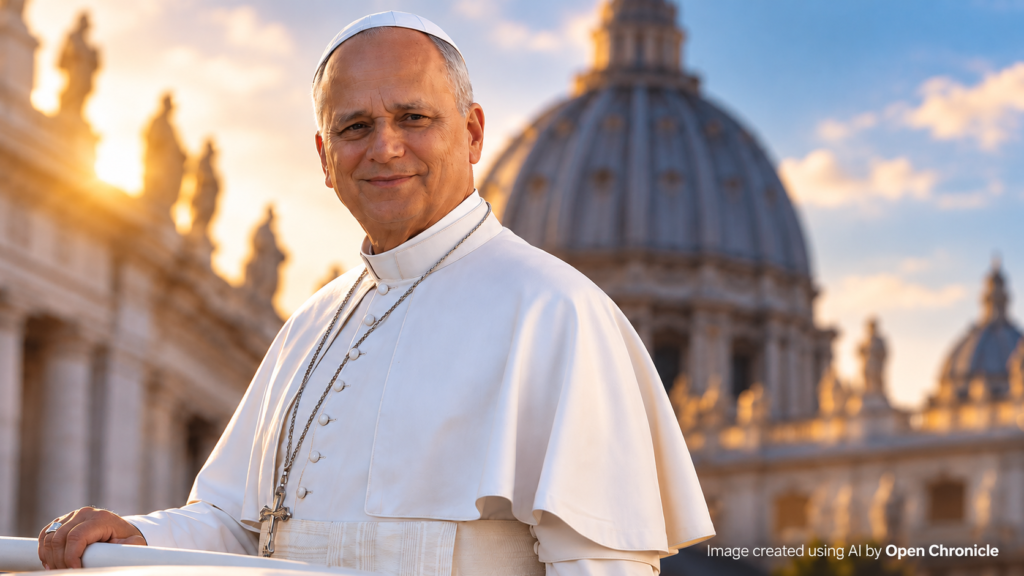
Pope Leo XIV has cast his ballot in the United States midterm elections scheduled for 3 November 2026, becoming the first known sitting pontiff to participate in an American election.
The Vatican confirmed on Friday, 30 October, that the pope had submitted a mail ballot in Chicago, marking an extraordinary moment in the relationship between the papacy and democratic citizenship.
For centuries, popes have exercised considerable influence over political and social affairs, frequently addressing questions of government, justice, war and the responsibilities of public authorities. Yet direct participation in an electoral process while occupying the papal office is an entirely different matter.
Leo XIV, born Robert Francis Prevost in Chicago, is the first American pope in the history of the Catholic Church. His decision to exercise his voting rights demonstrates an unusual continuity between his personal civic identity and his responsibilities as the spiritual leader of the world’s approximately 1.4 billion Catholics.
According to the Vatican, the pontiff’s participation reflects his belief that citizens have both a right and a responsibility to engage in democratic processes.
The announcement raises questions extending far beyond the immediate American election: whether a pope should participate directly in national politics, how religious leadership interacts with democratic citizenship, and whether Leo’s decision establishes a precedent for future pontiffs.
The first American pope and his Illinois roots
Leo XIV was elected pope in May 2025, succeeding Pope Francis and becoming the first pontiff born in the United States.
His background differs significantly from that of many predecessors.
Born in Chicago in 1955, Prevost spent substantial periods of his religious career outside the United States, particularly in Peru, where he worked as a missionary and later served as bishop of Chiclayo.
His international experience contributed to a religious identity shaped by both North and South America.
Despite his decades of service abroad, he maintained ties to Illinois, where members of his family continue to live.
According to American electoral records examined by the Chicago Sun-Times, Prevost remained registered to vote in New Lenox, a community southwest of Chicago in Will County, associated with the residence of his brother John.
Those records provide an unusual insight into the civic activities of a man who would eventually become the leader of the Catholic Church.
Before his election as pope, Prevost participated in American presidential and congressional elections, including the 2024 presidential contest.
His electoral history also includes participation in both Democratic and Republican primary elections.
Such participation does not establish permanent allegiance to either political party. Illinois operates a primary election system in which voters can choose a party’s primary ballot without maintaining a permanent party registration.
The available information does not disclose which candidates Leo XIV supported in previous general elections or in the 2026 midterms.
A precedent with few historical parallels
The significance of Leo XIV’s vote lies partly in the unusual institutional position occupied by the pope.
Unlike most religious leaders, the pontiff is also the sovereign of Vatican City State, an independent entity established under the Lateran Treaty of 1929.
The Holy See maintains diplomatic relations with governments around the world and participates in international affairs through a network of diplomatic missions.
Historically, the papacy has often exercised political influence without participating directly in the electoral systems of individual nations.
British historian and papal expert Michael Walsh has suggested that Leo’s decision may represent an unprecedented development in the history of the modern papacy.
The claim requires a degree of caution.
While Leo XIV is the first American pope and therefore the first known pontiff to vote in a United States election, establishing that no previous pope ever participated in any democratic secular election would require a comprehensive examination of historical electoral records.
Nevertheless, the symbolic importance of the announcement is considerable.
For the first time in modern American political history, the head of the Catholic Church has publicly confirmed his participation in the country’s electoral process while serving as pope.
It creates a new point of reference in discussions about the distinction between religious authority and individual citizenship.
Can a pope legally vote in an American election?
The pope’s position as head of Vatican City does not, by itself, eliminate his rights as a United States citizen.
American law provides mechanisms allowing eligible citizens living abroad to participate in federal elections through absentee voting.
The Uniformed and Overseas Citizens Absentee Voting Act, commonly known as UOCAVA, establishes protections for eligible Americans residing outside the country.
These provisions are particularly relevant to diplomats, military personnel, international workers and citizens who have established long-term residence abroad.
Election administration remains primarily the responsibility of individual states, which establish procedures governing registration, ballot requests and submission.
Illinois permits eligible overseas voters to participate through established absentee voting procedures.
Leo XIV’s continued registration in New Lenox therefore provides the electoral connection through which his participation has been reported.
The Vatican’s announcement confirms that a ballot was submitted. It does not independently establish whether election officials have completed every administrative step necessary for that ballot to be accepted and counted.
The distinction matters because submitting a ballot and having it included in the final certified election results are separate stages of the electoral process.
There is also no public evidence that the pope’s participation involved any unusual exemption from American election law.
Rather, the episode appears to illustrate how established overseas voting procedures can apply to an individual holding an exceptionally unusual international office.
A civic tradition extending beyond the United States
The Vatican’s statement included another revealing detail about Leo XIV’s past.
During the years he lived in Peru, the future pope also exercised his right to vote whenever he was eligible.
Prevost acquired Peruvian citizenship in 2015, adding another dimension to his identity as a religious leader whose life and career crossed national boundaries.
His voting history therefore reflects a longer pattern of civic participation rather than an entirely new interest in electoral politics.
That distinction is important when assessing the significance of his latest decision.
The unprecedented element is not that Robert Francis Prevost has voted before, but that he has continued to do so after becoming pope.
Previous pontiffs also retained connections to their countries of origin. Pope Francis, born Jorge Mario Bergoglio in Argentina, maintained his Argentine nationality, while John Paul II and Benedict XVI were closely associated with Poland and Germany respectively.
However, available historical reporting has not established that these predecessors voted in national elections while serving as pope.
Leo XIV’s participation consequently raises a question about whether the papal office necessarily requires complete withdrawal from the electoral responsibilities associated with citizenship.
The Vatican’s announcement suggests that the current pontiff does not regard the two roles as inherently incompatible.
The political context of the 2026 midterms
The announcement comes just days before American voters decide the composition of Congress and numerous state governments.
All 435 seats in the House of Representatives are being contested, alongside 35 Senate seats and gubernatorial elections in 36 states.
In Illinois, voters are choosing a successor to retiring Senator Dick Durbin and deciding whether Governor JB Pritzker should receive another term.
The election is taking place against a backdrop of disagreements over immigration, economic policy, federal spending and the United States’ involvement in the war with Iran.
Leo XIV has spoken publicly about several of these issues, particularly the treatment of migrants and the humanitarian consequences of armed conflict.
His statements have sometimes placed him at odds with President Donald Trump’s administration.
Nevertheless, the pope’s public positions should not be interpreted as evidence of how he voted.
The Vatican has not disclosed his ballot choices, and the secrecy of the electoral process protects those decisions.
Nor does his participation constitute an official endorsement of any American political party.
The distinction between expressing moral positions on public affairs and supporting specific electoral candidates remains central to understanding the papacy’s political role.
A sensitive boundary between religion and politics
The Catholic Church has long encouraged believers to participate responsibly in civic life.
Catholic social teaching addresses subjects including human dignity, economic justice, solidarity, peace, the protection of vulnerable people and the common good.
At the same time, the Church generally distinguishes its moral teaching from direct institutional alignment with political parties.
This creates a particularly sensitive situation for a sitting pope.
As an individual citizen, Leo XIV possesses political rights under the laws of his country of nationality.
As the leader of the Catholic Church, however, his actions can carry international symbolic weight beyond their immediate personal significance.
A vote cast privately by an ordinary citizen is primarily an individual democratic act. A vote cast by a pope can become a subject of international political interpretation, even when the voter’s preferences remain secret.
Some observers may regard the decision as a demonstration that civic responsibilities continue regardless of professional or religious status.
Others may question whether a pontiff who exercises electoral rights in one country risks appearing more directly connected to that country’s political system than to those of other nations.
Neither interpretation establishes that Leo XIV has breached a legal or ecclesiastical obligation.
The Vatican has presented the decision as a continuation of his longstanding civic participation, rather than as an intervention in an electoral campaign.
What the Vatican has not disclosed
Several questions remain unanswered.
The Holy See has not identified the candidates selected by Leo XIV, explained whether he intends to participate in every future American election or announced a broader policy concerning papal voting.
It has also not established whether future popes should follow the same practice.
The confirmation concerns one individual exercising his citizenship rights in a particular election.
The available reporting does not establish a formal change in Vatican policy or Catholic doctrine.
There is also an administrative distinction between sending a ballot and having it officially counted.
The Vatican confirmed that the pope submitted his ballot by mail. Final acceptance remains subject to the applicable election procedures.
These limitations do not diminish the historical importance of the announcement. They help define precisely what has occurred and what remains unknown.
A small act with wider historical significance
The physical act of voting is ordinary for millions of American citizens.
For a sitting pope, it is anything but ordinary.
Leo XIV’s decision brings together several identities that rarely intersect so visibly: American citizen, former missionary in Peru, head of the Catholic Church and sovereign of Vatican City State.
It also illustrates the changing international character of the modern papacy.
The Catholic Church’s leadership has become increasingly global, reflecting the experiences of pontiffs whose lives have extended across national and cultural boundaries.
Leo XIV embodies that international dimension while retaining an identifiable connection to his birthplace and electoral community.
Whether his decision becomes an enduring precedent remains uncertain.
Future popes may interpret their civic responsibilities differently, depending on their nationality, personal circumstances and understanding of the papal office.
For now, the significance lies in the confirmed event itself.
On 30 October 2026, the Vatican acknowledged that the first American pope had participated in a United States election while occupying the highest office of the Catholic Church.
It was an individual exercise of a democratic right, but one carrying historical implications far beyond the ballot box.
Sources and Further Reading
The following sources support the factual reporting and historical context of this article.
Vatican News
Pope Leo XIV votes in US midterm elections via mail-in ballot.
Published 30 October 2026. Official announcement from the Holy See Press Office, including the pontiff’s statement on civic participation.
America Magazine
Vatican confirms Pope Leo voted by mail in U.S. midterm election.
Published 30 October 2026. Electoral history, reporting from Illinois and historical comparisons with previous pontiffs.
Associated Press
Leo XIV has become the first pope in history to vote in a US general election.
Published 30 October 2026. Independent reporting on the election and its significance.
Reuters
Pope Leo becomes first pontiff to cast ballot in US election.
Published 30 October 2026. Confirmation of the historic vote, Illinois registration and political context.
National Catholic Reporter
In a papal first, Leo votes in US midterms.
Published 30 October 2026. Specialist reporting on the Vatican announcement and the pope’s electoral participation.
This article is based on the official statement issued by the Holy See Press Office on 30 October 2026 and contemporaneous reporting by international news organisations and specialist Catholic publications. The historical significance of the vote is assessed in the context of available records. While Leo XIV is the first known sitting pope to participate in a United States election, broader claims concerning all democratic elections in papal history remain subject to historical qualification. No information concerning the pope’s individual electoral choices has been disclosed.