
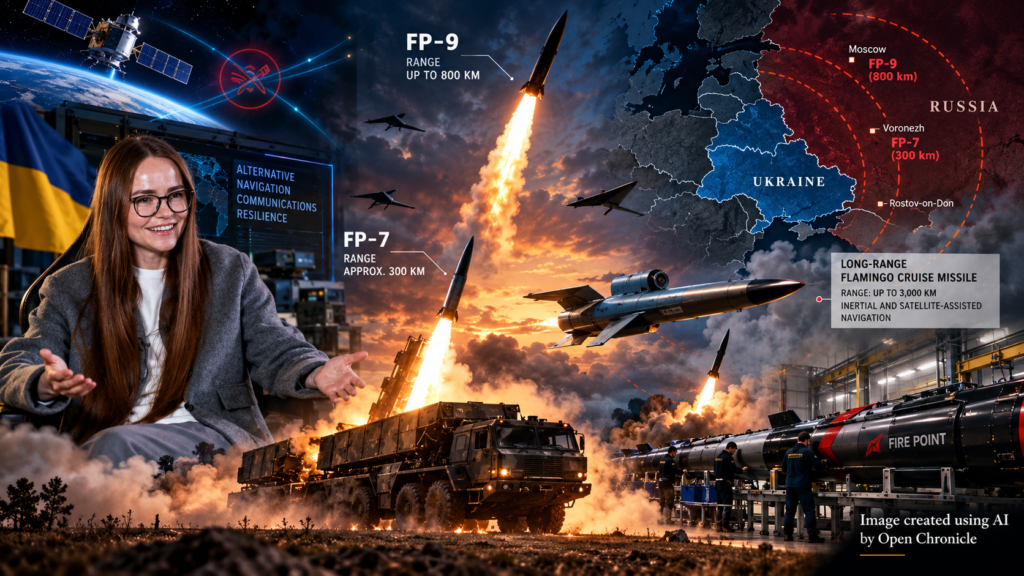
The Ukrainian defence manufacturer says it has developed alternatives to satellite connectivity restrictions while advancing the FP-7, FP-9 and a European missile defence programme, highlighting the growing importance of technological sovereignty in modern warfare.
WARFARE JOURNAL | MILITARY TECHNOLOGY & DEFENCE INDUSTRY
30 October 2026 | By Open Chronicle Warfare Journal
A new challenge to satellite dependence
Ukrainian defence manufacturer Fire Point says its long-range strike systems can complete missions without relying on SpaceX satellite connectivity, a development that could reduce one of Ukraine’s most significant technological vulnerabilities in its war against Russia.
The announcement follows a period of restrictions affecting SpaceX services used by Ukrainian military forces, exposing the operational risks associated with depending on commercial satellite infrastructure for battlefield communications and unmanned systems.
In an interview published by Reuters on 30 October 2026, Fire Point chief executive Iryna Terekh said the company had developed technical alternatives that allowed its systems to complete missions even when satellite connections were unavailable.
However, Terekh acknowledged that the solutions currently provide only a fraction of the operational capabilities that unrestricted satellite access could offer.
Her statements illustrate a broader challenge confronting Ukraine and other technologically advanced armed forces: how to maintain operational effectiveness when essential digital infrastructure is controlled by external commercial providers.
The implications extend beyond the Ukrainian battlefield, raising questions about military autonomy, resilient communications and the future relationship between private technology companies and national defence systems.
The SpaceX restrictions that exposed a vulnerability
Satellite communications have played an essential role in Ukrainian military operations since Russia launched its full-scale invasion in February 2022.
SpaceX’s Starlink network has supported communications between military units, command posts and mobile formations, while the company’s military-oriented Starshield services have been associated with more specialised defence applications.
These systems have helped Ukrainian forces operate across an extensive battlefield where conventional telecommunications infrastructure is frequently damaged or disrupted.
In October 2026, however, restrictions affecting SpaceX connectivity created operational difficulties for Ukrainian forces.
According to Reuters, the limitations lasted approximately ten days and affected certain high-speed applications.
Ukrainian officials reported that connectivity problems interfered with unmanned aircraft operations and forced some military units to interrupt planned missions.
The restrictions particularly affected systems operating above approximately 160 kilometres per hour, although Ukrainian units also reported connection difficulties at lower speeds.
SpaceX chief executive Elon Musk subsequently acknowledged restrictions on Starlink services, citing alleged violations of the civilian network’s terms of service.
Ukrainian authorities disputed that characterisation, maintaining that offensive military operations relied on the military-oriented Starshield system rather than the civilian service.
The episode also generated questions in Washington about the decision-making process behind changes to satellite availability.
The exact division of responsibility between commercial decisions and government involvement remains contested.
By 24 October, Ukrainian officials reported that the affected services had returned to their previous operating speeds.
Nevertheless, the disruption demonstrated how changes to satellite access could have immediate consequences for battlefield operations.
Fire Point’s approach to operating without satellite links
Fire Point says its systems were designed with the possibility of communications interruptions in mind.
According to Terekh, the company’s engineers have developed alternative methods allowing long-range strike missions to continue when external satellite connectivity is unavailable.
She did not disclose the technical details of these methods.
That limitation is significant.
Without independently verified technical information, it is not possible to determine precisely which navigation, guidance or communications capabilities remain available during satellite outages.
Military systems can potentially combine several forms of navigation and control, but Fire Point has not publicly established which specific technologies are responsible for the capabilities described by its chief executive.
Terekh also acknowledged that the alternatives do not reproduce the full operational advantages associated with unrestricted Starlink access.
She estimated that the current solutions provide approximately 15 to 20 percent of the capability that would be possible with broader satellite availability over Russian territory.
This distinction is essential to understanding the announcement.
Fire Point is not claiming that satellite communications have become unnecessary.
Rather, the company says it has developed sufficient resilience to prevent the complete failure of certain missions when those communications are interrupted.
The difference between maintaining basic mission continuity and preserving full operational flexibility is considerable.
For military planners, however, even partial independence from external infrastructure may represent an important improvement.
FP-7: Ukraine’s emerging tactical ballistic missile
Alongside its work on satellite-independent systems, Fire Point is developing a new generation of domestically produced ballistic missiles.
One of the company’s most significant projects is the FP-7, a tactical ballistic missile with a reported range of approximately 300 kilometres.
According to Reuters, Ukraine announced the missile’s first combat employment during October 2026, targeting a location in Russian-occupied Ukrainian territory.
Independent information about the missile’s operational performance remains limited.
The reported development nevertheless represents an important step in Ukraine’s efforts to expand its domestic missile production capabilities.
Ballistic missiles differ from many long-range unmanned aircraft in their speed and flight characteristics.
Depending on their design and operational employment, they may offer shorter response times against certain targets.
Terekh suggested that the FP-7 could contribute to Ukraine’s ability to threaten Russian missile launchers, including systems associated with the Iskander family.
Such launchers can be difficult to engage because they are mobile and may relocate before slower strike systems reach their positions.
A domestically produced tactical ballistic missile could therefore provide Ukrainian commanders with an additional operational option.
However, the effectiveness of such a capability would depend on factors including target detection, intelligence quality, missile availability, accuracy and the ability to engage mobile systems within a limited timeframe.
None of these operational parameters can be established solely from the manufacturer’s public statements.
Could the FP-7 help protect Ukrainian cities?
Fire Point has also presented the FP-7 as a potential contribution to the protection of Ukrainian cities.
This claim requires careful interpretation.
The FP-7 is described as a tactical ballistic strike missile, not as an interceptor designed to destroy incoming ballistic missiles.
Its possible defensive contribution would therefore be indirect.
By threatening launch platforms or other military assets associated with attacks against Ukrainian territory, a strike missile could potentially reduce an adversary’s ability to conduct future attacks.
That is fundamentally different from intercepting an incoming missile in flight.
Ukraine continues to depend on advanced air defence systems, including the American-made Patriot, for protection against certain ballistic missile threats.
The availability and cost of interceptor missiles remain major concerns for Kyiv.
Domestic strike weapons and dedicated air defence interceptors consequently perform different, although potentially complementary, military functions.
Fire Point’s FP-7 programme should be understood within that broader effort to strengthen Ukraine’s defensive and offensive capabilities.
FP-9: A longer-range missile approaching operational readiness
Fire Point is also developing the FP-9, a ballistic missile with a reported range of approximately 800 kilometres.
The project would represent a substantial expansion beyond the FP-7’s announced range.
According to Terekh, development and testing of the FP-9 are more complex because of its longer-range requirements.
She nevertheless indicated that the missile could become ready for combat employment before the end of 2026.
That timetable remains a company projection rather than a confirmed operational milestone.
Publicly available information does not yet establish the FP-9’s complete technical specifications, production capacity, operational accuracy or combat reliability.
The development of longer-range domestic missile systems nevertheless carries significant strategic implications.
Ukraine has sought to expand its ability to strike military infrastructure supporting Russian operations while reducing dependence on foreign-supplied weapons.
Domestically developed systems could provide greater flexibility over production, maintenance and operational availability.
They could also reduce exposure to restrictions imposed by foreign suppliers.
However, developing a missile and producing it in sufficient quantities for sustained military operations are separate challenges.
Industrial capacity, component availability, quality control and testing remain essential considerations.
Freyja: A European effort to reduce dependence on Patriot
Fire Point’s ambitions extend beyond offensive missile systems.
The company is coordinating Freyja, a multinational European programme intended to develop a ballistic missile interception capability.
The initiative brings together Ukrainian expertise and European defence industry partners.
According to Defense News, Ukraine has completed important elements of its contribution to the project, while participating companies continue developing and integrating other components.
The programme involves technologies including radar systems, missile guidance, command and control equipment, and interceptor development.
European companies associated with different aspects of the initiative include established defence technology manufacturers such as Kongsberg, Hensoldt and Diehl Defence.
Freyja is intended to provide an additional European-produced capability for countering ballistic missile threats.
Its development reflects concerns about the cost, availability and production limitations of existing interceptor systems.
Ukraine has faced particular difficulties securing sufficient quantities of advanced interceptors as demand increases across multiple conflict regions.
A more widely manufactured European alternative could eventually help diversify the supply of missile defence equipment.
However, Freyja has not yet demonstrated a complete operational ballistic missile interception capability.
Terekh said the programme aims to conduct a virtual-target test before the end of 2026, followed by a physical-target interception around the middle of 2027.
These are projected milestones and remain subject to technical and industrial progress.
European industry becomes part of Ukraine’s missile strategy
Fire Point’s development illustrates the growing integration of Ukraine’s defence industry with European manufacturers and financial institutions.
The company has established relationships with multiple European suppliers involved in missile defence technologies.
Denmark has also supported Fire Point’s industrial expansion.
On 21 October 2026, the Danish government announced a state-backed loan guarantee of approximately 750 million Danish kroner, equivalent to about $113 million, for the company’s Danish subsidiary.
The financing is intended to support industrial development under conditions where the war makes conventional commercial borrowing difficult.
A planned Danish facility for missile fuel production is expected to become operational by the end of 2027.
Locating elements of the production chain outside Ukraine could reduce exposure to Russian attacks against industrial facilities.
It could also support closer integration with European suppliers and regulatory frameworks.
At the same time, such arrangements introduce new requirements involving industrial coordination, security, export controls and political cooperation.
The broader significance is that Ukraine’s defence industrial development is increasingly becoming a European industrial issue rather than a purely national one.
The strategic problem of the commercial technology dependency
The SpaceX episode raises a fundamental question about modern military operations.
What happens when an armed force depends on a privately operated service that can be modified, restricted or suspended?
Commercial satellite networks offer capabilities that would be difficult and expensive for many governments to reproduce independently.
They can provide extensive coverage, rapidly deployable communications and access to sophisticated technological infrastructure.
However, dependence on commercial providers also creates operational vulnerabilities.
Service availability may be influenced by contractual restrictions, regulatory decisions, corporate policies or government intervention.
In a military environment, even temporary changes can affect command and control, reconnaissance, communications and operational planning.
The issue is not limited to SpaceX.
Modern armed forces increasingly depend on commercial technologies across satellite communications, cloud computing, artificial intelligence, software and data services.
The Ukrainian experience demonstrates why governments are examining ways to diversify suppliers and develop sovereign capabilities.
President Volodymyr Zelenskyy has said Ukraine is pursuing its own low Earth orbit satellite network as part of efforts to reduce dependence on external providers.
Such a programme would require substantial investment and would not necessarily eliminate all foreign technological dependencies.
Nevertheless, it reflects a wider strategic movement towards greater national control over critical military infrastructure.
Strategic analysis: Three lessons from Fire Point’s development
1. Resilience may matter as much as technological sophistication
Modern military systems are frequently evaluated according to their range, precision, speed and ability to exchange information.
The Ukrainian experience demonstrates that resilience under disrupted communications conditions is equally important.
A system that retains limited functionality during a network outage may provide greater operational reliability than one that depends entirely on uninterrupted connectivity.
2. Domestic missile production can expand strategic autonomy
The FP-7 and FP-9 programmes reflect Ukraine’s efforts to develop military capabilities that are less dependent on foreign delivery schedules and political authorisations.
However, strategic autonomy requires more than domestic design.
It also depends on secure component supplies, production capacity, testing infrastructure and sustainable financing.
3. European missile defence is becoming an industrial priority
The Freyja programme illustrates how the war is accelerating cooperation between Ukrainian engineers and European defence companies.
If successful, such initiatives could expand Europe’s missile defence manufacturing capacity and reduce reliance on a limited number of existing systems.
Their ultimate significance will depend on demonstrated technical performance and the ability to manufacture equipment at scale.
Conclusion: Towards a more autonomous Ukrainian defence industry
Fire Point’s latest announcements highlight a significant evolution in Ukraine’s defence industrial ambitions.
The company is pursuing several interconnected objectives: maintaining strike capabilities during satellite connectivity disruptions, developing domestic ballistic missiles and participating in a European missile defence programme.
Each initiative addresses a different aspect of Ukraine’s dependence on external military technologies.
The results remain uneven.
Fire Point says it can complete certain missions without SpaceX connectivity, but acknowledges that its alternatives currently offer substantially reduced capabilities.
The FP-7 has reportedly entered initial combat employment, while the FP-9 remains under development.
Freyja represents an ambitious multinational project, but its operational effectiveness has yet to be demonstrated.
These distinctions are important.
Ukraine’s technological independence is not an accomplished fact.
It is an evolving industrial and strategic objective, shaped by the demands of a prolonged war and the limitations of existing international supply arrangements.
The broader lesson extends well beyond Ukraine.
As military operations become increasingly dependent on commercial networks and advanced digital infrastructure, the ability to retain essential capabilities when those systems are unavailable may become one of the defining requirements of future defence planning.
Sources and Further Reading
The following journalistic and institutional references provide the factual and technical foundation for this article. Source links are presented separately from the editorial body in accordance with Open Chronicle’s publication standards.
Ukrainian Arms Maker Fire Point Says Its Systems Can Complete Missions Without SpaceX
Published 30 October 2026. Primary reporting based on an interview with Fire Point chief executive Iryna Terekh, addressing satellite connectivity, alternative mission capabilities and the company’s missile development programmes.
Musk Says He Was Behind Starlink Speed Restriction After Service in Ukraine Is Restored
Published 24 October 2026. Independent reporting examining restrictions affecting Starlink services in Ukraine, Elon Musk’s statements and the subsequent restoration of connectivity.
Ukraine Completes Work on New Missile Defense System, Awaits European Partner Components
Published 30 October 2026. Specialist defence industry reporting covering the development of the Freyja missile defence programme, European industrial cooperation and remaining technical integration requirements.
Ukraine’s Fire Point Gets $113 Million State Loan Guarantee in Denmark
Published 21 October 2026. Reporting on Danish state-backed financial support for Fire Point’s industrial expansion, including investment in European production capacity and defence manufacturing infrastructure.
Ukraine Says SpaceX Limits Starlink Operations, Disrupting Military
Published 14 October 2026. Initial reporting on restrictions affecting satellite connectivity and their reported operational consequences for Ukrainian military units and unmanned systems.
This article was prepared by Open Chronicle Warfare Journal using reporting from Reuters, Associated Press and Defense News. Technical capabilities, missile ranges and development schedules attributed to Fire Point are based on company statements and Ukrainian official announcements unless otherwise specified. Open Chronicle has not independently verified the operational performance of the FP-7, FP-9 or the satellite-independent mission capabilities described. Strategic assessments are editorial analysis, not confirmed military outcomes.