
OPEN CHRONICLE HISTORY | ARCHAEOLOGY & ANCIENT CIVILISATIONS
Cannabis seeds, preserved human hair and molecular traces discovered inside a monumental Scythian burial mound offer what researchers describe as the earliest directly dated evidence of the plant’s intoxicating use, raising extraordinary questions about ancient rituals, sacrifice and the origins of psychoactive traditions.
By Open Chronicle News Desk
November 6, 2026 | History Magazine | Archaeology
Deep in the vast landscapes of southern Siberia, archaeologists have uncovered evidence suggesting that humans were using cannabis for its psychoactive properties approximately 2,800 years ago, centuries earlier than the oldest previously established direct archaeological evidence.
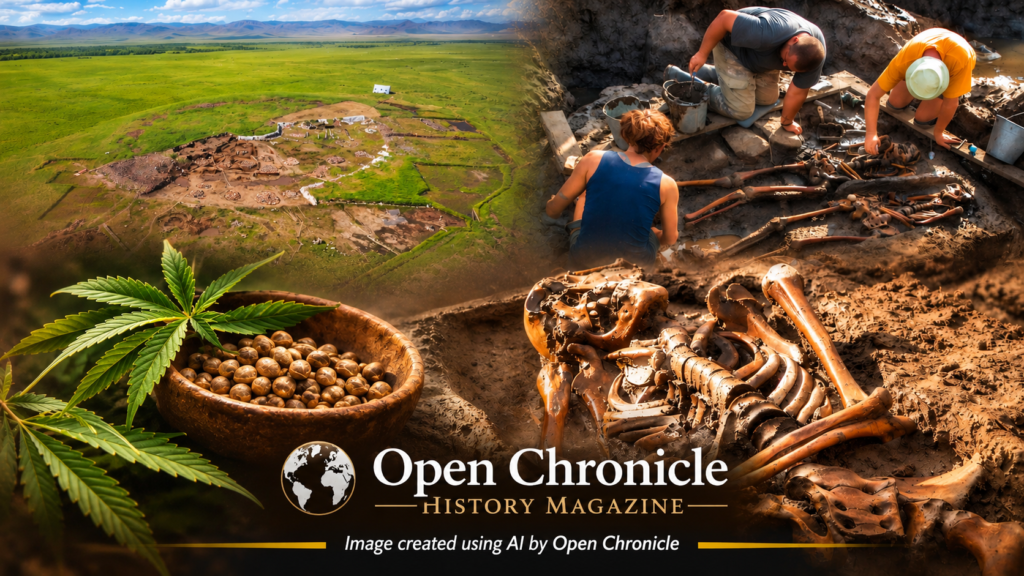
The discovery comes from Tunnug 1, an enormous burial mound in Russia’s Republic of Tyva, where researchers found cannabis seeds alongside exceptionally preserved human hair containing molecular traces associated with the plant’s intoxicating compounds.
The findings, published on November 5 in the scientific journal Science, offer a rare opportunity to investigate the behaviour, beliefs and ceremonial practices of ancient communities that left few written records of their own.
An international research team led by archaeologist Gino Caspari of the University of Bern and the Max Planck Institute of Geoanthropology combined radiocarbon dating, botanical analysis and advanced chemical techniques to examine the material.
Their conclusions suggest that cannabis was more than an ordinary plant placed inside a grave.
It may have played an important role in funerary ceremonies among the early Scythians, a group of horse-riding peoples whose cultures eventually spread across much of the Eurasian steppe.
The discovery also raises a particularly intriguing question: could psychoactive plants have been used during rituals involving animal and possibly human sacrifice?
For now, that possibility remains speculative. But the archaeological evidence is revealing a more complex picture of life and death in ancient Siberia.
A Royal Tomb in Siberia’s Valley of the Kings
Tunnug 1 lies in the Uyuk Valley of southern Siberia, a region sometimes described as the Valley of the Kings because of its concentration of monumental burial mounds.
The landscape contains some of the earliest known elite tombs associated with the Scythian cultural world.
These ancient communities are particularly remembered for their exceptional horsemanship, elaborate metalwork, weapons and distinctive burial traditions.
The Tunnug 1 mound measures approximately 140 metres in diameter, making it one of the most imposing archaeological monuments of its kind.
Its construction required considerable labour and organisation, suggesting that the individuals buried there occupied important positions within their society.
Excavations have revealed wooden burial chambers, human remains, ornaments and evidence of complex funerary ceremonies.
Researchers have also identified the remains of numerous horses that appear to have been deliberately sacrificed and arranged as part of the burial practices.
The scale of the monument indicates that death was not simply a private event for these communities.
It could involve elaborate public rituals expressing political authority, social hierarchy and beliefs about the afterlife.
Among the many objects recovered from the site, however, some of the most scientifically important discoveries were almost invisible.
They were tiny cannabis seeds.
More Than 1,000 Seeds Preserved for Nearly Three Millennia
Archaeologists recovered more than a thousand cannabis seeds from the burial complex.
Some were remarkably well preserved despite having remained underground for approximately 2,800 years.
To establish their age, researchers directly radiocarbon dated six seeds.
The results placed their deposition in the early eighth century BCE, during the formative period of Scythian culture.
This dating is particularly important because it connects the plant remains directly to the burial activities rather than relying exclusively on the age of surrounding archaeological materials.
But cannabis seeds alone cannot establish that ancient people used the plant to become intoxicated.
Throughout history, cannabis has served numerous purposes.
Its fibres can be processed into ropes and textiles, while its seeds have been used for food and oil.
The presence of cannabis inside an ancient grave might therefore reflect an offering, a practical commodity or a ceremonial tradition unrelated to intoxication.
To investigate whether the plant had another purpose, researchers turned to an unusually valuable source of evidence.
Human hair.
Ancient Human Hair Reveals Chemical Clues
Hair can preserve traces of substances to which a person was exposed during life.
As it grows, chemical compounds and their metabolites may become incorporated into its structure.
Under favourable preservation conditions, some of those traces can remain detectable for exceptionally long periods.
At Tunnug 1, researchers examined preserved human hair recovered from the central burial area.
Using high-resolution mass spectrometry and other analytical methods, they identified signals consistent with cannabinol, commonly known as CBN.
Cannabinol can form when tetrahydrocannabinol, or THC, undergoes oxidation.
THC is the principal psychoactive compound associated with cannabis.
The researchers also detected weaker chemical signals consistent with THC itself.
These findings led the team to conclude that individuals associated with the burial had probably been exposed to psychoactive cannabis.
The combination of directly dated seeds and molecular traces in human remains makes the discovery especially significant.
According to the research team, it represents the earliest directly dated archaeological evidence currently known for cannabis use involving intoxicating compounds.
Nevertheless, scientific caution remains necessary.
The researchers could not determine how much cannabis was consumed, how it entered the body or whether exposure occurred through inhalation, ingestion or another process.
Independent specialists have also questioned whether the hair results conclusively distinguish deliberate consumption from environmental contamination.
The findings are therefore important evidence supporting an interpretation, rather than a complete reconstruction of the individuals’ experiences.
Did Cannabis Play a Role in Ancient Funeral Rituals?
The location of the discovery provides an important clue.
The seeds were not found in an ordinary domestic settlement.
They were recovered from a monumental burial complex associated with elaborate funerary ceremonies.
This suggests that cannabis may have possessed ceremonial significance.
Researchers believe the plant could have been used during rituals connected with death, mourning or the transition to an afterlife.
Such practices would not have been entirely unusual in the ancient world.
Across different societies, plants with intoxicating or consciousness-altering properties have been associated with religious ceremonies, healing practices and communication with spiritual forces.
However, the precise beliefs of the people buried at Tunnug 1 remain unknown.
The archaeological evidence cannot reveal whether participants regarded cannabis as sacred, medicinal, socially important or simply useful during a particular ceremony.
The discovery becomes even more intriguing when considered alongside evidence of sacrifice at the site.
The Mystery of the Sacrificed Horses
Previous excavations at Tunnug 1 revealed the remains of 18 horses arranged around the burial mound.
Subsequent investigations identified additional horse remains and scattered human bones.
Researchers interpret the evidence as indicating extensive horse sacrifices and the possibility that humans were also sacrificed during funerary ceremonies.
Such practices are consistent with the broader archaeological record of elite burials in parts of ancient Eurasia.
Horses represented mobility, wealth, military power and social prestige.
Their inclusion in burial ceremonies may have symbolised the deceased individual’s status or provided symbolic companions for the afterlife.
The presence of cannabis introduces another possibility.
Could the plant have been used to alter consciousness during the ceremonies?
Could it have helped calm participants or individuals facing sacrifice?
Caspari and colleagues have raised these possibilities, but there is no direct evidence establishing that cannabis was administered to sacrificial victims.
The remains do not reveal the intentions of the people conducting the rituals.
Nor do the chemical findings establish whether the individuals whose hair was examined were participants, observers or victims.
The distinction matters because an intriguing archaeological hypothesis should not be confused with a demonstrated historical event.
Herodotus and the Ancient Scythians
The discovery also brings renewed attention to one of the most fascinating descriptions of ancient Scythian customs.
In the fifth century BCE, Greek historian Herodotus wrote about Scythian purification rituals involving hemp.
According to his account, participants placed hemp material on heated stones inside enclosed spaces, producing vapours that they inhaled.
His description has long been interpreted as possible evidence of ancient cannabis intoxication.
However, Herodotus wrote several centuries after the burial activities documented at Tunnug 1.
His account also concerns Scythian communities whose practices cannot automatically be assumed to have been identical to those of the earlier Siberian population.
The new discovery therefore does not prove that Herodotus described the precise rituals performed at Tunnug 1.
Instead, it provides archaeological evidence suggesting that cannabis-related practices may have existed within the wider Scythian cultural world before his lifetime.
That chronological connection is one of the most compelling aspects of the research.
It suggests that traditions involving cannabis could have deeper historical roots than previously demonstrated.
Was Cannabis Already Being Cultivated for Its Effects?
Another important question concerns the plants themselves.
Modern cannabis varieties differ considerably in their chemical composition.
Some are cultivated primarily for fibre or seeds, while others have been selected for their psychoactive characteristics.
The seeds recovered from Tunnug 1 appear consistent with plants that may have grown wild.
Researchers have not established that the ancient Siberian population deliberately cultivated cannabis to increase its THC content.
Nor can the chemical evidence determine the strength of the cannabis used approximately 2,800 years ago.
The team is now examining ancient plant DNA in an attempt to understand the history of cannabis domestication and distribution.
According to Caspari, the genetic material recovered from the seeds is exceptionally well preserved.
This could allow scientists to investigate how ancient cannabis populations were related to later cultivated varieties.
It may also help clarify whether communities across Eurasia exchanged seeds or developed local traditions of plant use.
The results could contribute to a much broader history of human interaction with cannabis.
The Eurasian Steppe as a Corridor of Cultural Exchange
The Scythian world occupied an enormous geographical area stretching across the Eurasian steppe.
Its communities were connected through migration, trade, warfare and shared cultural traditions.
Horses enabled people to travel considerable distances, while networks of exchange moved metal objects, technologies and other materials between regions.
These connections may also have facilitated the movement of plants and knowledge about their properties.
Cannabis grows naturally across parts of Central Asia, making it accessible to ancient populations long before modern agriculture and international trade.
Its use could have developed independently in different communities or spread through contact between them.
Archaeological discoveries from other parts of Asia have already demonstrated that cannabis was used for practical purposes thousands of years ago.
Evidence from later burial contexts has also suggested its use in rituals involving heat and inhalation.
The Tunnug 1 findings add an earlier and chemically distinctive chapter to that history.
Rather than establishing a single point of origin for psychoactive cannabis use, they demonstrate that such practices were present in at least one ancient Siberian burial context by the early eighth century BCE.
What the Discovery Does Not Prove
Several important questions remain unresolved.
The research does not establish that cannabis was smoked in the same manner as it is commonly consumed today.
It does not determine whether participants experienced intoxication, sedation or other effects of a particular intensity.
It does not prove that the plant was cultivated specifically for psychoactive purposes.
And it does not demonstrate that cannabis was used to prepare victims for sacrifice.
The study also does not establish that the Scythians were the first people in human history to discover the intoxicating properties of cannabis.
It identifies the earliest directly dated archaeological evidence currently recognised by the research team.
The actual history of human experimentation with psychoactive plants may extend much further into prehistory.
Earlier evidence may simply have failed to survive.
These limitations do not diminish the discovery’s importance.
They define what the archaeological record can presently tell us.
Why This Discovery Matters for Archaeology
The investigation demonstrates how modern scientific techniques are transforming the study of ancient societies.
Traditional archaeology relies heavily on objects, architecture, human remains and environmental evidence.
Chemical analysis adds another dimension.
It can sometimes reveal information about substances used by individuals who lived thousands of years ago.
The Tunnug 1 study combines several independent forms of evidence: radiocarbon dating, botanical identification, archaeological context and molecular analysis.
Together, they provide a more detailed understanding of the relationship between ancient people and plants.
The findings also illustrate the value of preserving archaeological material for future scientific examination.
As analytical techniques improve, discoveries that once appeared unremarkable may acquire entirely new significance.
A small collection of seeds or a preserved strand of hair can reveal information that monumental architecture alone cannot provide.
Conclusion | An Ancient Ritual World Revealed
The discovery at Tunnug 1 offers a remarkable glimpse into the lives and beliefs of people who inhabited southern Siberia approximately 2,800 years ago.
Within a monumental burial complex associated with elite status, horse sacrifices and elaborate ceremonies, archaeologists have identified cannabis seeds and chemical traces consistent with exposure to psychoactive compounds.
The findings suggest that cannabis may have played a meaningful role in the ritual practices of early Scythian communities.
They also provide a new scientific perspective on ancient descriptions of cannabis-related ceremonies across Eurasia.
Yet the most intriguing questions remain unanswered.
Who used the plant? How was it prepared? What did participants believe they were experiencing? And what role, if any, did it play in ceremonies involving sacrifice?
Future research into ancient DNA, plant chemistry and burial practices may provide additional clues.
For now, the discovery demonstrates something fundamental about archaeology.
Even after nearly three millennia, the smallest surviving traces of human life can transform our understanding of the ancient world.
Historical Sources and Further Reading
1. Science | Direct Evidence for Psychoactive Cannabis Use 2,800 Years Ago
Gino Caspari and colleagues, 5 November 2026.
Original scientific study presenting the archaeological,
radiocarbon and chemical evidence recovered from Tunnug 1.
2. University of Bern | Cannabis Was Used as an Intoxicant as Early as 2,800 Years Ago
Official research announcement describing the discovery,
the analytical methods and the limitations of the findings,
including uncertainty about consumption methods.
3. Max Planck Institute of Geoanthropology | Ancient Cannabis Evidence
Institutional explanation of the molecular traces detected
in preserved human hair, the burial context and ongoing
research into ancient cannabis DNA.
4. Associated Press | Ancient Cannabis Evidence and Scientific Debate
Independent coverage of the Siberian discovery, including
expert assessments and questions about whether chemical
traces conclusively demonstrate deliberate consumption.
Editorial Note
This article is based on scientific research published
in Science on November 5, 2026, and accompanying
institutional and independent reporting.
The findings support an interpretation of psychoactive
cannabis exposure approximately 2,800 years ago.
The exact method of consumption, the strength of the
ancient plants and the ceremonial purpose remain uncertain.
Suggestions that cannabis was used to sedate individuals
during human sacrifice remain speculative and should
not be regarded as established historical facts.