
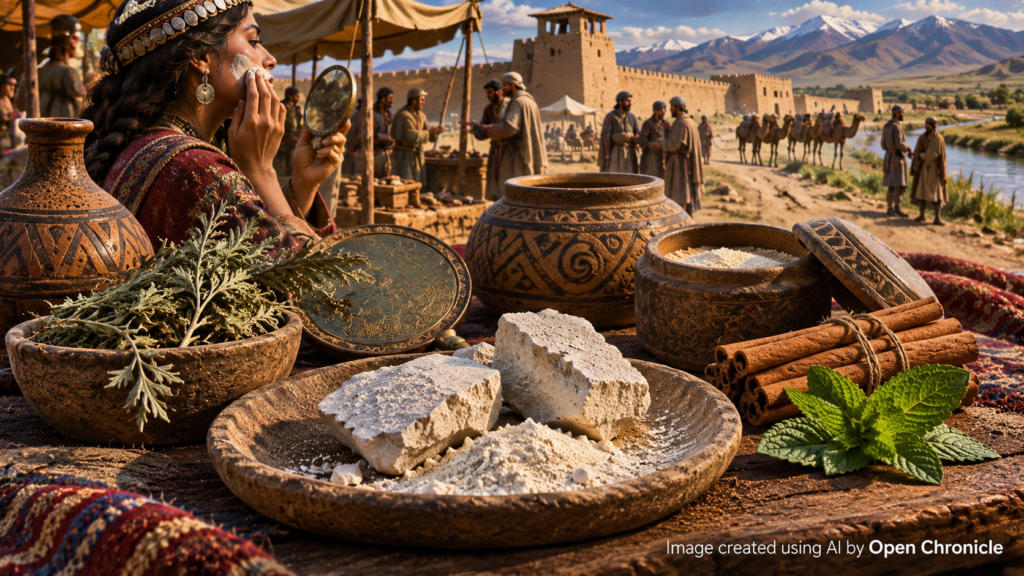
Chemical analysis of nearly 2,000-year-old cosmetic materials from two women’s graves reveals aromatic plant compounds, offering new clues about beauty practices, social identity and the movement of luxury ingredients across ancient Central Asia.
By Open Chronicle History Desk
ARCHAEOLOGY | SILK ROAD | ANCIENT COSMETICS | CENTRAL ASIA
A forgotten beauty preparation beneath the sands
Nearly two thousand years ago, two women living in the eastern Aral Sea region of Central Asia were buried with objects that would eventually reveal an unexpected chapter in the history of cosmetics.
Among their grave goods were small pieces of a pale, chalk-like substance.
At first glance, the fragments appeared unremarkable.
Yet modern chemical analysis has revealed that they contained far more than ordinary mineral material.
A scientific study published in October 2026 in npj Heritage Science identified a calcium carbonate base alongside a complex mixture of organic compounds associated with aromatic plants.
The researchers found chemical evidence consistent with ingredients derived from wormwood and cinnamon, as well as possible traces associated with mint.
Their findings suggest that the fragments may have formed part of cosmetic preparations used by women belonging to the ancient Jetyasar culture.
Even more intriguingly, some of the aromatic ingredients may have reached the region through long-distance commercial connections extending towards India.
The discovery offers a rare opportunity to investigate the personal care practices of communities that lived along the northern networks associated with the Silk Road.
It also demonstrates how objects recovered decades ago can reveal new information when examined using modern scientific techniques.
The research was conducted by a multidisciplinary team including specialists in chemistry, archaeology and anthropology.
Their investigation combined several analytical methods to examine both the mineral structure and the surviving organic residues of the ancient material.
The results provide evidence of a potentially sophisticated cosmetic preparation, while raising important questions about the origins of its ingredients.
Who were the Jetyasar people?
The Jetyasar culture developed in the eastern Aral Sea region, particularly around the lower Syr Darya River in what is now Kazakhstan.
Its history extends from the late first millennium BC into the early medieval period.
The communities associated with this archaeological culture occupied an important geographical position between agricultural settlements, steppe populations and the wider exchange networks of Central Asia.
Their economy combined different forms of subsistence.
Agriculture supported by irrigation played an important role, while animal husbandry and fishing also contributed to daily life.
Archaeological investigations have identified fortified settlements and extensive burial grounds, providing evidence of complex social organisation.
The Jetyasar world was not culturally isolated.
Its geographical position placed communities within reach of routes connecting Central Asia with regions farther south and east.
Objects recovered from archaeological sites indicate contact with different cultural and economic spheres.
These connections are particularly relevant to the new cosmetic study.
The presence of aromatic ingredients that may not have been readily available in the local environment suggests that personal care practices could have been influenced by wider networks of exchange.
However, the researchers do not claim that every ingredient was imported.
Some plants associated with the detected compounds could have grown locally.
The challenge is determining which substances originated nearby and which may have travelled considerable distances before being incorporated into the preparations.
Two women’s graves and a remarkable discovery
The materials examined in the study came from two female burials dated to approximately the second through fourth centuries AD.
The graves were located in the eastern Aral Sea region.
The objects had been recovered during archaeological excavations conducted in the late twentieth century and preserved in museum collections.
Their unusual appearance prompted researchers to investigate their composition.
The fragments resembled pieces of white chalk.
But their archaeological context suggested that they might have served a purpose beyond ordinary mineral use.
The researchers therefore examined their physical and chemical characteristics.
They sought to establish whether the fragments represented naturally occurring mineral deposits or deliberately prepared materials.
The analyses revealed a calcium carbonate structure combined with organic substances.
This association supported the interpretation that the fragments could have been used as cosmetic products.
The presence of aromatic compounds was particularly important.
It suggested that the material may have been mixed with plant-derived substances rather than simply collected and used as raw chalk.
The discovery provides a glimpse into a dimension of ancient life that is often difficult to reconstruct.
Personal grooming, scent and appearance rarely leave the same archaeological evidence as buildings, weapons or pottery.
Yet these practices could have been important expressions of identity, status and cultural preference.
The mineral foundation of an ancient cosmetic
One of the central findings concerns the mineral structure of the fragments.
The researchers identified a calcium carbonate base with a distinctive microscopic composition.
The material contained structures associated with coccoliths, the microscopic remains of certain marine algae.
Over geological time, the accumulation of such remains can contribute to the formation of chalk deposits.
This type of mineral material can be finely ground into powder.
Its pale colour and texture make it potentially suitable for cosmetic applications.
The researchers suggest that the ancient preparation may have been based on locally available chalk.
However, the precise geological source of the mineral has not been established.
Without direct comparison with suitable reference deposits, it is difficult to identify where the raw material was obtained.
The possibility of local production remains plausible.
A community could have combined accessible mineral resources with aromatic ingredients acquired through exchange.
Such a process would represent a mixture of local craftsmanship and wider commercial connections.
This is an important distinction.
A cosmetic containing an imported ingredient does not necessarily mean that the finished product itself was imported.
It may instead have been manufactured locally using materials obtained from different regions.
What chemical analysis revealed
The research team used several complementary scientific techniques.
These included gas chromatography coupled with mass spectrometry, X-ray fluorescence, scanning electron microscopy, micro-Raman spectroscopy and X-ray diffraction.
Each method provided different information.
Microscopy helped researchers examine the structure of the mineral material.
X-ray techniques contributed to identifying its elemental and crystalline composition.
Gas chromatography and mass spectrometry were especially important for investigating the organic compounds preserved in the samples.
This method separates components of a complex mixture and provides information about their chemical identities.
The researchers detected a diverse range of organic substances.
Some were consistent with compounds associated with aromatic plants.
Others required cautious interpretation because ancient materials can undergo chemical changes during burial and storage.
The team also identified substances that may reflect modern contamination.
This is a recurring challenge in archaeological chemistry.
Objects can absorb compounds from surrounding soil, conservation treatments, packaging or museum environments.
Researchers must therefore distinguish original ingredients from substances introduced long after an artefact was buried.
The study’s conclusions were based on the combined interpretation of several analytical results rather than a single chemical signal.
Wormwood, cinnamon and a possible trace of mint
Among the most intriguing findings were compounds associated with aromatic plants.
The researchers identified chemical patterns consistent with wormwood and cinnamon, together with weaker evidence suggesting the possible presence of mint.
These plants have different geographical distributions and histories of use.
Wormwood belongs to the genus Artemisia, which includes species found across Central Asia.
Its presence would not necessarily require long-distance trade.
Cinnamon, however, raises a different question.
Plants used to produce cinnamon and related aromatic products are associated with regions farther south and east.
If the detected compounds originated from cinnamon-derived material, their presence in the Jetyasar cosmetic preparation could indicate access to imported aromatic ingredients.
The researchers suggest that oils or other plant products may have reached the region through networks connected with India.
Yet the chemical evidence does not establish a precise route.
Nor does it identify the individual merchants, communities or exchanges responsible for moving the ingredients.
The possibility of mint is also treated cautiously.
The study does not establish an exact botanical recipe.
Instead, it identifies molecular evidence compatible with certain aromatic plant sources.
This distinction is essential because similar compounds can sometimes occur in different plants.
The findings are therefore best understood as evidence supporting a plausible reconstruction of the cosmetic preparation, rather than a complete identification of every original ingredient.
The Silk Road was more than silk
The discovery offers a reminder that the Silk Road was not a single highway connecting China and Europe.
It was a changing network of commercial, cultural and social relationships.
Different routes connected oasis settlements, agricultural regions, mountain communities and nomadic populations.
Goods could pass through several intermediaries before reaching their final destinations.
Silk became the most famous product associated with these networks, but it was far from the only commodity exchanged.
Spices, aromatic substances, precious stones, glass, textiles, metals and medicinal ingredients also circulated.
The movement of such goods could influence everyday practices far from their places of origin.
A small quantity of aromatic oil might travel through multiple trading communities before being incorporated into a cosmetic preparation.
In that sense, an apparently modest object could preserve evidence of relationships extending across enormous geographical distances.
The Jetyasar fragments provide a potential example.
If the cinnamon-related compounds came from imported aromatic material, the preparation would reflect the integration of local resources with products obtained through wider exchange.
However, the study does not prove that the cosmetics travelled along a specific named Silk Road route.
It supports the broader possibility of long-distance connections.
The distinction matters because ancient trade networks were complex, and the movement of a substance does not always leave a clearly identifiable geographical trail.
What cosmetics reveal about ancient women
The archaeological significance of the discovery extends beyond trade.
The fragments were recovered from women’s burials.
This context suggests that the objects may have been associated with personal care, appearance or social identity.
Cosmetics in ancient societies could serve several purposes.
They might be used to alter appearance, apply fragrance, protect the skin or participate in particular social practices.
Some substances could also possess medicinal or ritual associations.
The researchers consider cosmetic use the most plausible interpretation of the Jetyasar materials.
However, the exact manner in which the preparation was applied remains unknown.
The evidence does not establish whether it was used on the face, body or clothing.
Nor can the researchers determine whether it was used daily or reserved for particular occasions.
The presence of the material in a grave also raises questions about its symbolic significance.
Burial objects can reflect possessions valued during life, social expectations surrounding death or ritual choices made by surviving communities.
They do not necessarily provide a complete inventory of a person’s everyday belongings.
Nevertheless, the fragments reveal that personal care products may have formed part of the material culture of Jetyasar women.
This is particularly valuable because ancient history has often been reconstructed through objects associated with warfare, political authority and monumental architecture.
Cosmetics offer a different perspective.
They bring attention to individual experience, bodily practices and the circulation of small but potentially valuable goods.
Were the cosmetics a sign of wealth?
The researchers suggest that the preparations may have been associated with women of elevated social standing.
The possibility is supported by the burial context and the potential use of aromatic ingredients acquired through long-distance exchange.
Imported substances could have carried prestige.
Their rarity, scent or association with distant places might have made them desirable.
However, the exact social meaning of the cosmetic fragments cannot be determined from their chemical composition alone.
A substance that was valuable in one community might have been relatively accessible in another.
The presence of an aromatic ingredient does not automatically establish that its owner belonged to an elite social group.
Burial practices also vary considerably across cultures and periods.
For these reasons, the interpretation of the cosmetics as prestige objects remains plausible but not definitive.
Further study of the associated grave goods, burial structures and other Jetyasar cemeteries could help clarify their social significance.
The discovery nevertheless demonstrates that personal care materials deserve greater attention in archaeological investigations.
Even small fragments can preserve information about consumption, identity and cultural exchange.
Ancient materials, modern contamination
One of the study’s strengths is its recognition of the difficulties involved in analysing archaeological organic residues.
The fragments had spent many centuries in the ground and decades in museum collections.
During that time, they could have come into contact with numerous substances unrelated to their original manufacture.
The chemical investigation identified compounds that may have originated from modern materials, environmental contamination or conservation conditions.
Such findings complicate the reconstruction of ancient recipes.
A detected molecule does not automatically belong to the original object.
Researchers must consider its chemical characteristics, distribution and possible sources.
They must also evaluate whether it could have entered the sample during excavation, handling or storage.
This is particularly important when studying aromatic compounds.
Some organic substances are widespread in natural environments or modern manufactured products.
The researchers therefore interpreted the plant-related evidence alongside the mineral composition and archaeological context.
Their conclusions support the cosmetic hypothesis, but they do not eliminate every uncertainty.
The study provides a scientifically informed interpretation rather than an exact reproduction of the ancient preparation.
Why the discovery matters
The Jetyasar cosmetics illustrate the value of interdisciplinary archaeology.
Without chemical analysis, the fragments might have remained classified simply as pieces of chalk or unidentified mineral material.
Modern laboratory techniques revealed a more complex composition.
Archaeological context then helped researchers interpret what that composition might mean.
The result is a connection between personal care practices and the economic history of Central Asia.
The study suggests that Jetyasar communities may have combined locally available mineral resources with aromatic ingredients obtained through wider exchange.
It also provides evidence that cosmetics deserve consideration alongside textiles, jewellery and other objects when investigating ancient trade.
Small quantities of valuable ingredients may have travelled across regions without leaving the same archaeological traces as large commercial shipments.
Their survival in burial contexts can therefore offer unusually revealing evidence.
The discovery also shows why museum collections remain important sources of new scientific knowledge.
Objects excavated decades earlier can be re-examined using analytical methods that did not exist when they were first recovered.
Such investigations may reveal overlooked aspects of ancient technologies and everyday life.
What remains unanswered
The researchers have not established the exact recipe used to produce the cosmetic fragments.
The relative quantities of the original ingredients remain uncertain.
The precise species of plants associated with the aromatic compounds have not all been identified.
The geological source of the chalk has also not been conclusively determined.
Most importantly, the hypothesis that some aromatic ingredients came from India has not been confirmed through direct provenance evidence.
The chemical results are consistent with long-distance exchange, but they do not independently identify a specific trade route.
Future investigations could compare the Jetyasar samples with botanical reference materials, geological deposits and cosmetic objects from other archaeological sites.
Additional samples might also reveal whether similar preparations were widespread or restricted to particular communities.
Such research could help determine how personal care traditions developed across Central Asia and how they were influenced by contact with neighbouring regions.
A small object with a much larger story
The ancient cosmetic fragments from Kazakhstan are modest in size, but their significance extends far beyond the graves in which they were discovered.
They provide evidence of materials that may have been used for personal appearance or fragrance nearly two thousand years ago.
Their chemical composition suggests that Jetyasar women had access to preparations combining mineral substances with aromatic plant ingredients.
Some of those ingredients may have travelled considerable distances.
The discovery therefore connects intimate aspects of everyday life with the wider history of ancient exchange.
It also challenges the tendency to view the Silk Road exclusively through the movement of spectacular luxury goods.
The networks that connected ancient societies may also have carried the ingredients of ordinary human experiences: scent, grooming, personal expression and the desire to care for the body.
Nearly two millennia later, chemical traces preserved in two small fragments are helping researchers reconstruct those connections.
The cosmetics do not reveal the names or personal histories of the women who owned them.
But they offer a rare glimpse of a world in which local traditions and distant influences may have met in something as personal as a beauty preparation.
Historical Sources and Further Reading
Original scientific research and complementary archaeological studies examining ancient cosmetics, organic residues and the possible movement of aromatic ingredients across Central Asia.
npj Heritage Science | Springer Nature
Cosmetic powder of 2000-years old Jetyasar culture. A complex analytical study
Polyakova, O. V., and colleagues. Published 17 October 2026. Primary research examining chalk-like materials recovered from two female Jetyasar burials in Kazakhstan. The study identifies a calcium carbonate base and organic compounds associated with aromatic plants, including wormwood, cinnamon and possibly mint.
HeritageDaily
Ancient cosmetics reveal trade links along the Silk Road
Mark Milligan, 1 November 2026. Specialist coverage of the Jetyasar cosmetic materials, the archaeological context of the two burials and the hypothesis that aromatic ingredients circulated through long-distance trade networks.
Journal of Archaeological Science
Organic residue analysis in China: an overview, progress and prospects
Yimin Yang, June 2026. A review of organic residue analysis, including methods used to investigate ancient cosmetics, ornaments, craft production and biological materials. Included for methodological context, not as independent confirmation of the Jetyasar findings.
Archaeometry | Wiley
Insights into cosmetic ingredients in the late Northern Song dynasty: A case study from the Shijiatang tomb, southern China
First published 5 December 2024. Comparative archaeological research examining suspected cosmetic materials recovered from a historical burial in China. Provides a broader perspective on how scientific analysis can reconstruct ancient personal care practices.
This article is based primarily on the peer-reviewed study published in npj Heritage Science on 17 October 2026. The researchers examined mineral fragments recovered from two female burials associated with the Jetyasar culture in present-day Kazakhstan. Their analytical findings support the interpretation of the objects as possible cosmetic preparations containing calcium carbonate and aromatic plant compounds. The proposed presence of wormwood, cinnamon and mint reflects chemical interpretation and does not establish a complete botanical recipe. The suggestion that some ingredients originated in India and circulated through Silk Road exchange networks remains a hypothesis rather than directly demonstrated provenance. The precise purpose of the preparations, their manufacturing location and their social significance require further investigation. The comparative studies included above provide historical and methodological context but do not independently verify the Jetyasar samples.