
OPEN CHRONICLE | INTERNATIONAL RELATIONS | 10 NOVEMBER 2026
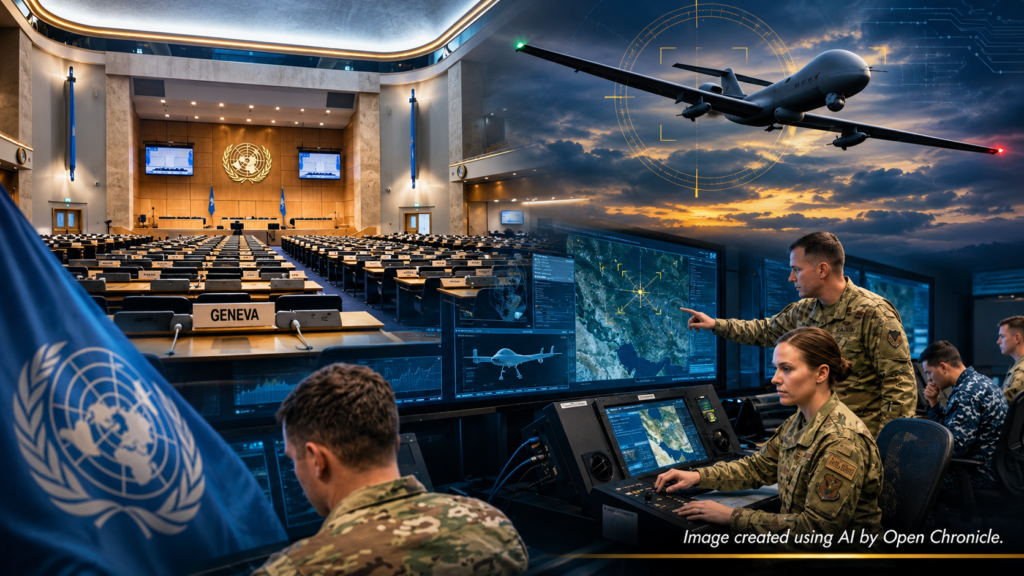
As governments prepare for a decisive United Nations conference in Geneva, the world faces a fundamental question about the future of warfare: how much authority should machines have over decisions involving human life? A decade of diplomatic negotiations has produced important common principles, but the United States, Russia and other military powers remain divided over whether those principles should become binding international law.
By Open Chronicle International Affairs Desk
International Affairs Analysis | Security and Conflict
The week that could shape the future of warfare
On 16 November 2026, diplomats, military experts and international legal specialists are scheduled to gather at the Palais des Nations in Geneva for a conference whose consequences could extend far beyond the negotiating rooms of the United Nations.
The Seventh Review Conference of the Convention on Certain Conventional Weapons, taking place from 16 to 20 November, will consider whether governments should begin formal negotiations on new international rules governing autonomous weapons.
These are systems capable of selecting and engaging targets without further human intervention after activation.
The central concern is not simply that artificial intelligence is becoming more sophisticated.
It is that advances in sensors, software, robotics and automated decision-making are making it increasingly possible for machines to exercise functions that were previously performed by human operators.
The technology raises questions that existing military doctrines and international legal frameworks were not designed to resolve in such specific terms.
Who decides when a machine may attack?
How reliably can an autonomous system distinguish a military objective from a civilian?
What happens when software behaves unpredictably in a crowded urban environment?
And who is legally responsible when a weapon selects the wrong target?
The answers could determine how future conflicts are fought, how military forces use artificial intelligence and whether international law can establish meaningful limits before autonomous weapons become more widely deployed.
The Geneva meeting is especially significant because governments have already spent years debating these issues.
In September 2026, a United Nations Group of Governmental Experts reached consensus on a report containing elements that could form the basis of an international instrument.
That achievement created a possible path towards negotiations.
But it did not establish a treaty.
Nor did it resolve the disagreement over whether future rules should be legally binding.
The immediate question facing governments is whether they are prepared to move from discussing principles to negotiating obligations.
The conference’s dates and mandate are confirmed by the United Nations Office at Geneva, while the September expert report provides the foundation for the forthcoming debate.
What exactly is an autonomous weapon?
Public debate often describes autonomous weapons as killer robots.
The expression is memorable, but it can be misleading.
An autonomous weapon does not necessarily resemble a humanoid machine carrying a firearm.
It may be a drone, a ground vehicle, a naval system or a stationary defensive platform.
Its defining characteristic is the degree of autonomy it possesses in performing critical functions.
An autonomous weapon system can be designed to identify potential targets and apply force without a human operator making a separate decision for each engagement.
This distinguishes it from many remotely operated weapons.
A conventional armed drone, for example, may be piloted remotely while a human operator selects the target and authorises the strike.
An autonomous system may perform some of those functions itself, within parameters established before activation.
The distinction is important because not every military system using artificial intelligence is an autonomous weapon.
Artificial intelligence can assist with navigation, intelligence analysis, image recognition, maintenance and operational planning without independently selecting and attacking targets.
Similarly, not every autonomous function requires artificial intelligence.
Some systems rely on predefined rules, sensor inputs and conventional software rather than machine learning.
The controversy becomes particularly acute when autonomy is applied to the use of lethal force.
A system might be instructed to attack objects matching specified characteristics within a geographical area.
But those characteristics may not reliably distinguish lawful military targets from protected civilians or civilian objects.
A vehicle, for instance, may resemble a military vehicle in certain sensor readings without actually being one.
A person carrying an object may be incorrectly classified as a combatant.
An autonomous system may also encounter circumstances that were not anticipated by its designers or operators.
The problem is therefore not simply whether a machine can recognise an object.
It is whether the circumstances surrounding a potential attack can be assessed with the judgment required by international humanitarian law.
Why Geneva matters in November 2026
The Convention on Certain Conventional Weapons, commonly known as the CCW, is an international framework concerned with weapons that may cause excessive injury or have indiscriminate effects.
Its protocols regulate or prohibit certain categories of conventional weapons and their use.
Autonomous weapons have been discussed within this framework for more than a decade.
Since 2017, a dedicated Group of Governmental Experts has examined emerging technologies in the area of lethal autonomous weapons systems.
The discussions have involved legal, technical, military, humanitarian and ethical considerations.
For much of this period, progress was constrained by disagreement over definitions, the interpretation of existing law and the appropriate form of international regulation.
The situation changed in September 2026.
At the conclusion of its final scheduled session, the expert group adopted a consensus report containing elements of a possible instrument.
The document is identified as CCW/GGE.1/2026/3.
It does not prejudge whether the eventual instrument should be legally binding.
That qualification is central to understanding the negotiations.
Governments were able to agree on a collection of principles and possible measures without agreeing that those measures should become enforceable treaty obligations.
Nevertheless, the report represents meaningful diplomatic progress.
It recognises the importance of human involvement in decisions concerning the use of force and the continued application of international humanitarian law.
It also provides a foundation for more detailed discussions about operational restrictions, accountability and the design and use of autonomous weapons.
The Seventh Review Conference must now decide what happens next.
One possible outcome would be a negotiating mandate for a new international instrument.
Another would be a continuation of discussions without a commitment to negotiate binding rules.
The distinction could determine whether the international community moves towards a new treaty or remains dependent on existing law, national policies and voluntary commitments.
France, New Zealand and other states have publicly supported using the September consensus as the basis for the next stage of negotiations.
A diplomatic divide between military powers
The debate over autonomous weapons reflects a broader disagreement about how emerging military technologies should be governed.
Many governments and humanitarian organisations argue that new, specific international rules are necessary.
They contend that existing international humanitarian law, although applicable to autonomous weapons, does not provide sufficiently detailed safeguards for systems that can select and attack targets without direct human approval.
Other governments favour a more cautious approach.
They argue that existing legal obligations remain applicable regardless of the technology used and that additional restrictions could be premature, difficult to define or unnecessarily limiting.
The United States and Russia are among the states resisting efforts to establish a fixed timetable for negotiations on legally binding restrictions, according to reporting published on 6 November.
Israel has also been identified among the governments opposing such a timetable.
Their positions are not necessarily identical.
Different governments may disagree about the scope of restrictions, the form of a future instrument, the relationship between autonomy and human control or the military advantages of particular technologies.
Nevertheless, their resistance matters because the CCW traditionally operates through consensus.
A small number of states can therefore prevent agreement on a negotiating mandate.
This creates a familiar dilemma in international arms control.
The governments with the greatest military capabilities are often among those most concerned about accepting restrictions that could affect future operational advantages.
At the same time, agreements reached without the participation of major military powers may have less practical influence over the development and deployment of advanced weapons.
Supporters of a binding instrument argue that these difficulties should not become a justification for indefinite delay.
They point to the September expert report as evidence that governments have already identified substantial areas of agreement.
The disagreement is now increasingly about political commitment rather than the absence of any technical or legal foundation for negotiations.
Recent reporting identifies the United States, Russia and Israel among opponents of a fixed negotiating timetable, while other states are pressing for a mandate in 2027.
The growing coalition demanding new rules
Support for international regulation has expanded considerably.
The International Committee of the Red Cross reported in October that more than 70 states supported moving towards negotiations on an instrument regulating autonomous weapons.
This included a group of 47 states and the African Group, although those expressions of support should not be interpreted as agreement on every provision of a future treaty.
The positions of individual governments vary.
Some favour broad prohibitions on particular categories of autonomous weapons.
Others support a combination of prohibitions and restrictions, allowing certain systems to remain in use under defined conditions.
Still others emphasise the importance of human control, weapons reviews and operational safeguards.
What unites many of these states is the belief that general legal principles need to be translated into more specific rules.
The International Committee of the Red Cross has advocated a legally binding instrument that would prohibit autonomous weapons that cannot be sufficiently understood or controlled.
It also supports prohibiting systems designed or used to target human beings directly.
For other autonomous weapons, the organisation recommends strict restrictions concerning targets, operating environments, duration of use and human supervision.
These proposals reflect a fundamental distinction.
Regulation does not necessarily require prohibiting every weapon with autonomous functions.
It may instead prohibit the most dangerous applications while establishing limits on systems considered capable of being used lawfully.
That approach has become an important element of the international debate.
The ICRC’s October statement and its June advocacy paper both call for the November conference to launch treaty negotiations.
The central principle: human control over lethal force
The expression meaningful human control has become one of the most important concepts in the autonomous weapons debate.
It also remains one of the most difficult to translate into operational rules.
A government may claim that humans retain control because military personnel decide where, when and under what circumstances a system can operate.
But critics argue that this may be insufficient if the system subsequently makes lethal targeting decisions that operators cannot predict, understand or interrupt.
Consider a hypothetical autonomous drone operating over a battlefield.
A commander activates the system and authorises it to attack specified military vehicles within a defined area.
The drone then searches for objects matching its programmed criteria.
If it identifies a potential target, it may launch an attack without requesting further human approval.
Whether that process provides adequate human control depends on several factors.
The commander must understand what the system is capable of detecting, the conditions under which it may make mistakes and the environment in which it will operate.
The system must also be sufficiently predictable for its use to comply with the rules governing attacks.
If civilians enter the area, if the battlefield changes or if the system encounters unexpected objects, its behaviour must remain within lawful limits.
Simply placing a human somewhere in the command structure does not necessarily resolve these questions.
The more important issue is whether human judgment meaningfully governs the use of force.
This is why proposed restrictions frequently address operational boundaries.
They may include limits on geographical areas, operating duration, target categories and the number of engagements permitted before further human authorisation is required.
They may also require effective supervision and the ability to deactivate or interrupt a system.
These measures seek to preserve the benefits of automation without allowing machines to operate beyond the circumstances that human commanders can reasonably assess.
The September 2026 expert report recognised the continuing necessity of human involvement and judgment in the use of force.
However, the precise legal requirements that would give effect to those principles remain subject to negotiation.
Can existing international humanitarian law handle autonomous weapons?
International humanitarian law already imposes obligations on parties conducting military operations.
Those obligations do not disappear when new technologies are introduced.
Three principles are especially relevant.
INTERNATIONAL HUMANITARIAN LAW
Distinction
Parties to a conflict must distinguish between combatants and civilians, and between military objectives and civilian objects. Attacks may only be directed against lawful targets.
An attack is prohibited when the expected incidental civilian harm would be excessive in relation to the concrete and direct military advantage anticipated.
Precautions
Those planning or deciding upon attacks must take feasible precautions to verify targets and minimise civilian harm.
These obligations apply to the use of autonomous weapons, just as they apply to other means and methods of warfare.
The difficulty is determining whether a particular autonomous system can be operated consistently with them.
Some assessments require contextual judgment.
A lawful target may be located close to a hospital, school or residential building.
Civilian presence may change rapidly.
The anticipated military advantage of an attack may depend on information unavailable to an automated system.
A machine might classify objects accurately under controlled testing conditions while performing less reliably in a complex operational environment.
It may also lack the information needed to evaluate the broader consequences of an attack.
Supporters of new regulation argue that these problems justify specific international prohibitions and restrictions.
Opponents of additional binding rules may argue that existing law already prohibits unlawful attacks and requires states to ensure their weapons can be used legally.
The disagreement is therefore not primarily about whether international humanitarian law applies.
It concerns whether existing obligations are sufficiently precise to govern increasingly autonomous military technologies.
The ICRC has argued that the law’s general applicability does not eliminate the need for more detailed restrictions.
Why artificial intelligence makes the problem more complicated
Autonomous weapons and artificial intelligence are related, but they are not interchangeable concepts.
Some autonomous weapons rely on conventional software and predefined responses.
Others may incorporate machine learning systems capable of processing complex information from sensors.
Artificial intelligence can improve object recognition, navigation, data processing and certain forms of decision support.
But it can also introduce additional uncertainty.
Machine learning systems may perform differently when operating conditions change.
A model trained on particular images, environments or equipment may produce unreliable results when confronted with unfamiliar circumstances.
Adversaries may attempt to deceive sensors or manipulate the information received by automated systems.
Communications interference, electronic warfare and degraded satellite navigation can also affect performance.
In military operations, these problems can have severe consequences.
An incorrect classification in a commercial application may result in inconvenience or financial loss.
An incorrect classification in a weapons system may result in an unlawful attack and civilian deaths.
Another concern is the speed of automated operations.
Machines can process information and initiate responses much faster than human operators.
In some defensive situations, this speed may provide genuine operational advantages.
But it can also reduce the time available for human intervention.
If opposing military systems react automatically to one another, an initial error or unexpected event could produce a rapid sequence of engagements.
Such scenarios are particularly concerning in environments involving high levels of military tension.
The risks become more serious when automated targeting systems interact with strategic early-warning networks, command structures or other sensitive military capabilities.
There is no basis for claiming that every use of military artificial intelligence will inevitably lead to escalation.
However, the possibility of rapid, poorly understood interactions is one reason governments are examining the relationship between autonomy, human supervision and international security.
Ukraine and the changing reality of drone warfare
Russia’s war against Ukraine has accelerated military innovation in unmanned systems.
Drones are used for reconnaissance, surveillance, electronic warfare, logistics and attacks against military targets.
Both sides have adapted technologies rapidly in response to battlefield conditions.
Electronic interference has become a particularly important challenge.
Systems that depend on continuous communication between an operator and a drone may become vulnerable when those communications are disrupted.
This creates incentives to develop systems capable of navigating, identifying objects or completing certain tasks with less direct operator involvement.
Artificial intelligence and computer vision can potentially support these functions.
However, it is essential to distinguish between autonomous navigation, automated target recognition and independent lethal targeting.
A drone that uses computer vision to continue following a target after a human operator has selected it is not necessarily equivalent to a system that independently searches for and chooses targets.
The degree of autonomy matters.
So does the timing of human authorisation.
The war in Ukraine demonstrates how quickly military technology can evolve under operational pressure.
It does not, by itself, establish that all advanced drones are fully autonomous or that their use is unlawful.
The wider significance lies in the growing availability of technologies that can reduce dependence on continuous human control.
As those technologies spread, the boundary between automated assistance and autonomous targeting may become increasingly important.
For international negotiators, the challenge is to establish rules that remain meaningful as software and military systems continue to evolve.
The problem of accountability
International humanitarian law places obligations on states and individuals.
Machines do not possess legal responsibility in the same way.
An autonomous weapon cannot be prosecuted for a war crime.
It cannot explain its decisions in court as a responsible human actor.
Nor can it independently fulfil the legal obligations imposed on military commanders.
This creates difficult questions when autonomous systems cause unlawful harm.
Responsibility may involve commanders, operators, military organisations, states or other individuals, depending on the facts and applicable legal rules.
But determining responsibility can become more complicated when a system’s behaviour is difficult to predict or reconstruct.
Suppose a weapon attacks an object that was incorrectly classified as a military target.
Investigators may need to establish whether the system was properly tested, whether the operator understood its limitations and whether the attack was authorised under appropriate conditions.
They may also need access to software records, sensor data, operational instructions and information about the system’s development.
A lack of transparency could make these investigations more difficult.
This does not mean autonomous weapons create a complete legal vacuum.
Existing rules governing state responsibility, military command and individual criminal liability remain relevant.
The concern is that increasingly complex systems may make it harder to identify precisely how an unlawful attack occurred and who bears responsibility.
The September 2026 expert process reaffirmed that accountability cannot simply be transferred from humans to machines.
The unresolved question is how future international rules should ensure that responsibility remains identifiable and enforceable.
The military argument for autonomy
The debate cannot be understood solely through the humanitarian objections.
Military planners also identify potential advantages in autonomous technologies.
Automation may allow systems to respond quickly to incoming threats.
It can help process large volumes of sensor information.
It may reduce the need for personnel to operate in particularly dangerous environments.
Certain defensive applications already rely on highly automated processes because the time available to respond to fast-moving threats can be extremely limited.
Autonomous capabilities may also help maintain operations when communications are disrupted.
For some governments, these benefits are central to national defence.
They argue that restrictions must be carefully designed to avoid preventing lawful and potentially protective uses of technology.
A system that automatically intercepts an incoming missile under tightly defined conditions presents different legal and operational questions from a weapon searching a populated area for human targets.
Treating both systems identically could produce rules that are either unnecessarily restrictive or insufficiently protective.
This is one reason proposals for a future instrument often distinguish between prohibited systems and systems permitted under strict conditions.
The central regulatory challenge is to define those categories clearly.
A workable agreement must account for technological differences without creating loopholes that undermine civilian protection.
Why the United States and Russia matter
The positions of major military powers carry particular weight.
The United States possesses extensive capabilities in artificial intelligence, advanced computing, autonomous systems and military research.
Russia also regards emerging military technologies as strategically important and has significant experience in unmanned warfare.
Both countries have strong incentives to preserve flexibility in the development of future military capabilities.
They also have concerns about whether international restrictions would be interpreted consistently and implemented by competitors.
Verification presents a particular challenge.
Autonomous functions may be embedded in software that can be modified without changing the external appearance of a weapon.
The same platform may operate under different levels of human supervision depending on its configuration.
A system might also be capable of both civilian and military applications.
These characteristics complicate efforts to establish inspection mechanisms or verify compliance.
However, technical difficulties do not necessarily make international regulation impossible.
Arms control agreements have historically addressed technologies that are difficult to monitor, sometimes through combinations of national implementation, reporting obligations, transparency measures and confidence-building arrangements.
A future autonomous weapons instrument could potentially adopt similar approaches.
Whether major military powers would accept such obligations remains uncertain.
The central diplomatic challenge is to create rules that provide meaningful protection while addressing legitimate security concerns.
The role of smaller states and the Global South
One of the most significant features of the current negotiations is that demands for regulation do not come exclusively from technologically advanced military powers.
Countries with limited resources for developing autonomous weapons also have a direct interest in the rules governing their use.
These states may be affected by the proliferation of inexpensive unmanned systems, imported military technologies and conflicts in which advanced weapons are deployed.
Some may also be concerned that international standards will be established primarily by countries with the greatest technological capabilities.
For smaller states, binding rules can offer a means of influencing technologies they may never develop themselves.
They can also help establish common expectations regarding civilian protection and military accountability.
The support expressed by the African Group is particularly relevant in this context.
It demonstrates that the debate is not simply a disagreement between Washington, Moscow and European governments.
It is also a question of who participates in shaping the international rules of warfare.
This has broader implications for global governance.
If international law is developed only after advanced weapons have become widely deployed, countries with fewer technological resources may have less influence over the standards that eventually emerge.
The November conference therefore presents an opportunity to consider how military innovation should be governed collectively rather than exclusively through national decisions.
What could happen in Geneva?
The Seventh Review Conference is not expected to produce a completed autonomous weapons treaty between 16 and 20 November.
The immediate decision concerns the next stage of negotiations.
Several outcomes are possible.
Three Possible Outcomes in Geneva
The November 2026 negotiations could follow three different diplomatic paths, each with important consequences for the future regulation of autonomous weapons.
A Mandate to Negotiate Binding Rules
Governments agree to launch formal negotiations, potentially beginning in 2027, using the September consensus report as a foundation. This would represent a major diplomatic advance, although the eventual treaty’s content and adoption would remain uncertain.
Further Technical Discussions
States agree to continue examining definitions, legal obligations and operational safeguards without committing to a binding instrument. This could preserve dialogue but delay the establishment of new rules.
Failure to Agree on a Common Path
Governments remain divided and the conference produces no substantial negotiating mandate. States supporting stronger regulation could then consider pursuing discussions through other international forums.
These are analytical scenarios, not predictions.
As of 10 November 2026, the conference has not yet taken place.
No final outcome should therefore be presented as an established fact.
Could negotiations move outside the CCW?
The consensus-based structure of the Convention on Certain Conventional Weapons has advantages.
It allows governments with different military capabilities and strategic interests to participate in the same process.
An agreement involving major military powers could have significant practical influence.
But consensus can also create institutional paralysis.
If a small number of governments prevent progress, states favouring stronger regulation may seek alternatives.
International arms control provides precedents for agreements negotiated outside frameworks where consensus proved impossible.
The 1997 Anti-Personnel Mine Ban Convention and the 2008 Convention on Cluster Munitions demonstrate that coalitions of states can establish international restrictions even without universal participation.
The 2017 Treaty on the Prohibition of Nuclear Weapons offers another example of a treaty negotiated through a process not dependent on agreement among all major military powers.
These precedents do not guarantee that the same approach would succeed for autonomous weapons.
The technologies, military applications and verification challenges are different.
Nevertheless, they demonstrate that the failure of one negotiating forum does not necessarily end international efforts to establish new legal rules.
A separate process could allow willing states to advance a treaty.
Its effectiveness would depend on participation, implementation and the influence it exerted on international norms.
The possibility of alternative negotiations may also affect the positions governments adopt in Geneva.
The danger of regulating yesterday’s technology
A major difficulty for diplomats is the pace of technological change.
International treaties can take years to negotiate, ratify and implement.
Military software can evolve much more quickly.
A system developed today may incorporate new capabilities within a relatively short period.
The underlying technology may also be adapted for applications that were not anticipated when regulations were drafted.
This creates a risk that an agreement based on narrow technical definitions could become outdated.
For example, a treaty that applies only to systems using a particular form of machine learning might fail to cover autonomous weapons based on different software architectures.
Similarly, rules focused on specific platforms could overlook new combinations of sensors, robotics and targeting systems.
A more durable approach may focus on functions and effects.
Rather than regulating only particular technologies, international rules could address whether a system selects targets, applies force and operates under adequate human control.
Such an approach could remain relevant even as technical capabilities change.
However, functional definitions must still be precise enough for governments and military organisations to understand their obligations.
This tension between technological flexibility and legal certainty will be central to any future negotiations.
The larger question: who governs military artificial intelligence?
Autonomous weapons are part of a wider transformation in military affairs.
Artificial intelligence is increasingly relevant to intelligence analysis, surveillance, logistics, cybersecurity, operational planning and decision support.
Some applications may improve efficiency or help reduce risks.
Others may create new vulnerabilities, accelerate military decision-making or complicate accountability.
Regulating autonomous weapons would therefore address only part of the wider challenge.
Governments will also need to consider how artificial intelligence affects command structures, strategic stability, information reliability and the relationship between human judgment and automated recommendations.
There is an important distinction between an AI system that recommends a military target and an autonomous weapon that independently attacks it.
But the two can become connected.
If human operators rely heavily on automated recommendations, they may approve decisions without adequately evaluating the underlying evidence.
This phenomenon, often described as automation bias, can weaken meaningful human oversight even when formal human approval remains part of the process.
The question is therefore not simply whether a human presses the final button.
It is whether that human has sufficient information, time and authority to exercise genuine judgment.
This is why the governance of military artificial intelligence must consider organisational practices as well as technical capabilities.
Training, operational procedures, testing, transparency and accountability all matter.
A treaty on autonomous weapons could establish an important foundation, but it would not resolve every challenge associated with artificial intelligence in warfare.
A decision that extends beyond the battlefield
The negotiations in Geneva concern weapons, but their significance extends into the wider international system.
They test whether governments can establish common rules for a rapidly developing technology before its military applications become deeply entrenched.
They also expose tensions between humanitarian protection and strategic competition.
States want to preserve military advantages.
They also have obligations to protect civilians and comply with international law.
Technological innovation can create new defensive capabilities.
It can also introduce new forms of risk.
International cooperation may reduce those risks, but it requires governments to accept limits on their freedom of action.
The autonomous weapons debate brings these competing interests into unusually sharp focus.
It is ultimately a question about the relationship between technology and political responsibility.
Machines may become increasingly capable of identifying objects, navigating environments and executing complex tasks.
But the decision to use force remains a matter with legal, ethical and political consequences.
Those consequences cannot be transferred to software.
Conclusion: the moment before the rules are written
The international community has reached an important stage in the debate over autonomous weapons.
The September 2026 consensus report established a foundation for further negotiations.
The International Committee of the Red Cross and the United Nations Secretary-General have urged governments to translate that progress into binding international rules.
A growing coalition of states supports negotiations.
Yet major military powers remain divided over how far those rules should go and whether they should become legally enforceable.
The Seventh Review Conference in Geneva will not settle every question.
It may not produce agreement.
But its decisions could determine whether the international community begins negotiating specific restrictions or continues discussing the issue while military technology advances.
The stakes are substantial.
Autonomous weapons could change how conflicts are conducted, how rapidly force is applied and how responsibility is assigned when attacks go wrong.
Their development also raises a question that international law cannot avoid indefinitely.
As machines become more capable of carrying out lethal functions, how much authority should human beings be permitted to delegate?
The answer will shape not only the future of warfare but also the credibility of international efforts to ensure that technological progress remains subject to human responsibility.
The fundamental challenge is not to stop every form of military innovation.
It is to establish limits before the absence of limits becomes the accepted norm.
Sources and Further Reading
Official United Nations documentation, international humanitarian law analysis, diplomatic statements and independent reporting on the November 2026 negotiations concerning autonomous weapons systems.
Seventh Review Conference of the Convention on Certain Conventional Weapons
Official conference information confirming the 16 to 20 November meeting in Geneva, its institutional purpose and the September 2026 consensus report on lethal autonomous weapons systems.
Renewed Call to Adopt International Rules on Autonomous Weapon Systems
Joint appeal by United Nations Secretary-General António Guterres and ICRC President Mirjana Spoljaric calling for urgent negotiations on legally binding prohibitions and restrictions.
A Key Opportunity to Prevent Unacceptable Autonomous Weapons
Humanitarian and legal recommendations advocating a new CCW protocol, including prohibitions on unpredictable systems and restrictions designed to preserve human control.
Group of Governmental Experts on Lethal Autonomous Weapons Systems
Official French diplomatic statement welcoming the September consensus and supporting a new mandate for negotiations on an international instrument.
Joint Statement on Lethal Autonomous Weapon Systems
Multilateral statement describing the consensus reached in September and calling for an ambitious negotiating mandate at the November Review Conference.
Russia and US Seek to Block Plan for Binding Rules on Autonomous Weapons
Recent investigative reporting on diplomatic disagreements, opposition to a fixed treaty timetable and proposals for negotiations beginning in 2027.
This analysis reflects information available as of 10 November 2026, before the Seventh Review Conference scheduled for 16 to 20 November in Geneva. The September 2026 Group of Governmental Experts report represents consensus on elements of a possible international instrument, not agreement on a legally binding treaty. Government positions are attributed to official diplomatic statements or identified reporting. Hypothetical military scenarios are included for explanation and should not be interpreted as verified descriptions of particular battlefield incidents. The article distinguishes existing international humanitarian law from proposed additional prohibitions and restrictions. Conference outcomes and any future negotiating mandate remain subject to decisions by participating states.
Explore International Relations
Discover more reporting and analysis on diplomacy, international security, global governance and the changing balance of power.
Return to International Relations →