
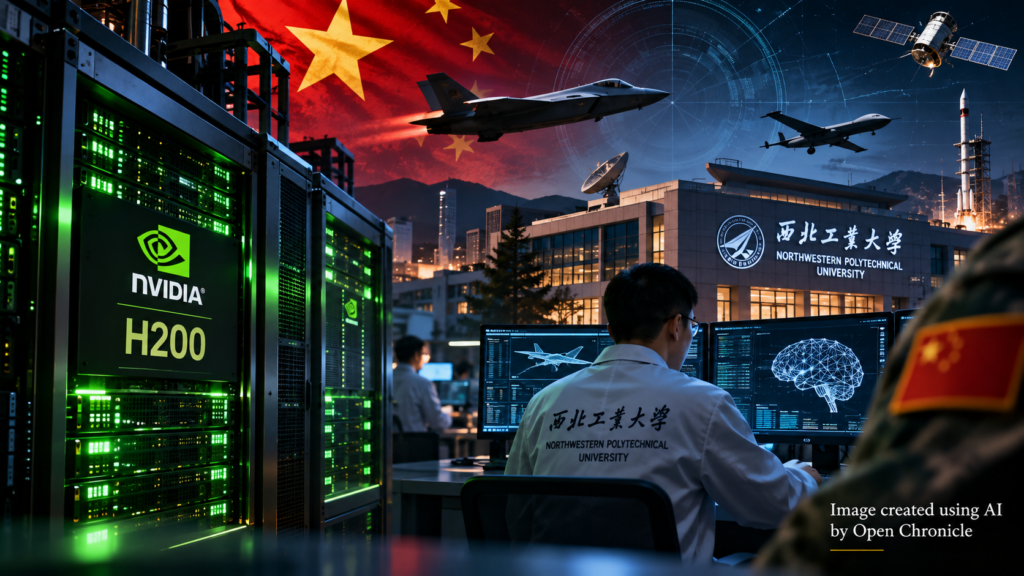
Procurement records reviewed by Reuters reveal how Chinese research institutions with defence connections have acquired restricted American AI processors and rented computing power, exposing a critical weakness in Washington’s technology controls.
WARFARE JOURNAL | MILITARY ARTIFICIAL INTELLIGENCE & DEFENCE TECHNOLOGY
11 November 2026 | By Open Chronicle Warfare Journal
The procurement records behind a new technology security controversy
A Chinese university with longstanding connections to the People’s Liberation Army purchased advanced Nvidia artificial intelligence processors in October 2026 despite being subject to strict United States export controls, according to procurement records examined by Reuters.
The discovery raises significant questions about Washington’s ability to restrict access to powerful computing technologies that could support China’s military modernisation.
Northwestern Polytechnical University, based in Xi’an, purchased two Nvidia H200 processors for 874,700 yuan, approximately $123,000, through a Chinese technology supplier.
The transaction was recorded in a procurement notice dated 21 October 2026.
The supplier was identified as Shaanxi Bosuan Network Technology, a domestic company rather than Nvidia itself.
The university is a member of China’s Seven Sons of National Defense, a group of institutions closely associated with the country’s aerospace, defence and military research programmes.
It has appeared on the US Department of Commerce’s Entity List since 2001.
The significance of the transaction extends beyond two individual processors.
Reuters examined 26 Chinese procurement and corporate records showing that several universities and research institutions obtained restricted Nvidia chips or contracted for access to computing services powered by such equipment.
The investigation suggests that restrictions on direct semiconductor exports may not be sufficient to prevent sensitive institutions from obtaining advanced computing capabilities through domestic commercial markets.
Northwestern Polytechnical University and its military connections
Northwestern Polytechnical University occupies an important position within China’s research and defence ecosystem.
The institution conducts research associated with aviation, aerospace engineering, missile technologies and other advanced industrial fields.
Its connections to the Chinese defence sector have attracted American regulatory attention for more than two decades.
In 2001, the United States Department of Commerce added the university to its Entity List over concerns involving missile proliferation and military research.
Restrictions were subsequently tightened in 2019, with most applications to export controlled American technologies to the university becoming subject to a presumption of denial.
The institution has also appeared in previous American export enforcement cases.
In 2021, US authorities announced that Chinese national Shuren Qin had pleaded guilty to offences involving the unlawful procurement and export of American-origin equipment for Northwestern Polytechnical University.
The case concerned marine technologies, including hydrophones relevant to underwater research and potential anti-submarine warfare applications.
The earlier enforcement action demonstrates that American concerns about the institution’s access to sensitive technologies predate the current artificial intelligence competition.
However, the 2026 semiconductor transactions represent a different technological challenge.
Advanced AI processors can support an exceptionally broad range of scientific and industrial activities, making the distinction between civilian research and potential military applications more difficult to assess.
The Nvidia H200 acquisition
According to the October procurement record reviewed by Reuters, Northwestern Polytechnical University’s management school purchased two Nvidia H200 processors from Shaanxi Bosuan Network Technology.
The H200 is a high-performance computing accelerator designed for demanding artificial intelligence workloads.
Its capabilities include supporting the training and operation of advanced AI models, large-scale data processing and computationally intensive research.
The recorded purchase raises questions because the university remains subject to specific American export restrictions.
In January 2026, the Trump administration introduced a policy allowing certain H200 exports to China to be considered individually, provided specified security conditions were satisfied.
That policy did not remove the separate restrictions applicable to organisations on the Entity List.
The distinction is important.
A decision to permit some semiconductor exports to approved Chinese customers does not automatically authorise access by institutions subject to stricter controls.
However, the available procurement records do not establish the precise route through which the processors entered China.
They also do not demonstrate that Nvidia directly supplied the university or knowingly participated in a prohibited transaction.
Determining whether an export-control violation occurred would require additional evidence about the chips’ origin, their movement through the supply chain and the applicable licensing requirements.
The larger discovery: Renting restricted computing power
One of the most significant elements of the Reuters investigation concerns the purchase of computing services rather than physical processors.
Northwestern Polytechnical University also contracted with Chinese suppliers for access to servers equipped with advanced Nvidia chips.
According to procurement records, its cybersecurity school awarded two seven-month contracts in January 2026 for computing capacity involving eight H200 processors per server.
The contracts were valued at 441,700 yuan and 441,000 yuan.
The specified applications included AI model fine-tuning and reinforcement learning.
Other contracts involved access to Nvidia A100 and A800 processors.
An additional university institute purchased computing services requiring at least 24 A100 processors for structural and fluid dynamics simulations.
These transactions illustrate a fundamental distinction in the modern computing economy.
An institution does not necessarily need to own a powerful processor to benefit from its computational capabilities.
Instead, researchers can purchase access to remote computing infrastructure operated by another organisation.
Such arrangements are common in legitimate scientific and commercial research.
They also create challenges for export-control systems designed around the physical movement of sensitive technology.
If a restricted organisation can obtain computing capacity through a third-party provider, the effective availability of advanced processing power may be broader than direct import figures suggest.
However, the Reuters records did not consistently identify where the rented servers were physically located.
Consequently, they do not establish whether every computing arrangement involved a cross-border transfer of controlled technology or violated a particular American restriction.
Beyond one university: A wider procurement pattern
The Reuters investigation identified similar acquisitions involving several other Chinese institutions.
Beihang University, another member of the Seven Sons of National Defense, purchased four Nvidia A800 processors for 489,000 yuan in April 2026.
Beihang has extensive connections to China’s aviation and aerospace research sectors.
Shenzhen University purchased three Nvidia H100 processors for 769,800 yuan in September.
Wuhan University of Technology acquired a server containing an H100 processor for 355,000 yuan in June, alongside a separate purchase of four A100 processors for 344,000 yuan.
Procurement notices also identified computing services involving H800 and A800 processors for the University of Chinese Academy of Sciences.
These records indicate that access to restricted high-performance computing technology is not confined to a single institution.
Nevertheless, the universities have different institutional roles, research priorities and regulatory circumstances.
The fact that a university acquired a restricted processor does not automatically establish that it was conducting military research with that equipment.
Nor does the existence of a procurement contract establish that every listed item was delivered, installed or used successfully.
The investigation provides evidence of procurement activity and contracted access.
It does not provide a comprehensive audit of how the computing resources were subsequently employed.
Why advanced AI chips matter to military modernisation
Artificial intelligence is becoming an increasingly important component of military research and defence planning.
Advanced computing infrastructure can support the development and evaluation of sophisticated machine-learning systems.
Potential defence applications include intelligence analysis, image interpretation, autonomous systems research, logistics optimisation and scientific simulation.
High-performance computing can also accelerate research involving complex physical processes and engineering design.
However, the relationship between computational capacity and military capability is not automatic.
A powerful processor does not independently create an operational weapon system.
Military applications also require specialised software, appropriate training data, technical expertise, testing and integration with existing equipment.
The potential military relevance of advanced AI hardware therefore depends on the wider research and development environment in which it is used.
For the United States, the concern is that unrestricted access to high-performance computing could strengthen China’s ability to develop technologies relevant to future military competition.
For China, advanced computing is also central to civilian scientific research, industrial development and commercial innovation.
These overlapping applications make semiconductor policy particularly difficult.
Export controls must address potential national security risks without assuming that every use of advanced computing technology is military.
China’s military-civil fusion challenge
The procurement findings also highlight the complexities associated with China’s military-civil fusion strategy.
The concept involves strengthening connections between civilian research, commercial industry and national defence development.
Universities can occupy an important position within this structure because they conduct scientific research, educate engineers and cooperate with industrial organisations.
In principle, research into materials, aerospace systems, communications and artificial intelligence may have both civilian and military applications.
The strategic concern for Washington is that technologies acquired for academic or commercial purposes could contribute indirectly to defence programmes.
This does not mean that every Chinese research institution is a military organisation or that every academic project supports the People’s Liberation Army.
Rather, it means that institutional relationships and the potential transfer of research results are important factors in assessing technology security.
Northwestern Polytechnical University’s documented defence connections make its procurement activities particularly sensitive.
The same considerations apply, to varying degrees, to other institutions associated with China’s aerospace and military research sectors.
The semiconductor supply chain problem
The Reuters findings expose a broader structural challenge for technology export controls.
Advanced processors can move through multiple commercial transactions before reaching their final users.
A chip may be manufactured, integrated into a server, sold to a distributor and subsequently transferred through other companies.
Computing services add another layer of complexity because the user may never physically possess the hardware.
Previous Reuters investigations documented Chinese purchases of servers containing restricted Nvidia processors through domestic resellers.
In March 2026, the agency reported that universities with military connections had obtained systems containing restricted AI chips, including servers manufactured by Super Micro Computer.
The origins of the equipment were not always established.
These findings suggest that the effectiveness of export controls depends on more than the licensing of direct manufacturer sales.
It also depends on commercial compliance, accurate identification of end users and enforcement across international supply chains.
However, evidence of restricted equipment appearing in procurement records is not equivalent to proof that the original manufacturer violated export law.
The precise legal responsibility must be assessed transaction by transaction.
Washington’s changing H200 export policy
American semiconductor policy has undergone significant changes as Washington attempts to balance technological leadership, commercial competitiveness and national security.
On 13 January 2026, the Bureau of Industry and Security announced revised licensing rules for certain advanced processors exported to China.
The policy allowed applications involving Nvidia H200 chips, AMD MI325X processors and comparable technologies to receive individual review under specified conditions.
Those conditions included customer screening, independent testing and safeguards intended to address security risks.
The administration argued that controlled exports could support the competitiveness of American technology companies while preserving regulatory oversight.
Critics have warned that access to powerful processors could accelerate China’s military and technological development.
The debate reflects two competing strategic considerations.
One is the desire to limit access to technologies considered important for future military capabilities.
The other is the concern that broad restrictions could encourage Chinese customers to develop alternatives to American hardware and software.
The Reuters investigation adds a third consideration.
Even when a government establishes detailed licensing rules, the practical effectiveness of those rules depends on whether restricted end users can obtain the technology through indirect channels.
Nvidia and the question of corporate responsibility
Nvidia has become a central company in the global artificial intelligence industry.
Its processors and associated computing technologies support major AI research programmes, commercial data centres and scientific institutions.
As a result, decisions about access to Nvidia hardware have acquired substantial geopolitical importance.
Chief executive Jensen Huang has argued that continued American participation in the Chinese technology market can help preserve US industrial leadership.
Some American lawmakers disagree, warning that advanced semiconductor exports may strengthen China’s defence capabilities.
The controversy has intensified congressional scrutiny of Nvidia’s commercial relationships and export-control compliance.
However, the procurement transactions identified in the Reuters investigation were conducted through Chinese suppliers rather than directly with Nvidia.
The reporting does not establish that Nvidia approved the transactions or knew the identity of the ultimate purchasers.
Nvidia, Northwestern Polytechnical University and the US Bureau of Industry and Security did not respond to Reuters requests for comment on the findings.
Corporate responsibility therefore remains a question requiring evidence about the individual transactions rather than assumptions based on the presence of Nvidia products in the records.
The intelligence dimension
The procurement findings are relevant not only to technology policy but also to military intelligence.
Advanced AI systems can assist analysts in processing large quantities of information, identifying patterns and supporting decision-making.
These capabilities may become increasingly important as armed forces generate growing volumes of imagery, sensor data and operational information.
Access to high-performance computing can support research into such applications.
Nevertheless, the public procurement records do not establish that the processors identified by Reuters were used for intelligence collection or operational military analysis.
The distinction between potential capability and demonstrated application remains essential.
For defence analysts, the more immediate significance is that restricted computing technologies appear to remain accessible to some institutions associated with China’s military research ecosystem.
That finding raises questions about the practical boundaries of technology restrictions in an increasingly interconnected digital economy.
Strategic analysis: Five implications for military AI competition
1. Export controls face an expanding challenge from computing services
Restrictions focused on physical hardware must account for the growing importance of remotely accessed computing infrastructure.
The ability to purchase processing capacity can complicate efforts to control access to advanced technology.
2. Defence-linked universities remain important actors in technological competition
Academic institutions can connect fundamental scientific research with advanced engineering and industrial development.
Their role makes them relevant to assessments of future military capabilities, even when individual research projects are civilian.
3. Commercial supply chains can obscure the final destination of sensitive equipment
Multiple distributors, resellers and service providers can make it difficult to establish how restricted technology reaches a particular institution.
The Reuters investigation demonstrates the importance of documentary evidence in reconstructing those transactions.
4. Semiconductor policy involves competing strategic objectives
Washington must balance national security restrictions against the commercial and technological consequences of limiting access to American products.
The debate is unlikely to disappear as demand for advanced computing continues to expand.
5. Procurement evidence is not the same as operational military capability
The existence of advanced processors within a university’s procurement records does not establish that the equipment has produced a specific military system or intelligence capability.
Assessing military significance requires evidence concerning actual research, technical integration and operational results.
Conclusion: The limits of controlling military-relevant computing power
The discovery that Northwestern Polytechnical University acquired Nvidia H200 processors despite longstanding American restrictions illustrates the difficulty of controlling advanced technology in a globally interconnected market.
The wider Reuters investigation suggests that Chinese research institutions continue to obtain restricted computing resources through domestic suppliers and commercial service arrangements.
The findings are significant because artificial intelligence has become an important area of competition between the United States and China.
Yet the available evidence supports a carefully defined conclusion.
Procurement records demonstrate purchases and contracted access to advanced processors.
They do not independently establish the complete supply routes, the legality of every transaction or the military applications ultimately developed using the equipment.
The distinction matters for policymakers, manufacturers and defence analysts.
Effective technology security requires both credible enforcement and a clear understanding of how modern computing infrastructure is acquired and used.
As artificial intelligence becomes increasingly important to civilian innovation and military research, the challenge of distinguishing legitimate scientific activity from prohibited military technology transfers will become more complex.
For Washington and Beijing, the struggle over advanced semiconductors is therefore about more than individual chips.
It concerns the future distribution of computing power, technological influence and the industrial foundations of military capability.
Sources and Further Reading
The following journalistic and institutional references provide the factual and regulatory foundation for this investigation. Reuters serves as the primary reporting source, complemented by official documentation from the United States Bureau of Industry and Security concerning semiconductor export controls, restricted entities and previous enforcement actions.
PLA-linked Chinese University Bought Nvidia H200 Chips Despite US Blacklist, Records Show
Investigation by Eduardo Baptista based on 26 Chinese procurement and corporate records. The reporting examines purchases of advanced Nvidia H200 processors by Northwestern Polytechnical University and additional computing contracts involving Chinese research institutions with defence connections.
Department of Commerce Revises License Review Policy for Semiconductors Exported to China
Official United States Department of Commerce documentation explaining revised licensing procedures for exports of certain advanced semiconductors to China, including Nvidia H200 processors and comparable computing technologies. The policy establishes specific conditions for individual export licence reviews.
Chinese National Pleads Guilty to Illegal Exports to Northwestern Polytechnical University
Official enforcement documentation concerning a previous case involving the unlawful export of American-origin equipment to Northwestern Polytechnical University. The case provides historical context for US restrictions on technology transfers to the Chinese institution and its defence-related research activities.
Chinese Universities with Military Links Bought Super Micro Servers with Restricted AI Chips
Previous Reuters investigation examining the acquisition of servers containing restricted advanced AI processors by Chinese universities with military research connections. The report provides additional context concerning domestic resellers, computing infrastructure and the enforcement challenges associated with semiconductor export restrictions.
Export Administration Regulations, Part 744
Official United States export-control regulations addressing restrictions involving designated end users, prohibited activities and entities subject to additional licensing requirements. Part 744 provides the regulatory framework relevant to evaluating transactions involving restricted Chinese research institutions.
This article was prepared by Open Chronicle Warfare Journal using an investigation published by Reuters on 11 November 2026, previous Reuters reporting and official documentation from the United States Bureau of Industry and Security. The procurement figures and contracts involving Chinese universities are attributed to records reviewed by Reuters. Open Chronicle has not independently authenticated every original procurement document or established the complete supply routes of the processors involved. The acquisition of restricted computing equipment does not, by itself, demonstrate a violation by the original manufacturer or prove that the equipment was used for military purposes. References to potential defence applications are identified as strategic analysis rather than confirmed operational findings.