
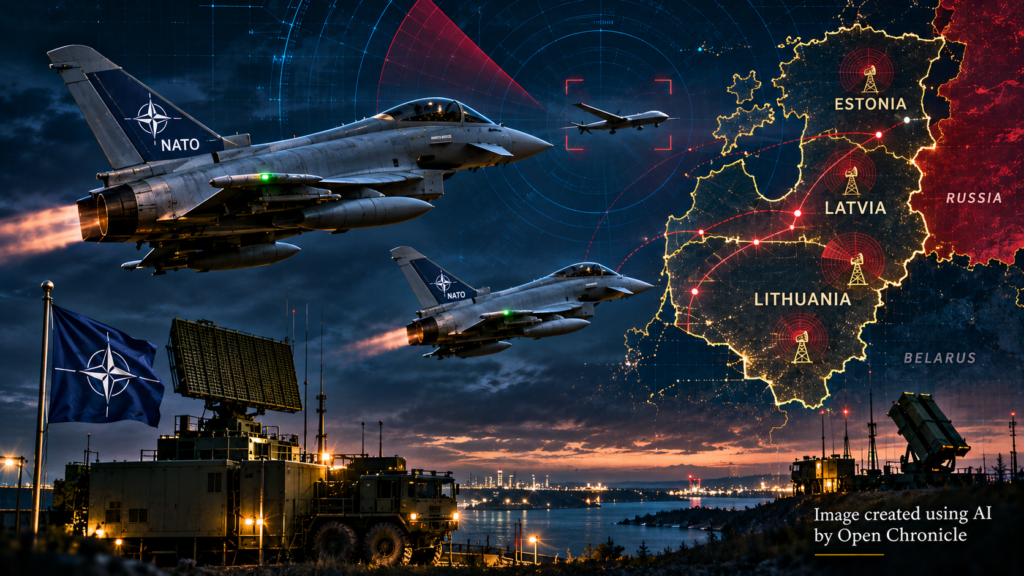
Unidentified drones triggered warnings across Lithuania, Latvia and Estonia, forcing NATO fighters into action and exposing the growing difficulty of protecting Allied airspace from the spillover effects of the war in Ukraine.
WARFARE JOURNAL | NATO, AIR DEFENCE & REGIONAL SECURITY
11 November 2026 | By Open Chronicle Warfare Journal
A night of uncertainty on NATO’s eastern frontier
NATO’s air defence system faced another serious test overnight on 10 and 11 November 2026, when unidentified drones entered or approached the airspace of Lithuania, Latvia and Estonia, prompting emergency warnings, military interceptions and precautionary restrictions across the Baltic region.
Fighter aircraft assigned to NATO’s Baltic air defence mission were activated as national authorities attempted to track aerial objects moving across borders.
Residents in several areas were instructed to seek shelter while air defence units and specialised drone interception teams prepared to respond.
The alerts eventually ended without reported injuries in the Baltic states.
However, the incidents revealed a security problem that extends far beyond the immediate danger posed by individual unmanned aircraft.
As the war between Russia and Ukraine increasingly involves long-range drone attacks against infrastructure near the Baltic Sea, NATO countries face the possibility that aircraft associated with the conflict may enter Allied territory, whether through navigational failures, electronic interference or deliberate action.
The challenge is particularly acute for Lithuania, Latvia and Estonia, whose geographic position places them close to Russian and Belarusian territory.
For NATO, the question is no longer simply whether its air forces can detect and intercept conventional military aircraft.
It is whether the Alliance can consistently identify, track and respond to smaller, less predictable unmanned threats without creating additional risks for the civilian population.
What happened over Lithuania, Latvia and Estonia?
According to Reuters and official military statements, multiple aerial threats were detected during the night.
Lithuanian authorities activated emergency procedures after drones were reported approaching or entering national airspace from the direction of Belarus.
Warnings extended to several regions, including areas around Kaunas, the country’s second-largest city.
NATO fighter aircraft were dispatched to investigate the threat.
One drone subsequently travelled north through Lithuanian airspace and entered Latvia.
The Latvian National Armed Forces later confirmed that three unmanned aircraft had entered Latvian airspace during the night.
Two briefly crossed the country’s eastern border, remaining inside Latvian territory for approximately one to two minutes.
A third entered Latvia from Lithuania, travelled across the country from south to north and continued towards Estonia.
Latvian authorities activated interceptor drones, ground-based air defence units and NATO fighter aircraft.
The Latvian military said that the operational conditions required to destroy the aircraft were not present while it crossed Latvian territory, with civilian safety forming part of the assessment.
The drone eventually left Latvian airspace in the direction of Estonia, where surveillance contact was subsequently lost.
Other suspected drones approached Latvia’s eastern frontier but did not cross into the country.
These distinctions are important because the number of aircraft detected near a border is not necessarily the same as the number that actually entered national airspace.
The attempted interception over Lithuania
The most technically significant part of the incident involved NATO fighters operating over Lithuania.
Lithuanian military officials reported that aircraft attempted to intercept a drone travelling north towards Latvia.
According to reporting by Euronews and AeroTime, the fighters made two unsuccessful attempts to destroy the aircraft near Biržai.
Those reports also described a missile or missile debris reaching the ground following one of the attempts.
The precise sequence of engagement actions requires careful interpretation because publicly available accounts differ in their descriptions of whether a missile was fired and how the attempts unfolded.
What is clear is that the drone was not destroyed before it continued into Latvia.
The episode demonstrates why counter-drone operations over populated territory can be exceptionally difficult.
A military aircraft may have the speed, sensors and weapons necessary to engage an aerial target, but those capabilities do not guarantee a safe interception.
Commanders must consider the position of the drone, the surrounding population, the trajectory of any weapon used and the consequences of an unsuccessful engagement.
Even when a drone is judged potentially hostile, destroying it above a populated area can introduce dangers of its own.
For NATO, this creates an operational dilemma.
The Alliance must protect its airspace while ensuring that defensive actions do not produce avoidable civilian casualties.
Latvia’s response: Detection, interception and civilian protection
The Latvian military’s official account provides one of the clearest descriptions of the overnight response.
At approximately 23:30 on 10 November, authorities issued warnings in Ludza municipality after two drones briefly entered Latvian airspace.
Additional warnings followed in Krāslava and Augšdaugava as another aircraft approached from Belarus.
That aircraft did not enter Latvian territory.
After midnight, further alerts were issued in Balvi municipality when additional drones approached the eastern border.
Those aircraft also remained outside Latvian airspace.
At approximately 02:30, authorities detected a separate threat approaching from Lithuania.
The drone entered Latvia and continued northward, prompting successive alerts in municipalities along its route.
As the aircraft moved, the authorities adjusted the geographical coverage of warnings.
NATO fighters had already been activated in Lithuania and continued responding while the drone travelled through Latvia.
The Latvian National Armed Forces subsequently announced that they would review the incident with NATO allies, including detection procedures, information exchange and operational responses.
The statement also confirmed that Latvia’s dedicated interceptor drone units were then positioned only along the eastern border.
That detail has operational significance.
An unmanned aircraft that crosses a country from south to north may move beyond areas where specialised interception capabilities are concentrated.
The incident therefore raises questions about the geographical distribution of counter-drone systems and the speed with which they can be repositioned.
Why the Baltic states are particularly exposed
Lithuania, Latvia and Estonia occupy a strategically sensitive position on NATO’s northeastern frontier.
They border Russia or Belarus and lie close to areas that have become increasingly important to military operations connected with the war in Ukraine.
Russia’s Kaliningrad exclave also creates a distinctive security environment for the region.
The Baltic states do not maintain large independent fighter fleets comparable to those of major NATO powers.
Instead, Allied aircraft have provided continuous protection through NATO’s Baltic Air Policing mission since the three countries joined the Alliance in 2004.
The mission has evolved significantly.
Originally focused on identifying and intercepting aircraft that might threaten Allied airspace, NATO’s regional posture has expanded to address a wider spectrum of airborne threats.
The Alliance’s updated air defence approach combines fighter aircraft with surveillance systems, ground-based air defence and counter-drone capabilities.
Nevertheless, geography continues to create operational difficulties.
Borders are relatively close to civilian communities, major transport routes and strategically important infrastructure.
An unidentified aircraft may cross from one country’s airspace into another within a short period.
That makes rapid information exchange between national authorities essential.
The November incident demonstrated how an aerial threat can become a multinational security problem in a matter of minutes.
The connection with Ukraine’s long-range drone campaign
The incidents occurred during a period of intensified Ukrainian drone attacks against Russian infrastructure near the Baltic Sea.
On 11 November, a drone strike caused a fire at the Russian port of Ust-Luga in the Leningrad region.
Ukrainian authorities claimed responsibility for the attack and reported damage to fuel storage facilities.
Russian regional officials reported injuries and extensive drone interception activity.
Ust-Luga is an important export hub for Russian oil, petroleum products and other commodities.
Its proximity to the Estonian border makes military activity in the surrounding region especially relevant to Baltic security.
However, the timing of the strikes does not establish that the drones detected over NATO territory were necessarily launched by Ukraine or were part of the Ust-Luga operation.
The identity and intended destinations of the aircraft involved in the Baltic incursions had not been conclusively established.
This uncertainty is central to understanding the incident.
A drone may enter another country’s airspace because of technical malfunction, navigation errors, electronic interference or intentional routing.
Determining which explanation applies requires evidence from flight paths, recovered components, electronic data and other investigative sources.
Without such evidence, attributing responsibility to a particular military would be premature.
Electronic warfare and the problem of diverted drones
Electronic warfare is one of the most important factors in understanding the risks created by modern unmanned aircraft.
Both Russia and Ukraine employ technologies intended to disrupt the navigation and communications systems used by drones.
Electronic interference can affect satellite navigation signals or communication links.
Under some circumstances, this can cause an aircraft to lose positional accuracy, change its route or operate in ways not intended by its controllers.
Ukrainian officials have previously argued that Russian electronic warfare activity has contributed to drones deviating from their intended flight paths.
Russian authorities have offered different interpretations, including allegations that Ukrainian forces exploit NATO airspace during attacks.
These competing claims should not be treated as established explanations for the November incidents.
No publicly verified technical reconstruction has demonstrated that electronic warfare caused the particular drones involved to enter Baltic airspace.
Nevertheless, the possibility is strategically important.
It means that electronic warfare conducted within an active conflict zone can potentially produce effects beyond the borders of the countries directly involved.
For NATO, counter-drone planning must therefore account for aircraft that may be dangerous even when their presence is unintended.
The challenge of detecting and identifying small drones
Traditional air defence systems were developed primarily to detect and respond to threats such as military aircraft, helicopters and missiles.
Small drones introduce different operational characteristics.
They may fly at relatively low altitudes, present limited radar signatures and travel along routes that complicate identification.
Their speed and flight patterns can differ significantly from those of conventional combat aircraft.
A detection system must also distinguish genuine threats from birds, balloons and other objects.
This creates a demanding task for operators responsible for monitoring crowded airspace.
The challenge becomes greater when several countries must coordinate their responses.
A drone that passes through Lithuania, Latvia and Estonia may require successive handovers between national surveillance systems and military command structures.
Even if an aircraft is detected, commanders still need sufficient information to determine whether it represents a threat requiring engagement.
The November incident illustrates why detection, identification and interception must be treated as separate stages.
A successful detection does not guarantee successful destruction.
Similarly, the decision not to engage a drone does not necessarily indicate that the defence system has failed.
Operational conditions, uncertainty and civilian safety can all influence that decision.
Why expensive fighter jets are not the complete answer
One of the most important lessons from the war in Ukraine concerns the relationship between the cost of an attacking drone and the cost of defending against it.
Many unmanned aircraft can be manufactured at substantially lower cost than advanced fighter aircraft or sophisticated air defence missiles.
Using expensive military platforms against relatively inexpensive aerial threats can create an unfavourable economic balance.
It can also place additional demands on aircraft availability, maintenance and personnel.
NATO has acknowledged the need to strengthen more affordable counter-drone defences.
During a September 2026 meeting with Lithuania’s prime minister, Secretary General Mark Rutte emphasised the importance of developing systems capable of addressing drone threats without relying exclusively on high-end fighter aircraft.
The Alliance has been expanding its approach through initiatives involving layered defence, emerging counter-drone technologies and improved integration between military systems.
The objective is not to eliminate the role of fighter aircraft.
Fighters remain essential for responding to conventional aircraft and other airborne threats.
Rather, the objective is to ensure that NATO possesses a range of response options suited to different types of threats.
This may involve surveillance networks, electronic countermeasures, interceptor drones and ground-based air defence systems.
Each capability has limitations.
The effectiveness of the overall system depends on how well those capabilities operate together.
Eastern Sentry and NATO’s changing defence posture
The November incidents occurred against the background of NATO’s broader efforts to reinforce its eastern flank.
In September 2025, the Alliance launched Eastern Sentry following serious airspace violations involving Russian drones and military aircraft.
The initiative strengthened NATO’s ability to monitor and defend Allied territory through additional aircraft, surveillance capabilities and other military assets.
Throughout 2026, NATO continued upgrading its traditional air policing arrangements into a more comprehensive air defence posture.
This evolution reflects a change in the nature of the threat.
Defending airspace is no longer limited to intercepting conventional military aircraft.
It increasingly involves responding to drones, missiles and other aerial systems operating across multiple domains.
The Alliance’s integrated air and missile defence framework is intended to coordinate national and multinational capabilities.
However, the November episode shows that improvements in doctrine and deployment do not automatically eliminate the practical difficulties of responding to individual drones.
A sophisticated regional defence network can still encounter uncertainty over an aircraft’s identity, flight path and safe interception opportunities.
The operational challenge is therefore both technological and organisational.
The risk of escalation through miscalculation
The presence of unidentified drones inside NATO airspace raises political questions as well as military ones.
A drone may be unarmed, armed, malfunctioning or deliberately directed towards a particular location.
The uncertainty surrounding its purpose can make decisions more difficult.
If an aircraft is destroyed, the resulting debris may endanger civilians.
If it is allowed to continue, it may threaten infrastructure or create public alarm.
If its origin is incorrectly identified, the incident may generate accusations that intensify diplomatic tensions.
This makes reliable attribution particularly important.
Not every airspace violation is necessarily a deliberate attack against NATO.
Similarly, the activation of NATO fighters does not automatically mean that the Alliance has entered a military confrontation with the country from which an aircraft originated.
NATO’s response mechanisms are designed to protect Allied territory while allowing political and military authorities to assess the nature of each incident.
The distinction between an accidental incursion, a hostile act and an armed attack remains fundamental.
In a region already affected by military confrontation, premature conclusions can increase the danger of escalation.
Finland’s precautionary response
The security concerns extended beyond the three Baltic states.
Finland temporarily introduced restrictions affecting airspace and maritime activity in the eastern Gulf of Finland.
The measures were described as precautionary and were subsequently lifted.
Finland’s response demonstrates the regional consequences of the growing drone threat.
Unmanned aircraft operating near the Gulf of Finland can create uncertainty for both military and civilian activities.
Authorities may need to restrict air or maritime movements while assessing possible threats.
Such decisions carry economic and operational consequences, even when no attack occurs.
The episode also illustrates the importance of coordination among NATO members bordering Russia.
A threat detected in one national airspace may quickly become relevant to neighbouring countries.
Strategic analysis: Five lessons for NATO
1. The Baltic air defence problem is increasingly multinational.
A single drone can move through several countries, requiring continuous surveillance and coordinated military responses.
2. Counter-drone systems must extend beyond border regions.
The Latvian account indicates that dedicated interceptor drone units were concentrated near the eastern frontier. Aircraft travelling across national territory may require additional response options.
3. Fighter aircraft remain necessary but cannot solve every drone threat.
High-performance aircraft provide rapid reaction capabilities, yet small drones can present difficult engagement conditions, especially near populated areas.
4. Electronic warfare complicates attribution.
Navigation interference may affect drone behaviour, but claims about electronic diversion require technical evidence before they can be accepted as explanations for individual incidents.
5. Civilian protection must remain central to interception decisions.
The ability to destroy an aircraft is only one consideration. Commanders must also evaluate where an engagement would occur and what consequences it could produce on the ground.
Conclusion: A new phase in the defence of NATO airspace
The drone incursions of 10 and 11 November 2026 demonstrate how the war in Ukraine continues to reshape the security environment of NATO’s eastern frontier.
The activation of Allied fighters, national air defence systems and public warning networks showed that the Baltic states were capable of responding rapidly to an emerging aerial threat.
Yet the inability to destroy the drone that crossed Lithuania and Latvia also exposed the difficulties associated with tracking and intercepting small unmanned aircraft over populated territory.
The incident does not establish that NATO’s air defence system has failed.
It does, however, reveal the operational challenges that the Alliance must continue addressing.
As drones become more widespread and electronic warfare increasingly affects their navigation, protecting national airspace will require more than conventional military aircraft.
It will demand integrated surveillance, reliable information sharing, appropriately distributed counter-drone systems and engagement procedures that balance military necessity with civilian safety.
For Lithuania, Latvia and Estonia, these are no longer theoretical requirements.
They are immediate responsibilities on one of Europe’s most sensitive security frontiers.
Sources and Further Reading
The following journalistic investigations, official military statements and NATO documents provide the factual and strategic foundation for this article. The sources cover the drone incursions across Baltic airspace, the military response, interception challenges and NATO’s evolving air defence posture along its eastern flank.
Baltic Nations, Finland Issue Overnight Drone Warnings as Russia, Ukraine Exchange Strikes
Reuters reporting on drone incursions and security alerts across Lithuania, Latvia and Estonia, together with precautionary measures in Finland. The report examines NATO’s military response and the timing of the incidents alongside Ukrainian strikes against Russian infrastructure near the Baltic Sea.
Three Unmanned Aircraft Entered Latvian Airspace
Official statement from the Latvian National Armed Forces documenting three unmanned aircraft entering national airspace during the night. The military account provides a detailed chronology of the incidents, public warnings, defensive preparations and operational considerations affecting the decision not to engage a drone travelling across Latvia towards Estonia. The original statement is in Latvian.
NATO Air Defence
Official NATO documentation explaining the Alliance’s air defence framework, including the evolution of Baltic Air Policing towards a broader integrated air defence posture. The reference provides context on surveillance, fighter aircraft, national defence systems and the protection of Allied airspace against increasingly diverse aerial threats.
Strengthening NATO’s Eastern Flank
NATO’s official strategic overview of measures intended to reinforce deterrence and defence along the Alliance’s eastern frontier. The documentation addresses Eastern Sentry, multinational military cooperation, integrated air and missile defence, surveillance and the reinforcement of Allied capabilities in response to regional security threats.
A Restless and Difficult Night in the Baltics as NATO Fighter Jets Fail to Shoot Down Drone
Supplementary reporting on the attempted interception of an unidentified drone over Lithuania, including statements attributed to military officials and the operational difficulties encountered by NATO fighter aircraft. The report provides additional context concerning interception decisions, civilian safety and uncertainty surrounding the aircraft’s origin.
This article was prepared by Open Chronicle Warfare Journal using reporting published by Reuters on 11 November 2026, official statements from the Latvian National Armed Forces, NATO documentation and supplementary reporting from Euronews. The number and movements of drones entering Latvian airspace are based on the Latvian military’s official account. Reports concerning attempted interceptions over Lithuania are attributed to the relevant news organisations, as publicly available descriptions of the engagement sequence are not entirely consistent. The identity, origin and intended destinations of the aircraft involved have not been independently established by Open Chronicle. Claims concerning electronic warfare and possible diversion of drones are presented as potential explanations rather than verified causes. Strategic assessments are editorial analysis and should not be interpreted as confirmed military intelligence.