
OPEN CHRONICLE | ART & CULTURE · 10 November 2026
New research into the relationship between art, culture and well-being is challenging the way we think about museums. Could spending just one hour a month surrounded by art make a difference to our physical and mental health?
By Open Chronicle Culture & Ideas
Introduction: The Museum as a Place of Well-Being
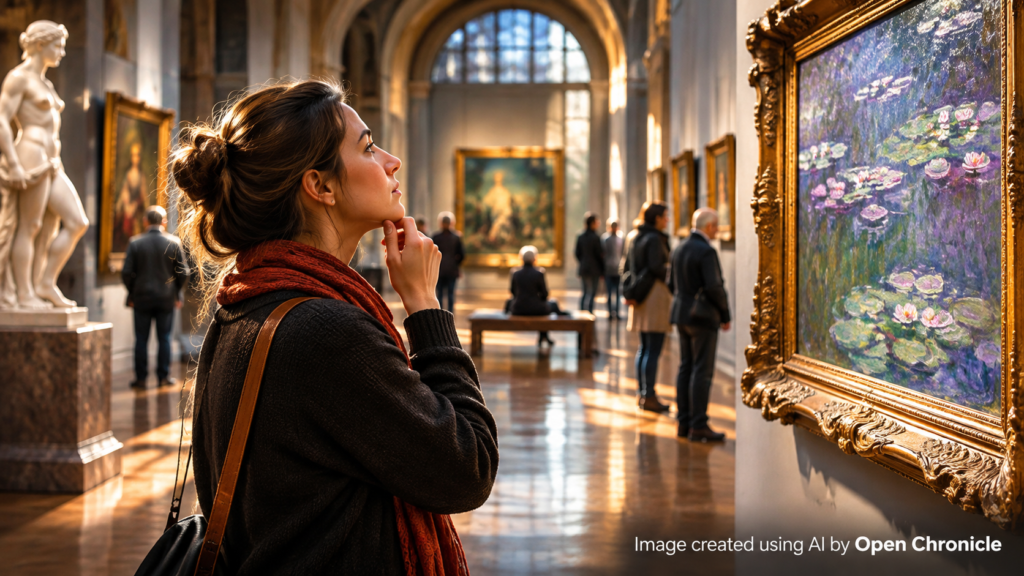
Imagine walking into a museum after a demanding week.
Outside, the city moves at its usual pace. Traffic fills the streets, notifications compete for attention and the pressures of everyday life seem impossible to escape.
Inside, something changes.
The atmosphere becomes quieter. The pace of movement slows. A painting invites you to stop. A sculpture encourages you to look from another perspective. An unfamiliar object raises a question you had never considered before.
For an hour, your attention belongs to something other than the demands of daily life.
But could this simple experience have measurable consequences for your health?
A growing body of scientific research suggests that engagement with the arts may be associated with improvements in psychological well-being, social connection and certain aspects of physical health.
In November 2026, a new report associated with the British charity Art Fund renewed attention on the subject by encouraging people to spend at least 60 minutes a month engaging with art.
The proposal is appealing because it transforms an ambitious idea into a relatively accessible habit.
Rather than treating culture as an occasional luxury, it invites people to consider artistic engagement as part of ordinary life.
Yet the scientific questions are more complicated than the recommendation might suggest.
Can visiting a museum reduce stress? Does cultural participation help protect against depression? Could regular exposure to art contribute to healthier ageing?
And, perhaps most importantly, how much of the evidence demonstrates genuine health benefits, rather than simply an association between cultural participation and healthier lifestyles?
To answer these questions, we need to examine what researchers have actually discovered.
1. The New Proposal: A Recommended Dose of Art
On 3 November 2026, the British charity Art Fund published The Recommended Dose of Art: A Prescription for Health and Wellbeing, developed in partnership with Professor Daisy Fancourt, a specialist in psychobiology and epidemiology at University College London.
The report proposes a simple target: spend at least one hour every month engaging with art in a museum or gallery.
The idea is not presented as a medical prescription or an officially established clinical guideline. It is a public engagement recommendation designed to encourage people to make cultural participation a regular habit.
The accompanying survey of 2,000 British adults found that 89% did not meet this proposed monthly target.
Only 17% identified mental well-being as a potential benefit of visiting museums, while just 7% recognized possible benefits to physical health.
The findings suggest a considerable gap between the growing scientific interest in arts engagement and public awareness of its potential health implications.
Art, Museums & Well-Being in Numbers
Proposed monthly museum or gallery visit
UK respondents below the proposed target
Recognized possible mental well-being benefits
Recognized possible physical health benefits
Source: Art Fund, 3 November 2026.
Survey of 2,000 UK adults.
The 60-minute target is a proposal, not a scientifically established minimum effective dose.
2. What the World Health Organization Already Knows
The relationship between art and health was attracting serious scientific attention long before the new Art Fund report.
In November 2019, the World Health Organization published an extensive review titled What Is the Evidence on the Role of the Arts in Improving Health and Well-Being?
Prepared by Daisy Fancourt and Saoirse Finn, the report examined evidence drawn from more than 3,000 studies.
Its findings suggested that artistic engagement could contribute to health promotion, illness prevention and the management of certain health conditions.
The review considered many forms of participation, including music, theatre, dance, literature and visual arts.
It also examined different research methods, ranging from small experimental studies to large longitudinal investigations.
This breadth is important.
The evidence does not suggest that every artistic activity produces identical benefits.
Listening to music, participating in a choir, visiting an exhibition and taking part in a creative workshop involve different psychological, physical and social processes.
Nevertheless, the WHO review established that the relationship between culture and health deserves serious attention from researchers and policymakers.
3. Can Looking at Art Reduce Stress?
Stress is one of the most frequently discussed areas of research into art and well-being.
When people experience stress, the body activates physiological systems involving hormones, cardiovascular responses and changes in attention.
Cortisol is one hormone commonly examined in this context.
Researchers have investigated whether viewing artworks can influence cortisol levels and other physiological indicators.
The new Art Fund report highlights research suggesting that viewing original artworks in a gallery can produce a greater reduction in cortisol than viewing reproductions in a laboratory setting.
One study reported an approximately 22% greater reduction under the original-art viewing condition.
This finding is intriguing, but it requires careful interpretation.
It does not mean that every museum visit reduces cortisol by 22%, nor that original paintings necessarily produce the same response in every visitor.
The comparison involved particular viewing conditions, participants and measurement procedures.
Still, the results suggest that the physical experience of encountering art may matter.
A museum provides more than a visual image.
It offers scale, texture, architectural surroundings, movement through space and an opportunity to concentrate without the constant interruptions associated with everyday digital life.
These features may contribute to the experience of looking at art.
4. The Question of Depression: What Does the Evidence Show?
Some of the most widely reported findings concern depression.
Research cited in the Art Fund report found that adults who engaged regularly in cultural activities experienced a substantially lower risk of developing depression during subsequent years.
One longitudinal study associated frequent cultural engagement with an approximately 48% lower risk of depression.
The result is striking.
However, a lower observed risk does not necessarily demonstrate that museum visits caused the difference.
People who participate regularly in cultural activities may differ from non-participants in several important ways.
They may have greater financial resources, better access to transport, stronger social networks or fewer existing health limitations.
Researchers attempt to account for these differences through statistical adjustments.
But observational studies cannot eliminate every possible source of confounding.
The responsible conclusion is therefore that regular cultural engagement has been associated with a lower incidence of depression, rather than that a monthly museum visit has been proven to prevent depression.
For individuals experiencing depression, museum visits may be a valuable complementary activity, but they are not a replacement for appropriate clinical assessment and treatment.
5. Museums, Loneliness and the Importance of Social Connection
Loneliness is another important dimension of the relationship between culture and health.
Museums can provide opportunities for social interaction, shared experiences and participation in community life.
A person visiting an exhibition with a friend may engage in conversation, exchange interpretations and discover new interests.
Guided tours, educational programmes and public events can create additional opportunities for connection.
The Art Fund report cites longitudinal research associating cultural participation among older adults with lower subsequent levels of loneliness.
One finding indicated that older adults who attended museums, galleries or concerts had 32% lower odds of reporting loneliness ten years later than less culturally active adults.
Again, the result describes an association.
It does not establish that museums alone were responsible.
Nevertheless, the relationship is plausible.
Cultural activities can encourage people to leave their homes, participate in public life and maintain social relationships.
For older adults, these opportunities may become particularly valuable when retirement, mobility limitations or changes in family circumstances reduce everyday social contact.
6. Could Art Help Protect the Ageing Brain?
The possibility that cultural engagement may contribute to healthier ageing has attracted increasing scientific interest.
Museums stimulate several cognitive processes simultaneously.
Visitors encounter unfamiliar information, interpret images, recall historical knowledge and make connections between different ideas.
An exhibition may encourage attention, memory, curiosity and discussion.
These activities are relevant to broader research into cognitive stimulation and healthy ageing.
The Art Fund report summarizes studies linking cultural engagement with lower risks of cognitive decline and dementia.
It also highlights research suggesting associations between arts participation and reduced frailty in older age.
However, the evidence must be interpreted cautiously.
A person who remains cognitively and physically healthy may be more capable of visiting museums regularly.
This creates a difficult question of direction: does cultural participation contribute to better health, or does better health make cultural participation easier?
Both processes may occur.
Longitudinal studies and carefully designed interventions can help researchers investigate these relationships, but no museum visit should be presented as a proven method of preventing dementia.
7. Biological Ageing: A New Area of Investigation
One of the most intriguing developments concerns biological ageing.
Chronological age measures the number of years a person has lived.
Biological ageing attempts to describe changes in physiological systems that may occur at different rates between individuals.
Researchers increasingly examine biological markers to investigate how behaviour, environment and health conditions relate to these processes.
A study discussed by the Museums Association in November 2026 examined data from 3,556 adults participating in the UK Household Longitudinal Study.
It found an association between frequent cultural participation and a slower pace of biological ageing.
The activities considered included museums, galleries and heritage visits.
The findings raise interesting questions about whether artistic engagement contributes to healthier ageing through stress regulation, social participation, cognitive stimulation or other pathways.
But the research does not demonstrate that visiting a museum directly reverses ageing.
Biological ageing is influenced by numerous interacting factors, and further studies are needed to establish the mechanisms involved.
8. Does Art Have to Be Experienced in Person?
The distinction between viewing original artworks and seeing reproductions raises a fascinating question.
Millions of people encounter art primarily through books, websites, social media and digital museum collections.
These resources have dramatically expanded access to cultural heritage.
A person living thousands of kilometres from Paris can study paintings in the Louvre. Someone who cannot travel to Florence can explore Renaissance masterpieces through digital archives.
But does looking at a reproduction create the same experience as standing before the original?
Not necessarily.
An original painting possesses physical characteristics that digital images may struggle to communicate.
Its scale can influence the viewer’s emotional response.
Its surface may reveal brushwork, texture and the effects of light.
The surrounding gallery contributes to the experience through architecture, acoustics and the presence of other visitors.
Research comparing original artworks with reproductions suggests that the context of viewing may influence physiological responses.
That does not mean digital art experiences are without value.
Online collections can support learning, enjoyment and access for people who cannot visit museums.
The more useful question is not whether digital art should replace physical museums.
It is how different forms of artistic engagement can complement one another.
9. The Problem With Prescribing Art Like Medicine
The proposed 60-minute monthly recommendation has also generated criticism.
Some commentators question whether the value of art should be measured primarily through its contribution to health.
The concern is philosophical as well as practical.
Art can provoke discomfort, sadness, anger or uncertainty.
A painting addressing war, displacement or injustice may not produce immediate relaxation.
A challenging exhibition may leave visitors emotionally unsettled.
Yet these experiences can still be culturally meaningful.
Treating art primarily as a wellness intervention risks reducing its purpose to a measurable health outcome.
There is also a scientific limitation.
The evidence supporting arts engagement is broader than the specific recommendation to spend 60 minutes in a museum each month.
That precise duration has not been established as a universal therapeutic threshold through definitive clinical trials.
It is better understood as a practical public engagement target.
This distinction matters because a useful recommendation should not be confused with a proven medical dosage.
Art can contribute to a fulfilling life without needing to function as medicine.
10. Why Museums Could Become Important Public Health Partners
Despite these limitations, the growing research has important implications for cultural policy.
Museums are often discussed in terms of tourism, education, preservation and economic development.
Their potential contribution to community well-being introduces another dimension.
A museum can provide a quiet environment for reflection.
It can offer opportunities for learning throughout life.
It can support social participation and introduce visitors to unfamiliar perspectives.
For some people, these experiences may contribute to a broader pattern of activities associated with well-being.
The WHO’s 2019 review encouraged collaboration between cultural organizations and health sectors.
Such partnerships can take different forms.
Museums may develop programmes for older adults, community groups or people experiencing social isolation.
Healthcare professionals may recommend suitable cultural activities as part of broader social prescribing initiatives.
Educational institutions may collaborate with museums to support creativity and emotional development.
But successful programmes require accessibility.
Admission costs, transport, disability access, opening hours and cultural barriers can all influence who benefits.
A recommendation to visit a museum regularly is only meaningful if people have realistic opportunities to do so.
11. The Global Challenge of Cultural Access
The Art Fund’s recommendation was developed within the British cultural context.
Its findings cannot automatically be applied to every country.
Museum access varies considerably around the world.
Some cities offer extensive networks of public museums with free permanent collections.
Other regions have limited cultural infrastructure or institutions concentrated in major urban centres.
Economic inequality can also influence participation.
Even when admission is free, visitors may face transport costs, limited leisure time or other practical obstacles.
These differences matter when considering the relationship between culture and public health.
If cultural participation is associated with better health outcomes, unequal access to culture may reinforce existing inequalities.
This raises a question for governments and cultural institutions.
Should access to museums be considered not only an educational and cultural objective, but also part of wider efforts to support community well-being?
The evidence does not yet justify treating museums as a substitute for healthcare.
It does, however, strengthen the argument that cultural access can have value beyond tourism and entertainment.
12. How to Make a Monthly Museum Visit More Meaningful
Your 60-Minute Museum Visit
An editorial suggestion inspired by the Art Fund proposal, not a clinically validated treatment schedule.
YOUR MUSEUM EXPERIENCE
60 MIN
Five simple stages. One hour dedicated to art, discovery and reflection.
Arrive and Explore
Become familiar with the exhibition space and choose an area that interests you.
Look Closely
Select two or three artworks and spend time examining their details.
Discover the Context
Read about the artists, materials, historical periods or ideas behind the works.
Reflect or Discuss
Consider what surprised you or share your impressions with another visitor.
Choose Your Next Visit
Identify another exhibition, museum or cultural activity you would like to explore.
The purpose of this routine is not to transform a museum visit into another demanding obligation.
The purpose of this routine is not to transform a museum visit into another demanding obligation.
It is to create space for sustained attention.
Visitors do not need specialist knowledge to enjoy art.
They do not need to understand every historical reference or identify every artistic technique.
Curiosity is enough to begin.
Some may prefer paintings. Others may enjoy sculpture, photography, design or historical objects.
The most meaningful experience is often the one that creates a genuine personal connection.
13. What the Evidence Actually Allows Us to Conclude
The scientific literature supports several important observations.
Arts engagement has been associated with psychological well-being, social participation and certain indicators of physical and cognitive health.
Some experimental studies suggest that viewing art can influence short-term physiological responses.
Longitudinal research has identified relationships between cultural participation and later health outcomes.
Large evidence reviews, including the WHO’s 2019 report, indicate that the arts deserve attention within public health research.
But the evidence also has limitations.
Not every study concerns museums specifically.
Many examine broader cultural participation, including music, theatre, dance and other activities.
Some findings are observational, making it difficult to establish causation.
And the proposed monthly target of 60 minutes remains a public engagement recommendation rather than an independently validated medical threshold.
These qualifications do not make the research unimportant.
They make its interpretation more responsible.
The central message is not that one museum visit can cure illness.
It is that cultural participation may be one useful component of a healthy, socially connected and intellectually stimulating life.
Conclusion: Perhaps Art Is More Essential Than We Think
For centuries, museums have preserved objects that societies consider worthy of remembering.
They have protected paintings, sculptures, manuscripts and historical artefacts.
They have introduced generations of visitors to different cultures, ideas and ways of seeing the world.
Now, scientific research is encouraging us to consider another possibility.
The value of museums may extend beyond the knowledge they preserve and the beauty they display.
Their environments may support reflection, curiosity, social connection and emotional engagement.
The new Art Fund recommendation offers a simple invitation: make time for art regularly.
The evidence does not establish that exactly 60 minutes a month will transform everyone’s health.
But it suggests that meaningful engagement with culture deserves a place in discussions about well-being.
Perhaps the most compelling reason to visit a museum is also the simplest.
Art allows us to encounter something beyond the routines of everyday life.
It invites us to slow down, look more carefully and discover unfamiliar perspectives.
And even before science measures the consequences, those experiences have value in themselves.
Research at a Glance
| Finding | Evidence and interpretation |
|---|---|
| 60 minutes per month | Proposed by Art Fund as a practical cultural engagement target |
| 89% | Share of surveyed UK adults below the proposed target |
| Stress response | Some experimental evidence suggests original artworks may produce stronger physiological responses than reproductions |
| Depression | Observational studies associate frequent cultural engagement with lower subsequent risk |
| Loneliness | Longitudinal research suggests a relationship between cultural participation and lower loneliness |
| Cognitive health | Promising associations, but causation remains uncertain |
| Biological ageing | Emerging observational evidence, requiring further investigation |
Sources and Further Reading
Scientific research, institutional publications
and independent reporting examining the relationship
between museum visits, cultural engagement,
public health and well-being.
Art Fund | The Recommended Dose of Art
3 November 2026.
Primary institutional announcement of the report
developed with Professor Daisy Fancourt, including
the proposed 60-minute target, survey findings
and summaries of the scientific evidence.
World Health Organization | What Is the Evidence on the Role of the Arts in Improving Health and Well-Being?
5 November 2019.
Scientific evidence review by Daisy Fancourt
and Saoirse Finn, examining findings from
more than 3,000 studies.
Museums Association | Monthly Museum Visits Could Improve Public Health
10 November 2026.
Reporting on the Art Fund recommendation,
survey findings and research concerning
stress, loneliness and biological ageing.
The Art Newspaper | One Museum Visit a Month Could Improve Health, New Report Finds
5 November 2026.
Independent arts journalism examining the
report’s recommendations and implications
for museums and public health.
National Center for Biotechnology Information | WHO Arts and Health Evidence Review
Full accessible research text, including
methodology, evidence categories,
conclusions and references.
This article distinguishes findings from experimental research, observational associations and public health recommendations. The proposed monthly 60-minute museum visit is not a clinically established treatment or a substitute for medical care. The scientific evidence concerns multiple forms of artistic and cultural participation, and results should not automatically be interpreted as demonstrating that museum attendance causes specific health improvements.
Open Chronicle Arts Magazine
Explore the world of art, creativity and culture. Discover extraordinary artists, timeless masterpieces, contemporary movements and the stories behind the works that shape our world.
Back to Arts Magazine