
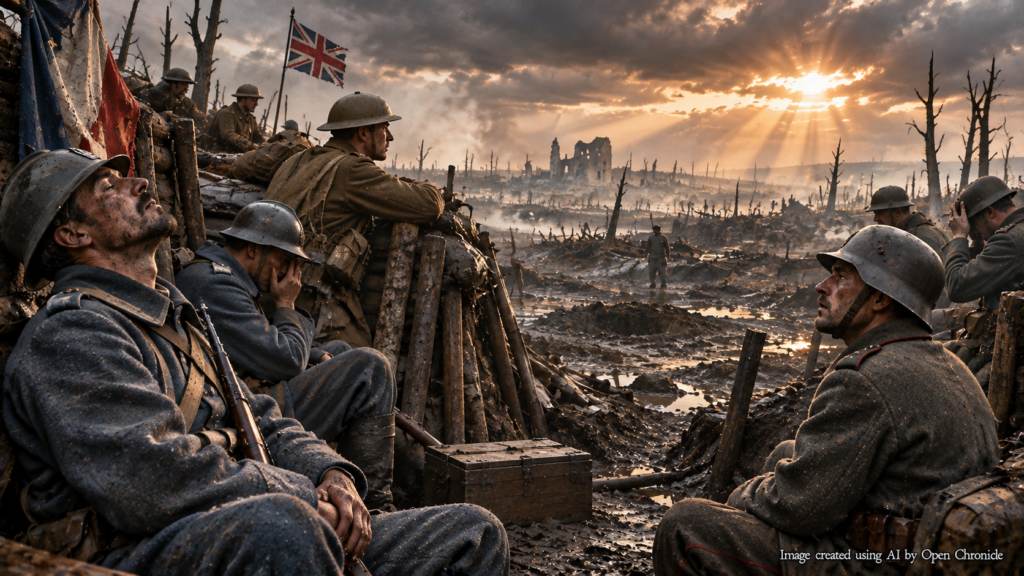
At the eleventh hour of the eleventh day of the eleventh month, the guns fell silent on the Western Front. But the end of the fighting was only the beginning of a difficult and uncertain peace.
By Open Chronicle History Desk
At eleven o’clock on the morning of November 11, 1918, the guns fell silent along the Western Front.
For more than four years, Europe had endured a conflict of unprecedented destruction.
Millions of soldiers had fought across trenches, forests, fields and ruined towns.
Entire generations had been transformed by industrial warfare.
Artillery had devastated landscapes.
Machine guns had made frontal assaults extraordinarily costly.
Poison gas had introduced new forms of suffering.
And the war had expanded far beyond Europe, drawing soldiers, workers and resources from empires and countries across the world.
But on that cold November morning, something extraordinary happened.
The fighting stopped.
Earlier that day, representatives of Germany and the Allied powers had signed an armistice in a railway carriage in the Forest of Compiègne, France.
The agreement required German forces to cease hostilities, withdraw from occupied territories and surrender substantial quantities of military equipment.
The armistice took effect at 11 a.m.
For soldiers who had survived years of combat, the silence was almost unimaginable.
Yet the moment was not universally joyful.
Many mourned comrades who would never return.
Others remained uncertain about their future.
Families across Europe were still waiting for news of missing relatives.
And the political consequences of the war were only beginning to emerge.
The armistice ended the fighting between Germany and the Allies on the Western Front.
It did not formally end the state of war.
That required subsequent peace agreements, including the Treaty of Versailles in 1919.
Nor did November 11 bring peace to every part of Europe.
Revolutions, civil wars and border conflicts continued.
The Ottoman Empire, Austria-Hungary and the Russian Empire had already undergone profound political transformations.
Germany itself was experiencing revolution.
The old European order had collapsed.
New states were emerging.
And the consequences of the war would shape the remainder of the twentieth century.
To understand November 11, 1918, we must examine not only the final hours of the First World War, but also the decisions, sacrifices and unresolved tensions that made the armistice possible.
1. Europe Before the Catastrophe
In 1914, Europe was dominated by powerful empires.
Germany, Austria-Hungary, Russia, Britain and France exercised enormous political and military influence.
Diplomatic alliances connected the major powers.
Nationalist movements challenged imperial authority.
Military planning increasingly assumed that a future conflict would require rapid mobilization.
The international system was vulnerable to escalation.
A regional crisis could become a continental war.
2. The Assassination at Sarajevo
On June 28, 1914, Archduke Franz Ferdinand, heir to the Austro-Hungarian throne, was assassinated in Sarajevo.
The assassin, Gavrilo Princip, was a Bosnian Serb nationalist.
Austria-Hungary blamed Serbia for tolerating the networks associated with the attack.
The assassination triggered a diplomatic confrontation.
But the war resulted from decisions made by governments during the following weeks.
3. The July Crisis
Austria-Hungary issued an ultimatum to Serbia.
Germany supported its ally.
Russia prepared to defend Serbian interests.
France maintained its alliance with Russia.
Britain became increasingly concerned about the European balance of power and Belgian neutrality.
Diplomatic efforts failed.
Austria-Hungary declared war on Serbia on July 28.
Within days, the conflict expanded.
4. The War Spreads Across Europe
Germany declared war on Russia and France.
German forces invaded Belgium.
Britain entered the war on August 4, 1914.
The conflict rapidly involved several major European powers.
Military mobilization plans and political calculations accelerated the crisis.
What began as a confrontation in southeastern Europe became a general European war.
5. The Western Front
Germany’s initial offensive advanced through Belgium into France.
The Allied victory at the First Battle of the Marne in September 1914 halted the German advance toward Paris.
Both sides attempted to outflank each other.
Eventually, a continuous system of trenches developed from the North Sea to the Swiss frontier.
The Western Front became the defining battlefield of the war.
6. Life in the Trenches
Soldiers endured mud, cold, disease, exhaustion and constant danger.
Artillery bombardments could continue for hours or days.
Trenches offered protection but were rarely safe.
Rats and lice were common.
Medical services struggled to treat enormous numbers of wounded men.
The psychological consequences of prolonged combat were severe.
7. Industrial Warfare
The First World War demonstrated the destructive capacity of modern industry.
Machine guns, heavy artillery and rapid-fire weapons transformed combat.
Railways transported troops and supplies.
Factories produced ammunition on an unprecedented scale.
Aircraft became increasingly important.
Tanks appeared on the battlefield in 1916.
The war demanded the mobilization of entire national economies.
8. The Battle of Verdun
In February 1916, German forces attacked the French defenses around Verdun.
The battle continued for much of the year.
Both sides suffered enormous casualties.
Verdun became a symbol of French endurance.
Its devastation demonstrated the human cost of prolonged industrial warfare.
The battle also exposed the limitations of strategies based on attrition.
9. The Battle of the Somme
The Somme offensive began on July 1, 1916.
British forces suffered catastrophic casualties on the first day.
The battle continued for months.
The Allies achieved limited territorial gains at enormous cost.
The Somme became one of the most recognizable symbols of the First World War.
Its memory remains central to British and Commonwealth commemorations.
10. A Global Conflict
The war extended far beyond the Western Front.
Fighting occurred in Eastern Europe, the Balkans, the Middle East, Africa and at sea.
Colonial soldiers served in European armies.
Imperial resources supported military operations.
Naval blockades affected international commerce.
The conflict reshaped societies across the world.
11. The Eastern Front
Germany and Austria-Hungary fought against the Russian Empire.
The Eastern Front involved vast territories and highly mobile operations.
Russian forces suffered major defeats.
Military losses, economic hardship and political dissatisfaction undermined the Russian monarchy.
The war contributed directly to the revolutionary crises of 1917.
12. The Russian Revolution
In March 1917, according to the Gregorian calendar, Tsar Nicholas II abdicated.
A provisional government continued the war.
In November 1917, the Bolsheviks seized power.
The new government sought peace.
Russia’s withdrawal transformed the strategic situation.
Germany could transfer forces from the east to the Western Front.
13. The Treaty of Brest-Litovsk
In March 1918, Soviet Russia signed the Treaty of Brest-Litovsk with the Central Powers.
Russia accepted severe territorial losses.
The treaty ended its participation in the war.
Germany hoped that the resulting military advantage would allow it to achieve victory in the west.
But the strategic opportunity was temporary.
American military strength was increasing.
14. The United States Enters the War
The United States entered the war in April 1917.
German unrestricted submarine warfare was a major factor.
The Zimmermann Telegram also influenced American opinion.
President Woodrow Wilson presented intervention as a defense of international order.
American entry transformed the long-term balance of resources.
But substantial American forces required time to reach Europe.
15. American Soldiers Arrive
During 1917 and 1918, increasing numbers of American soldiers arrived in France.
The American Expeditionary Forces were commanded by General John J. Pershing.
American troops participated in major operations during 1918.
Their arrival strengthened Allied manpower.
It also reinforced the expectation that Germany’s strategic position would deteriorate if the war continued.
16. Germany’s Last Opportunity
By early 1918, German leaders recognized that time was running against them.
The British naval blockade had placed severe pressure on Germany.
Food shortages weakened civilian morale.
American forces were arriving in increasing numbers.
German commanders sought a decisive victory before Allied strength became overwhelming.
They prepared a major offensive.
17. The German Spring Offensive
On March 21, 1918, Germany launched Operation Michael.
It was the first of several major offensives.
German forces achieved significant initial advances.
Specialized assault tactics helped break through parts of the Allied lines.
But the offensives failed to secure a decisive victory.
German casualties were severe.
The army exhausted many of its best troops.
18. The Second Battle of the Marne
In July 1918, German forces launched another offensive near the Marne.
Allied troops resisted and counterattacked.
French, American and other Allied forces played important roles.
The German offensive failed.
The initiative increasingly passed to the Allies.
The battle marked an important turning point.
19. The Hundred Days Offensive
On August 8, 1918, Allied forces launched a major offensive near Amiens.
The operation achieved significant success.
German defensive positions were disrupted.
The Allies continued attacking along different sections of the front.
The campaign became known as the Hundred Days Offensive.
It steadily weakened Germany’s military position.
20. The Battle of Amiens
The Allied attack at Amiens combined infantry, artillery, tanks and aircraft.
Surprise and coordination contributed to its success.
German forces suffered major losses.
The offensive demonstrated improvements in Allied operational methods.
German commanders recognized the seriousness of the situation.
The possibility of military victory was rapidly disappearing.
21. The Hindenburg Line
German forces relied on extensive defensive positions known collectively as the Hindenburg Line.
During September and October 1918, Allied armies broke through important sections.
The German army continued resisting.
But its capacity to maintain a stable front was declining.
Retreat became increasingly necessary.
22. The Collapse of Germany’s Allies
Germany’s allies were also approaching defeat.
Bulgaria signed an armistice in September 1918.
The Ottoman Empire agreed to an armistice in October.
Austria-Hungary concluded an armistice in early November.
Germany became increasingly isolated.
The Central Powers were collapsing.
23. Austria-Hungary Disintegrates
National movements within Austria-Hungary declared independence or established new governments.
The empire’s military and political institutions lost authority.
The Habsburg monarchy could no longer maintain its multinational state.
The collapse transformed Central Europe.
Germany lost its most important continental ally.
24. The German Home Front
German civilians had endured years of hardship.
Food shortages and inflation weakened morale.
The naval blockade restricted supplies.
Industrial workers faced difficult conditions.
The gap between military promises and battlefield reality became increasingly apparent.
Political dissatisfaction intensified.
25. The German Naval Mutinies
In late October 1918, German naval commanders planned a final fleet operation.
Sailors resisted orders that could lead to another major battle.
Mutinies spread.
The unrest contributed to a wider revolutionary movement.
The naval crisis demonstrated the collapse of confidence in the imperial leadership.
26. Revolution in Germany
During early November, revolutionary unrest spread across Germany.
Workers’ and soldiers’ councils appeared.
Demonstrations challenged the monarchy.
Political leaders struggled to maintain control.
The crisis accelerated the end of imperial rule.
Germany’s political transformation unfolded alongside military defeat.
27. Kaiser Wilhelm II Abdicates
On November 9, 1918, the abdication of Kaiser Wilhelm II was announced.
The German monarchy collapsed.
Wilhelm subsequently went into exile in the Netherlands.
The end of the empire marked a fundamental political change.
Germany was moving toward republican government.
28. The German Republic
On November 9, Philipp Scheidemann proclaimed a German republic in Berlin.
Other revolutionary leaders proposed different political futures.
Friedrich Ebert became a central figure in the provisional government.
The new authorities faced an immediate challenge.
They had to end the war while maintaining political order.
29. The Decision to Seek an Armistice
German military leaders had already concluded that the war could not be won.
In late September 1918, the Supreme Army Command pressed for an armistice request.
The government contacted President Wilson.
Diplomatic exchanges followed.
The negotiations took place amid military retreat and political revolution.
Germany’s bargaining position was weak.
30. Woodrow Wilson’s Fourteen Points
In January 1918, President Wilson had presented his Fourteen Points.
They outlined principles for a postwar settlement.
These included diplomatic openness, national self-determination in certain contexts and a new international organization.
German leaders hoped that Wilson’s proposals might influence the peace terms.
But Allied governments did not accept every principle without qualification.
The armistice conditions were primarily military.
31. Marshal Ferdinand Foch
Marshal Ferdinand Foch served as the Allied generalissimo during the final campaigns.
He played a central role in coordinating Allied military operations.
Foch represented the Allied side during the armistice negotiations.
He was determined to impose conditions that would prevent Germany from immediately resuming the war.
His position reflected France’s experience of invasion and destruction.
32. The German Delegation
The German armistice delegation was led by Matthias Erzberger.
Erzberger was a civilian politician.
His delegation included military and diplomatic representatives.
They traveled through the front lines to meet Allied officials.
The negotiations took place under conditions of military and political urgency.
Germany had little capacity to demand substantial changes.
33. The Forest of Compiègne
The negotiations occurred in a railway carriage in the Forest of Compiègne, northeast of Paris.
The carriage served as Foch’s headquarters.
The location offered privacy and security.
It would become one of the most famous settings in twentieth-century diplomatic history.
The symbolism of the railway carriage later acquired additional significance.
34. The Armistice Terms
The agreement required Germany to cease hostilities and withdraw from occupied territories.
German forces had to evacuate Belgium, France and Luxembourg.
They also had to withdraw from Alsace-Lorraine.
The Allies required the surrender of large quantities of military equipment.
The Rhineland would be occupied under the armistice arrangements.
The conditions were designed to reduce Germany’s ability to resume fighting.
35. The Naval Conditions
Germany was required to surrender submarines and submit major surface warships to internment.
The naval blockade remained in force under the armistice terms.
These provisions reflected Allied concerns about German military capabilities.
The naval conditions also contributed to continuing economic pressure.
The agreement was not a negotiated peace treaty between equal military positions.
36. The Signing at 5:10 a.m.
The armistice was signed in the early hours of November 11.
The commonly cited signing time is approximately 5:10 a.m., although historical accounts and official documents sometimes use slightly different times.
The agreement specified that hostilities would cease at 11 a.m.
This created a period of several hours between signature and implementation.
Fighting continued during that interval.
37. The Final Hours
Soldiers on both sides knew that the war was approaching its end.
But military operations did not stop immediately.
Some commanders continued attacks.
Artillery fire persisted.
Men were killed and wounded during the final hours.
The deaths became especially tragic because the cessation of hostilities had already been agreed.
38. The Last Casualties
Several soldiers died shortly before the armistice took effect.
Among the most frequently cited was American soldier Henry Gunther, killed shortly before 11 a.m.
His death became a symbol of the war’s final moments.
The precise identification of the last soldier killed across all fronts is difficult.
But the broader reality is clear.
The war continued taking lives until the final minutes.
39. Eleven O’Clock
At 11 a.m., the armistice took effect.
The artillery gradually fell silent.
Rifle fire stopped.
Across the Western Front, soldiers experienced an extraordinary change.
The constant noise of warfare disappeared.
Some celebrated.
Others remained silent.
For many, the end of combat brought relief mixed with grief and exhaustion.
40. The Reaction in Paris
News of the armistice produced enormous celebrations in Paris.
Crowds filled the streets.
Flags appeared.
People embraced.
The end of the fighting brought relief after years of sacrifice.
France had suffered immense destruction.
The celebrations reflected both victory and survival.
41. London Celebrates
In London, crowds gathered to celebrate the end of the war.
Church bells rang.
People filled public spaces.
The announcement brought relief to families who had endured years of anxiety.
But Britain had also suffered enormous losses.
The celebrations could not erase the grief of bereaved households.
42. The Reaction in Germany
In Germany, the armistice arrived amid revolution and uncertainty.
The monarchy had collapsed.
The new government faced economic and political instability.
Many Germans experienced the agreement as defeat and humiliation.
Others welcomed the end of fighting.
The country’s future remained deeply uncertain.
43. The War’s Human Cost
The First World War caused enormous loss of life.
Millions of military personnel died.
Civilian populations suffered from violence, disease, hunger and displacement.
The exact totals vary according to definitions and historical estimates.
The conflict left millions wounded or permanently disabled.
Its demographic and social consequences lasted for generations.
44. The Influenza Pandemic
The influenza pandemic of 1918 spread during the final year of the war.
Military movement and crowded conditions contributed to its transmission.
The pandemic caused millions of deaths worldwide.
It overlapped with wartime suffering.
The armistice did not end this public health catastrophe.
For many communities, November 1918 remained a period of profound hardship.
45. The Treaty of Versailles
The armistice did not formally establish peace.
The Treaty of Versailles was signed on June 28, 1919.
It imposed territorial, military and financial obligations on Germany.
The treaty became one of the most controversial diplomatic settlements of the twentieth century.
Its consequences influenced European politics during the interwar period.
46. The League of Nations
The postwar settlement established the League of Nations.
The organization was intended to promote international cooperation and collective security.
It represented an ambitious attempt to prevent future wars.
But the League faced serious limitations.
The United States did not join.
The organization struggled to respond effectively to major international crises.
47. The Myth of the Stab in the Back
After the war, nationalist groups in Germany promoted the claim that the army had not truly been defeated.
They alleged that civilian politicians and other internal enemies had betrayed the country.
The narrative became known as the stab-in-the-back myth.
It distorted the military reality of Germany’s deteriorating position in 1918.
The myth was later exploited by extremist political movements, including the Nazis.
48. The Railway Carriage in 1940
In June 1940, Nazi Germany defeated France.
Adolf Hitler arranged for the French armistice to be signed in the same railway carriage associated with November 1918.
The location was deliberately chosen for its symbolic significance.
Hitler sought to reverse the humiliation associated with Germany’s earlier defeat.
The episode demonstrated how the memory of 1918 had become entangled with the politics of revenge.
49. Armistice Day and Remembrance
November 11 became a day of remembrance in many countries.
In Britain and several Commonwealth nations, commemorations honor those who died in war.
France observes the anniversary of the 1918 armistice.
In the United States, Armistice Day eventually became Veterans Day.
The date remains one of the most important commemorations associated with the First World War.
50. Why November 11 Matters
November 11, 1918 marked the end of major fighting between Germany and the Allies on the Western Front.
It ended more than four years of industrial warfare in that theater.
It confirmed the defeat of Germany.
It accompanied the collapse of several European empires.
It opened the way for a new international political order.
But it did not guarantee lasting peace.
The unresolved tensions of the postwar settlement would shape the decades that followed.
November 11, 1918: When the Guns Fell Silent
Imagine a trench on the Western Front.
The morning is cold.
The ground is scarred by artillery.
Broken trees stand against a gray sky.
Soldiers wait.
Some know that an armistice has been signed.
Others have heard only rumors.
The minutes pass.
At eleven o’clock, the firing stops.
For the first time in years, the landscape becomes quiet.
There is no immediate transformation.
The trenches remain.
The ruined villages remain.
The dead remain.
But the fighting has ended.
Across Europe, people celebrate.
Families embrace.
Church bells ring.
Yet millions will never return home.
The war has destroyed empires.
It has transformed political borders.
It has accelerated technological and social change.
It has left unresolved questions about nationalism, security and international order.
The peace that follows will prove fragile.
Within a generation, Europe will experience another catastrophic war.
But November 11 remains a defining moment.
It represents the end of one of the most destructive conflicts in human history.
It also reminds us that the cessation of fighting and the achievement of lasting peace are not the same thing.
On November 11, 1918, the armistice ended the fighting between Germany and the Allies on the Western Front. The guns fell silent, but the political consequences of the First World War would shape the world for generations.
Historical Sources and Further Reading
Institutional records and historical scholarship examining the Armistice of November 11, 1918, the final campaigns of the First World War, the cessation of hostilities and the political consequences of the conflict.
Armistice and the End of the First World War
Museum research and historical collections documenting the final months of the war, the armistice negotiations, the cessation of fighting and the experiences of soldiers and civilians in November 1918.
Explore the Historical Collections →
The First World War and Its Legacy
Historical exhibitions, educational resources and archival collections examining the global conflict, the American contribution, the end of the war and its enduring consequences.
Explore the Museum Resources →
The Vanquished: Why the First World War Failed to End
Robert Gerwarth examines the political violence, revolutions, imperial collapse and armed conflicts that continued across Europe after the November 1918 armistice, challenging the assumption that the end of the Western Front fighting immediately brought peace.
Paris 1919: Six Months That Changed the World
Margaret MacMillan’s study of the Paris Peace Conference, the negotiations that followed the armistice, the Treaty of Versailles and the international settlement that reshaped Europe and the wider world.
The Armistice of November 11, 1918, was signed in the Forest of Compiègne, France, and took effect at 11:00 a.m. It ended hostilities between Germany and the Allied powers on the Western Front but did not constitute a final peace treaty. The formal peace settlement followed through the Paris Peace Conference and subsequent treaties, including the Treaty of Versailles in 1919. This article distinguishes the military cessation of hostilities from the political and diplomatic settlement that followed. It also recognizes that armed conflicts, revolutions and political violence continued in several regions after November 1918. Casualty estimates, the circumstances of individual deaths during the final hours and certain details of the negotiations may vary across historical sources.