
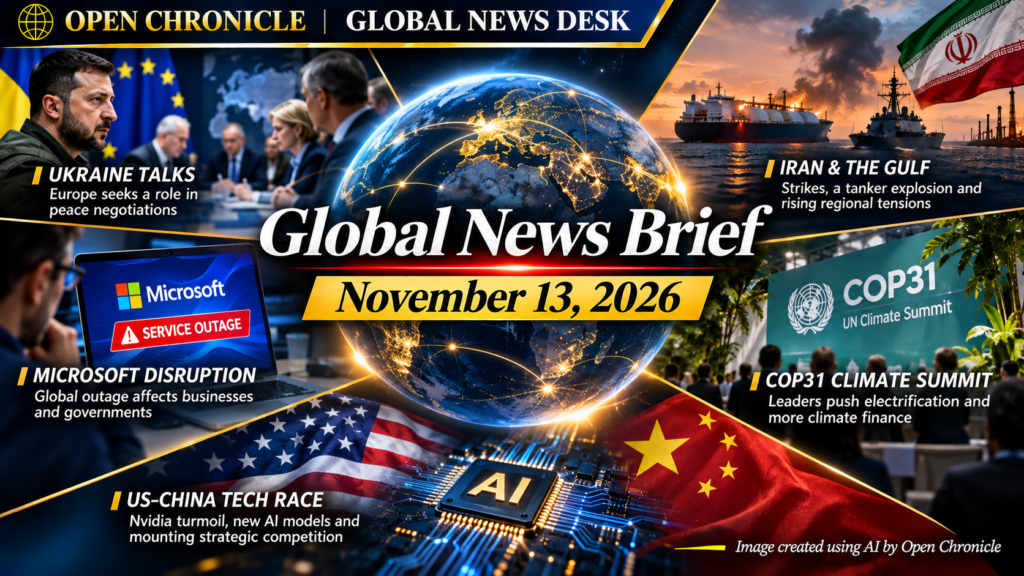
OPEN CHRONICLE | GLOBAL NEWS DESK | FRIDAY, NOVEMBER 13, 2026
Diplomacy over Ukraine enters a potentially decisive phase, Europe seeks a stronger role in peace negotiations, tensions involving Iran and the Gulf intensify, and a major Microsoft disruption affects businesses worldwide. From Washington and Brussels to Beijing, Gaza and Sudan, Open Chronicle examines the developments shaping the international agenda.
By Open Chronicle News Desk
November 13, 2026 | Morning Edition
Editorial overview: This briefing is organized by geographical region and subject. It draws on the supplied international headline feeds available during the morning of November 13. Reports concerning rapidly evolving conflicts, allegations and investigations are attributed to their sources and should not be treated as independently confirmed where supporting evidence remains unavailable.
1. Europe | Diplomacy, Security and Political Developments
Ukraine peace talks: Europe seeks a place at the negotiating table
European participation in future negotiations over Russia’s war against Ukraine has emerged as one of the day’s most important diplomatic developments.
Following talks involving American representatives Steve Witkoff and Jared Kushner, reports indicate that European governments could participate in the next phase of discussions.
Ukrainian President Volodymyr Zelenskyy has welcomed the prospect of greater European involvement, while European leaders continue to debate how to establish a common negotiating position.
The diplomatic question extends beyond the immediate possibility of a ceasefire. Any lasting settlement would have implications for territorial security, military guarantees, sanctions and Europe’s relationship with Russia.
European governments argue that decisions affecting the continent’s security architecture cannot be made without their participation.
However, differences remain over who should represent Europe and how negotiations should address Russian demands.
Russia and Ukraine discuss a potentially major prisoner exchange
American diplomatic representatives have indicated that discussions are advancing toward what could become one of the largest prisoner exchanges of the war.
Ukrainian officials have also signaled progress.
Such an exchange would represent a significant humanitarian development, particularly for families awaiting the return of detained military personnel.
Nevertheless, prisoner exchanges do not necessarily indicate agreement on the central political and territorial disputes.
The number of prisoners, implementation timetable and final arrangements require official confirmation.
New drone strikes affect Ukraine and Russia
Military operations continue despite renewed diplomatic activity.
Reports from Ukraine describe deadly Russian drone strikes in Odesa and the Sumy region, with additional injuries reported in Rivne.
Russian media, meanwhile, report a drone attack that caused a fire at an oil refinery in Volgograd. Some accounts attribute four deaths to the incident.
Russian authorities also reported intercepting drones approaching Moscow, with disruptions affecting aviation.
The reports illustrate the continuing intensity of long-range warfare, including attacks against energy infrastructure.
Casualty figures and damage assessments remain subject to confirmation.
EU leaders gather in Dublin amid security disagreements
European leaders are meeting in Dublin against a backdrop of disagreements over Ukraine policy, defense responsibilities and the continent’s diplomatic influence.
The summit agenda has also been linked in reporting to artificial intelligence and European technological competitiveness.
One central concern is whether European governments can act collectively when major international negotiations are led by Washington.
Bulgaria has reportedly expressed reservations concerning the wording of a European security declaration, demonstrating the difficulty of achieving complete agreement.
France considers additional sanctions against Russia
France is reportedly promoting further European sanctions targeting Russian financial institutions and entities connected to Moscow’s economy.
The proposals described in the supplied reporting include approximately 50 banks and 150 additional entities.
These figures concern proposals rather than confirmed new sanctions.
Their adoption would require the relevant European decision-making procedures.
The broader objective is to constrain Russia’s ability to finance military operations while maintaining pressure during negotiations.
Norway warns of possible Russian sabotage threats
Norwegian security assessments reportedly anticipate an increased risk of covert Russian sabotage targeting the defense sector in 2027.
The warning reflects growing concern about the protection of military industries, logistics networks and strategically important infrastructure.
Such assessments are forecasts of potential threats, not confirmation that a particular future attack will occur.
United Kingdom sanctions Russian oil producers
British reporting indicates that the United Kingdom has announced sanctions against Russia’s ten largest oil producers.
The measures are presented as part of continued economic pressure on Moscow.
Their practical effect will depend on the exact legal design, enforcement and the extent of international coordination.
Spain approaches election amid political and transport concerns
Prime Minister Pedro Sánchez faces renewed political pressure ahead of Spain’s November 29 general election.
Recent reporting highlights disillusionment among sections of the left and the political consequences of a reported train crash.
Housing affordability and the aftermath of the November 11 general strike remain important electoral issues.
The combination of economic grievances, public safety concerns and political fragmentation makes the campaign increasingly unpredictable.
Portugal faces disruption from Storm Charles
Reports indicate that Storm Charles has brought severe weather to mainland Portugal, prompting closures of schools and nonessential public services in affected areas.
Heavy rain and strong winds have raised concerns about flooding, transport disruption and public safety.
Residents should follow official weather warnings and civil protection instructions as conditions evolve.
2. North America | Politics, Technology and Economic Security
Democratic leadership contest emerges after US midterm elections
Senator Chris Van Hollen has reportedly launched a challenge to Chuck Schumer for the leadership of Senate Democrats following the party’s midterm election success.
The contest reflects competing views about how Democrats should use their strengthened position, respond to President Donald Trump’s administration and prepare for future elections.
The outcome could influence the party’s legislative priorities, oversight strategy and approach to foreign policy.
Nvidia faces leadership turmoil and national security scrutiny
Nvidia is facing an extraordinary period of uncertainty following reports of Jensen Huang’s departure as chief executive amid allegations concerning personal relationships and possible Chinese intelligence connections.
The supplied reports identify Chief Financial Officer Colette Kress as interim chief executive and describe congressional demands for documents and testimony.
The allegations have also drawn attention to the company’s relationships with China and restrictions on advanced semiconductor exports.
Importantly, a US Justice Department official reportedly stated that investigators had not determined whether Alice Huang was acting as a Chinese spy.
Personal allegations, corporate leadership changes and intelligence claims must therefore be assessed separately.
The controversy has also generated questions about corporate governance and the resilience of a company central to global artificial intelligence infrastructure.
SpaceX announces major investment in AI computing infrastructure
SpaceX is reportedly planning investments exceeding $74 billion in artificial intelligence supercomputing facilities in the United States.
The proposals involve large computing campuses, including projects in Texas and Arizona.
If implemented at the reported scale, the investments could strengthen American AI infrastructure while increasing demand for electricity, water, advanced chips and construction capacity.
The announced investment figure should be distinguished from capital already spent or facilities already completed.
FBI reports major cryptocurrency seizure
The FBI has reportedly announced the seizure of approximately $1.5 billion in cryptocurrency connected to funds stolen from Binance.
The case highlights the growing importance of financial investigations involving digital assets.
Separately, reports describe North Korean cybercriminals using manipulated video communications and deceptive identities in cryptocurrency theft operations.
The exact relationship between the reported incidents should not be assumed without official evidence.
Trump administration maintains pressure on Iran and Mexico
President Trump has renewed warnings toward Iran amid continuing military tensions.
Separate reports indicate that he has threatened additional tariffs against Mexico in response to migration developments.
Both issues demonstrate the administration’s willingness to connect economic and security policy with diplomatic pressure.
The actual consequences will depend on whether these statements lead to formal decisions.
3. Middle East | Military Escalation, Humanitarian Crisis and Diplomacy
Iran and the United States face renewed confrontation
The security situation surrounding Iran remains volatile.
Iranian authorities have reported strikes near Sirik County, close to the strategically important Strait of Hormuz.
Iran’s Revolutionary Guard has also claimed that it targeted a US early-warning radar installation in Bahrain.
These are Iranian claims, and the extent of any damage or casualties requires independent confirmation.
President Trump has meanwhile defended American military operations and suggested that Washington does not necessarily need a negotiated agreement with Tehran.
The competing statements illustrate the danger of further escalation.
The presence of US military facilities across the Gulf means that an attack on regional installations could have consequences beyond Iran and the United States.
Strait of Hormuz incident raises maritime security concerns
Iranian reports describe an LNG carrier suffering an explosion after allegedly striking a mine in the Strait of Hormuz.
The precise circumstances remain unclear in the supplied material.
If confirmed, the incident would be particularly significant because the strait is a major route for international energy shipments.
Disruption in these waters can influence shipping insurance, freight costs and global energy markets.
However, reports of a maritime explosion should not be treated as proof of responsibility by any particular country or armed group.
UN nuclear watchdog raises concerns over Iranian facilities
The International Atomic Energy Agency has reportedly expressed concern about the absence of inspections at an Iranian uranium enrichment facility in Isfahan.
The issue adds another dimension to the confrontation over Iran’s nuclear activities.
International monitoring is essential for establishing the status of nuclear material and assessing compliance with applicable safeguards obligations.
The reported inspection concerns do not, by themselves, establish that Iran has decided to produce a nuclear weapon.
They do, however, highlight the importance of verifiable access and transparent reporting.
Yemen: UN renews sanctions as Houthi attacks continue
The United Nations Security Council has renewed sanctions related to Yemen for another year.
The decision comes amid reports of renewed Houthi attacks and military confrontations involving Saudi Arabia.
Saudi-led forces have reported intercepting drones, while Houthi statements describe operations involving Saudi military aircraft.
The claims require careful attribution because independent battlefield verification remains limited.
The renewed sanctions underline continuing international concern about Yemen’s security situation and the risk of regional escalation.
Gaza hospitals face continuing danger
The humanitarian situation in Gaza remains severe following reports of an Israeli strike affecting a hospital surgical wing.
Palestinian health authorities reported six deaths, including a doctor, and additional injuries.
The incident has renewed attention to the vulnerability of healthcare infrastructure and the difficulties faced by medical personnel operating during the conflict.
International humanitarian law provides special protections for medical facilities, subject to specific legal conditions.
Determining the circumstances and legality of a particular strike requires a factual investigation.
Heavy rainfall threatens displaced families in Gaza
Severe weather is creating additional hardship for Palestinians living in temporary shelters.
Reports describe heavy rain and strong winds affecting tents and other fragile accommodation.
Flooding can damage bedding, food supplies and essential equipment while increasing the risk of disease.
The situation is especially dangerous for children, older people and individuals requiring medical treatment.
The arrival of colder weather makes adequate shelter and humanitarian access increasingly urgent.
Lebanon seeks support for banking restructuring
International Monetary Fund staff are reportedly visiting Lebanon for discussions concerning the country’s banking restructuring strategy.
The talks are important for a country still dealing with the consequences of a prolonged financial crisis.
A credible restructuring framework would need to address banking losses, depositor protection, financial governance and the restoration of confidence.
Separately, reductions in funding for UNRWA are reported to be increasing hardship among Palestinian refugees in Lebanon.
These developments highlight the interaction between financial instability and humanitarian vulnerability.
4. Asia-Pacific | China, Regional Security and Political Change
China prepares for APEC summit in Shenzhen
President Xi Jinping is expected to address the forthcoming Asia-Pacific Economic Cooperation summit in Shenzhen.
The gathering is attracting attention because of the prospect of participation by major international leaders, including Donald Trump and Vladimir Putin.
APEC provides an important forum for discussing trade, investment, supply chains and economic cooperation.
However, the presence of competing geopolitical powers also creates opportunities for diplomatic exchanges beyond the organization’s formal economic agenda.
Any proposed summit meetings should be distinguished from encounters officially confirmed by the respective governments.
Taiwan reports Chinese military activity in the Pacific
Taiwanese officials have reported unannounced Chinese military exercises in the Pacific.
The activity has been described by Taiwanese sources as an attempt to apply pressure without formal notification.
Beijing continues to insist that Taiwan is part of China and that reunification must eventually occur.
Taiwan’s government rejects Beijing’s claim to govern the island.
The competing positions remain a major source of tension in the Indo-Pacific.
Military exercises are particularly sensitive because they can increase the risk of miscalculation involving regional armed forces.
ASEAN faces renewed divisions over Myanmar
The Association of Southeast Asian Nations is confronting disagreements over relations with Myanmar.
Some member states are reportedly pursuing closer contacts while others continue to emphasize the need for progress toward a political settlement.
The issue tests ASEAN’s ability to maintain a common approach while respecting the different interests of its members.
Myanmar’s continuing internal conflict also creates humanitarian, migration and regional security challenges.
North Korea adjusts national flag specifications
Reports indicate that North Korea has changed the proportions of its national flag for the first time since 1948.
Although largely symbolic, the reported modification has attracted attention because official state symbols are closely associated with political identity in Pyongyang.
The change should not automatically be interpreted as evidence of a broader constitutional or diplomatic transformation.
South Korea considers financial market reforms
South Korea’s president has reportedly pledged stronger capital market reforms and a crackdown on stock manipulation.
The proposals aim to improve investor confidence and strengthen the integrity of domestic financial markets.
The effectiveness of the measures will depend on enforcement, corporate governance and the details of any legislation introduced.
Malaysia investigates possible AI chip diversion
Malaysian authorities are reportedly investigating a subsidiary of Megaspeed over concerns about the possible diversion of advanced AI chips.
The case reflects growing international attention to semiconductor supply chains and restrictions on the transfer of sensitive computing technology.
An investigation does not establish wrongdoing, and any allegations require examination through the relevant legal process.
India faces severe air pollution
New Delhi has reportedly overtaken Lahore in air pollution rankings as hazardous smog affects northern India.
Air quality readings cited in the supplied headlines indicate extremely unhealthy conditions in parts of the capital.
Poor air quality can create serious risks for people with respiratory and cardiovascular conditions.
The crisis also highlights the need for regional cooperation, as pollution crosses administrative and national boundaries.
Pakistan reports operations against militants
Pakistan’s military has announced that dozens of militants were killed during security operations in Khyber Pakhtunkhwa.
The reported figures vary between accounts covering different time periods.
The military’s claims have not been independently verified in the supplied material.
The operations reflect the continuing security challenge in areas affected by militant violence and instability along the Afghan border.
5. Africa | Humanitarian Emergencies, Security and Governance
Sudan’s hunger crisis deepens as WFP calls for an end to the war
The World Food Programme has renewed its appeal for an end to Sudan’s conflict as food insecurity continues to worsen.
The war has displaced millions of people, disrupted agricultural production and damaged essential infrastructure.
Humanitarian organizations face serious difficulties delivering assistance to communities affected by fighting and restricted access.
The WFP’s appeal underscores the urgency of protecting civilians and ensuring that relief supplies can reach those in need.
South Sudan massacre prompts renewed scrutiny
Amnesty International has called for investigations into the Abiemnom massacre in South Sudan.
The incident has also raised questions about civilian protection and the effectiveness of international peacekeeping operations.
Establishing responsibility requires independent investigation and access to evidence.
The broader issue concerns the ability of national authorities and international organizations to prevent attacks against vulnerable communities.
UN renews peacekeeping mandate in Central African Republic
The Security Council has renewed the mandate of the United Nations peacekeeping mission in the Central African Republic.
The mission continues to operate in a country affected by armed group activity, political instability and humanitarian needs.
The renewal reflects international concern about the consequences of withdrawing security support before conditions permit a sustainable transition.
Guinea reports deadly clashes involving miners
At least ten people have reportedly died in clashes between security forces and miners in Guinea.
The circumstances of the confrontation and the responsibility for the deaths require further investigation.
The incident highlights longstanding tensions surrounding mining operations, economic opportunities and the relationship between local communities and security authorities.
Cape Verde prepares for presidential contest
Cape Verde’s president is reportedly seeking another term, supported by recent political developments following legislative elections.
The electoral process will provide another test of the country’s democratic institutions.
Cape Verde remains an important example of multiparty political competition in West Africa.
6. Latin America and the Caribbean | Security, Politics and Society
Haiti’s police reportedly retake national stadium
Haitian police have reportedly regained control of the national stadium after approximately two years of gang occupation.
If sustained, the operation could represent an important symbolic and operational development in efforts to restore state authority.
However, recovering a single location does not resolve the broader security crisis.
Gang violence, displacement and the weakness of public institutions remain major challenges.
Venezuela faces renewed scrutiny over detention conditions
New reporting examines the death of Venezuelan opposition figure Alfredo Díaz while in detention.
The case raises questions about medical care, prison conditions and the treatment of political detainees.
Determining responsibility requires access to medical records, official documentation and independent investigation.
Mexico faces renewed US tariff pressure
The Trump administration has reportedly threatened higher tariffs against Mexico if a new migrant caravan advances.
The warning adds pressure to bilateral relations already shaped by trade negotiations, migration enforcement and border security.
Mexico’s response could have implications for North American supply chains and regional diplomacy.
The threatened measures should not be described as implemented tariffs unless a formal decision is confirmed.
Pope Leo XIV meets abuse survivors in Peru
Pope Leo XIV has met survivors of clerical sexual abuse during his visit to Peru.
The meetings have renewed attention to demands for accountability, justice and institutional reform within the Catholic Church.
The Pope has acknowledged the importance of making amends, according to reports of the visit.
For survivors, the central issue remains whether public commitments produce effective investigations, protection and remedies.
7. Global Economy and Technology | Digital Infrastructure, AI and Markets
Worldwide Microsoft outage disrupts businesses and governments
Microsoft 365 global disruption
74
Countries and territories reporting problems within an early monitoring window
~130,000
Peak US Outlook problem reports cited by DW, not a count of affected users
Outage tracking figures are indicative and do not measure the total number of users or organizations affected.
A major Microsoft 365 outage has disrupted digital services used by businesses, educational institutions and government agencies across the world.
Affected applications include Outlook, Teams and Copilot, alongside services dependent on Exchange Online.
The disruption began on November 12 and continued into November 13, with Microsoft reporting difficulties restoring affected infrastructure.
The company has stated that there is no indication of malicious activity.
The outage has also affected some integrations used by AI companies and other third-party services.
The incident illustrates the extent to which public institutions and private businesses depend on a relatively small number of global cloud technology providers.
It also raises questions about service resilience, contingency planning and the concentration of critical digital infrastructure.
Nvidia turmoil creates uncertainty for the AI sector
The reported leadership crisis at Nvidia is generating concern across semiconductor markets.
Nvidia’s advanced processors play an important role in AI computing, cloud infrastructure and research.
A sudden leadership transition could affect investor confidence and strategic planning.
Nevertheless, reports concerning personal misconduct, corporate investigations and alleged espionage must remain clearly distinguished.
The company’s technological position cannot be assessed solely through unverified allegations involving individuals.
Google introduces a new AI model
Google has reportedly unveiled Gemini 4 Hydrogen, a model promoted for speed and efficiency.
The announcement reflects intensifying competition among major AI developers.
Performance, cost, reliability and integration with existing products are becoming increasingly important competitive factors.
The model’s practical capabilities will require independent assessment.
Bitcoin falls amid financial market uncertainty
Bitcoin has reportedly fallen below $70,000, with some reports describing its lowest level in approximately three months.
The decline has been associated with concerns about liquidity and rising bond yields.
Cryptocurrency prices can change rapidly, and the reported level reflects the market conditions described in the supplied morning feed rather than a live quotation.
The movement highlights the sensitivity of speculative digital assets to wider financial conditions.
International competition over AI regulation intensifies
The supplied analytical reports point to a growing divergence between regulatory approaches to artificial intelligence.
Governments are balancing innovation, national security, competition, privacy and the risks associated with increasingly autonomous systems.
Differences between American, European and Chinese approaches could complicate the development of international standards.
The central challenge is ensuring that safety and accountability measures remain effective as AI systems move from development into widespread deployment.
8. Climate, Environment and Energy | COP31 and Global Risks
COP31 faces pressure to deliver stronger climate commitments
The United Nations climate summit in Antalya continues amid warnings that international action is insufficient to meet long-term temperature goals.
Negotiators are discussing emissions reductions, electrification, adaptation and financial assistance for vulnerable countries.
The central challenge remains the gap between political commitments and implementation.
Governments must determine how to accelerate energy transitions while addressing economic costs and development needs.
UN chief calls for major climate finance expansion
UN Secretary-General António Guterres has reportedly called for approximately $1.3 trillion in climate finance for vulnerable countries.
The appeal reflects the scale of investment required to support adaptation, resilience and lower-emission development.
However, financial pledges do not necessarily translate into immediately available funding.
Developing countries continue to emphasize the importance of predictable financing and fair access to resources.
African countries seek stronger adaptation financing
African representatives have expressed concern that proposals to substantially increase adaptation finance are not receiving sufficient attention in the formal COP31 agenda.
Many African economies face severe exposure to droughts, floods and changing rainfall patterns despite contributing comparatively little to historical global emissions.
The debate concerns not only the volume of financing but also whether support arrives through grants, concessional lending or instruments that increase debt burdens.
Clean energy expansion raises questions about mining
COP31 discussions are also focusing on electrification and the materials required for the energy transition.
Batteries, power networks, electric vehicles and renewable energy systems depend on minerals such as lithium, copper, nickel and rare earth elements.
Environmental organizations are calling for stronger safeguards around extraction and processing.
The challenge is to expand clean energy without creating avoidable environmental damage or undermining the rights of affected communities.
Extreme weather disrupts communities
Severe weather events remain an immediate concern in several regions.
Storm Charles has reportedly disrupted public services in Portugal, while heavy rainfall has worsened conditions for displaced people in Gaza.
These events differ in cause and context.
Nevertheless, both demonstrate the importance of resilient infrastructure, emergency preparedness and protection for vulnerable populations.
9. International Institutions | Diplomacy, Human Rights and Global Governance
UN Security Council addresses multiple crises
The Security Council’s decisions on Yemen sanctions and peacekeeping in the Central African Republic demonstrate the continuing role of multilateral institutions in managing international insecurity.
At the same time, disagreements among major powers can limit the Council’s ability to respond decisively to conflicts.
The challenge remains translating resolutions and mandates into effective protection and political progress.
International attention turns to indigenous rights in Australia
A United Nations representative has reportedly criticized aspects of Australia’s treatment of Indigenous peoples.
The comments have renewed attention to persistent inequalities, recognition and the implementation of international human rights commitments.
A full assessment requires examination of the envoy’s findings and the Australian government’s response.
Global institutions confront overlapping crises
The day’s developments reveal how interconnected international challenges have become.
Wars affect food prices, energy security and migration.
Technology failures disrupt governments and businesses across borders.
Climate pressures increase humanitarian needs.
Political disagreements complicate collective responses.
For international institutions, the challenge is not simply responding to individual emergencies but maintaining the capacity to address several major crises simultaneously.
10. The Day Ahead | What to Watch
The developments most likely to shape the next news cycle are the proposed inclusion of European representatives in Ukraine peace negotiations, progress toward a large prisoner exchange, the continuing Microsoft service recovery, the risk of escalation around Iran and the Strait of Hormuz, and the diplomatic outcome of COP31 discussions.
Other developments requiring close attention include the reported security operations in Haiti, the situation in Sudan, Chinese military activity around Taiwan and the political consequences of Nvidia’s leadership crisis.
Editorial Assessment | A World Under Pressure
November 13, 2026, opens with several overlapping tests of international stability.
The possibility of broader Ukraine peace negotiations offers a diplomatic opening, but the conflict continues and the most difficult political questions remain unresolved.
The confrontation involving Iran and the Gulf demonstrates how quickly regional military incidents can threaten wider international security.
In the digital economy, the Microsoft outage shows that technological dependence creates vulnerabilities extending well beyond the technology sector.
Meanwhile, humanitarian emergencies in Gaza, Sudan and other conflict zones continue to demand attention even as governments focus on strategic competition.
COP31 adds another dimension to the international agenda by confronting leaders with the need to translate climate commitments into practical action.
The defining question of the day is whether governments and international institutions can turn diplomatic initiatives into meaningful results while preventing existing crises from escalating further.
Open Chronicle will continue following these developments throughout November 13 as official information becomes available.
Sources and Further Reading
Selected reporting and reference material covering international diplomacy, the war in Ukraine, global technology disruption and major developments on November 13, 2026.
US Working Toward Major Russia-Ukraine Prisoner Exchange
Reporting on Jared Kushner’s statements, European participation in future negotiations and efforts to arrange a large prisoner exchange.
US Envoys Meet Putin and Zelenskyy
Coverage of the Moscow and Dublin meetings, territorial disagreements, security guarantees and diplomatic efforts to revive negotiations.
Europe Seeks Direct Role in Ukraine Peace Talks
Analysis of European participation, the Dublin summit and continuing disagreements over Russia’s territorial demands.
Global Microsoft Outage Disrupts Outlook and Teams
Reporting on international service disruptions, affected applications and Microsoft’s efforts to restore availability.
Microsoft 365 Recovery Efforts Continue
Technical reporting on Exchange Online failures, traffic management problems and the wider effects on Microsoft cloud services.
Microsoft 365 Service Health
Official service status information for Microsoft cloud applications and reported disruptions.
This morning briefing was prepared on November 13, 2026, using international headline feeds and selected independently checked reports. The reference links above support the corresponding Ukraine diplomacy and Microsoft outage coverage, not every development summarized in the briefing. Claims concerning military operations, intelligence investigations, casualties and political allegations are attributed where independent confirmation remains unavailable. Figures and circumstances may change as further information emerges.