
OPEN CHRONICLE LIFESTYLE MAGAZINE · WELLBEING & MINDFUL LIVING · FEATURED STORIES LIFESTYLE
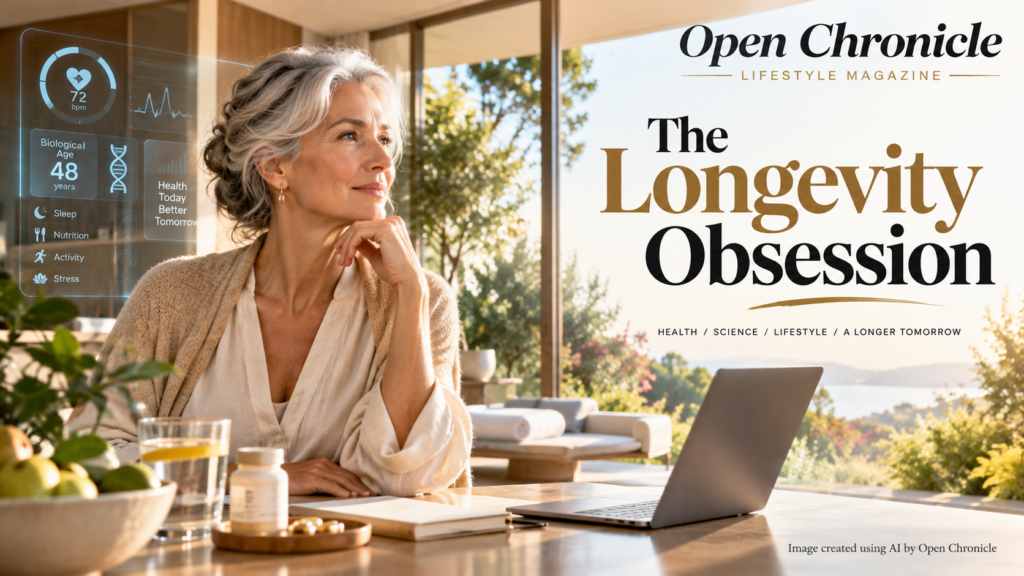
From biological age tests and wearable technology to expensive longevity clinics and the promise of personalised health, growing older is becoming something we are encouraged to measure, manage and optimise. But behind the pursuit of a longer life lies a more complicated question: when does caring for our health become a fear of ageing itself?
By Open Chronicle Lifestyle Magazine
The New Dream of Living Longer
Imagine entering a beautifully designed clinic where the atmosphere resembles a luxury hotel more than a traditional medical practice.
The lighting is soft.
The furniture is minimalist.
The consultation begins not with a particular illness, but with a question.
How old is your body, really?
A specialist may discuss blood biomarkers, metabolic health, sleep patterns and physical performance. A digital dashboard might display estimates of biological age. A personalised programme could promise to help improve the numbers.
Outside the clinic, an entire industry offers products and services associated with longevity.
Smartwatches monitor recovery.
Applications analyse sleep.
Companies sell biological age tests.
Supplements promise cellular support.
Wellness retreats advertise programmes designed around healthy ageing.
Some of these approaches are grounded in established preventive medicine.
Others are experimental.
And some rely on claims that extend well beyond the available scientific evidence.
What unites them is an increasingly powerful cultural idea.
Ageing is no longer presented simply as a natural process to understand and accommodate.
It is increasingly portrayed as something to measure, manage and perhaps delay.
The ambition to live longer is hardly new.
For centuries, human beings have searched for ways to preserve youth and extend life.
What is changing is the combination of modern biotechnology, consumer technology, commercial investment and an expanding wellness economy.
Longevity is becoming both a scientific field and a lifestyle aspiration.
Yet an important distinction risks disappearing in the excitement.
Living longer and living better are related goals, but they are not the same thing.
And the pursuit of one does not automatically guarantee the other.
1. When Ageing Became a Lifestyle Project
For much of modern history, discussions about ageing focused on retirement, healthcare and the challenges associated with later life.
Today, the language has changed.
We hear about optimisation.
Biological age.
Cellular health.
Metabolic flexibility.
Recovery scores.
Healthspan.
Ageing is increasingly discussed using the vocabulary of performance.
The body becomes something to monitor.
Sleep becomes a metric.
Exercise becomes a programme.
Nutrition becomes a strategy.
Even rest can become an activity to optimise.
This approach reflects a broader transformation in wellness culture.
Consumers are no longer interested only in treating illness after it appears.
Many want to understand how everyday habits might influence their future health.
That ambition can be constructive.
Preventive healthcare, physical activity, adequate sleep and healthy eating have substantial evidence behind them.
But the language of optimisation can also encourage the belief that every aspect of ageing is controllable.
It is not.
Genetics, environmental exposures, socioeconomic conditions, chance and access to healthcare all influence how people age.
Healthy behaviours can improve the probability of better outcomes.
They cannot eliminate uncertainty.
A lifestyle focused entirely on avoiding ageing may therefore create expectations that biology cannot fulfil.
2. The Difference Between Lifespan and Healthspan
One of the most useful ideas in longevity research is the distinction between lifespan and healthspan.
Lifespan refers to how long a person lives.
Healthspan generally refers to the period of life spent in relatively good health, although researchers use different definitions and measurement approaches.
The distinction matters.
Living to an advanced age is not necessarily the same as enjoying decades of independence, mobility and wellbeing.
Someone may live longer while experiencing years of significant disability or chronic illness.
Another person may have a shorter life but remain physically and socially active for much of it.
Public health research increasingly emphasises the importance of healthy ageing.
The World Health Organization describes healthy ageing in terms of developing and maintaining the functional ability that enables wellbeing in older age.
This perspective is broader than the absence of disease.
It considers what people are able to do.
Can they move comfortably?
Maintain relationships?
Participate in their communities?
Make decisions about their lives?
Access the support they need?
A meaningful approach to longevity therefore involves more than extending the number of years.
It involves improving the quality and possibilities of those years.
3. The Rise of the Longevity Industry
Longevity has become an increasingly visible part of the wellness economy.
Private clinics, health technology companies, supplement manufacturers and hospitality businesses are developing services aimed at consumers interested in ageing well.
Some offer comprehensive medical assessments.
Others focus on nutrition, fitness or sleep.
More experimental providers may advertise biological age testing, specialised infusions or interventions associated with emerging research.
These services vary enormously in their scientific credibility.
A programme encouraging physical activity, smoking cessation and evidence-based management of cardiovascular risk factors is fundamentally different from a treatment claiming to reverse biological ageing without convincing human clinical evidence.
Yet commercial marketing can place them under the same attractive label.
Longevity.
The word itself carries powerful emotional appeal.
It suggests more time.
More opportunities.
More years with family.
More freedom to enjoy life.
The commercial opportunity is understandable.
But consumers need to distinguish between three very different categories.
Established preventive healthcare.
Promising but still experimental research.
And products or services whose benefits remain inadequately demonstrated.
The existence of scientific research in a particular field does not automatically validate every commercial product associated with it.
4. The Biological Age Question
Chronological age is simple.
It measures the number of years since birth.
Biological age is more complicated.
Researchers use different indicators to estimate aspects of physiological ageing.
Some approaches examine patterns of DNA methylation.
Others use combinations of blood biomarkers, clinical measurements or functional indicators.
These methods may provide valuable information for research.
But biological age is not a single universally agreed measurement.
Different tests can produce different estimates.
Their results may depend on the model used, the population in which it was developed and the biological processes being measured.
An estimate that a person is biologically younger than their chronological age can sound reassuring.
An older estimate may create anxiety.
Yet neither result should automatically be treated as a definitive forecast of individual lifespan.
Researchers continue to investigate how accurately different biological ageing measures predict disease, disability and mortality.
They are also studying whether changes in particular biomarkers reliably correspond to meaningful improvements in health.
For consumers, this distinction is crucial.
A number on a dashboard may be interesting.
It is not necessarily a diagnosis.
Nor does improving that number automatically prove that someone will live longer.
5. The Seduction of Measuring Everything
Wearable technology has made health-related information more accessible than ever.
Many devices can estimate sleep duration, track physical activity and monitor heart rate.
Some offer additional measures such as heart rate variability or estimated recovery.
These tools can help users recognise patterns.
A person may notice that their sleep becomes shorter during stressful periods.
Another may discover that regular walking improves their activity levels.
Someone recovering from illness may find certain trends useful to discuss with a healthcare professional.
But measurements are not the same as understanding.
Consumer devices vary in accuracy.
Algorithms use different assumptions.
Some metrics are estimates rather than direct clinical measurements.
And a change in a number may not always have a clear medical meaning.
There is also a psychological dimension.
When every night produces a sleep score, rest can become another performance evaluation.
A person may wake up feeling refreshed but become concerned because an application reports poor recovery.
Another may repeatedly check health metrics without gaining useful insight.
Technology intended to provide reassurance can sometimes create additional uncertainty.
The value of monitoring depends on whether the information supports sensible decisions.
Not on how many numbers a device can generate.
6. The Science We Already Know
Amid the excitement surrounding experimental longevity interventions, it is easy to overlook the importance of established public health knowledge.
Regular physical activity supports cardiovascular, metabolic and musculoskeletal health.
Avoiding tobacco reduces major health risks.
Adequate sleep contributes to health and functioning.
Nutritious dietary patterns can support long-term wellbeing.
Managing blood pressure, cholesterol and other clinically relevant risk factors can reduce the likelihood of certain diseases.
Vaccination and appropriate preventive healthcare also matter.
These approaches are not glamorous.
They do not promise biological transformation overnight.
They rarely generate the excitement associated with futuristic treatments.
But they have a far stronger evidence base than many products marketed as longevity breakthroughs.
This does not mean lifestyle habits can prevent every illness.
Nor does it mean everyone has equal control over their health.
Work conditions, income, housing, environmental exposure, disability and access to healthcare can profoundly affect people’s options.
Nevertheless, the scientific foundations of healthy ageing remain remarkably practical.
Movement.
Nutrition.
Sleep.
Prevention.
Social participation.
The challenge is often not discovering another extraordinary intervention.
It is making established health-promoting conditions accessible and sustainable.
7. The Supplement Promise
The longevity market includes a growing range of dietary supplements.
Products may be advertised as supporting cellular energy, mitochondrial function, metabolism or healthy ageing.
Some contain substances investigated in laboratory or animal studies.
Others are marketed using broad claims about antioxidants or inflammation.
Scientific interest in a biological pathway does not necessarily establish that a supplement improves human longevity.
Evidence from cells or animals may not translate into meaningful benefits for people.
Small clinical studies may identify changes in biomarkers without demonstrating reduced disease or longer life.
The quality, dosage and safety of products can also vary.
Supplements may interact with medications or be inappropriate for certain health conditions.
This is particularly important because the language of longevity can make products appear more medically established than they are.
A consumer may interpret the phrase scientifically researched as proof of effectiveness.
But research can mean many things.
A substance may have been investigated without showing a clinically meaningful benefit.
The responsible question is not simply whether a product has been studied.
It is whether high-quality human evidence demonstrates that it produces the specific benefit being claimed, with an acceptable safety profile.
8. The Billionaire Version of Ageing
Longevity culture has acquired a distinctive public image.
Highly resourced individuals may pursue elaborate health routines involving frequent testing, specialised diets, exercise programmes and expensive interventions.
Their experiences attract attention because they appear to offer a glimpse of the future.
A life organised around measurement.
Personalised medicine.
Continuous monitoring.
And the possibility of extending healthy years.
But these examples raise questions about accessibility and evidence.
A programme that requires substantial financial resources, specialised professionals and extensive free time cannot easily become a universal model for healthy ageing.
Nor does an individual’s improved biomarker profile demonstrate that an entire programme is effective.
Personal experiences can be interesting.
They are not substitutes for controlled research.
There is also a cultural danger in treating exceptional wealth as evidence of exceptional health wisdom.
Money can purchase access to services.
It cannot purchase certainty about ageing.
A sophisticated programme may include useful preventive care alongside interventions whose benefits remain uncertain.
The distinction between the two deserves more attention than the spectacle surrounding them.
9. The Inequality of Living Longer
Longevity is often discussed as though everyone has the same opportunity to pursue it.
Reality is considerably more complicated.
Life expectancy and healthy life expectancy differ between populations.
Income, education, employment conditions, healthcare access and environmental factors influence health outcomes.
People living in insecure housing or working physically demanding jobs may face challenges that cannot be solved through a personalised wellness subscription.
Someone caring for relatives may struggle to find time for exercise.
A worker with irregular shifts may find consistent sleep difficult.
A person living in an area with limited healthcare access may face delays in preventive treatment.
These are not simply failures of individual discipline.
They reflect structural conditions.
An equitable approach to longevity must therefore include public health, accessible healthcare and supportive communities.
It cannot depend exclusively on expensive technologies.
The most important longevity intervention for a population may sometimes be a better healthcare system, safer working conditions or improved access to nutritious food.
Such measures may lack the glamour of experimental biotechnology.
But their social significance can be substantial.
10. When Wellness Becomes Anxiety
The pursuit of health can become emotionally complicated.
A person begins monitoring sleep to improve wellbeing.
Soon, every poor night feels like a failure.
They start exercising to feel stronger.
Eventually, missing a workout produces guilt.
They become interested in nutrition.
Gradually, ordinary meals become sources of concern.
The problem is not the original desire to be healthy.
It is the transformation of health into a constant performance obligation.
Longevity culture can intensify this pressure by presenting ageing as something individuals should continually resist.
Every choice appears to carry consequences for the future.
Every indulgence becomes a potential mistake.
Every biomarker becomes a judgement.
This can create an exhausting relationship with the body.
Healthy living should ideally support life rather than dominate it.
There is room for pleasure.
For flexibility.
For imperfect routines.
For meals shared without calculations.
For evenings spent relaxing rather than optimising recovery.
A longer life has limited appeal if the pursuit of longevity makes everyday life unnecessarily anxious.
11. The Fear Behind the Promise
Why does longevity attract so much attention?
Part of the answer is practical.
People want to remain healthy.
They hope to avoid serious illness.
They want more time with those they love.
But the appeal also reflects deeper fears.
Ageing can involve uncertainty.
Changes in appearance.
Physical limitations.
Loss of independence.
The possibility of illness.
And ultimately, mortality.
Modern consumer culture often struggles to accommodate these realities.
Youth is frequently associated with beauty, opportunity and relevance.
Ageing may be presented as something to conceal or correct.
Longevity marketing can exploit these anxieties, even when it presents itself through scientific language.
The message becomes subtle but powerful.
If you monitor enough.
Spend enough.
Optimise enough.
Perhaps you can remain young.
Yet ageing is not a personal failure.
It is a universal biological process, although its course varies widely.
The challenge is learning how to support health without turning the passage of time into an enemy.
12. The Difference Between Prevention and Control
Preventive medicine seeks to reduce risk and improve health outcomes.
It does not promise complete control over the future.
This distinction is fundamental.
A person can follow sensible health recommendations and still develop illness.
Another may experience good health despite behaviours that increase statistical risk.
Individual outcomes involve probability, not certainty.
Longevity marketing sometimes blurs this distinction.
It may imply that sufficient knowledge and discipline can eliminate the unpredictability of ageing.
Such promises can create unrealistic expectations.
They can also encourage blame.
If health becomes entirely a matter of optimisation, illness may be interpreted as evidence that someone failed to make the correct choices.
That conclusion is neither scientifically justified nor humane.
Personal behaviour matters.
But it operates within a much larger biological and social context.
Responsible longevity advice should communicate both the benefits of prevention and the limits of individual control.
13. The Future of Longevity Science
The scientific study of ageing is a legitimate and rapidly developing field.
Researchers are investigating cellular senescence, metabolic pathways, inflammation, genetic regulation and other biological processes associated with ageing.
Some experimental approaches aim to understand whether modifying these processes could improve health outcomes.
There is also interest in identifying biomarkers that may help evaluate biological ageing and responses to interventions.
This research could contribute to important medical advances.
But the path from laboratory discovery to safe and effective treatment is demanding.
An intervention that produces promising results in animals may fail in human trials.
A biological mechanism may prove more complex than initially expected.
A treatment may improve one outcome while creating unacceptable risks elsewhere.
Long-term effects can take years to evaluate.
For these reasons, claims about reversing ageing or dramatically extending human lifespan require particular caution.
The science deserves attention.
But scientific curiosity should not be confused with commercial certainty.
The most responsible position is neither dismissing emerging research nor treating every discovery as an imminent breakthrough.
It is following the evidence as it develops.
14. What Does It Mean to Age Well?
A meaningful conversation about longevity should include more than biology.
Consider two different visions of later life.
In the first, a person has excellent health metrics but feels isolated, anxious and disconnected from everyday pleasures.
In the second, someone lives with manageable health limitations but maintains friendships, interests, independence and a strong sense of purpose.
Neither situation can be reduced to a single measure of success.
Health matters enormously.
But so do relationships.
Autonomy.
Dignity.
Participation.
Enjoyment.
The World Health Organization’s framework for healthy ageing recognises the importance of functional ability and supportive environments.
This broader perspective challenges the idea that successful ageing means preserving the body of a younger person.
Instead, it asks whether individuals can continue doing what matters to them.
That may mean walking independently.
Travelling.
Gardening.
Caring for grandchildren.
Creating art.
Learning something new.
Or simply maintaining meaningful relationships.
The purpose of longevity should be to expand life’s possibilities.
Not to impose a single ideal of youthfulness.
15. The Forgotten Importance of Human Connection
Longevity conversations often focus on biological measurements.
Blood markers.
Sleep scores.
Fitness levels.
Metabolic indicators.
But health also has a social dimension.
Relationships can influence emotional wellbeing, practical support and opportunities for participation.
Social isolation and loneliness are recognised public health concerns.
Maintaining meaningful connections may become especially important as circumstances change with age.
Retirement can alter daily routines.
Family members may move away.
Mobility limitations can reduce opportunities for social interaction.
Communities that provide accessible public spaces, transport and social activities can help people remain engaged.
This perspective offers a different understanding of longevity.
A healthy life is not simply a body that functions efficiently.
It is also a life connected to other people.
A medical test cannot fully measure the pleasure of a familiar conversation.
A wearable device cannot capture the emotional value of friendship.
Technology may support wellbeing.
But it cannot replace every human dimension of it.
16. The Business of Hope
Longevity is an unusually powerful commercial proposition because it offers something people cannot easily dismiss.
The possibility of more time.
More time with family.
More time to travel.
More time to pursue ambitions.
More time to experience life.
This emotional appeal creates opportunities for responsible innovation.
It also creates opportunities for exaggerated claims.
Consumers may be willing to pay substantial amounts for interventions whose benefits remain uncertain.
Scientific terminology can make products appear credible.
Sophisticated branding can suggest medical authority.
Testimonials can create impressions that controlled studies have not established.
The challenge is separating hope from evidence.
A responsible longevity industry should communicate uncertainty.
Explain limitations.
Avoid implying that experimental interventions are proven.
And distinguish medical services from lifestyle products.
Consumers deserve to know not only what a treatment claims to do, but also what research has actually demonstrated.
Hope can motivate progress.
It should not become a substitute for proof.
17. A Healthier Way to Think About Longevity
Perhaps the most useful response to the longevity movement is to reclaim its original purpose.
Not eternal youth.
Not perfect biomarkers.
Not a life organised around constant measurement.
But more years of meaningful activity, where possible.
That means paying attention to established health recommendations.
Seeking appropriate preventive care.
Maintaining physical activity in ways suited to individual circumstances.
Valuing sleep and nutrition without turning them into sources of obsession.
Preserving relationships.
Remaining curious.
And recognising that ageing involves adaptation as well as prevention.
It also means accepting that health is not entirely within personal control.
People should not be judged according to their biological age scores, physical appearance or ability to purchase wellness services.
The pursuit of longevity should make life more accessible and enjoyable.
Not more exclusive or demanding.
The question is not how to eliminate every sign of ageing.
It is how to create conditions in which more people can experience later life with dignity, health and opportunity.
18. The Years That Matter
Imagine two people celebrating their eightieth birthdays.
One has spent decades carefully monitoring health metrics, following elaborate routines and pursuing the latest longevity interventions.
The other has approached health more conventionally, combining medical care and everyday habits with family, friendships and personal interests.
Neither person’s experience tells us which approach produces better outcomes.
Individual stories cannot establish scientific effectiveness.
But the comparison invites a different question.
What are we ultimately trying to preserve?
Is it youth?
Physical performance?
A particular biological measurement?
Or the ability to continue participating in life?
Perhaps the greatest promise of longevity research is not that it might allow us to escape ageing.
It is that it could help more people remain healthy, independent and engaged for longer.
That would be a profound achievement.
But it should not require us to treat growing older as a problem that must always be corrected.
Ageing brings challenges.
It can also bring experience, perspective, relationships and forms of fulfilment that cannot be measured by a laboratory test.
The future of longevity will undoubtedly involve new technologies and scientific discoveries.
Some may prove transformative.
Others will disappoint.
But the meaning of a good life will remain larger than the technologies used to extend it.
The real ambition should not be to spend our lives trying to avoid becoming old.
It should be to make the years we are given worth living.
Longevity should be measured not only by the years we add to life, but by the life we are able to bring to those years.
Research context: Why longevity matters in 2026
Global wellness economy
in 2025
Personalised medicine segment
in 2025
Longevity clinics analysed
in a 2026 international survey
Sources: Global Wellness Institute, Global Wellness Economy Monitor 2026, published 11 November 2026; International Institute of Longevity, May 2026. The wellness economy and personalised medicine are broader markets than longevity treatments alone. The clinic survey is not a census of the industry.
O dado mais interessante é a tensão entre duas tendências identificadas pelo Global Wellness Summit em 2026: o crescimento das clínicas e tecnologias de longevidade e, simultaneamente, uma reação contra a monitorização excessiva e a transformação do bem-estar numa obrigação permanente.
Sources and Further Reading
The following international public health resources, research reports and industry analyses provide the background for this article, examining healthy ageing, longevity science, preventive healthcare, emerging wellness technologies and the importance of social connection in later life.
Healthy Ageing and Functional Ability
World Health Organization | 26 October 2020
The WHO’s framework for understanding healthy ageing through functional ability, supportive environments, independence and participation rather than merely the absence of disease.
Global Wellness Economy Monitor 2026
Global Wellness Institute | 11 November 2026
Research examining the global wellness market, preventive health, personalised medicine and the commercial growth of services associated with healthy ageing.
Global Survey on Health, Wellness and Longevity Clinics
International Institute of Longevity | 20 May 2026
Research based on 22 longevity clinics and a wider sample of organisations, examining the gap between rapid commercial adoption, validated measurement and clinical evidence.
The Future of Wellness: 2026 Trends
Global Wellness Summit | 27 January 2026
An industry trends report exploring the expansion of longevity services, diagnostic technologies and wearables alongside a growing interest in less technologically intensive approaches to wellbeing.
From Loneliness to Social Connection: Charting a Path to Healthier Societies
World Health Organization | 30 June 2025
An international report examining the health and social consequences of loneliness and isolation, reinforcing the importance of relationships and community participation.
EDITORIAL TRANSPARENCY
This article combines international public health guidance, longevity industry research, wellness trend analysis and original lifestyle commentary. It distinguishes established preventive healthcare from experimental longevity interventions and commercial claims that may lack sufficient human clinical evidence. Biological age estimates, wearable metrics and emerging treatments are discussed as evolving areas of research rather than validated methods for predicting or extending an individual’s lifespan. The article does not imply that ageing can be prevented, that expensive longevity services are necessary for good health or that individual behaviour determines all health outcomes. Illustrative scenarios are fictional and are not presented as documented clinical cases. The discussion recognises socioeconomic inequalities, individual circumstances and the importance of professional medical guidance.
Discover More Lifestyle Stories
Explore inspiring stories about contemporary living, remarkable people, travel, style, wellbeing and the experiences that shape our everyday lives.
← Back to Open Chronicle Lifestyle