
OPEN CHRONICLE | GLOBAL NEWS DESK | GEOPOLITICS & WORLD ORDER
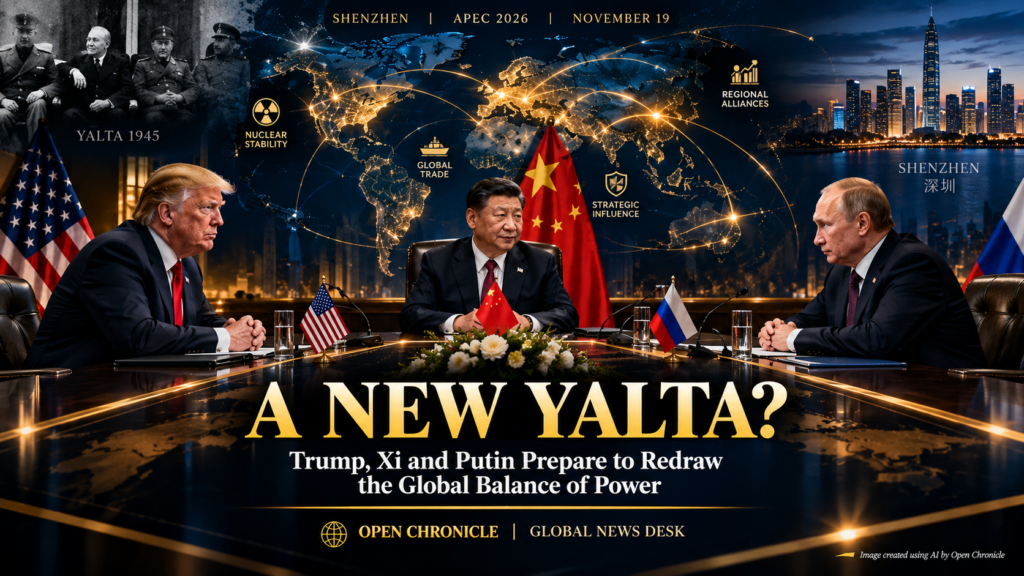
An unprecedented meeting between the leaders of the United States, China and Russia is planned for November 19 in Shenzhen. Nuclear weapons, Iran and the future of global power are at the center of the diplomatic agenda. But with Ukraine excluded from the formal discussions and Beijing resisting a three-way arms agreement, the summit is already raising a fundamental question: are the world’s major powers preparing to negotiate a new international order?
By Open Chronicle News Desk
November 14, 2026 | Special Report | Global Geopolitics
Verification update | November 14, 2026
The White House and Kremlin have announced plans for a trilateral meeting in Shenzhen on November 19. However, Reuters reported on November 14 that the detailed agenda and format were still being negotiated. The meeting has not taken place, and no nuclear or geopolitical agreement has been reached.
1. Three Presidents, One Table and a World Watching
For the first time, the leaders of the United States, China and Russia are preparing to sit together in a diplomatic format that could become one of the defining images of the decade.
Donald Trump, Xi Jinping and Vladimir Putin are expected to meet in Shenzhen, southern China, on November 19, during the Asia-Pacific Economic Cooperation summit.
The proposed gathering is extraordinary not simply because of the personalities involved, but because of what their countries represent.
Together, Washington, Beijing and Moscow possess enormous military, economic and technological influence. Their decisions affect international trade, energy markets, nuclear deterrence, global institutions and the security of countries thousands of kilometers beyond their borders.
Yet the three leaders are not entering the discussions with a common vision.
Trump wants to demonstrate that Washington can negotiate directly with its principal strategic competitors. Putin seeks recognition of Russia’s status as a decisive global power. Xi wants to strengthen China’s international position without accepting obligations that could constrain Beijing’s long-term ambitions.
The meeting therefore presents a paradox.
It could open a new channel for strategic dialogue at a moment of exceptional international instability. It could also reinforce fears that the strongest states are increasingly willing to discuss the security of others without those countries participating.
That tension explains why comparisons with the historic Yalta Conference of 1945 have emerged even before the leaders have gathered.
2. Why the World Is Talking About a New Yalta
In February 1945, Franklin D. Roosevelt, Winston Churchill and Joseph Stalin met at Yalta as the Second World War approached its conclusion.
The American, British and Soviet leaders negotiated arrangements concerning postwar Europe, Germany, the United Nations and the political future of territories liberated or occupied during the conflict.
Yalta did not single-handedly divide Europe into the blocs that subsequently emerged during the Cold War. Nevertheless, the conference became a powerful symbol of great-power diplomacy, particularly the idea that decisions affecting smaller countries could be shaped by negotiations among stronger states.
More than eight decades later, the symbolism has returned.
The international environment is fundamentally different. China now occupies a central position in the global economy, Russia is fighting a war in Ukraine, and the United States faces strategic competition across several continents.
There is no defeated Germany awaiting occupation arrangements, and the international institutions created after 1945 remain in existence.
But the underlying concern is recognizable.
Can major powers negotiate arrangements that fundamentally affect other countries without giving those countries an equal voice?
For Ukraine, this question is immediate. For European governments, it concerns the future of continental security. For Asian countries, it raises fears about the consequences of US-China bargaining over regional influence.
The comparison with Yalta is therefore politically significant, even if it should not be treated as evidence that a new division of the world has already been agreed.
3. Trump’s Objective: Nuclear Diplomacy and a Presidential Legacy
The White House has identified nuclear arms control as a principal subject of the proposed summit.
The timing is important.
The New Strategic Arms Reduction Treaty, commonly known as New START, expired in February 2026. Its expiration removed the last major bilateral treaty limits on the strategic nuclear arsenals of the United States and Russia.
Washington has argued that a modern arms control arrangement should include China, whose nuclear capabilities have expanded substantially.
For Trump, the attraction of such an agreement is clear.
A successful three-way framework could be presented as a historic diplomatic achievement, potentially establishing new constraints on the world’s most consequential nuclear competitors.
It would also reinforce the administration’s preference for direct negotiations between national leaders.
But the obstacles are considerable.
The United States and Russia possess much larger nuclear arsenals than China. Beijing has consistently argued that it would be unreasonable to impose equivalent restrictions on countries with dramatically different capabilities.
Moreover, nuclear arms control is not simply a matter of agreeing to reduce a headline number of warheads.
A credible treaty requires detailed definitions, verification mechanisms, transparency arrangements, rules governing delivery systems and procedures for addressing suspected violations.
Even the preliminary task of deciding what should be negotiated could prove difficult.
American officials have acknowledged that no immediate agreement is expected.
The summit may therefore be better understood as a potential opening conversation rather than the final stage of a diplomatic breakthrough.
4. Putin’s Objective: Recognition, Ukraine and Strategic Influence
For Vladimir Putin, participation in the trilateral meeting offers a diplomatic advantage even before any substantive agreement emerges.
Russia’s war in Ukraine has produced deep confrontation with European governments and much of the Western alliance.
A high-profile meeting with the American and Chinese presidents would nevertheless place Moscow at the center of a major international diplomatic event.
That visibility matters.
The Kremlin has repeatedly sought to present Russia as an indispensable power whose security interests cannot be ignored.
A meeting with Trump and Xi would reinforce that message domestically and internationally.
The greater question concerns Ukraine.
Moscow has continued to demand arrangements that would protect what it describes as Russian security interests, including restrictions affecting NATO and the European security order.
Ukraine, by contrast, insists that any settlement must respect its sovereignty and provide credible protection against renewed aggression.
A summit that gives Russia a prominent diplomatic platform while leaving Ukraine outside the room could intensify concerns in Kyiv.
However, the White House has indicated that Ukraine is not expected to be part of the formal trilateral agenda, with negotiations involving Kyiv and Moscow proceeding through a separate diplomatic channel.
That distinction is crucial.
There is currently no verified agreement under which Trump, Xi and Putin would determine Ukraine’s territorial future.
Nevertheless, the symbolism of their meeting could influence political expectations surrounding the war.
5. Xi Jinping’s Dilemma: Prestige Without Unwanted Commitments
For China, hosting the gathering offers both an opportunity and a risk.
Shenzhen represents the extraordinary transformation of the Chinese economy.
Once a relatively small coastal settlement, the city became a major center of manufacturing, international trade, advanced technology and innovation.
Hosting the leaders of the United States and Russia in such a setting would reinforce Beijing’s image as a central diplomatic and economic power.
Xi could also use the summit to demonstrate that China is capable of engaging directly with Washington while maintaining its strategic relationship with Moscow.
But Beijing has reasons to be cautious.
First, China does not want to enter a nuclear arms control framework that treats its arsenal as equivalent to those of the United States and Russia.
Second, Beijing has sought to portray itself as a defender of multilateral diplomacy and the interests of developing countries.
A summit interpreted as three powerful states deciding the future of smaller nations could undermine that message.
Third, China’s economic relationship with the United States remains too important to subordinate entirely to its partnership with Russia.
Beijing must balance competition, commercial interdependence and strategic cooperation without becoming trapped in commitments that limit its options.
Xi’s preferred outcome may therefore be a carefully managed diplomatic event that strengthens China’s prestige while avoiding major concessions.
6. The Nuclear Question: Three Arsenals, Very Different Realities
The asymmetry behind the negotiations
Illustrative estimates reported in November 2026, including total inventories rather than deployed strategic weapons alone.
Approximate figures from contemporary reporting. Inventory definitions and estimates vary by source.
Russia and the United States each possess approximately 5,000 nuclear warheads according to the rounded estimates used in this illustration, while China’s arsenal is represented at approximately 600. These figures are simplified for visual comparison and should not be interpreted as exact inventory totals or deployed strategic warheads.
The differences in nuclear capabilities are among the most significant barriers to a trilateral agreement.
Washington and Moscow possess vast arsenals developed over decades of strategic competition.
China has a smaller but expanding nuclear force.
Beijing argues that the countries with the largest arsenals should undertake the greatest reductions before expecting China to accept equivalent constraints.
The United States, meanwhile, is concerned that a purely bilateral framework could become increasingly inadequate as China’s capabilities grow.
Russia has its own strategic calculations, including the relationship between nuclear deterrence, conventional military power and NATO.
A successful negotiation would need to reconcile these competing positions.
There is also a broader challenge.
Modern strategic competition increasingly involves missile defense, hypersonic weapons, cyber capabilities, space infrastructure and artificial intelligence.
Future arms control agreements may need to address technologies that were far less prominent when earlier nuclear treaties were negotiated.
This makes the diplomatic challenge considerably more complex than simply reproducing the structures of the Cold War.
7. Iran: The Conflict That Could Dominate the Agenda
The White House has indicated that Iran will be discussed during the summit.
The conflict involving the United States, Israel and Iran has generated serious regional instability, with consequences for energy markets, maritime security and relations among major powers.
The Strait of Hormuz has become a particular concern because of its importance to international oil and gas shipments.
For Washington, diplomatic engagement with Moscow and Beijing could potentially contribute to efforts to reduce tensions.
But Russia and China maintain their own relationships with Tehran.
Neither government necessarily shares Washington’s preferred political or security outcome.
Beijing has significant economic interests in regional stability and reliable energy supplies.
Moscow may see opportunities to strengthen its diplomatic influence while challenging American policy.
Consequently, any discussion of Iran is likely to expose important differences among the three leaders.
A common statement supporting stability would be easier to achieve than a detailed agreement on sanctions, military operations or Iran’s nuclear program.
8. Ukraine and Europe: The Countries Outside the Room
For European governments, the proposed summit raises a central concern: the future of European security cannot be determined solely by Washington, Moscow and Beijing.
The war in Ukraine has fundamentally changed the continent’s strategic priorities.
European countries have increased defense spending, strengthened cooperation within NATO and expanded military assistance to Kyiv.
At the same time, they remain dependent on the United States for important elements of deterrence, intelligence and military capability.
A diplomatic process dominated by the world’s largest powers could leave European governments struggling to influence decisions that directly affect them.
Ukraine faces an even more immediate challenge.
President Volodymyr Zelenskyy has warned against a return to arrangements resembling Yalta, where the political future of countries could be negotiated without their consent.
The concern is not simply symbolic.
A settlement involving territory, security guarantees, sanctions or NATO’s future posture would have long-term consequences for Ukraine’s independence and Europe’s security architecture.
Yet the existence of a trilateral summit does not establish that such a settlement is being negotiated within that forum.
The distinction between diplomatic symbolism and actual agreements must remain central to any assessment.
9. The US-China Economic Rivalry Cannot Be Separated From Diplomacy
Although nuclear weapons and Iran are expected to dominate the official discussions, the broader relationship between Washington and Beijing will remain essential.
The United States and China are engaged in strategic competition involving trade, semiconductors, artificial intelligence, industrial production and critical raw materials.
Both countries also have powerful reasons to prevent a complete breakdown in economic relations.
American businesses remain exposed to Chinese manufacturing and supply chains.
China depends on international markets, advanced technology and stable commercial relationships to support its economic development.
The summit could therefore provide a political setting for reducing tensions, even if detailed economic negotiations take place separately.
However, the structural competition between the two countries is unlikely to disappear.
Technology restrictions, national security concerns and industrial policy disputes are not easily resolved through a single meeting.
The question is whether the leaders can establish boundaries that prevent competition from escalating into broader confrontation.
10. Is the World Moving Toward Spheres of Influence?
The phrase spheres of influence describes an international arrangement in which powerful states claim privileged authority or influence over particular geographic regions.
Historically, such arrangements have often limited the freedom of smaller countries to determine their own political and security relationships.
The concern surrounding Shenzhen is that direct negotiations among the three major powers could normalize this approach.
Russia has sought recognition of its security interests across the former Soviet space.
China insists on its sovereignty claims regarding Taiwan and maintains significant strategic interests in East Asia.
The United States has emphasized its own national security priorities across the Western Hemisphere and other regions.
These positions are not identical, and the three countries do not necessarily recognize one another’s claims.
Nevertheless, a diplomatic framework centered primarily on their competing interests could place pressure on smaller states.
The consequences would extend beyond Ukraine.
Taiwan, Japan, South Korea, European NATO members and countries in the Middle East would all have reasons to examine the implications.
But a world divided into three clearly defined blocs is not an inevitable outcome.
Other powers, including India, the European Union and influential regional states, retain significant economic and diplomatic autonomy.
The international system is more interconnected and institutionally complex than the world of 1945.
The danger is therefore not necessarily a formal agreement to divide the planet.
It is the gradual normalization of diplomacy in which the preferences of powerful countries outweigh the sovereignty and interests of others.
11. Three Leaders, Three Different Definitions of Success
Three Leaders, Three Strategic Agendas
Washington, Beijing and Moscow approach the proposed trilateral summit with different strategic priorities, competing interests and significant diplomatic obstacles.

Donald Trump
Open negotiations on a broader nuclear arms control framework and demonstrate American diplomatic leadership.
China is reluctant to accept restrictions comparable to those affecting much larger American and Russian arsenals.

Xi Jinping
Reinforce China’s international status while preserving flexibility on nuclear policy, trade and strategic relationships.
Avoiding commitments that weaken Beijing’s negotiating position or undermine its multilateral diplomatic message.

Vladimir Putin
Secure recognition of Russia’s strategic importance and strengthen Moscow’s influence over international security discussions.
Fundamental disagreements over Ukraine, NATO and the legitimacy of Russia’s territorial demands.
These assessments summarize the principal strategic objectives and diplomatic obstacles associated with the proposed trilateral summit. They are editorial interpretations based on publicly reported positions, not official negotiating documents. The meeting’s final format, agenda and outcomes remain subject to confirmation.
The leaders may therefore emerge from the summit claiming different achievements.
Trump could emphasize the opening of a new nuclear dialogue.
Xi could present the gathering as evidence of China’s central role in global diplomacy.
Putin could portray his participation as confirmation that Russia remains an indispensable strategic power.
None of these outcomes would necessarily require a substantive agreement.
That is precisely why the political symbolism of the meeting could prove as important as its formal conclusions.
12. What Could Actually Emerge From Shenzhen?
Several outcomes are plausible.
The most modest would be a joint statement supporting continued dialogue on nuclear risk reduction and international security.
A more ambitious result could involve the creation of working groups to explore future arms control negotiations.
The leaders might also agree to maintain direct communication channels during periods of international crisis.
Such measures would be meaningful, particularly after the expiration of New START.
But they would fall far short of a comprehensive geopolitical settlement.
A detailed nuclear treaty would require extensive technical negotiations and verification arrangements.
An agreement concerning Ukraine would require the participation and consent of Ukraine itself.
Any lasting settlement involving Iran would depend on actors and circumstances far beyond the three leaders meeting in Shenzhen.
The most realistic expectation is therefore a diplomatic opening rather than a historic final agreement.
13. What to Watch on November 19
The most important indicators will not be the photographs or ceremonial statements, but the substance of what the governments announce.
First, whether the three leaders formally agree to begin structured nuclear arms control negotiations.
Second, whether China accepts any specific role in a future framework or continues to insist that Washington and Moscow should reduce their larger arsenals first.
Third, whether Iran produces a concrete diplomatic initiative or only general expressions of concern.
Fourth, whether Ukraine remains outside the formal agenda, as American officials have indicated.
Fifth, whether the summit produces mechanisms for continued negotiations rather than a single high-profile encounter.
Finally, the reactions of European governments and Asian allies will reveal whether the meeting reassures other countries or deepens fears about great-power bargaining.
These responses may be just as important as the summit’s official communiqué.
Conclusion | A New Yalta, or a New Diplomatic Opening?
The planned meeting between Donald Trump, Xi Jinping and Vladimir Putin could become a defining moment in contemporary diplomacy.
It brings together three leaders whose decisions influence nuclear security, global commerce, regional conflicts and the future of international institutions.
Yet the summit’s historical significance should not be confused with evidence of a predetermined outcome.
The leaders have different priorities, incompatible interests and limited room for immediate compromise.
The comparison with Yalta captures an understandable anxiety about the return of great-power politics.
But the world of 2026 is not the world of 1945.
Countries excluded from the proposed trilateral meeting still possess political agency, economic influence and international rights.
The crucial test will be whether Shenzhen strengthens diplomacy without undermining the principle that states should determine their own future.
If the summit opens credible negotiations on nuclear risk and regional stability, it could represent a constructive diplomatic turning point. If it becomes a platform for negotiating influence over others, it may deepen the divisions it was intended to manage.
The world will be watching not only what the three presidents say, but also whose interests they choose to recognize.
Sources and Further Reading
Selected international reporting, strategic research and historical resources examining the proposed Shenzhen summit, nuclear arms control and the future of global power.
A New Yalta? Trump and Putin Push for a Meeting That Xi Is Wary of Hosting
Reporting on the competing objectives of Washington, Beijing and Moscow, diplomatic preparations, and concerns about great-power negotiations.
Trump, Xi and Putin Plan Unprecedented Joint Meeting
Coverage of the announced meeting in Shenzhen, American diplomatic objectives and expectations concerning nuclear weapons and Iran.
Trump to Discuss Iran, Nuclear Arms With Putin and Xi
Analysis of the expected summit agenda, New START’s expiration, China’s nuclear position and the diplomatic obstacles facing a trilateral agreement.
SIPRI Yearbook 2026: World Nuclear Forces
Independent estimates of global nuclear inventories, modernization programs and the risks created by weakening arms control arrangements.
Status of World Nuclear Forces
Comparative estimates of deployed warheads, military stockpiles and total nuclear inventories for the United States, Russia, China and other nuclear-armed countries.
Yalta Became a Byword for Betrayal. Will Trump, Xi and Putin Enact Another Carve-up?
Historical and geopolitical analysis examining the comparison with the 1945 Yalta Conference and the implications for smaller states.
This article was prepared using reporting and research available on November 14, 2026. The White House and Kremlin have announced plans for a trilateral meeting on November 19, but Reuters reported that the detailed agenda and format remained under negotiation. No summit outcome or agreement is presented as an established fact. Historical comparisons with the 1945 Yalta Conference are analytical interpretations rather than evidence of a negotiated division of international influence. Nuclear inventory estimates are approximate and distinguish total inventories from operational military stockpiles.