
OPEN CHRONICLE | GLOBAL NEWS DESK | EUROPE & UNITED STATES | BREAKING NEWS
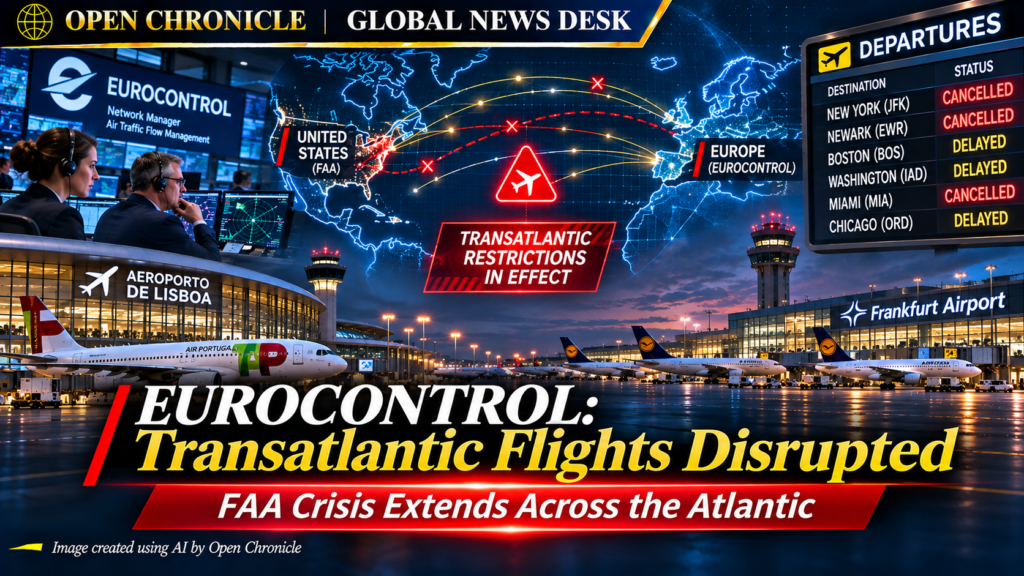
European air traffic coordination has reportedly extended the impact of America’s nationwide aviation shutdown to flights departing Europe for the United States. The restrictions, attributed to a request from the Federal Aviation Administration, threaten transatlantic schedules as airlines confront cancellations, delays and uncertainty over the restoration of normal operations.
By Open Chronicle News Desk
November 13, 2026 | Breaking News & Analysis
Verification status: The FAA’s nationwide ground stop is independently confirmed. A EUROCONTROL restriction on flights from European airspace to the United States has been reported through an operational notice shared by aviation observers, but its precise scope and duration have not yet been independently confirmed in a directly accessible EUROCONTROL bulletin.
Introduction | America’s aviation shutdown reaches Europe
The aviation crisis unfolding across the United States has entered a new international phase, with reports that EUROCONTROL has suspended departures from European airspace bound for American airports following a request from the Federal Aviation Administration.
The development represents a significant escalation in the operational consequences of the nationwide communications failure affecting American air traffic control.
The FAA ordered departing aircraft across the United States to remain on the ground on Friday, November 13, citing exceptional safety circumstances after serious communications problems disrupted regional air traffic control operations.
The agency also indicated that international arrivals would be managed individually, rather than automatically treating every aircraft already crossing the Atlantic as subject to the same restrictions.
Reuters confirmed the American ground stop and the exceptional arrangements for international arrivals.
Reports subsequently circulated of an operational restriction affecting flights from the European Civil Aviation Conference area to the United States, attributed to an FAA request and associated with EUROCONTROL’s Network Manager.
The reported notice was linked by aviation observers to EUROCONTROL’s Network Operations Portal. However, the full operational message was not independently retrievable through the publicly accessible material reviewed for this article.
If confirmed in the terms reported, the restriction would mean that the United States’ domestic air traffic control emergency is now directly influencing departure decisions at European airports.
The implications extend to airlines, passengers, airport operators and the broader transatlantic aviation network.
1. What EUROCONTROL’s reported intervention means
EUROCONTROL is a central organization in European air traffic management.
Through its Network Manager function, it coordinates air traffic flows and helps manage capacity across a complex network of national airspaces.
Its role is particularly important when disruptions in one region require adjustments elsewhere.
A reported restriction on flights from Europe to the United States would therefore be an operational coordination measure rather than evidence that EUROCONTROL had independently discovered a new safety problem within European airspace.
The distinction matters.
The FAA is responsible for American air traffic control, while EUROCONTROL helps coordinate European network operations.
When American airspace cannot accommodate normal traffic flows, European authorities and airlines may need to prevent additional aircraft from departing toward affected destinations.
This can reduce the risk of aircraft arriving at airports unable to receive them under normal operating conditions.
It can also limit the possibility of aircraft requiring diversion after spending several hours crossing the Atlantic.
However, the exact categories of flights affected, any exemptions and the duration of the reported European restriction remain subject to official clarification.
2. Why the FAA requested international coordination
The underlying crisis began with serious communications problems affecting American air traffic control facilities.
Transportation Secretary Sean Duffy said the disruption involved the country’s 22 regional air traffic control centers, which manage aircraft traveling between airports.
These centers are essential to coordinating movements across the United States.
A nationwide ground stop prevents additional departing aircraft from entering the system while controllers and technical teams work to maintain safe operations.
But American aviation does not operate in isolation.
Every day, aircraft arrive from Europe, Canada, Latin America, Asia and other regions.
Even if domestic departures are suspended, international aircraft already airborne may continue approaching American airports.
This creates a complex operational challenge.
Airlines and air traffic authorities must determine which aircraft can safely continue, which departures should be postponed and how airport capacity can be managed.
Restricting some overseas departures before aircraft begin long flights can be a practical way of reducing pressure on the destination network.
It does not necessarily mean that American airspace has been closed to every international aircraft.
The FAA’s initial guidance explicitly allowed international arrivals to be considered individually.
3. European airports face potential transatlantic disruption
A restriction affecting flights to the United States could have consequences across major European aviation hubs.
London Heathrow, Paris Charles de Gaulle, Frankfurt, Amsterdam Schiphol, Madrid Barajas, Dublin and Lisbon are among the airports with substantial transatlantic connections.
These airports support complex airline schedules involving direct flights, connecting passengers and aircraft rotations.
When an American destination becomes temporarily unavailable or subject to restrictions, the consequences can extend across an airline’s wider network.
An aircraft delayed in Europe may subsequently be unavailable for another service.
Passengers arriving from other European cities may miss onward connections.
Flight crews can approach regulatory duty limits.
Airport gates may remain occupied longer than scheduled.
The disruption can therefore continue even after the original air traffic control problem has been resolved.
Nevertheless, the presence of an airport in the transatlantic network does not establish that all its American services have been canceled.
Individual flight statuses require confirmation from airlines and airport operators.
4. Portugal and TAP Air Portugal face particular exposure
Portugal is directly connected to the United States through scheduled transatlantic services.
TAP Air Portugal operates an important network linking Lisbon and other Portuguese airports with destinations in North America.
New York, Newark, Boston, Washington and Miami are among the American destinations relevant to Portuguese travelers.
The reported EUROCONTROL measure could affect departures from Portugal if the restriction applies to the relevant flight plans and remains in force at their scheduled departure times.
However, the available information does not establish that every TAP flight to the United States has been suspended.
Nor does it confirm that flights already airborne must return to Portugal.
Those decisions depend on the instructions issued to individual operators and aircraft.
Passengers should consult TAP’s official flight information and airport departure boards before traveling.
For airlines, the situation requires coordination between European network management, American aviation authorities and individual destination airports.
The consequences may also affect return services from the United States to Portugal if aircraft and crews are delayed.
5. Flights already crossing the Atlantic present a different challenge
Aircraft already airborne when a restriction is announced cannot be managed in the same way as flights waiting at departure gates.
Transatlantic operations involve long distances, substantial fuel planning and coordination between multiple air traffic control regions.
An aircraft already crossing the ocean may be closer to its American destination than to its departure airport.
Turning around is not automatically the safest or most practical response.
Air traffic authorities may instead permit an aircraft to continue, assign a revised arrival procedure or arrange an alternative destination if necessary.
Such decisions depend on available airport capacity, fuel reserves, weather conditions and the operational circumstances of the flight.
This explains why the FAA’s case-by-case approach to international arrivals is significant.
A restriction on new departures is not equivalent to an order requiring every aircraft already in flight to reverse course.
For passengers, the difference is important because dramatic flight tracking images can create a misleading impression of what aviation authorities have actually ordered.
6. Why the disruption could extend beyond November 13
Even a relatively short interruption can create lasting problems for international aviation.
Transatlantic aircraft operate according to schedules that depend on carefully coordinated departures, arrivals and turnaround times.
A flight delayed for several hours may miss its planned operating window.
Crew members may no longer have sufficient permitted duty time to complete a journey.
Passengers with connecting flights may require rebooking.
An aircraft arriving late in the United States may also be unable to operate its scheduled return service on time.
These consequences can accumulate across multiple airlines and airports.
The extent of the disruption will depend on how long the restrictions remain in place, how many flights are affected and how quickly normal air traffic control operations can be restored.
There is not yet sufficient verified information to estimate the number of European flights directly affected by the reported EUROCONTROL restriction.
7. A crisis that exposes the interdependence of aviation systems
The incident illustrates how modern aviation depends on coordination between national and international institutions.
A serious technical failure in the United States can influence flight planning thousands of kilometers away.
European air traffic authorities must account for American capacity restrictions.
Airlines must adjust schedules across multiple countries.
Airport operators must accommodate aircraft that remain on the ground longer than expected.
The disruption also raises questions about contingency planning for large-scale failures in air traffic communications.
The FAA and EUROCONTROL operate within different regulatory and technical frameworks, but the transatlantic aviation system depends on both.
When one part of that system experiences a major interruption, the consequences can spread quickly.
The challenge is ensuring that safety decisions can be coordinated internationally without introducing unnecessary uncertainty for operators and passengers.
8. Is there evidence of a cyberattack?
The American communications failure has generated speculation about cybersecurity and the possibility of deliberate interference.
Federal officials have said there is no indication of a malicious attack based on the information available during the initial investigation.
The technical cause remains under investigation.
There is no verified evidence that the reported EUROCONTROL restrictions resulted from a separate cyberattack against European aviation systems.
Nor is there evidence that EUROCONTROL itself experienced a technical failure.
The reported European action should be understood as a response to the American aviation emergency unless subsequent official findings establish otherwise.
The distinction between an operational restriction and a technical outage is essential.
9. What authorities still need to clarify
Several questions will determine the scale of the transatlantic consequences.
First, EUROCONTROL needs to confirm the exact scope of any restriction applied to departures toward the United States.
Second, the FAA must clarify which American airports and international arrivals can be accommodated safely.
Third, airlines need to establish which services are canceled, delayed or permitted to operate under exemptions.
Fourth, authorities must identify the technical cause of the original communications failure.
Finally, the aviation industry will need to assess how quickly normal schedules can recover after the restrictions are lifted.
Until those details are confirmed, claims of a complete suspension of all Europe-to-US flights should be treated cautiously.
Conclusion | An American emergency becomes a transatlantic challenge
The FAA’s nationwide ground stop has already caused major disruption across the United States.
Reports of a EUROCONTROL restriction on US-bound departures indicate that the operational consequences may now extend directly to European airports.
The reported measure reflects the interconnected nature of international aviation, where a communications failure in one country can require coordinated action across several regions.
For passengers in Portugal and elsewhere in Europe, the immediate concern is whether their flights can depart as scheduled.
For airlines, the challenge involves aircraft availability, crew planning and the management of international connections.
For aviation authorities, the priority remains ensuring that safety is maintained while the American communications system is restored.
The central lesson is that a nationwide aviation failure does not stop at national borders. In a globally connected air transport system, the consequences can spread across the Atlantic long before the original technical problem is resolved.
Open Chronicle will continue monitoring official FAA and EUROCONTROL communications, airline updates and the consequences for transatlantic passengers.
Sources and Further Reading
FAA Orders Nationwide Ground Stop
Reporting on the American air traffic control communications failure, nationwide departure restrictions and case-by-case management of international arrivals.
Network Operations Portal
EUROCONTROL’s operational portal for European air traffic network information, flight flow management and operational notices. The specific reported restriction could not be independently retrieved from the public portal.
European Air Traffic Network Status
Official monitoring resource for European air traffic network conditions, delays and operational performance. The information is updated over time and does not constitute an archived incident confirmation.
National Airspace System Status
Official FAA information on ground stops, airport restrictions and national air traffic operations. Relevant for monitoring the American restrictions affecting transatlantic services.
This article was prepared on November 13, 2026, during an active international aviation disruption. The FAA’s nationwide ground stop was independently confirmed. A restriction on flights from European airspace to the United States was reported through an operational notice attributed to EUROCONTROL following an FAA request. The precise scope and duration of that measure had not been independently verified through a directly accessible official bulletin at publication. Individual flight cancellations and delays require confirmation from the relevant airlines and airports. No verified evidence establishes that the disruption resulted from a cyberattack.