
OPEN CHRONICLE | GLOBAL NEWS DESK | UNITED STATES | AVIATION CRISIS
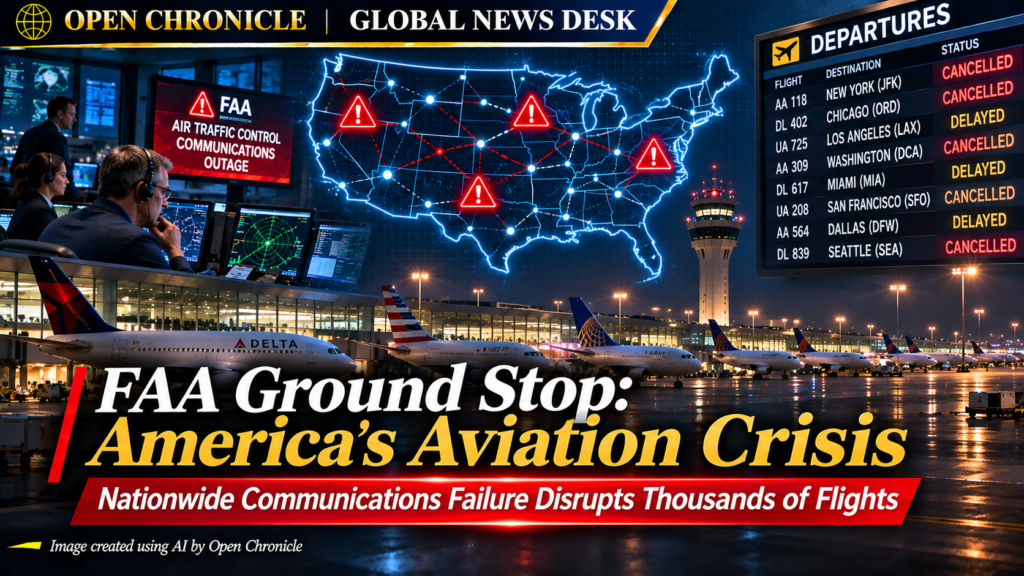
Airports across the United States are reporting widespread delays and suspended departures following an extraordinary nationwide ground stop ordered by the Federal Aviation Administration. The disruption is affecting major aviation hubs, regional airports, international connections and even college sports teams, while federal officials say there is no current indication of a deliberate attack.
By Open Chronicle News Desk
November 13, 2026 | Breaking News Roundup
A nationwide aviation emergency
A major communications failure affecting the Federal Aviation Administration has triggered one of the most significant disruptions to American air travel in recent years, forcing airports across the United States to suspend departures and leaving thousands of passengers facing uncertainty.
The nationwide ground stop, introduced on Friday for safety reasons, has generated an extraordinary volume of breaking news coverage, with airports from Chicago and Washington to Texas, California, Hawaii and Alaska reporting operational consequences.
The initial problem was identified as a failure affecting air traffic control communications. Federal authorities are investigating its cause while airlines and airports attempt to manage the resulting disruption.
Homeland Security Secretary Markwayne Mullin has sought to reassure the public, saying there is no indication of an immediate threat to the United States and rejecting comparisons with the terrorist attacks of September 11, 2001.
The latest reports also raise questions about recently introduced aviation technology, the resilience of aging air traffic control infrastructure and the consequences for international travel.
However, several claims circulating in news headlines remain unverified, particularly suggestions that a new artificial intelligence system contributed to the failure.
1. Major American airports report widespread disruption
The effects of the nationwide ground stop have been reported across the country’s aviation network.
Chicago’s O’Hare and Midway airports are among the major facilities affected. In Washington, passengers at Reagan National and Dulles International are facing uncertainty over departures.
Dallas Fort Worth International Airport and Dallas Love Field have also reported disruption, while Salt Lake City International Airport has reportedly activated its emergency operations center.
Airports in Nashville, Las Vegas, San Francisco, Seattle, San Diego, Louisville, Wichita and Charleston are among those appearing in local coverage.
Regional airports have not been spared.
Reports from New Mexico, Montana, Nebraska, Kentucky, Missouri, Arizona and other states describe suspended departures, delayed flights and passengers being advised to contact their airlines.
The geographical spread demonstrates how a national air traffic control restriction can affect airports regardless of their size.
Even airports with relatively few daily commercial flights depend on the same national airspace management system.
2. Thousands of flights affected, with disruption continuing
Several reports describe thousands of flights being delayed, canceled or otherwise affected.
Some headlines cite more than 7,000 disrupted flights, while others refer to approximately 7,000 cancellations.
These figures should not be treated as interchangeable.
A flight that is delayed, canceled, diverted or temporarily held on the ground represents a different operational outcome.
Without a consistent, independently verified dataset, it is not possible to establish a definitive national cancellation total from the supplied headlines.
Nevertheless, the scale of the reported disruption is substantial.
The longer a nationwide ground stop remains in effect, the greater the potential consequences for airline schedules, aircraft rotations, crew availability and connecting passengers.
Even after departures resume, airlines may require considerable time to restore normal operations.
3. Federal authorities reject comparisons with September 11
The national security implications of the disruption have become a central part of the public debate.
Homeland Security Secretary Markwayne Mullin has rejected suggestions that the situation resembles the September 11 terrorist attacks.
According to the reports, Mullin said there was no indication that the communications failure resulted from malicious activity.
His remarks were intended to reassure passengers and distinguish the current operational emergency from a confirmed security attack.
However, federal officials have not yet provided a definitive technical explanation for the communications breakdown.
A cyberattack has been discussed as a possibility in some media coverage, but the supplied reports contain no verified evidence establishing one.
The distinction is essential.
An investigation that has not conclusively ruled out malicious interference is not evidence that malicious interference occurred.
4. Questions emerge over the FAA’s new artificial intelligence tool
One of the most widely discussed developments concerns a recently introduced FAA artificial intelligence traffic management tool, described in several headlines as SMART AI.
Some reports suggest the tool was introduced shortly before the nationwide communications failure.
Others question whether its deployment might have contributed to the disruption.
At present, however, the available headlines establish only that questions have been raised.
They do not demonstrate that the tool caused, contributed to or was technically connected with the communications outage.
The FAA’s investigation will need to determine which systems failed and whether any recent software or infrastructure changes were involved.
The incident may intensify scrutiny of how new technologies are tested and integrated into safety-critical aviation environments.
But speculation about artificial intelligence should not be presented as a confirmed explanation.
5. International flights face additional uncertainty
The consequences are extending beyond American airports.
Reports indicate that Toronto Pearson International Airport has suspended some US-bound departures, while Montreal Trudeau International Airport has also been affected.
Fiji Airways has warned passengers about possible disruptions to services involving the United States.
The FAA’s initial order indicated that international inbound flights would be managed individually.
This means a nationwide restriction on departures from US airports does not necessarily imply that every international aircraft approaching the country must turn back.
Airlines must coordinate with aviation authorities to determine the status of individual flights.
The situation is particularly relevant for transatlantic travelers, including passengers flying between Europe and the United States.
International disruptions could persist even after normal domestic departures begin to resume.
6. College football teams caught in the aviation shutdown
An unusual consequence of the emergency is its impact on American college football.
Several university teams have reportedly experienced travel problems ahead of scheduled weekend games.
Texas, Tennessee, Kansas State and Ole Miss are among the programs mentioned in coverage of delayed departures or uncertain travel arrangements.
Reports indicate that some teams were unable to leave their departure airports, while others managed to travel before the restrictions were imposed.
The disruption illustrates how aviation emergencies can affect major sporting events that depend on coordinated travel schedules.
However, reports of delayed team flights do not establish that the corresponding games have been postponed.
Any changes to sporting schedules require confirmation from the universities, conferences or competition organizers.
7. Passengers confront delays and uncertain travel arrangements
Across the United States, airports are advising passengers to verify their flight status directly with airlines.
Departure boards in Nashville and other cities reportedly show widespread delays.
Passengers at Washington Reagan National Airport have described uncertainty as they wait for information about when departures may resume.
The disruption has also prompted questions about airline refunds, rebooking and passenger rights.
These depend on the circumstances of each cancellation or delay, the applicable regulations and airline policies.
A technical failure affecting national air traffic control does not automatically establish that every traveler is entitled to the same compensation.
Passengers should retain booking information, monitor airline communications and check the status of their flights before traveling to airports.
8. Congress faces questions over aviation infrastructure
The crisis is also becoming a political and infrastructure issue.
Members of Congress, including Representative Mark DeSaulnier, have responded to the nationwide ground stop, while other lawmakers are demanding explanations from federal authorities.
The disruption has revived debate about the age and reliability of American air traffic control systems.
Congress approved $12.5 billion for modernization in 2025, and Transportation Secretary Sean Duffy has identified a further $30 billion in funding needs.
The modernization program includes replacing aging copper communications infrastructure and upgrading radio equipment.
Aviation experts have suggested that outdated technology could be relevant to the latest failure, but investigators have not yet confirmed that explanation.
The incident is likely to intensify scrutiny of system redundancy, technical testing and the management of new aviation technologies.
9. What is confirmed and what remains uncertain?
Editorial verification | November 13, 2026
| Confirmed by reporting | Nationwide FAA ground stop, communications problems affecting regional centers, federal investigation and widespread airport disruption. |
| Reported locally | Disruption to individual airports, international routes, passengers and university sports teams. Specific outcomes require individual confirmation. |
| Not established | Whether SMART AI, a cyberattack, the Microsoft outage or another external incident caused the FAA failure. |
| Still developing | Exact flight cancellation totals, full technical cause, restoration timetable and recovery of airline schedules. |
Conclusion | A national crisis with consequences beyond aviation
The Federal Aviation Administration’s nationwide ground stop has developed into a major operational emergency affecting airports, airlines, passengers and organizations across the United States.
From Chicago and Washington to California, Texas and smaller regional airports, the disruption has demonstrated the national consequences of a communications failure within the air traffic control system.
The impact is also extending internationally, while the interruption of university sports travel shows how dependent other sectors have become on reliable aviation services.
Federal officials have emphasized that the situation is being treated as a technical and operational emergency, with no confirmed evidence of a deliberate attack.
Questions about artificial intelligence, cybersecurity and aging infrastructure remain subjects for investigation rather than established explanations.
The immediate challenge is restoring safe departures. The longer-term question is how the United States can prevent a failure in essential communications infrastructure from disrupting aviation across an entire country.
The coming hours will be critical for determining when normal operations can resume, how many flights have been affected and whether the technical investigation identifies weaknesses requiring urgent corrective action.
Sources and Further Reading
Selected reporting and official resources documenting the nationwide FAA ground stop, air traffic control communications failures
and the federal response on November 13, 2026.
Nationwide FAA Ground Stop
Reporting published on November 13, 2026, examining the nationwide suspension of flight departures, communications failures affecting 22 regional air traffic control centers, statements from federal officials and the ongoing modernization of America’s aviation infrastructure.
FAA Daily Air Traffic Report
Official Federal Aviation Administration reporting on national air traffic conditions, operational restrictions and potential disruptions affecting airports across the United States. This resource provides operational context and may be updated as conditions change.
National Airspace System Status
Official operational information concerning ground stops, airport delays, air traffic restrictions and national airspace management. The system provides ongoing status information rather than a permanent historical record of the November 13 incident.
Homeland Security Response to the FAA Crisis
Coverage of statements by Homeland Security Secretary Markwayne Mullin concerning the nationwide aviation disruption and the absence of initial evidence indicating a deliberate attack. The report also examines the federal government’s response to the communications failure.
This article summarizes developing reports available on November 13, 2026. Individual airport disruptions, flight totals and claims about possible technical causes may change as official investigations continue. The headline collection supplied for this report is not itself independent confirmation of every reported event. No verified technical evidence available at the time of publication established that the FAA communications failure
was caused by a cyberattack, the recently introduced SMART AI system or another external technology disruption.