
OPEN CHRONICLE | GLOBAL NEWS DESK | UKRAINE WAR & EUROPEAN SECURITY
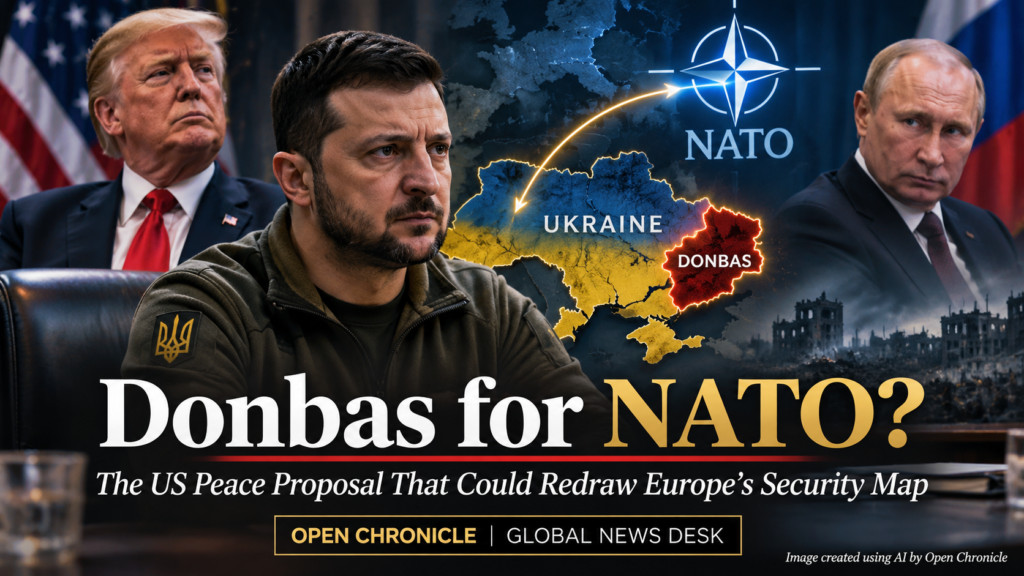
Washington has raised the possibility of Ukraine withdrawing from territory it still controls in the Donbas in exchange for NATO membership, according to President Volodymyr Zelenskyy. The idea exposes a profound diplomatic contradiction: Russia has demanded Ukrainian territorial concessions while opposing the very alliance membership that could make those concessions politically conceivable.
By Open Chronicle News Desk
November 14, 2026 | Special Report | Ukraine, NATO & European Security
1. A Question That Could Change the War
A single diplomatic question has reopened one of the most difficult debates surrounding the war in Ukraine.
Would Kyiv consider withdrawing from the parts of the Donbas it still controls if Ukraine were offered membership in NATO?
According to President Volodymyr Zelenskyy, American negotiators raised that possibility during the latest diplomatic efforts to end Russia’s war against Ukraine.
It was the first time, he said, that the United States had explicitly connected the possibility of Ukrainian NATO membership with a withdrawal from the eastern region.
The significance extends far beyond the immediate negotiations.
For Ukraine, the Donbas represents sovereign territory, strategically important defensive positions and communities that have endured years of war.
For Russia, control of the region has become one of the central objectives of its military campaign.
For NATO, admitting Ukraine would create new security obligations and potentially transform the alliance’s relationship with Moscow.
The American suggestion therefore links three issues that have repeatedly obstructed negotiations: territory, security guarantees and the future of European defense.
Yet it also exposes a fundamental problem.
Russia has consistently opposed Ukrainian membership in NATO.
Any arrangement that combined Ukrainian territorial withdrawal with admission to the alliance would therefore require a political reversal by Moscow or a settlement that Russia might reject.
What initially appears to be a possible diplomatic compromise could consequently become one of the most difficult proposals of the entire peace process.
2. What Zelenskyy Actually Said
Zelenskyy’s remarks followed two days of American-mediated negotiations between Ukrainian and Russian representatives in Abu Dhabi.
The Ukrainian president said American negotiators asked whether Kyiv might withdraw from the Donbas if NATO membership became available.
He emphasized that Ukraine had not agreed to surrender territory.
At the same time, Zelenskyy acknowledged that a comprehensive arrangement involving credible security guarantees, a sufficiently strong Ukrainian military and financial support for reconstruction could be presented to the Ukrainian people.
Such a decision, he indicated, could not be made by the president alone.
A national referendum would be necessary to establish whether Ukrainians accepted a proposed settlement.
This distinction matters.
Zelenskyy was not announcing a territorial agreement. Nor was he confirming that NATO membership had been formally offered or approved.
He was describing a question introduced into diplomatic discussions.
The Ukrainian government continues to insist that the country’s sovereignty and long-term security must remain central to any peace settlement.
The American suggestion nevertheless indicates that negotiators are exploring arrangements previously considered politically improbable.
The issue now is whether those ideas can be developed into something acceptable to Ukraine, its Western partners and Russia.
3. Why the Donbas Matters So Much
The Donbas is not simply another territorial bargaining position.
The region encompasses the Donetsk and Luhansk oblasts in eastern Ukraine.
Russia has occupied parts of the area since 2014, and the region became a central battlefield following the full-scale invasion in February 2022.
Moscow announced the annexation of Donetsk and Luhansk in September 2022, alongside two other Ukrainian regions. Those territorial claims are not recognized by Ukraine or most of the international community.
Russian forces control nearly all of Luhansk and much of Donetsk, but Ukrainian forces continue to hold territory in Donetsk.
These remaining positions are strategically important.
They include defensive infrastructure, urban settlements, transport connections and military positions developed over years of fighting.
Withdrawing from them would not simply change the map.
It could require the evacuation or abandonment of communities, the dismantling of defensive positions and the creation of a new military line farther west.
Such a withdrawal might also expose additional Ukrainian territory if an agreement failed or hostilities resumed.
The military consequences would depend on the exact boundaries, monitoring arrangements and security guarantees established in any settlement.
For Ukrainian leaders, these considerations make territorial concessions inseparable from the question of how another Russian offensive could be prevented.
4. NATO Membership: The Guarantee Kyiv Wants and Moscow Rejects
Ukraine has pursued closer relations with NATO for years, but Russia’s invasion has made the issue far more urgent.
Kyiv argues that promises of support without binding security commitments have proved insufficient to prevent repeated Russian aggression.
NATO membership would offer a fundamentally different framework.
Article 5 of the North Atlantic Treaty establishes that an armed attack against one member is considered an attack against all members, creating an obligation for allies to assist the attacked country.
However, Article 5 does not automatically prescribe a specific military response by every member. Each ally determines the action it considers necessary, including the possible use of armed force.
Membership would nevertheless represent a major political and strategic commitment.
For Russia, that prospect has long been unacceptable.
The Kremlin has repeatedly demanded restrictions on NATO’s expansion and on the alliance’s military presence near Russian territory.
Moscow has also attempted to connect the war in Ukraine to a broader renegotiation of Europe’s security architecture.
That creates an obvious contradiction.
If NATO membership is the principal incentive offered to Ukraine in exchange for leaving the Donbas, the proposal depends on Russia accepting an outcome it has repeatedly identified as a threat.
No evidence currently establishes that Moscow has abandoned that position.
Nor has NATO announced a collective decision to admit Ukraine under such an arrangement.
5. Could Ukraine Join NATO While Territorial Disputes Remain?
The legal and political dimensions of NATO membership are more complicated than a simple exchange of territory for protection.
Under Article 10 of the North Atlantic Treaty, existing members may unanimously invite another European state capable of furthering the treaty’s principles and contributing to North Atlantic security.
Unanimity is essential.
The United States cannot independently grant NATO membership to Ukraine.
Every existing member would need to agree, and accession would require the applicable national ratification procedures.
There is also the question of disputed territory.
The treaty does not contain an explicit blanket prohibition against admitting a country with unresolved territorial disputes.
Nevertheless, the military and political consequences would be substantial.
Allies would need to determine how collective defense commitments applied to Ukrainian territory under occupation and what obligations would arise if hostilities resumed.
Some historical security arrangements have involved territorial limitations or special conditions.
But those precedents do not automatically provide a workable solution for Ukraine.
Any such arrangement would require extraordinary diplomatic precision.
The question is not only whether Ukraine could technically become a NATO member.
It is whether the alliance’s members would be willing to accept the resulting risks and responsibilities.
6. The Ukrainian Public Would Have the Final Word
Zelenskyy’s reference to a possible referendum introduces another major obstacle.
A peace settlement involving territorial concessions would be politically and constitutionally sensitive.
Ukraine’s constitution protects the country’s territorial integrity and provides for national referendums on changes to its territory.
The precise legal process would depend on the content of any proposed agreement and the constitutional rules applicable at the time.
A referendum held during or immediately after a major war would also raise difficult practical questions.
Millions of Ukrainians have been displaced internally or abroad.
Others live under Russian occupation.
Military personnel remain deployed across the country.
Authorities would need to address voter registration, access to polling, security and the participation of displaced citizens.
These challenges do not make a public vote impossible in principle.
They do mean that a referendum could not be treated as a simple procedural step.
For many Ukrainians, the question would be profoundly personal.
It would concern not only international security guarantees, but also homes, families, occupied communities and the meaning of sovereignty after years of resistance.
A proposal that appeared diplomatically attractive to foreign negotiators might therefore encounter significant resistance within Ukraine.
7. What Happened in Abu Dhabi?
The latest negotiations took place in the United Arab Emirates, with American representatives facilitating discussions between Ukraine and Russia.
The meetings did not produce a comprehensive peace agreement.
They did, however, generate movement on a potential large prisoner exchange.
Zelenskyy indicated that the two sides had reached an agreement in principle concerning more than 1,000 prisoners, although the final numbers and arrangements remained under discussion.
Prisoner exchanges have become one of the few areas where practical agreements can sometimes be achieved despite the broader conflict.
The negotiations also addressed the possibility of an energy ceasefire.
Ukraine has repeatedly sought arrangements to reduce attacks on energy infrastructure, particularly as Russian strikes continue to disrupt electricity and heating.
According to Zelenskyy, American envoys Steve Witkoff and Jared Kushner had agreed to raise the issue with Putin.
However, the Ukrainian president subsequently said that Moscow had not supported the proposed energy ceasefire.
This outcome illustrates the central difficulty of the peace process.
Even limited agreements designed to protect civilian infrastructure remain difficult to secure.
A comprehensive arrangement involving NATO membership and territorial concessions would be considerably more complex.
8. Europe Demands a Place at the Negotiating Table
The latest diplomatic developments have also intensified European concerns about representation.
European countries are now among Ukraine’s most important military and financial supporters.
They would also face the consequences of any agreement changing the continent’s security arrangements.
During the recent diplomatic discussions, European representatives met American and Ukrainian officials in Abu Dhabi but did not participate directly in the negotiations with Russia.
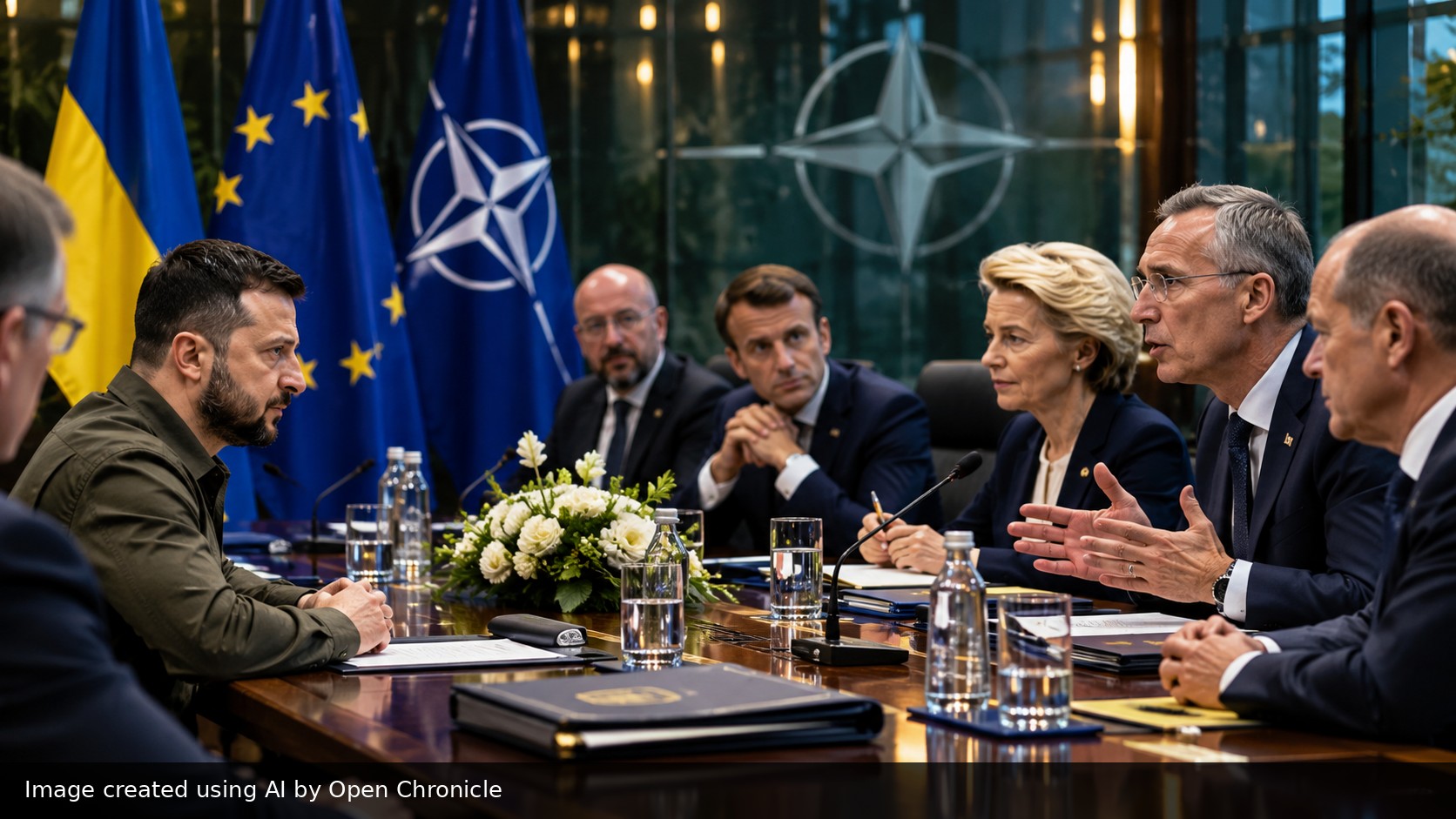
Following discussions at the European summit in Ireland, European leaders agreed on a proposed negotiating group involving Britain, France, Germany, Italy and Poland, alongside representatives of European Union institutions.
The arrangement reflects an effort to ensure that Europe is not excluded from decisions affecting its own security.
For Poland and the Baltic states, the consequences of any concessions to Moscow are especially sensitive.
These countries have repeatedly warned against arrangements that could reward territorial aggression or weaken NATO’s eastern defenses.
France, Germany and Britain also have significant interests in the future structure of European deterrence.
The central European argument is straightforward.
An agreement that affects NATO, European borders, sanctions and long-term defense commitments cannot be negotiated as though Europe were merely an observer.
9. Putin Wants a Broader European Security Settlement
Russia has sought to extend negotiations beyond the immediate conflict in Ukraine.
Moscow has called for changes to the wider European security order, including arrangements affecting NATO.
Zelenskyy has rejected the idea that such a restructuring should precede an agreement to end the war.
From Kyiv’s perspective, allowing Russia to make the broader European security system a precondition for peace could give Moscow influence over decisions affecting countries beyond Ukraine.
That concern extends to states that joined NATO after the Cold War.
The alliance’s eastern members regard their security arrangements as sovereign choices, not concessions granted by Moscow.
Finland and Sweden’s accession to NATO has also transformed the strategic geography of northern Europe.
A settlement that appeared to reopen questions about their membership or security commitments would face considerable political resistance.
The proposed Donbas arrangement must therefore be understood within a much larger diplomatic contest.
The issue is not simply where the front line might be drawn.
It is whether Russia can use the war to secure changes to Europe’s broader security structure.
10. Three Possible Outcomes
OPEN CHRONICLE | DIPLOMATIC SCENARIO ANALYSIS
Where the negotiations could lead
Where the Negotiations Could Lead
EDITORIAL NOTE
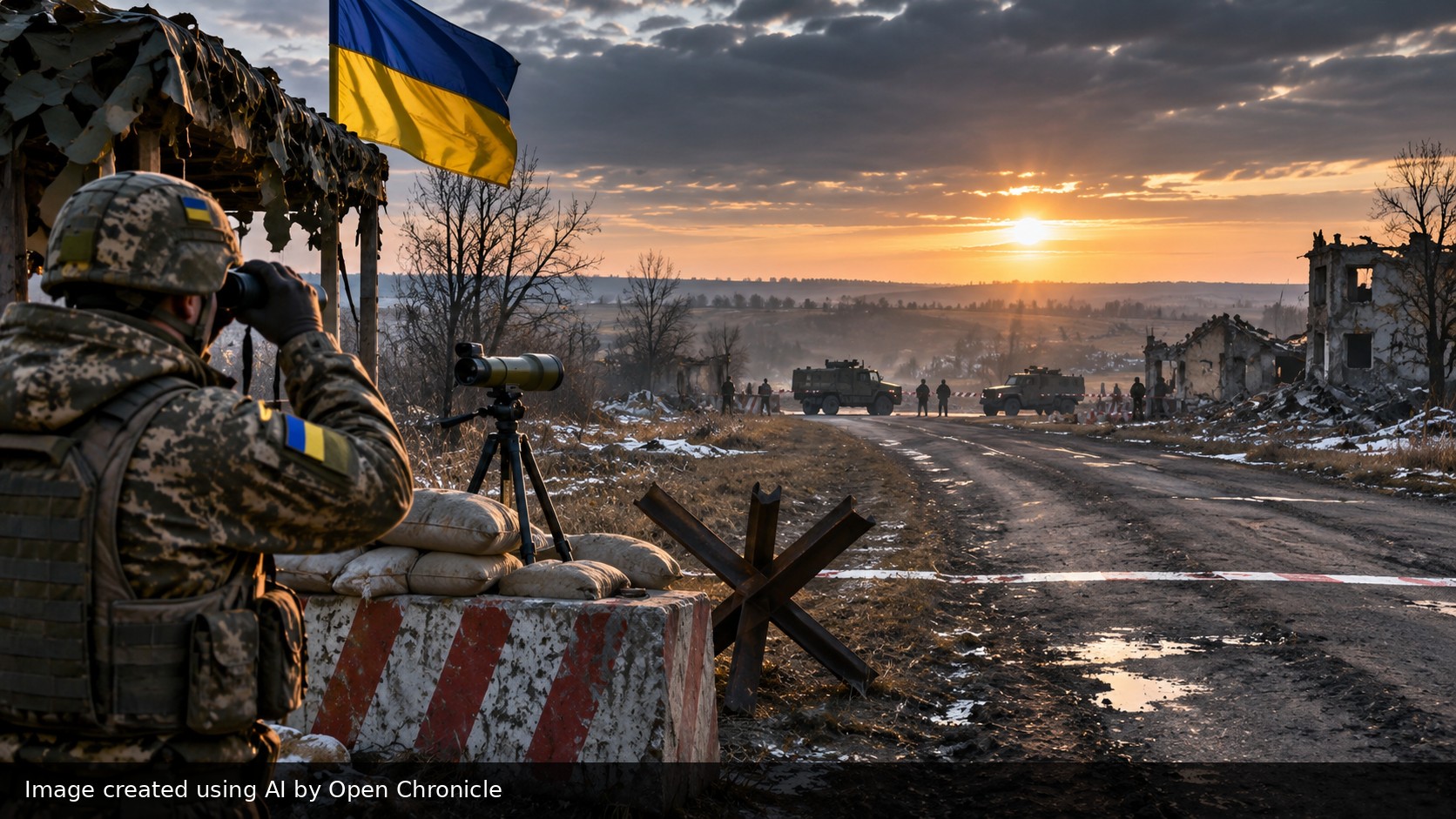
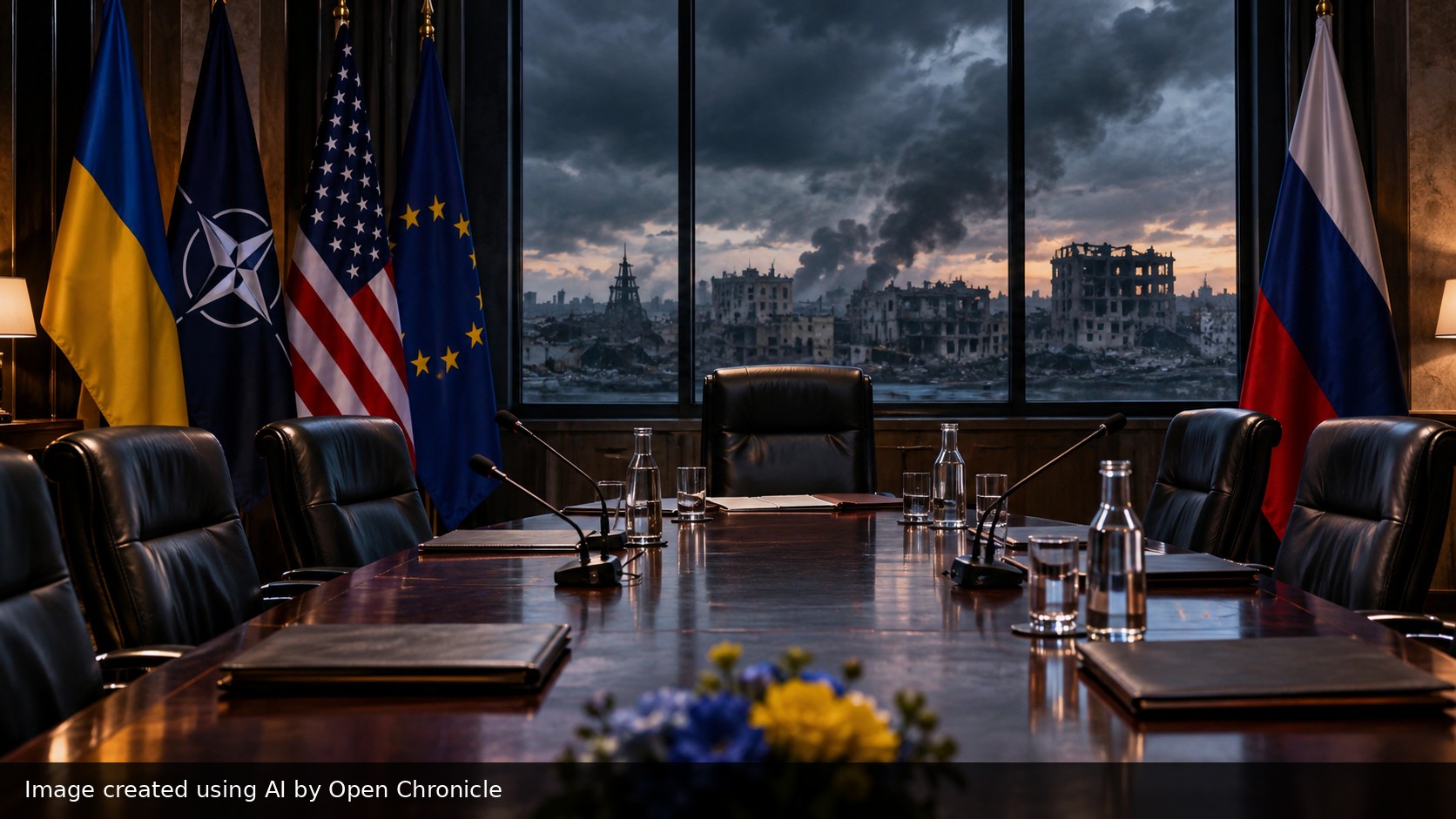
These scenarios are editorial assessments, not announced agreements or probability forecasts. The AI-generated images are conceptual illustrations and do not depict actual negotiations or documented battlefield scenes.
These are analytical scenarios, not announced agreements or probability forecasts.
Each scenario carries significant risks.
A comprehensive agreement could offer greater long-term stability, but would be difficult to negotiate and enforce.
A ceasefire without a final territorial settlement might reduce immediate casualties while leaving the underlying dispute unresolved.
A diplomatic breakdown would prolong the war and deepen the humanitarian and economic consequences.
The most important variable is whether the parties can agree on security arrangements that are credible, enforceable and acceptable to Ukraine.
11. Why This Matters Beyond Ukraine
The debate over the Donbas has implications far beyond Eastern Europe.
A settlement involving territorial concessions would be closely examined by governments concerned about the precedent it might establish.
The principle that internationally recognized borders should not be changed through force remains central to the United Nations Charter.
At the same time, international diplomacy frequently involves compromises intended to stop active conflicts.
The difficulty is determining whether a proposed compromise creates sustainable peace or encourages future coercion.
Other countries facing territorial disputes will observe how the international community responds.
NATO members will examine whether the alliance can maintain a credible collective defense posture.
European governments will consider how much military capability they must develop independently.
China and other major powers will also study the relationship between territorial control, international recognition and security guarantees.
The outcome could therefore influence strategic calculations in regions far removed from the Ukrainian battlefield.
12. The Questions That Must Be Answered
Before any territorial arrangement can become a credible peace proposal, several fundamental questions remain unresolved.
Would Ukraine receive full NATO membership or merely a promise of future accession?
Would all NATO members support the arrangement?
Would Russia accept Ukraine joining the alliance?
Would a Ukrainian withdrawal involve formal recognition of Russian sovereignty, or would Ukraine maintain its legal claims?
How would the security of civilians and communities in the affected territories be protected?
What military guarantees would prevent renewed Russian attacks?
Who would monitor compliance with a ceasefire or peace agreement?
How would reconstruction be financed?
And, perhaps most importantly, would Ukrainian citizens accept the terms?
Until these questions receive credible answers, the American suggestion remains an exploratory diplomatic idea rather than an actionable peace settlement.
Conclusion | A Bargain That Could Redefine European Security
The possibility of exchanging a Ukrainian withdrawal from the Donbas for NATO membership represents one of the most consequential ideas to emerge from the latest peace discussions.
It attempts to connect Russia’s territorial demands with Ukraine’s overriding need for long-term protection.
But the arrangement contains a fundamental contradiction.
Moscow wants control over the Donbas while opposing Ukraine’s membership in NATO.
Kyiv wants credible security guarantees while refusing to surrender sovereign territory.
NATO cannot offer membership without the agreement of all its members.
And the Ukrainian public would need a meaningful role in any settlement involving territorial concessions.
These obstacles explain why the proposal remains so uncertain.
Nevertheless, the fact that the question has entered diplomatic discussions is significant.
It demonstrates that negotiators are examining difficult combinations of territorial and security arrangements as they search for a possible end to the war.
The central question is no longer simply whether Ukraine can recover its territory or obtain stronger guarantees. It is whether any diplomatic formula can provide lasting security without making territorial aggression an acceptable instrument of international politics.
For Ukraine, Europe and NATO, the answer could shape the continent’s security for generations.
Sources and Further Reading
Selected international reporting and institutional resources covering the latest Ukraine peace negotiations, NATO membership, territorial sovereignty and European security.
US Floated Idea of Ukraine Ceding Donbas for NATO Membership, Zelenskiy Says
Primary reporting on Zelenskyy’s remarks, the American suggestion, Abu Dhabi negotiations, potential prisoner exchanges and European participation.
Zelenskyy Warns New European Security Framework Could Benefit Putin
Coverage of Ukraine’s concerns about changes to Europe’s security architecture, Russian demands and the latest diplomatic efforts.
Ukraine: Zelenskyy Says Security Deal Could Go to Referendum
Reporting on the conditions Zelenskyy identified for consulting Ukrainian voters and the difficulties surrounding territorial concessions.
US Floats NATO Membership for Ukraine in Exchange for Donbas Withdrawal
Ukrainian reporting on the proposed diplomatic tradeoff, security guarantees and Kyiv’s position on territorial sovereignty.
The North Atlantic Treaty
Official treaty text, including Article 5 on collective defense and Article 10 governing invitations to join the alliance.
Charter of the United Nations
Foundational international legal principles concerning sovereignty, territorial integrity and the prohibition of the threat or use of force.
This article was prepared using information available on November 14, 2026. The reported possibility of linking Ukrainian withdrawal from the Donbas to NATO membership originates from statements by President Volodymyr Zelenskyy. It does not constitute a confirmed agreement, an approved NATO accession offer or Ukrainian acceptance of territorial concessions. Diplomatic scenarios presented in the article are editorial analysis, not official negotiating positions. Developments remain subject to further confirmation.