
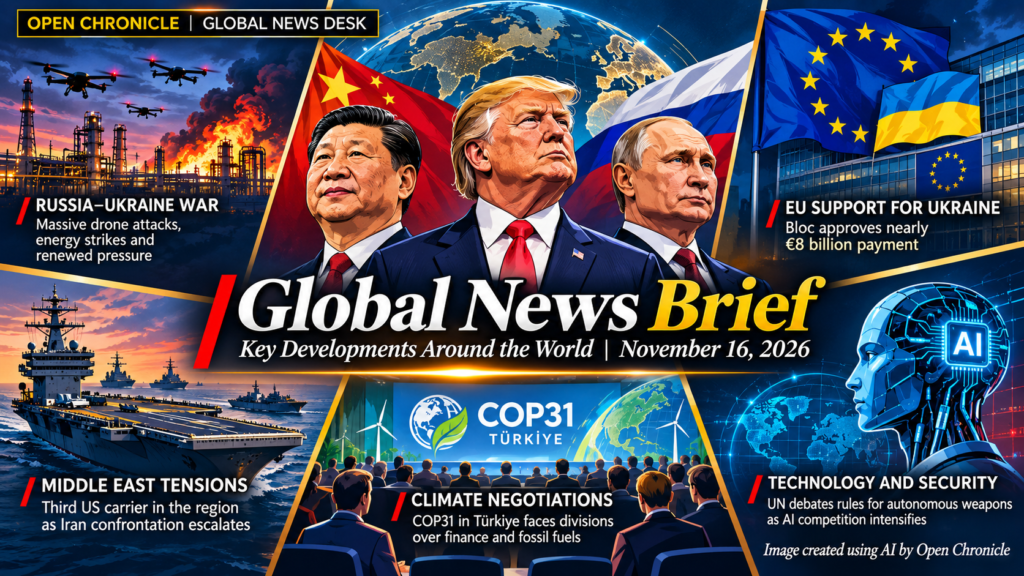
OPEN CHRONICLE | GLOBAL NEWS DESK
China confirms an unprecedented summit bringing together Xi Jinping, Donald Trump and Vladimir Putin. The European Union approves nearly €8 billion for Ukraine as Russia reports a massive Ukrainian drone offensive. Meanwhile, escalating tensions in the Middle East, deadly shootings in South Africa, new European migration proposals and difficult climate negotiations highlight a world confronting simultaneous security, humanitarian and economic crises.
By Open Chronicle News Desk
November 16, 2026 | International Affairs | World News
Today’s Global Picture
Four developments defining the international news agenda, from major diplomatic negotiations and European financial assistance to deadly violence and the expanding use of drones in modern warfare.
Figures reflect announcements and reports available on November 16, 2026. Military interception totals are claims by the reporting authorities, not independently established counts. Other figures and scheduled events may be revised as additional information becomes available.
1. Global Diplomacy | Xi, Trump and Putin Prepare for an Unprecedented Summit
One of the most consequential diplomatic developments of November 16 is China’s confirmation that President Xi Jinping will host US President Donald Trump and Russian President Vladimir Putin for a trilateral meeting in Shenzhen on November 19.
The meeting, expected to take place alongside the Asia-Pacific Economic Cooperation summit, would bring together the leaders of the world’s three largest nuclear powers in an unprecedented format.
Beijing has presented the gathering as an opportunity to discuss international peace and strategic stability.
The White House has indicated that nuclear arms control and the conflict involving Iran are among Washington’s priorities.
However, expectations of a major agreement remain limited.
China has historically maintained that the United States and Russia, which possess substantially larger nuclear arsenals, should undertake significant reductions before Beijing accepts comparable limitations.
The future of nuclear arms control has become particularly important following the expiration of New START, the last major treaty limiting deployed strategic nuclear weapons between Washington and Moscow.
The absence of a comprehensive replacement agreement has intensified concerns about a renewed nuclear arms competition.
The Ukraine Question
Perhaps the most politically sensitive issue surrounding the meeting is the reported exclusion of Russia’s war against Ukraine from the formal agenda.
European governments have repeatedly insisted that decisions affecting Ukraine’s sovereignty and European security cannot be made without Kyiv and its European partners.
The meeting therefore raises a wider question about the distribution of diplomatic influence.
Will the three powers use the summit to establish new channels for managing their rivalries, or will the gathering reinforce concerns that major international decisions are increasingly being discussed within exclusive groups of powerful states?
The answer will depend on the substance of the discussions and any agreements that follow.
For now, the Shenzhen summit represents a major diplomatic event, not evidence that a new world order has already been negotiated.
2. Europe | EU Approves Record Financial Payment to Ukraine
The European Union has approved a payment of nearly €8 billion to Ukraine following Kyiv’s completion of more than 20 reform commitments under the Ukraine Facility.
The disbursement represents the largest single payment reported under the programme.
The funding is intended to support Ukraine’s financial stability, reconstruction and reform efforts while the country continues to confront Russia’s invasion.
The decision comes at a moment when Ukraine faces substantial budgetary pressures.
The war has damaged infrastructure, disrupted economic activity and increased the cost of maintaining essential public services.
European financial assistance has consequently become an important component of Ukraine’s ability to sustain government operations.
The Ukraine Facility links financial support to reform commitments, including measures related to governance, public administration and economic modernisation.
European officials view the mechanism as both a source of emergency financial assistance and a means of encouraging longer-term institutional development.
A Divided Europe on Future Financing
Despite the latest approval, disagreements remain over the EU’s long-term financial commitments to Ukraine.
German Chancellor Friedrich Merz has acknowledged continuing divisions among member states over future assistance and the bloc’s broader budget.
The European Commission is also considering additional lending mechanisms, including proposals involving approximately €45 billion in support.
Those discussions remain politically sensitive because governments must balance Ukraine’s needs against domestic spending pressures and competing European priorities.
The latest payment demonstrates continued institutional support for Kyiv, but it does not resolve the debate over how the war and Ukraine’s reconstruction should be financed in the years ahead.
3. Russia–Ukraine War | Moscow Claims More Than 1,300 Ukrainian Drones Intercepted
Russia says its air defence forces intercepted more than 1,300 Ukrainian drones during a massive aerial offensive.
Russian military figures put the total at approximately 1,336 drones, making the reported operation one of the largest of the war.
The figures have not been independently verified.
The scale of the reported attack nevertheless illustrates how unmanned aircraft have become central to Ukraine’s long-range military strategy.
Russian authorities and regional reporting described attacks involving oil facilities, industrial infrastructure and locations around the Black Sea.
Among the reported targets were facilities in the Krasnodar and Rostov regions.
Ukrainian military sources also described strikes against the Ilsky oil refinery, claiming damage to processing infrastructure.
The precise extent of the damage remains uncertain.
The Crimean Bridge Returns to the Headlines
Traffic across the Crimean Bridge, which connects Russia with the occupied Crimean Peninsula, was reportedly disrupted following another Ukrainian attack.
The bridge carries significant political and logistical importance for Moscow.
Russia uses it as a connection between its territory and Crimea, which it annexed in 2014 in a move widely rejected internationally.
Ukraine has repeatedly targeted the crossing during the war.
Reports of renewed attacks do not, however, establish that the bridge suffered major structural damage.
Any assessment of the latest operation must distinguish between a temporary traffic suspension, a successful strike and confirmed destruction of infrastructure.
Energy Infrastructure Under Pressure
Russia has continued its own attacks against Ukrainian energy facilities.
Reports from Odesa Oblast described strikes affecting electricity infrastructure, while Ukrainian officials warned of the risk of further attacks as winter approaches.
The growing concentration of attacks on power systems has also renewed concerns about nuclear safety.
Ukraine’s nuclear facilities depend on reliable external electricity supplies for essential safety functions.
Damage to the surrounding power network can therefore create risks extending beyond immediate electricity shortages.
Both countries are increasingly confronting the consequences of infrastructure warfare, although the legal status and military significance of individual targets must be assessed separately.
4. European Security | Estonia Accuses Russia of Preparing Industrial Sabotage
Estonia has accused Russian intelligence services of involvement in a plot targeting Threod Systems, an Estonian company associated with unmanned aircraft technology.
Estonian security officials have warned that additional defence companies may also face sabotage threats.
The allegations form part of growing European concern about hostile intelligence activity directed against military industries, critical infrastructure and transport networks.
Estonia has announced plans to close its road border crossings with Russia from December 1, citing security concerns.
Moscow denies responsibility for the alleged sabotage attempt.
The dispute highlights the deteriorating security relationship between Russia and NATO’s eastern members.
Estonia, Latvia, Lithuania and Poland have all expressed concern about sabotage, cyber operations and other forms of hostile activity below the threshold of conventional military confrontation.
Lithuania is also seeking to strengthen its defence relationship with the United States, including discussions about a more enduring American military presence.
Meanwhile, the European Union has announced further sanctions targeting individuals and organisations accused of involvement in Russian disinformation and cyber operations.
These measures reflect an expanding European effort to respond to threats that extend beyond the battlefield in Ukraine.
5. Middle East | Iran Tensions Intensify as US Carrier Presence Expands
The military confrontation involving Iran continues to dominate developments across the Persian Gulf.
Reports on November 16 indicated that the United States had increased its aircraft carrier presence in the Middle East to three carrier strike groups, following the arrival of USS Theodore Roosevelt.
The deployment comes amid continuing exchanges of threats and military activity involving Iran, the United States and regional partners.
Iranian authorities have reported additional maritime incidents near the Strait of Hormuz, including claims that several oil tankers struck mines.
Reports described fires aboard vessels and the possible loss of one tanker.
The precise circumstances of the incidents, the number of vessels affected and responsibility for any mines require independent confirmation.
The Strait of Hormuz remains one of the world’s most important maritime energy corridors.
Any sustained disruption to shipping through the waterway could affect international oil markets, insurance costs and commercial transportation.
Bahrain and the Regional Security Crisis
Bahrain has remained a focal point of regional tensions following Iranian claims of drone attacks against American military infrastructure.
Bahraini authorities have reported aerial interceptions, while Iranian officials have described operations against US military facilities.
Independent confirmation of the claimed damage remains limited.
Bahrain also announced prison sentences ranging from 15 years to life imprisonment in a case involving an alleged terrorist network linked to Iran’s Islamic Revolutionary Guard Corps.
The proceedings add a domestic security dimension to the wider confrontation.
Iran Restricts Nuclear Inspections
Tehran has reportedly said that access to certain nuclear facilities by United Nations inspectors will remain restricted until the conflict ends.
Any prolonged interruption to inspections would complicate international efforts to establish a reliable picture of Iran’s nuclear activities.
The development comes as diplomatic discussions remain overshadowed by military escalation and sanctions.
6. Yemen | Houthi Advances Raise Concerns Over Red Sea Security
Yemen’s conflict has entered another period of instability.
Reports indicate that Houthi forces have advanced along parts of the country’s southern coastline following the withdrawal of opposing Yemeni units from positions near the Bab al-Mandeb Strait.
The reported changes in territorial control have raised concerns about the security of Aden and nearby maritime routes.
Bab al-Mandeb connects the Red Sea with the Gulf of Aden and is strategically important to shipping between Europe and Asia.
Military developments near the strait can influence maritime security even when commercial vessels are not directly targeted.
Saudi Arabia is reportedly considering adjustments to its regional security partnerships in response to the changing situation.
Reports have also raised the possibility of Syrian participation in a new coalition, although the details and any deployment commitments remain uncertain.
The renewed fighting demonstrates the difficulty of stabilising Yemen while broader regional tensions involving Iran and its allies continue.
7. Israel, Gaza and the West Bank | Diplomatic Tensions Deepen
Israeli forces reportedly ordered a European delegation to leave a village in the occupied West Bank after declaring the area a closed military zone.
The incident has prompted renewed attention to restrictions on diplomatic access and the situation facing Palestinian communities.
Japan has expressed serious concern about violence by Israeli settlers in the West Bank and the humanitarian conditions in Gaza.
European officials have also urged Israel to permit more consistent humanitarian access to the Gaza Strip.
Winter weather has compounded the difficulties facing displaced Palestinian families, with flooding reported in areas where people are living in temporary shelters.
Aid organisations continue to warn that insufficient shelter, damaged infrastructure and restrictions on relief operations are increasing humanitarian risks.
Meanwhile, Israeli military operations have continued in Lebanon.
Israel has reported strikes against what it describes as Hezbollah weapons and military equipment, including targets near the Lebanese border.
Lebanese reports also describe Israeli military operations involving the detention of two brothers.
The circumstances of those detentions require further independent verification.
Discussions involving Lebanon and the United States about security arrangements following the eventual conclusion of the UNIFIL mission add another diplomatic dimension to the situation.
8. Africa | At Least 17 Killed in Two Mass Shootings in South Africa
South Africa is confronting another episode of deadly gun violence after two separate mass shootings left at least 17 people dead.
The attacks occurred on Sunday, November 15, in locations hundreds of kilometres apart.
In Sweetwaters, near Pietermaritzburg, police discovered eight people shot dead inside a vehicle.
In Jeffsville, near Pretoria, nine people were killed inside a shack.
Police have not established a definitive connection between the two attacks.
Investigators are examining possible criminal motives, including whether the Jeffsville shooting may be connected to an earlier mass killing in the surrounding area.
No arrests had been announced in the immediate aftermath of the incidents.
The shootings have renewed scrutiny of violent crime in South Africa, where illegal firearms, organised criminal activity and local disputes continue to present serious public safety challenges.
The deaths also underline the importance of distinguishing between confirmed casualties and speculation about responsibility.
9. Sudan | Fresh Displacement in Darfur and Blue Nile
Sudan’s humanitarian crisis continues to deteriorate.
The International Organization for Migration has reported approximately 1,515 newly displaced people in North Darfur and Blue Nile states.
The latest movements add to one of the world’s largest displacement emergencies.
Sudan’s conflict has devastated communities, disrupted agricultural production and placed enormous pressure on humanitarian services.
Millions of people remain dependent on assistance, while insecurity frequently prevents aid organisations from reaching those most in need.
The latest displacement figures represent newly recorded movements rather than the total number of people displaced by the war.
Humanitarian organisations continue to warn that sustained international attention and funding are essential to prevent further deterioration.
10. European Migration | Five Countries Consider Rwanda Return Centre
Five European Union countries are reportedly preparing to announce a proposal for a migrant return centre in Rwanda.
The proposed arrangement would involve transferring certain people whose asylum applications have been rejected.
The initiative reflects growing pressure within parts of Europe to strengthen deportation procedures and increase the number of enforceable return decisions.
However, the proposal raises substantial legal and humanitarian questions.
Any arrangement would need to comply with applicable European and international obligations, including protections against returning people to places where they face persecution, torture or other serious harm.
The legal framework, participating countries, eligibility rules and oversight arrangements remain important unresolved issues.
A proposed return centre is not equivalent to an operational deportation programme.
The details of any final agreement will determine whether the initiative can proceed.
Canary Islands Experience Another Migration Surge
Spain’s Canary Islands have received approximately 2,200 migrants over a two-day period, according to reports from Spanish authorities and rescue services.
The arrivals have increased pressure on reception facilities and local authorities.
The Atlantic migration route remains dangerous, with overcrowded boats, difficult weather conditions and long journeys exposing passengers to serious risks.
Spain’s latest emergency response highlights the continuing tension between border management, humanitarian rescue responsibilities and European migration policy.
11. COP31 | Climate Negotiations Enter a Difficult Phase in Türkiye
Negotiations at the COP31 climate conference in Türkiye are entering a politically sensitive stage.
An initial draft of the proposed agreement has exposed divisions over climate finance, accountability and the future of fossil fuels.
African countries have expressed concern that the draft may weaken attention to the delivery of previously promised financial assistance.
For many developing economies, the central question is not simply whether wealthy countries announce new commitments.
It is whether funding becomes available in forms that countries can realistically use.
Loans, grants, debt burdens and access to private investment remain central points of disagreement.
Fossil Fuel Expansion Remains a Major Dispute
Environmental campaigners and climate policy specialists have criticised plans by some wealthy countries to expand oil and gas production despite previous commitments to accelerate the transition away from fossil fuels.
The dispute highlights the gap between long-term climate objectives and immediate energy policy.
Some governments argue that domestic production remains necessary for energy security and economic stability.
Others contend that expanding fossil fuel infrastructure risks locking in emissions for decades.
The conference has also drawn attention to climate investment in Africa.
Reports indicate that private investment in African climate projects tripled in 2024, although substantial financing gaps remain.
Uncertainty surrounding regulations, currency risks and infrastructure development continues to discourage investment in several major African economies.
With more than 102,000 registrations reportedly recorded for the conference’s Blue Zone, COP31 is also attracting significant international participation.
High attendance, however, does not guarantee agreement on the most difficult negotiating issues.
12. Technology and Security | UN Debates Autonomous Weapons
The United Nations has opened an important round of discussions in Geneva concerning autonomous weapons systems.
The Seventh Review Conference of the Convention on Certain Conventional Weapons runs from November 16 to 20.
A central issue is whether governments should begin negotiating binding international restrictions on weapons capable of selecting and engaging targets without direct human approval of every individual action.
UN officials have warned that advances in artificial intelligence are increasing the urgency of establishing safeguards.
The debate involves fundamental questions about human control, international humanitarian law and accountability.
Some governments and civil society organisations support a legally binding treaty prohibiting certain autonomous weapons and regulating others.
Other states favour more flexible approaches or oppose restrictions that could limit future military capabilities.
Reports indicate that the United States and Russia are resisting proposals for comprehensive international curbs.
The negotiations therefore face considerable obstacles.
Who Is Responsible When a Machine Uses Force?
One of the most difficult questions concerns responsibility when an autonomous system causes unlawful harm.
Military commanders remain responsible for decisions within their authority, while states have obligations under international law.
Developers, manufacturers and operators may also have responsibilities under relevant legal frameworks.
However, the precise allocation of responsibility depends on the system’s design, how it was deployed and the circumstances of its use.
The Geneva discussions could help shape future international standards, but no comprehensive new treaty has yet been agreed.
13. Artificial Intelligence | US Tightens Controls on Advanced Chips
Washington is reportedly introducing additional restrictions on remote access to advanced artificial intelligence computing technology.
The measures reflect growing concern that export controls on physical semiconductor shipments may be circumvented through cloud services or remote computing arrangements.
Advanced AI systems depend on a combination of high-performance processors, specialised software, data centres and access to substantial electricity supplies.
Restrictions on one component can affect the broader technology ecosystem.
The United States is also working with international partners to strengthen the security of AI technology supply chains.
The competition extends beyond China and the United States.
Governments across Asia and Europe are seeking to develop domestic semiconductor capacity, computing infrastructure and technological expertise.
China, meanwhile, has called for international cooperation on AI development and warned against exclusive technological blocs.
The latest developments illustrate the growing overlap between economic competition, technological sovereignty and national security.
14. Asia-Pacific | ASEAN Leaders Confront Regional Security and Trade Challenges
Diplomatic activity is intensifying across Asia as leaders gather for the ASEAN summit in Manila ahead of the APEC meetings in China.
The discussions include regional trade, maritime security, relations with major powers and the continuing political crisis in Myanmar.
ASEAN leaders have signalled an intention to pursue a calibrated approach toward Myanmar, balancing diplomatic engagement with concerns about violence and political repression.
United Nations Secretary-General António Guterres has urged further action to end the country’s conflict.
The South China Sea also remains an important subject.
Southeast Asian governments are seeking greater clarity over maritime security arrangements while managing economic relationships with China and defence partnerships with the United States and other countries.
Beijing is reportedly promoting a road map toward a wider Asia-Pacific free trade area.
Brazilian President Luiz Inácio Lula da Silva has also expressed interest in expanding commercial relations with ASEAN economies.
The concentration of diplomatic meetings reflects the region’s growing importance to global trade and international security.
15. South Korea | AI Cheating Scandal Raises Questions About Examination Security
South Korea is confronting renewed concern about academic integrity after a top-performing student reportedly admitted using a concealed camera and artificial intelligence to cheat.
The case has prompted discussion about whether traditional examination security measures can detect increasingly discreet electronic devices.
Small cameras, wireless communications equipment and AI-enabled applications can potentially transmit or process examination material without obvious interaction with a conventional computer.
South Korea’s university entrance examination is among the country’s most consequential academic assessments.
The authorities face pressure to preserve confidence in the examination system while avoiding disproportionate surveillance of students.
The wider implications extend beyond South Korea.
Schools and universities around the world are reassessing assessment methods as AI tools become more capable and accessible.
16. Public Safety | Deadly Fire on Thailand’s Phuket Island
At least 11 people have reportedly died in a fire at a commercial and residential building on Thailand’s Phuket island.
The blaze occurred in a shophouse, a type of building that commonly combines commercial premises with accommodation.
Authorities are investigating the cause of the fire.
The incident raises questions about emergency exits, building safety and fire prevention in densely occupied commercial properties.
Phuket is one of Thailand’s most important tourism destinations, making public safety a significant concern for both residents and visitors.
The identities of the victims and the circumstances surrounding the fire require confirmation through official investigation.
17. France | Government Restricts Firework Mortars Amid School Protests
France has imposed temporary restrictions on the sale and use of certain fireworks following disturbances involving school blockades and confrontations with police.
The measures focus particularly on firework mortars, which can cause serious injuries when used as projectiles.
French authorities have linked the restrictions to public safety concerns.
Student organisations have challenged aspects of the government’s response, arguing that restrictions on demonstrations must respect freedom of assembly and expression.
The dispute illustrates the tension between maintaining public order and protecting the right to protest.
The legal scope and duration of the restrictions will be important in determining their practical consequences.
18. Global Economy | Inflation, Investment and Trade Uncertainty
Canada’s annual inflation rate reportedly remained at 3.1% in October, below some market expectations.
The figure will be closely watched by investors and policymakers assessing the outlook for interest rates.
Canada’s economic relationship with the United States remains another source of uncertainty.
Prime Minister Mark Carney has indicated that Canada could consider deeper commercial relationships with Chinese automotive manufacturers if trade negotiations with Washington fail to produce satisfactory results.
Such a move could have implications for North American automotive supply chains and industrial policy.
European Banking and Industry
European regulators have reportedly approved UniCredit’s proposed takeover of Commerzbank despite objections from Germany.
The decision highlights continuing tensions between European financial integration and national concerns about the ownership of strategically important banks.
Elsewhere, economic uncertainty continues to affect European manufacturing and investment.
Governments face competing demands to strengthen defence industries, finance energy transitions and support economic growth.
Oil Markets
Oil prices have come under pressure from forecasts of a possible supply surplus, despite renewed security concerns in the Middle East.
The contrast illustrates the competing forces shaping energy markets.
Geopolitical disruptions can increase the risk of supply interruptions, while weaker demand or expectations of abundant production can exert downward pressure on prices.
The immediate market reaction does not eliminate the longer-term risks associated with instability around the Strait of Hormuz.
19. Global Health | WHO Warns About Antimicrobial Resistance
The World Health Organization has renewed warnings about antimicrobial resistance, a growing threat to public health.
Drug-resistant infections can make common medical treatments more difficult, increase hospital stays and raise the risk of death.
The WHO has highlighted projections suggesting that antimicrobial resistance could contribute to tens of millions of deaths over the coming decades.
These figures represent long-term projections rather than confirmed future outcomes.
The problem affects healthcare systems worldwide, but countries with limited diagnostic capacity and restricted access to effective medicines may face particularly severe consequences.
Public health specialists emphasise the importance of responsible antibiotic use, infection prevention, surveillance and investment in new treatments.
Bangladesh Faces Continuing Dengue Emergency
Bangladesh has reported additional dengue deaths, with the national toll reportedly exceeding 500.
The outbreak illustrates the continuing burden of mosquito-borne disease in densely populated regions.
Public health responses depend on mosquito control, timely diagnosis and access to appropriate clinical care.
Climate conditions, urban development and public sanitation can all influence the spread of dengue.
20. International Politics and Society | Other Developments to Watch
Several additional stories are shaping the international news agenda.
Pakistan: Former Prime Minister Imran Khan has appealed to senior judges for urgent medical assistance, citing serious concerns about his eyesight and health while imprisoned. The claims and his access to treatment require independent medical and legal scrutiny.
Iraq: Authorities are reportedly examining oil-smuggling networks associated with armed groups while considering additional measures against Telegram on national security grounds. These developments highlight the country’s continuing struggle to balance security, political stability and institutional authority.
Poland: Police have detained three teenagers suspected of preparing a terrorist attack associated with neo-Nazi extremism. The allegations remain subject to investigation and legal proceedings.
Cape Verde: Provisional election results indicate that President José Maria Neves has secured another term, providing continuity in the island nation’s political leadership.
Cambodia: The West Mebon Temple, approximately 1,000 years old, has reopened following a restoration project lasting 14 years. The development represents an important achievement in the preservation of Southeast Asia’s cultural heritage.
Guatemala: The ashes of Nobel Prize-winning writer Miguel Ángel Asturias have been returned to his homeland, marking a significant moment of cultural remembrance.
Peru: Pope Leo has drawn large crowds during his visit to South America, with the trip attracting attention to both his public engagements and his health.
Haiti: Political preparations for future elections are continuing amid serious security challenges and uncertainty over the country’s institutional recovery.
Indonesia: President Prabowo Subianto has apologised to neighbouring countries over haze caused by forest fires, renewing attention to the regional consequences of environmental degradation.
Afghanistan: Reports indicate that Taliban authorities have imposed further restrictions on radio broadcasting, including cricket commentary in a provincial area, reflecting continuing controls over public communications.
21. The Global Picture | Five Forces Shaping November 16
Five Forces Shaping November 16
The developments of November 16 reveal five interconnected trends. Together, they illustrate how diplomacy, infrastructure security, migration, technological competition and international commitments are reshaping the global agenda.
01
Great-Power Diplomacy Is Becoming More Concentrated
The planned Shenzhen summit places the United States, China and Russia at the centre of discussions about nuclear stability, while raising questions about the participation of other affected countries.
02
Infrastructure Is Increasingly a Strategic Battleground
Attacks against energy facilities, transport networks and industrial sites are becoming central to the Russia–Ukraine war and wider regional security crises.
03
Migration and Humanitarian Pressures Remain Unresolved
The Canary Islands arrivals, proposals for offshore return centres and displacement in Sudan illustrate continuing tensions between border policy and humanitarian protection.
04
Technological Competition Is Reshaping Security
AI chip restrictions and debates about autonomous weapons demonstrate how technological development is challenging existing economic and legal frameworks.
05
International Commitments Face Implementation Tests
From European financial support for Ukraine to climate finance at COP31, governments are being judged increasingly on whether announced commitments translate into measurable results.
These five trends represent an editorial synthesis of developments reported on November 16, 2026. They identify broader international patterns rather than predict specific political, economic or military outcomes. Their longer-term significance will depend on subsequent decisions, implementation and independently verifiable developments.
Conclusion | A World Negotiating Stability While Confronting Escalation
November 16, 2026, presents a striking contrast between diplomatic ambition and continuing instability.
In China, preparations are underway for an unprecedented meeting between the leaders of the United States, Russia and China.
In Europe, governments are committing substantial resources to Ukraine while debating the future of continental security.
Across the Middle East, military tensions continue to threaten regional stability and international shipping.
In Africa, deadly violence and humanitarian emergencies remain urgent concerns, while climate negotiations expose persistent disagreements about international responsibility.
Technology is creating new possibilities but also new security risks, from advanced AI computing to weapons capable of operating with increasing autonomy.
These developments are not isolated.
They form part of a wider international environment in which economic competition, military power, technological innovation and diplomatic influence are becoming increasingly interconnected.
The central challenge facing governments is not simply to manage individual crises, but to prevent simultaneous pressures from undermining the institutions and agreements on which international stability depends.
The Shenzhen summit may offer an important opportunity for dialogue. The European Union’s latest financial commitment demonstrates the continuing importance of institutional cooperation. The UN discussions in Geneva show that international rules are still being debated even as technology advances.
Whether these efforts produce lasting results will become clearer in the days and weeks ahead.
Sources and Further Reading
Selected international reporting and official institutional documentation covering major diplomatic developments, European security, armed conflict, international humanitarian concerns and emerging military technologies.
Channel NewsAsia | China Confirms First Xi, Trump and Putin Summit
Reporting on the planned trilateral meeting involving Chinese President Xi Jinping, US President Donald Trump and Russian President Vladimir Putin, scheduled for November 19 in Shenzhen, China.
Radio Free Europe/Radio Liberty | Trump to Discuss Iran and Nuclear Arms
Diplomatic reporting examining the priorities announced for the trilateral summit, including nuclear arms control, strategic stability and the ongoing confrontation involving Iran.
Associated Press | Two Mass Shootings in South Africa
Reporting on two separate mass shootings in South Africa that left at least 17 people dead, including incidents in Sweetwaters and Jeffsville, and the subsequent police investigations.
United Nations Office at Geneva | Seventh Review Conference on Conventional Weapons
Official United Nations documentation concerning the Seventh Review Conference of the Convention on Certain Conventional Weapons, scheduled for November 16 to 20, 2026, including discussions relevant to emerging weapons technologies.
United Nations | Autonomous Weapon Systems
United Nations background information explaining the humanitarian, legal and security concerns surrounding autonomous weapons systems, including meaningful human control and accountability for the use of force.
Council of the European Union | Foreign Affairs and Defence Agenda
Official Council documentation providing institutional context for European foreign affairs, security and defence discussions, including the European Union’s continued support for Ukraine.
This global briefing combines independently checked reporting, official documentation and additional developing headlines supplied to the Open Chronicle News Desk. Not every reported development has been independently corroborated. Military claims, proposed policies and preliminary casualty figures should be treated as provisional until further confirmation becomes available. The analysis distinguishes reported events from possible strategic consequences.