
OPEN CHRONICLE | INTERNATIONAL RELATIONS | 16 NOVEMBER 2026
In a diplomatic contest largely overshadowed by war and great power rivalry, Russia has failed to secure influential positions at the United Nations agency responsible for coordinating the world’s radio frequencies, satellite communications and telecommunications standards. The defeat in Doha reveals how geopolitical competition increasingly extends into the institutions governing the infrastructure of modern life.
By Open Chronicle International Affairs Desk
International Relations | Diplomacy and Governance | In-depth Analysis
The Story at a Glance
Votes for Russia’s Radio Regulations Board candidate
Seats on the ITU Council
ITU Member States
SOURCES:
Reuters, 16 November 2026, and International Telecommunication Union.
A diplomatic defeat far from the headlines
While international attention remains focused on the war in Ukraine, tensions in the Middle East and competition between Washington and Beijing, another geopolitical contest has unfolded in Doha, Qatar.
Its battlefield was not a disputed territory or a maritime chokepoint.
It was an election inside one of the world’s oldest international organisations.
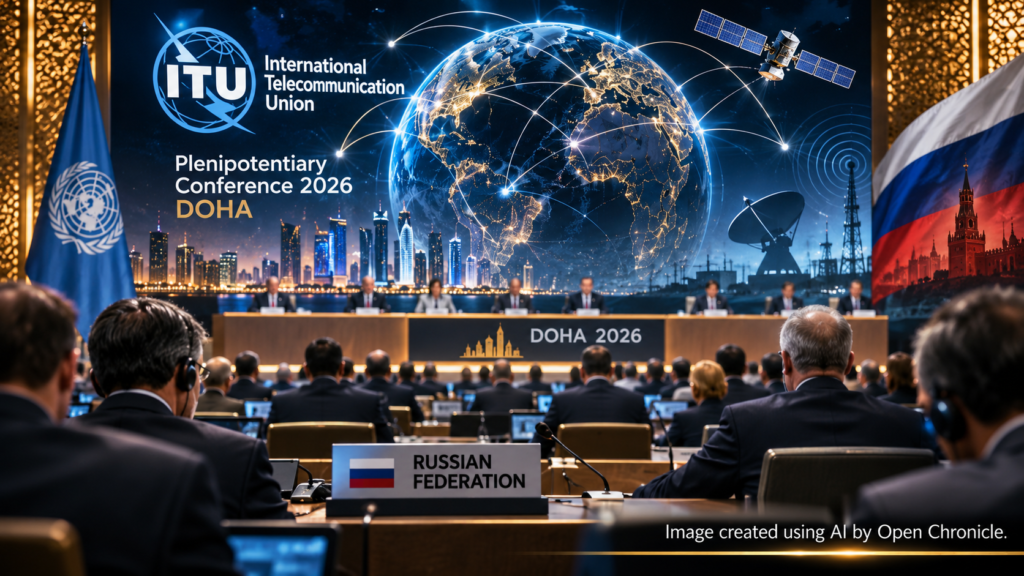
On 16 November 2026, Russia failed in its attempts to secure positions on two important bodies of the International Telecommunication Union, the United Nations specialised agency responsible for coordinating global telecommunications.
The result was a setback for Moscow’s efforts to regain influence within parts of the multilateral system at a time when the war in Ukraine continues to shape its international relationships.
Russia’s candidate for the ITU’s Radio Regulations Board received 58 votes. Successful candidates from Azerbaijan and Kazakhstan received 111 and 70 votes respectively.
Moscow also failed to obtain a seat on the organisation’s 48-member Council, which oversees important aspects of the agency’s strategy, budget and administration between its major conferences.
The results were reported by Reuters on Monday, citing diplomatic assessments of Russia’s efforts to reduce its international isolation.
The significance of the elections extends beyond the immediate outcome.
The ITU is responsible for an international framework that helps mobile networks, satellites, broadcasters and other wireless systems operate without unacceptable interference.
It is also involved in telecommunications standardisation, digital development and international cooperation on emerging technologies.
Influence inside this institution can provide opportunities to shape technical discussions, participate in regulatory decisions and contribute to long-term international policy.
For Russia, the unsuccessful candidacies therefore represent more than a symbolic diplomatic defeat.
They illustrate the difficulties Moscow continues to encounter when attempting to translate its international relationships into institutional influence.
At the same time, the result raises a larger question.
Who will shape the rules governing the global communications systems on which modern societies increasingly depend?
What happened in Doha?
The elections took place during the ITU’s 2026 Plenipotentiary Conference, held in Doha from 9 to 27 November.
The conference is the organisation’s highest decision-making forum.
Every four years, representatives of member states gather to determine strategic priorities, approve financial plans and elect the officials and bodies responsible for guiding the organisation.
The 2026 conference is particularly significant because telecommunications are undergoing rapid technological change.
Artificial intelligence, satellite connectivity, next-generation wireless systems and the growing demand for radio spectrum are transforming the global communications environment.
Against this background, Russia sought representation in two institutional bodies.
The first was the Radio Regulations Board, a 12-member body concerned with the application and interpretation of the international Radio Regulations.
The second was the ITU Council, which has 48 seats allocated through regional electoral arrangements.
These are different institutions with distinct responsibilities.
The Radio Regulations Board deals with specialised regulatory matters relating to the use of radio frequencies and satellite systems.
The Council has a broader role in overseeing the organisation’s activities between Plenipotentiary Conferences.
According to Reuters, Russia failed to secure representation in either body.
The Radio Regulations Board result is particularly revealing.
The Russian candidate received fewer votes than the successful candidates from Azerbaijan and Kazakhstan, two countries with important historical and economic connections to Moscow.
That does not establish how either country’s government voted, because the reported totals concern individual candidacies rather than identifiable national ballots.
Nevertheless, the outcome demonstrates that longstanding regional relationships do not automatically translate into electoral success within international institutions.
The ITU’s official documentation confirms the structure of the elections and the responsibilities of the two bodies.
The results also need to be understood in the context of a much broader conference, where leadership elections and policy negotiations continue to shape the organisation’s future.
Why the International Telecommunication Union matters
The ITU rarely attracts the attention given to the United Nations Security Council, NATO or major international economic institutions.
Yet its work affects technologies used by billions of people.
Founded in 1865 as the International Telegraph Union, it predates the United Nations by eight decades.
Its original purpose was to facilitate international telegraph communications at a time when networks were expanding across national borders.
The organisation evolved as new technologies transformed communication.
Telephony, radio broadcasting, satellite systems, mobile networks and digital connectivity created increasingly complex international coordination requirements.
Today, the ITU brings together 194 member states and more than 1,000 companies, universities and other organisations.
Its work is organised around three principal areas: radiocommunication, telecommunications standardisation and telecommunications development.
These functions may appear technical.
Their geopolitical importance is substantial.
Consider a satellite transmitting information across several countries.
Its communications depend on radio frequencies that must be coordinated internationally to reduce harmful interference.
Consider mobile networks operating near national borders.
Without appropriate coordination, systems using overlapping frequencies could disrupt one another.
Consider the expansion of satellite internet services.
Companies and governments must navigate international regulatory frameworks governing spectrum use and orbital resources.
These arrangements are not simply commercial conveniences.
They are part of the infrastructure supporting international communications.
The ITU helps establish the technical and regulatory conditions under which those systems operate.
It does not control every aspect of the internet, nor does it independently govern all artificial intelligence technologies.
Its authority is more specific.
But within its areas of responsibility, international coordination is essential.
That makes the organisation strategically important even when its decisions attract little public attention.
The invisible geography of radio frequencies
Modern geopolitics is often described through territory.
States compete over borders, maritime routes, energy resources and strategically important regions.
But communications technology introduces another dimension.
The electromagnetic spectrum is an essential resource for wireless communication.
Different portions of the spectrum support different services, including mobile networks, broadcasting, satellite communications, aviation systems and scientific applications.
Unlike a conventional physical resource, radio spectrum cannot be divided into exclusive national territories without considering how transmissions propagate.
Signals can cross borders.
Satellites can serve multiple countries.
Different systems may interfere with one another when frequencies are not appropriately coordinated.
International rules therefore help manage a resource that is simultaneously technical, economic and strategic.
The ITU’s Radio Regulations provide an international treaty framework for the use of radio frequencies and associated satellite-orbit resources.
The Radio Regulations Board has a defined role in applying and interpreting aspects of that framework.
Membership does not give a country ownership of frequencies or the unilateral power to decide how other states use them.
Nor does it allow an individual board member to act simply as a national delegate.
Board members are expected to exercise their responsibilities independently under the organisation’s rules.
Nevertheless, elections determine who participates in this specialised regulatory institution.
That creates an important connection between international diplomacy and technical governance.
States seek representation not necessarily because a single election will determine the future of telecommunications, but because institutional participation provides opportunities to contribute to decisions and debates that may have lasting consequences.
Why Russia wanted to regain influence
Russia’s unsuccessful candidacies took place against the background of its continuing war against Ukraine.
Since the full-scale invasion began in February 2022, Moscow has faced sanctions, diplomatic criticism and restrictions on participation in various international activities.
However, Russia has not been excluded from the entire multilateral system.
It remains a permanent member of the United Nations Security Council and continues to participate in numerous international organisations.
Its relationships with countries outside Europe and North America also remain significant.
This creates a complex diplomatic environment.
Russia faces substantial opposition in some institutions while maintaining partnerships and channels of influence in others.
According to diplomats cited by Reuters, Moscow had hoped to benefit from growing fatigue surrounding the war in Ukraine and from the reluctance of some governments to oppose Russia publicly.
The objective, as described in that reporting, was to reduce its isolation and increase its influence within international bodies.
That assessment should be distinguished from a publicly verified statement of Russia’s own electoral strategy.
The fact that Moscow submitted candidacies is established.
Its broader diplomatic intentions are partly interpreted through the accounts of diplomats familiar with the process.
The distinction matters because international elections involve multiple motivations.
A country may seek representation to defend technical interests, maintain institutional visibility, contribute expertise or advance broader diplomatic objectives.
These motivations can overlap.
For Russia, telecommunications are strategically relevant because modern military, economic and governmental systems depend heavily on communications infrastructure.
Satellite networks, radio systems and digital connectivity are increasingly important to national security.
But the ITU’s mandate remains primarily concerned with international telecommunications coordination and development.
The election should therefore not be portrayed as a direct vote on control of military communications.
It was an institutional contest with wider geopolitical implications.
Ukraine and the struggle over communications infrastructure
Ukraine’s response to Russia’s electoral defeat reflects the connection between telecommunications governance and the ongoing war.
According to Reuters, Ukraine’s ambassador to the United Nations described the result as evidence that Russia continued to face international isolation because of its aggression.
Ukraine has repeatedly raised concerns about the destruction and disruption of telecommunications infrastructure during the conflict.
The war has damaged mobile networks, communications facilities and other essential systems.
Reuters reported a Ukrainian estimate of more than $2.5 billion in damage to telecommunications infrastructure, excluding cyberattacks.
That figure should be understood as a Ukrainian assessment, rather than an independently audited total established in this article.
The ITU has also dealt with complaints involving interference with satellite signals attributed to Russia.
Such disputes demonstrate why international telecommunications regulation can become politically sensitive during armed conflict.
Radio interference may affect communications services across national boundaries.
Damage to telecommunications networks can disrupt civilian life, emergency services and economic activity.
Satellite systems can become entangled in wider security disputes.
International institutions responsible for technical coordination may consequently face questions that are difficult to separate from geopolitical conflict.
This does not mean that the ITU is a court responsible for determining every allegation of wartime wrongdoing.
Its procedures and authority are defined by its governing instruments.
Nevertheless, the organisation operates in a world where telecommunications infrastructure is increasingly connected to national security.
The war in Ukraine has made that connection especially visible.
A defeat that reveals the limits of diplomatic recovery
Russia’s electoral failure is noteworthy because it occurred at a time when some governments have been reconsidering aspects of their relationships with Moscow.
Diplomatic isolation is rarely absolute.
Countries may condemn particular military actions while maintaining trade, energy cooperation or diplomatic dialogue.
Others may avoid taking explicit positions in international disputes.
A government may also support Russia in one institution while voting differently in another.
International elections are therefore imperfect measures of geopolitical alignment.
The ITU results cannot be interpreted as proof that all participating governments have adopted a unified policy toward Moscow.
Nor do they establish that Russia has lost influence across the wider United Nations system.
They do, however, provide a concrete example of the limits Moscow continues to face in securing institutional representation.
That distinction is important.
The election represents a measurable outcome.
The broader significance requires interpretation.
A diplomatic defeat at a technical agency is not equivalent to a major strategic reversal.
But repeated failures to secure international positions can affect a country’s opportunities to participate in institutional governance.
Over time, such outcomes may influence how states assess their diplomatic reach.
For Russia, the challenge is not simply maintaining bilateral relationships.
It is translating those relationships into support in competitive multilateral elections.
The Doha results suggest that this remains difficult in at least some international forums.
The broader contest for technological influence
The significance of the ITU elections extends beyond Russia.
The organisation operates at the intersection of technology, economics and international governance.
Governments increasingly regard advanced communications systems as essential to economic competitiveness and national security.
The development of future mobile networks, satellite services and digital infrastructure involves choices that can influence markets for years.
Technical standards can affect interoperability.
Spectrum arrangements can influence the availability and performance of wireless services.
International cooperation can help expand connectivity in countries with limited telecommunications infrastructure.
These issues are not necessarily zero-sum contests.
Shared technical rules can benefit competing states simultaneously.
A globally coordinated system may reduce interference, support investment and improve access to communications services.
Nevertheless, governments and companies can have different interests concerning technological development.
A country with a strong satellite industry may prioritise regulatory arrangements that support particular services.
A country seeking to expand mobile connectivity may emphasise access to additional spectrum.
Governments concerned about security may place greater weight on resilience and interference protection.
Developing economies may focus on affordability, infrastructure investment and access to international expertise.
The ITU provides a forum where such interests can be discussed and negotiated.
The resulting decisions often involve technical compromises rather than dramatic geopolitical confrontations.
But those compromises can shape the environment in which global technology develops.
This is why elections at the ITU deserve attention.
They help determine who participates in important institutional processes, even if no single elected position gives its holder control over global communications.
The importance of the new ITU leadership
The Russian defeat also comes during a broader renewal of the organisation’s leadership.
On 12 November, member states re-elected Doreen Bogdan-Martin of the United States as Secretary-General.
She received 164 votes out of 173 cast, securing a second term.
The following day, Adel Darwish of Bahrain was elected Deputy Secretary-General.
The conference also elected directors responsible for the ITU’s three technical sectors.
Eric Fournier of France was elected to lead the Radiocommunication Bureau.
Seizo Onoe of Japan was re-elected to lead the Telecommunication Standardization Bureau.
Nele Leosk of Estonia was elected to lead the Telecommunication Development Bureau.
These appointments demonstrate the international composition of the organisation’s leadership.
They should not be interpreted as a single geopolitical bloc taking control of the ITU.
Elected officials serve within an international institutional framework and are expected to fulfil their responsibilities accordingly.
Nevertheless, the elections determine the leadership responsible for guiding the organisation through a period of technological transformation.
The coming years will involve difficult questions about satellite connectivity, digital inclusion, international standards and the coordination of increasingly congested communications systems.
The ITU’s ability to maintain cooperation among states with competing interests will be an important measure of its effectiveness.
The paradox of international technology governance
The Doha elections highlight a paradox.
The world’s governments are increasingly divided over security, trade and technology.
Yet the technologies they rely upon require international cooperation.
Satellites cannot operate effectively within purely national regulatory systems.
Radio interference does not respect political borders.
Global communications networks depend on compatibility, coordination and predictable rules.
Even states engaged in serious geopolitical confrontation have practical reasons to preserve certain forms of technical cooperation.
The ITU embodies this tension.
Its members may disagree profoundly about international security while continuing to negotiate the technical arrangements required for communications systems to function.
This is one reason the organisation’s governance matters.
If technical institutions become dominated by political confrontation, their capacity to deliver practical cooperation could weaken.
Conversely, international coordination does not require governments to abandon their political disagreements.
The challenge is to maintain rules that serve the wider international system while allowing states to defend legitimate national interests.
Russia’s electoral defeat should therefore be examined within two separate frameworks.
The first is geopolitical: Moscow failed to secure the positions it sought.
The second is institutional: the ITU must continue to function as a forum for international technical cooperation regardless of the outcome.
Both dimensions matter.
Three implications for international relations
Three Strategic Implications for International Relations
Russia’s electoral setback at the International Telecommunication Union reveals broader questions about diplomatic influence, international institutions and the governance of global communications.
Technical Institutions Are Becoming Arenas of Geopolitical Competition
International influence is increasingly exercised through regulatory bodies, standard-setting organisations and specialised agencies, not only through traditional diplomatic negotiations.
Russia’s Diplomatic Isolation Remains Uneven but Consequential
Moscow retains international relationships and institutional participation, yet the Doha results demonstrate that these connections do not guarantee success in competitive elections.
Global Communications Still Depend on Cooperation
Despite geopolitical tensions, radio-frequency coordination, satellite regulation and technical interoperability require functioning international institutions.
What happens next?
The Plenipotentiary Conference continues until 27 November 2026.
The elections are only one component of a broader agenda.
Member states are also considering the ITU’s strategic and financial direction for the coming years, including the period from 2028 to 2031.
Several questions deserve attention as the conference proceeds.
Will geopolitical tensions influence the organisation’s future priorities?
Can member states maintain cooperation on spectrum and satellite regulation despite disputes involving military communications and interference?
How will the ITU address emerging technological demands while continuing its work on universal connectivity?
And will Russia’s electoral defeats affect its approach to participation in specialised United Nations institutions?
These questions cannot be answered solely from the election results.
Their significance will become clearer through the decisions adopted by the conference and the subsequent work of the organisation’s governing bodies.
For now, the Doha vote provides a revealing snapshot of international diplomacy.
Russia remains an important actor in global affairs, but its efforts to secure additional institutional influence continue to face resistance.
Conclusion: The struggle for influence is not always visible
The most consequential international contests do not always involve military deployments, economic sanctions or high-profile summits.
Sometimes they take place through ballots inside institutions whose work is unfamiliar to the wider public.
The International Telecommunication Union is one such institution.
Its decisions help shape the technical environment in which global communications operate.
Russia’s failure to secure positions on the Radio Regulations Board and ITU Council is therefore more significant than an obscure administrative setback.
It illustrates how diplomatic influence can be contested through the governance of essential technological infrastructure.
The result does not mean that Moscow has been excluded from international telecommunications cooperation.
Nor does it establish that a rival power has gained control over the world’s communications networks.
It does, however, show that international institutional influence must be earned through political support, even in organisations whose work is primarily technical.
As competition over digital infrastructure, satellites and emerging technologies intensifies, the importance of these institutions is likely to grow.
The struggle to shape the future of global communications is already underway.
And much of it is taking place far from the headlines.
Sources and Further Reading
Independent reporting and official International Telecommunication Union documentation concerning the 2026 Doha elections, international telecommunications governance and global technology diplomacy.
Russia Remains Isolated After Losing Votes for UN Telecoms Agency Posts
Reporting by Emma Farge documenting Russia’s unsuccessful bids for the Radio Regulations Board and ITU Council, election results and diplomatic reactions.
PP-26 Official Election Results
Official conference election portal providing results for the organisation’s leadership and governing bodies, including the Radio Regulations Board and ITU Council.
ITU Plenipotentiary Conference Opens in Doha
Official information concerning the conference, its mandate, the election process and the strategic priorities of the United Nations agency for digital technologies.
ITU Elects Senior Leaders in Radiocommunication, Standardization and Development
Official announcement confirming the election of Eric Fournier, Seizo Onoe and Nele Leosk to the three technical bureau director positions.
This article reflects information available on 16 November 2026. Russia’s electoral defeats and reported vote totals are based on Reuters reporting, with the ITU’s official election documentation providing institutional context. Diplomatic interpretations are distinguished from established election results. The article does not suggest that membership of ITU governing bodies confers unilateral control over international telecommunications networks or radio-frequency allocations. Strategic implications are independent editorial analysis.
Explore International Relations
Discover more reporting and analysis on diplomacy, international security, global governance and the changing balance of power.
Return to International Relations →