
OPEN CHRONICLE SPORTS MAGAZINE | MOTOGP | 17 NOVEMBER 2026
The Colombian sensation has reportedly completed his first laps aboard Honda’s new 850cc RC214V at Sepang. Beyond an early introduction to MotoGP machinery, the private session offers a revealing glimpse into Honda’s preparations for a championship entering a radically different technical era.
By Open Chronicle Sports
17 November 2026 | MotoGP News & Analysis
A Private Test With Major Implications
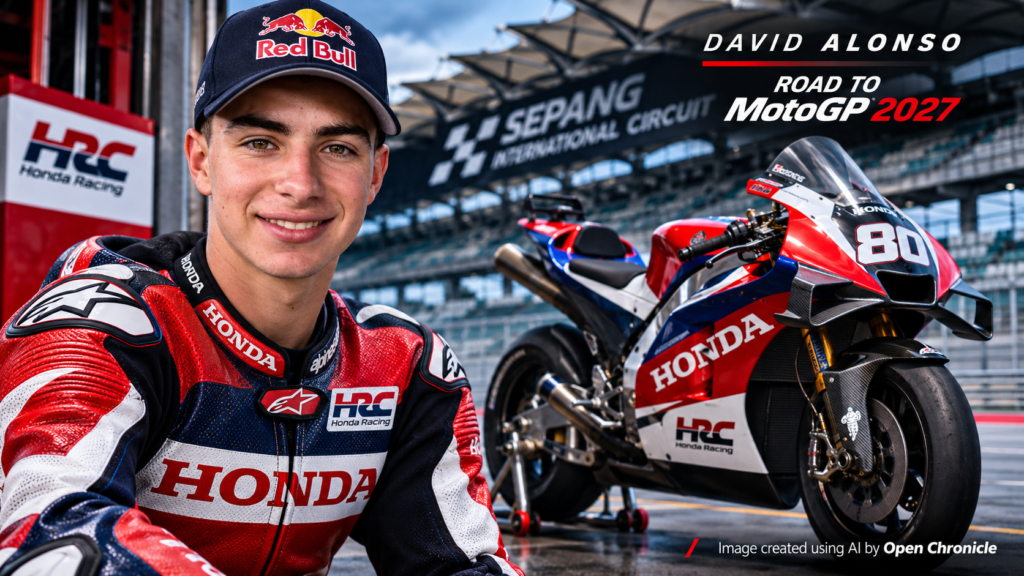
David Alonso has taken an important step towards his MotoGP debut, reportedly completing a private test aboard Honda’s new 850cc prototype at Malaysia’s Sepang International Circuit.
According to Motorsport.com, the 20-year-old rider travelled directly from the Qatar Grand Prix to Malaysia, where Honda Racing Corporation’s development team had been working on its next-generation RC214V.
The session gave Alonso his first experience of the motorcycle he is expected to race for LCR Honda in 2027.
Honda’s official test riders, Aleix Espargaró and Takaaki Nakagami, were also involved in the manufacturer’s development programme.
The test reportedly lasted a full day, with Alonso completing numerous laps and recording encouraging times. However, no official lap times or detailed performance figures have been published.
The significance extends beyond the rider’s personal preparation.
For Honda, the test represents another stage in a technical development programme designed to position the Japanese manufacturer for one of MotoGP’s most substantial regulatory transformations.
For Alonso, it provides something equally valuable: time.
Time to understand a new motorcycle, adapt to unfamiliar tyres and begin developing the technical awareness required to compete against the world’s most accomplished motorcycle racers.
Why Honda Wanted Alonso on the Bike Early
The transition from Moto2 to MotoGP is already one of the most demanding challenges in professional motorcycle racing.
Riders must adapt to substantially greater power, sophisticated electronic systems, different braking characteristics and motorcycles that generate aerodynamic forces absent from the intermediate category.
The introduction of completely new MotoGP regulations in 2027 makes that transition particularly unusual.
Alonso will not simply be learning an established machine. He will be joining the premier class as manufacturers and experienced riders adapt to a fundamentally revised technical formula.
This creates an interesting competitive opportunity.
Established MotoGP riders possess years of experience with premier-class machinery, but much of their accumulated knowledge concerns motorcycles built around the previous 1,000cc regulations and Michelin tyres.
Alonso arrives without those established habits.
That does not eliminate the enormous advantage enjoyed by experienced MotoGP competitors, but it could make his adaptation to certain aspects of the new technical package more straightforward.
Honda’s decision to introduce him to the RC214V before the official Valencia test may therefore serve two purposes.
First, it accelerates the rider’s development.
Second, it gives Honda an opportunity to gather feedback from a competitor whose recent experience comes almost entirely from smaller-capacity racing motorcycles.
That perspective could prove useful as engineers evaluate how accessible and predictable the new machine is for different riding styles.
The RC214V: Honda’s New Technical Starting Point
The motorcycle Alonso reportedly tested is Honda’s RC214V, developed for MotoGP’s 2027 regulations.
The new rules represent a major technical reset, intended to reshape performance characteristics, reduce certain aerodynamic and mechanical complexities, and create a different competitive environment.
MOTOGP TECHNICAL RESET | 2027
Engine capacity
850cc
Down from 1,000cc
Capacity reduction
15%
Compared with the previous limit
Tyre supplier
Pirelli
Replacing Michelin
Ride-height devices
Banned
Under the 2027 regulations
The revised rules also reduce aerodynamic freedoms and introduce other technical changes, including a narrower maximum cylinder bore.
Smaller Engines, Different Performance
Reducing engine capacity from 1,000cc to 850cc will change the way manufacturers approach power delivery, torque characteristics and engine development.
However, smaller engines do not necessarily mean dramatically slower motorcycles.
Manufacturers can compensate for some of the capacity reduction through combustion efficiency, electronic management, chassis development and aerodynamic optimisation.
The challenge will be producing competitive performance while remaining within the revised regulations.
Honda’s development programme at Sepang is particularly important because the manufacturer must establish a competitive technical foundation before the new era begins.
The Pirelli Factor
The transition from Michelin to Pirelli introduces another major variable.
Tyres influence almost every aspect of motorcycle behaviour, including braking stability, corner entry, maximum lean angle, traction and acceleration.
A motorcycle designed around one tyre construction cannot necessarily reproduce the same performance characteristics with another.
Honda must therefore develop its new chassis and suspension package around Pirelli’s characteristics.
For Alonso, learning those characteristics early could be just as important as understanding the new engine.
The experience gained at Sepang may help him arrive at the official test with a clearer understanding of the motorcycle’s behaviour.
A Remarkable Parallel With Marc Márquez
Honda’s decision to give Alonso an early private test also carries historical significance.
According to Motorsport.com, the manufacturer’s previous comparable private introduction for an incoming MotoGP rookie involved Marc Márquez in 2012.
Márquez subsequently entered the premier class in 2013 and immediately established himself as one of the most formidable competitors in motorcycle racing.
The comparison is intriguing, but it requires perspective.
An early private test does not establish Alonso as the next Márquez, nor does it guarantee that Honda will provide him with championship-winning machinery.
The technical environment, competitive landscape and rider development pathways are very different.
Nevertheless, the decision suggests that Honda considers Alonso’s preparation sufficiently important to justify giving him additional time aboard its future motorcycle.
That is a meaningful indication of the manufacturer’s investment in its incoming talent.
The 2027 Rookie Battle Has Already Begun
Alonso is not the only newcomer gaining experience with next-generation MotoGP machinery.
Several manufacturers have already provided opportunities for their incoming riders to familiarise themselves with the new technical package.
Nicolò Bulega has accumulated substantial testing mileage with Ducati’s 850cc prototype ahead of his move to VR46.
Izan Guevara and Senna Agius have also experienced their respective future machinery during testing in Austria.
Meanwhile, Daniel Holgado remains among the newcomers awaiting an initial opportunity to ride his 2027 motorcycle.
This creates an interesting difference in preparation across the rookie field.
Some riders will arrive at the first collective test with substantial experience of their new machines.
Others will begin with significantly less familiarity.
Whether that difference translates into meaningful performance advantages remains uncertain.
Testing mileage is valuable, but the quality of development, adaptability of the rider and competitiveness of the final motorcycle will ultimately matter more.
Honda’s Broader Strategic Challenge
The 2027 regulations offer manufacturers an opportunity to reconsider their technical direction.
Honda’s challenge is not merely to develop a competitive engine.
The company must integrate its new power unit with a chassis, aerodynamic package, electronic systems and tyre characteristics capable of producing consistent performance across different circuits.
That process requires extensive testing and close cooperation between engineers and riders.
The involvement of Aleix Espargaró and Takaaki Nakagami at Sepang provides Honda with experienced development feedback.
Alonso adds another dimension.
His introduction to the RC214V allows the manufacturer to evaluate how an incoming MotoGP rider responds to the machine without years of established experience on the previous generation.
That does not mean his feedback will automatically carry greater technical value than that of experienced test riders.
Instead, it provides a different reference point.
For a manufacturer preparing to compete under completely revised regulations, multiple perspectives can be useful.
Sports Analysis | Why This Test Matters More Than the Lap Times
The most revealing aspect of Alonso’s Sepang appearance may not be his reported pace.
It is the timing.
Honda has introduced its incoming rookie to the new motorcycle before the first official collective test of the 2027 machines.
That decision reduces one source of uncertainty in the rider’s preparation.
When Alonso arrives in Valencia on 1 December, he should already possess an initial understanding of the RC214V’s physical demands, braking behaviour and general handling characteristics.
He will also have experienced Pirelli tyres in a MotoGP environment.
This could allow him to spend more of the official session refining his understanding of the motorcycle rather than concentrating entirely on basic familiarisation.
However, the private nature of the Sepang test limits what can be concluded about performance.
Without official lap times, detailed technical information or direct statements from Honda and Alonso, there is no reliable basis for claiming that the rider is already competitive against established MotoGP competitors.
The test demonstrates preparation, not proven superiority.
For Honda, the real measure of progress will emerge when the RC214V runs alongside rival manufacturers’ machines under comparable conditions.
For Alonso, the challenge will be converting early experience into consistent performance during the 2027 season.
What Happens Next?
Road to MotoGP 2027
Five key milestones on the road to MotoGP’s new technical era.
Valencia Official Test
Official Valencia test, the first collective opportunity to assess the new generation of motorcycles.
Sepang Shakedown
Additional development and preparation as manufacturers continue refining their new-generation machines.
Official Sepang Test
Official preseason testing at Sepang, offering an early comparison of manufacturers, riders and technical packages.
Buriram Preseason Test
Final preseason development and evaluation at Thailand’s Chang International Circuit.
Thailand Grand Prix
Scheduled opening Grand Prix of the 2027 MotoGP World Championship.
What These Milestones Will Reveal
These sessions will offer a clearer picture of the competitive order and Alonso’s adaptation to MotoGP machinery.
For now, Honda’s private test in Malaysia represents an important early milestone rather than a definitive performance breakthrough.
MotoGP’s 2027 revolution is not simply about reducing engine capacity.
It represents a comprehensive transformation involving motorcycles, tyres, aerodynamics and rider adaptation.
Every manufacturer faces uncertainty, and every competitor must learn how to extract performance from unfamiliar machinery.
David Alonso’s early introduction to the Honda RC214V illustrates how seriously teams are approaching that transition.
The Colombian rider enters the premier class with considerable promise, but also with substantial challenges ahead.
Honda has given him an early opportunity to begin understanding those challenges.
Whether that preparation becomes a competitive advantage will only become clear when the new generation of MotoGP motorcycles takes to the grid in 2027.
For now, one thing is evident: Honda’s preparations for the future are already well underway, and David Alonso is becoming part of that project earlier than expected.
Sources and Further Reading
Official documentation, specialist motorsport reporting and additional background sources supporting this article.
David Alonso Tested Honda’s MotoGP Bike in a Private Test at Sepang
17 November 2026. Original reporting on Alonso’s private session, Honda’s development programme and preparations for 2027.
David Alonso Makes Secret MotoGP Debut?
17 November 2026. Additional reporting on Alonso’s test, the 2027 rookie field and Honda’s preparations.
Welcome to the Future of MotoGP: New Bikes in 2027
6 May 2024. Official explanation of the new engine capacity, aerodynamic restrictions, device bans and wider regulatory changes.
Aleix Espargaró on the 850cc Era
26 May 2026. Honda test rider Aleix Espargaró discusses the characteristics of the new motorcycles and Pirelli tyres.
Editorial Transparency
This article combines reporting published on 17 November 2026 with official MotoGP technical information and independent editorial analysis. Details of the private test originate primarily from Motorsport.com and have not been independently verified through published Honda telemetry or official lap-time data. Interpretations concerning Honda’s strategy and Alonso’s potential competitive advantages are editorial assessments, not confirmed statements from the manufacturer.