
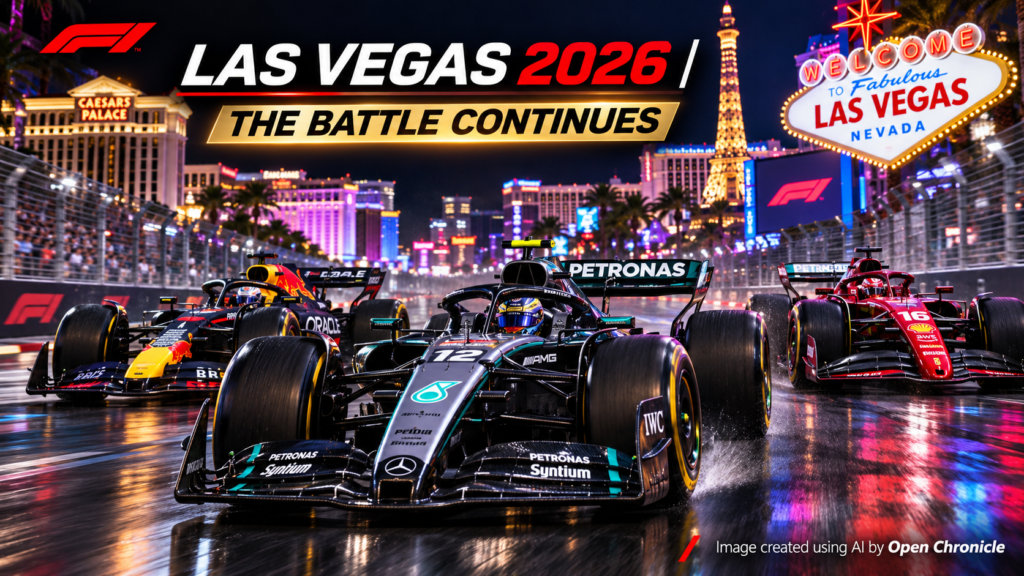
OPEN CHRONICLE SPORTS MAGAZINE | FORMULA 1 | 17 NOVEMBER 2026
Kimi Antonelli has emerged as Formula 1’s new world champion, but the championship’s final three races still carry enormous significance. As the paddock prepares for the spectacular Las Vegas Grand Prix, the battle for championship positions, technical supremacy and commercial influence is far from over.
By Open Chronicle Sports
17 November 2026 | Formula 1 | Championship Watch | Race Analysis
The Championship Is Settled. The Competition Is Not.
Formula 1 arrives in Las Vegas with an unusual combination of certainty and uncertainty.
The 2026 Drivers’ World Championship has already been decided, with Mercedes driver Kimi Antonelli establishing an unassailable advantage after a remarkable campaign.
Yet the championship still has three races remaining: Las Vegas, Qatar and Abu Dhabi.
The Las Vegas Grand Prix, scheduled for 21 November, represents the 21st round of a 23-race season. It takes place against the illuminated backdrop of the city’s famous Strip, where Formula 1 has established one of its most commercially ambitious events.
For Antonelli, the remaining races offer an opportunity to reinforce the authority of his championship-winning season.
For Max Verstappen, George Russell, Lewis Hamilton, Charles Leclerc and Lando Norris, the final rounds represent a different challenge.
The world title may no longer be available, but the battle for positions, prestige and momentum continues.
And for Formula 1 itself, Las Vegas represents something even larger: a demonstration of how far the championship’s transformation into a global entertainment business has progressed.
Antonelli’s Breakthrough Has Redefined the Season
Few developments have shaped Formula 1 in 2026 more dramatically than the emergence of Kimi Antonelli as world champion.
The Mercedes driver has combined speed, consistency and an ability to capitalise on opportunities throughout the season.
After 20 rounds, Antonelli leads the Drivers’ Championship with 390 points, 111 ahead of Verstappen.
With a maximum of 83 points available across the remaining three standard Grand Prix weekends, the championship lead is mathematically insurmountable.
His nine victories underline the scale of his achievement.
However, the statistics tell only part of the story.
Antonelli’s championship represents a generational shift in Formula 1, placing a young driver at the centre of the sport’s competitive hierarchy.
It also reinforces Mercedes’ position in a season shaped by the introduction of new technical regulations.
The significance extends beyond a single title.
Mercedes now enters the final races with the opportunity to consolidate its technical and competitive authority before rival teams redirect their development efforts towards 2027.
For Antonelli, Las Vegas is therefore not about securing the championship.
It is about demonstrating that his success can be sustained even when the pressure of the title battle has disappeared.
The Championship Battle Behind the Champion
Although first place is settled, the competition immediately behind Antonelli remains remarkably close.
2026 DRIVERS’ CHAMPIONSHIP | AFTER 20 ROUNDS
| POS | DRIVER | POINTS |
| 1 | Kimi Antonelli | 390 |
| 2 | Max Verstappen | 279 |
| 3 | George Russell | 262 |
| 4 | Lewis Hamilton | 261 |
| 5 | Charles Leclerc | 249 |
| 6 | Lando Norris | 246 |
Standings following the São Paulo Grand Prix, 8 November 2026.
Samwise Agency+1
Verstappen occupies second place, but his advantage over Russell is only 17 points.
Hamilton sits a further point behind Russell, while Leclerc and Norris remain close enough to influence the final championship order.
This creates several competing narratives.
Verstappen is seeking to defend his position as the leading challenger to Antonelli.
Russell is attempting to reinforce Mercedes’ dominance by securing second place in the championship.
Hamilton and Leclerc are fighting for the strongest possible conclusion to Ferrari’s campaign.
Norris, meanwhile, has the opportunity to recover ground and demonstrate McLaren’s competitiveness over the final races.
These battles matter because championship positions are more than statistical distinctions.
They shape how teams evaluate their seasons, influence the perception of individual drivers and contribute to the competitive narratives carried into the following year.
Mercedes Has a Different Kind of Pressure
Mercedes enters Las Vegas with both an advantage and a responsibility.
The team leads the Constructors’ Championship with 652 points, compared with Ferrari’s 510.
That advantage places Mercedes in an exceptionally strong position.
With only three races remaining, the team has already established a substantial competitive cushion.
Yet dominance creates expectations.
A championship-leading team is judged not simply by whether it wins, but by how consistently it performs across different types of circuit.
Las Vegas presents a particularly interesting test because its layout demands a combination of straight-line efficiency, braking stability, tyre management and confidence in low-grip conditions.
A car that performs exceptionally well on conventional permanent circuits does not automatically enjoy the same advantage on a street circuit with unusual surface characteristics.
Mercedes therefore has an opportunity to demonstrate the versatility of its technical package.
Its rivals have an equally important opportunity to identify areas where that package may be vulnerable.
Las Vegas: A Circuit That Rewards Efficiency and Punishes Mistakes
The Las Vegas Strip Circuit measures 6.201 kilometres and features 50 laps, producing a scheduled race distance of 309.958 kilometres.
F1 Race+1
LAS VEGAS GRAND PRIX | CIRCUIT PROFILE
Circuit length
6.201 km
Race laps
50
Race distance
309.958 km
Race date
21 Nov 2026
Local Las Vegas time
Source: Official Formula 1 Las Vegas Grand Prix circuit and event information.
The Challenge of Low Temperatures
Las Vegas is unusual because the Grand Prix takes place at night in November.
Cooler conditions can make it more difficult for drivers to bring tyres into their optimal operating window.
Tyre preparation becomes especially important during qualifying, when drivers need immediate grip to produce a competitive lap.
During the race, teams must balance tyre temperature, degradation and the risks associated with prolonged running in traffic.
The challenge is not necessarily excessive tyre wear.
In some conditions, maintaining sufficient temperature and avoiding graining may become more significant concerns.
This creates opportunities for teams with strong tyre management characteristics and drivers capable of adapting quickly to changing grip levels.
Straight-Line Speed Versus Downforce
Las Vegas also creates a demanding aerodynamic compromise.
Teams require sufficient straight-line efficiency to remain competitive along the circuit’s extended high-speed sections.
However, reducing aerodynamic drag can come at the expense of braking stability and cornering performance.
Engineers must determine how much downforce can be sacrificed without creating excessive instability through slower corners.
Under the 2026 technical regulations, the interaction between aerodynamic configuration, power-unit deployment and energy management adds further complexity.
The fastest car on a straight is not necessarily the fastest car over an entire lap.
Braking and Track Position
Heavy braking zones offer overtaking opportunities, but they also increase the importance of mechanical stability and driver confidence.
A small mistake can compromise an entire lap.
In qualifying, traffic management and track evolution may prove decisive.
During the Grand Prix, the timing of pit stops and the ability to maintain competitive pace after changing tyres could influence the result.
These characteristics make Las Vegas more than a spectacular television setting.
It is a technically demanding circuit that can expose weaknesses hidden at other venues.
The Strategy Room | Where Las Vegas Could Be Won or Lost
The most important strategic decisions may emerge from three interconnected factors: tyre preparation, energy management and the timing of pit stops.
OPEN CHRONICLE F1 | STRATEGY ROOM
01 | Tyre temperature
Drivers must generate sufficient grip without overstressing the tyres. Cool evening conditions could reward teams that manage the warm-up phase effectively.
02 | Energy deployment
The 2026 power-unit regulations place greater emphasis on electrical energy. Deployment and recovery strategies could influence straight-line performance and overtaking.
03 | Pit-stop timing
Teams must evaluate tyre degradation, traffic and potential neutralisations. The best strategy may change rapidly if a Safety Car appears.
04 | Qualifying position
A clean qualifying lap will provide a significant advantage, although the circuit’s overtaking opportunities mean grid position alone cannot determine the result.
The central strategic question is whether teams should prioritise outright qualifying performance or prepare their cars for greater consistency over the race distance.
In a tightly contested field, the difference between those approaches could determine which drivers reach the podium.
Ferrari, Red Bull and McLaren Have Their Own Reasons to Fight
With the Drivers’ Championship decided, the competitive priorities of the leading teams are no longer identical.
For Ferrari, the final three races represent an opportunity to secure second place in the Constructors’ Championship and finish the season with renewed confidence.
Hamilton and Leclerc also have individual championship positions at stake.
Their performances will be examined not only against rival teams but against each other.
Red Bull faces a different challenge.
Verstappen remains second in the Drivers’ Championship, but the team sits behind both Ferrari and Mercedes in the Constructors’ standings.
McLaren, meanwhile, is attempting to finish a difficult campaign with stronger results.
For all three teams, Las Vegas offers an opportunity to demonstrate that Mercedes’ dominance is not absolute.
A victory would not change the identity of the world champion, but it could alter the narrative surrounding the final weeks of the season.
Formula 1’s Las Vegas Experiment Is Becoming a Long-Term Project
Beyond the championship, Las Vegas represents one of Formula 1’s most ambitious commercial ventures.
The race combines international sport, luxury hospitality, live entertainment and the global visibility of the Las Vegas Strip.
It is an event designed to attract audiences beyond traditional motorsport followers.
The Las Vegas Convention and Visitors Authority confirmed on 6 November that the Grand Prix’s presence in the city has been extended through 2037.
LVCVA
That long-term commitment is significant.
It suggests that Formula 1 and its local partners see Las Vegas not as a temporary spectacle, but as an established component of the championship’s international commercial strategy.
The race also illustrates how Formula 1 has changed its approach to major events.
A Grand Prix is no longer measured exclusively by ticket sales, sporting attendance or television audiences.
Its wider economic and cultural impact has become increasingly important.
Hotels, restaurants, entertainment venues, sponsors and hospitality operators all form part of the broader commercial ecosystem.
However, the model also raises legitimate questions.
Can the event maintain its appeal over time?
How should organisers balance the interests of visitors, residents and local businesses?
And can the commercial spectacle continue to enhance the sporting product without overwhelming it?
These are important questions because Las Vegas has become a prominent symbol of Formula 1’s modern identity.
Business of F1 | Why Las Vegas Matters Beyond Racing
THE LAS VEGAS BUSINESS MODEL
Global visibility
An internationally recognisable location designed for worldwide media exposure.
Hospitality economy
Premium experiences connecting the race with hotels, restaurants and entertainment.
Commercial partnerships
Opportunities for sponsors to engage audiences across sport, tourism and lifestyle.
Long-term commitment
An event presence extended through 2037, supporting continued planning and investment.
The commercial importance of Las Vegas should not be confused with guaranteed financial success for every stakeholder.
Large international sporting events involve substantial infrastructure, operational and logistical costs.
Their economic benefits can also be distributed unevenly.
Nevertheless, the long-term agreement demonstrates the strategic importance that Formula 1 attaches to the event.
Championship Watch | The Final Three Races
Las Vegas Grand Prix
21 November 2026, Las Vegas Strip Circuit, United States. A night race defined by long straights, heavy braking and unusual tyre conditions.
Qatar Grand Prix
29 November 2026, Lusail International Circuit. A different challenge, with sustained cornering loads and demanding tyre management.
Abu Dhabi Grand Prix
6 December 2026, Yas Marina Circuit. The season finale and the last opportunity to settle the remaining championship positions.
Dates from the official Formula 1 2026 calendar.
Official Calendar of Grand Prix Races+1
Race Analysis | Five Questions That Will Define Las Vegas
1. Can Antonelli continue winning without championship pressure?
His title is secure, but the remaining races offer an opportunity to strengthen his position as Formula 1’s new benchmark.
2. Can Verstappen defend second place?
Russell, Hamilton and the other leading contenders still have opportunities to change the final championship order.
3. Will Ferrari close the gap to Mercedes?
Ferrari’s performance will provide another indication of its ability to challenge the championship’s leading constructor.
4. Which team will master the circuit’s technical demands?
Tyre temperature, energy management and aerodynamic efficiency could create unexpected competitive advantages.
5. Can Las Vegas deliver another compelling sporting event?
The commercial spectacle is firmly established, but Formula 1’s long-term success depends on the quality of the racing as well as the surrounding entertainment.
The Bigger Picture | A New Champion, an Unfinished Season
Formula 1’s 2026 championship has already produced a defining result.
Kimi Antonelli has emerged as world champion, establishing himself at the forefront of a new competitive era.
But championships are not defined exclusively by their winners.
The final races will help determine how the season is remembered, which teams finish with momentum and which drivers enter the following year with questions still to answer.
Las Vegas is an ideal setting for that final confrontation.
It combines the technical complexity of modern Formula 1 with the commercial ambition of a championship increasingly positioned at the intersection of sport and global entertainment.
The world title may be decided.
The fight for everything else is not.
Sources and Further Reading
Official championship documentation, Formula 1 reporting and independent sources supporting this analysis of the 2026 Las Vegas Grand Prix.
Official 2026 Championship Calendar
Official race dates, venues and championship schedule, including Las Vegas, Qatar and Abu Dhabi.
Las Vegas Grand Prix 2026
Official circuit information, race distance, number of laps and event schedule.
2026 Formula One World Championship Calendar
Official championship calendar documentation from the Fédération Internationale de l’Automobile.
Las Vegas Grand Prix 2026
6 November 2026. Official tourism authority announcement covering the event, entertainment programme and extension through 2037.
F1 Daily Newsletter, 14 November 2026
Championship standings following the São Paulo Grand Prix, including the leading drivers and constructors.
Editorial Transparency
This article combines official Formula 1 and FIA information, championship standings and independent editorial analysis. Assessments of team performance, strategic priorities, commercial implications and possible race outcomes are analytical interpretations rather than confirmed predictions. Championship figures reflect the standings following the São Paulo Grand Prix and may change during the remaining rounds.