
OPEN CHRONICLE | GLOBAL NEWS DESK
WORLD NEWS | EUROPEAN SECURITY | TRAVEL ADVISORY | NOVEMBER 17, 2026
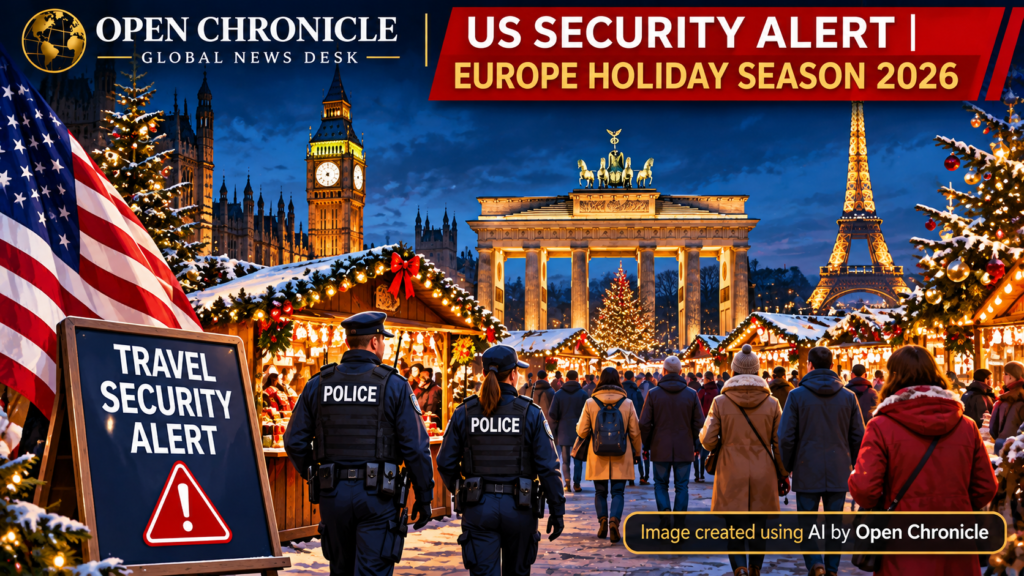
American embassies are urging travellers to remain vigilant at Christmas markets, transport hubs, religious sites and crowded public events. The security warning highlights potential risks during the holiday season, but does not, by itself, establish that a specific attack is imminent.
By Open Chronicle News Desk
November 17, 2026 | Washington, London and Europe
Washington’s Warning to Americans Travelling Across Europe
The United States has issued a security warning to American citizens travelling or residing in Europe, urging heightened vigilance as the continent prepares for the Christmas and New Year holiday season.
According to a security statement attributed to the US Embassy in London, American citizens should exercise additional caution at public gatherings, holiday festivals, transport facilities and other locations attracting large crowds.
The warning reflects longstanding concerns among security authorities that crowded public spaces may present opportunities for terrorist violence or other criminal activity.
The embassy advised Americans to maintain awareness of their surroundings and follow developments in their destinations.
“US citizens should remain vigilant of their surroundings and practice sound personal security and situational awareness,” the statement said.
It specifically identified tourist attractions, markets, shopping centres, transportation hubs, places of worship and other public spaces as locations where additional caution may be appropriate.
The embassy also warned that travel disruptions could occur during the holiday period, citing reports of hoax bomb threats affecting civil aviation in European countries.
For American travellers planning visits to London, Paris, Berlin, Rome, Madrid or other European destinations, the message is precautionary rather than a general instruction to cancel travel.
The warning does not establish that authorities have identified a specific, imminent attack against a particular European city or event.
That distinction is essential when interpreting public security alerts.
1. A Europe-wide Alert, Not Just a Warning for Britain
The security communication was not limited to the United Kingdom.
Reporting published on November 16 and 17 confirms that similar warnings were circulated through American diplomatic missions in several European countries.
The US Embassy in Berlin was among those distributing the alert, while corresponding notices appeared through diplomatic missions in Brussels, Warsaw and Bucharest. The American Embassy in Madrid also communicated the warning to travellers.
This coordinated approach suggests a broad seasonal security advisory rather than an alert focused exclusively on one city or a single identified incident.
The central message was consistent: Americans should remain alert in crowded locations, avoid demonstrations and areas of significant police activity, and follow instructions from local authorities.
Importantly, the communication did not announce that European Christmas markets were closing or that American citizens should abandon planned travel.
It also did not identify a specific terrorist organisation preparing an imminent attack at a named location.
2. Why Christmas Markets and Holiday Festivals Are a Security Concern
Europe’s Christmas markets attract millions of visitors during November and December.
Cities such as Berlin, Vienna, Strasbourg, Prague and Brussels host seasonal celebrations that bring together residents, tourists and families in densely populated public spaces.
These events often take place in historic city centres, pedestrian streets and squares where access cannot be controlled as easily as at airports or ticketed venues.
For security authorities, the concern is not that every crowded event faces an immediate threat.
It is that open public spaces can be difficult to protect completely against individuals acting alone or small groups seeking to cause mass casualties.
The latest American alert specifically mentions the possibility of attacks by lone actors, a category that can include individuals who act without direct operational support from a larger organisation.
Such threats can be particularly difficult to detect because the individual involved may not communicate extensively with an established network.
European authorities have previously responded to attacks and attempted attacks on public gatherings by introducing additional protective measures, including vehicle barriers, increased police patrols, surveillance and emergency response planning.
The new American warning should be understood within that wider security environment.
It is a reminder of an existing vulnerability, not evidence that every holiday market is currently under a specific threat.
3. Britain Remains at a Severe Terrorism Threat Level
The warning has particular significance in the United Kingdom, where the national terrorism threat level remains at severe.
Under Britain’s official threat classification system, that means an attack is considered highly likely.
The classification does not mean that an attack is necessarily expected at a specific time or place.
British reporting on November 17 confirmed that the US Embassy’s warning was consistent with heightened vigilance ahead of Christmas.
The embassy also advised American visitors to keep a low profile, avoid demonstrations and remain attentive to developments around popular tourist destinations.
For Americans visiting London, the practical implications include paying attention to security instructions at major railway stations, shopping districts, tourist attractions and seasonal events.
Travellers should also recognise that the United Kingdom’s national threat classification and the American embassy’s seasonal security alert serve different purposes.
The British classification reflects a national assessment of terrorism risk.
The American alert provides practical security guidance for US citizens abroad.
Neither should automatically be interpreted as confirmation of an imminent attack.
4. Recent Security Incidents at US Military Facilities in Britain
The warning comes against a backdrop of separate security concerns involving American military installations in the United Kingdom.
Recent incidents have included unauthorised drone activity near RAF Lakenheath and precautionary security measures affecting American military aircraft at other British facilities.
According to Associated Press reporting, US and British authorities responded to drone activity at RAF Lakenheath, while separate investigations have involved suspected threats to military installations.
The US Air Force said the Lakenheath incident was resolved without damage to personnel, aircraft or infrastructure.
These developments are relevant to the broader security environment, but they must not be confused with evidence explaining the holiday travel warning.
There is no publicly established connection between the reported military base incidents and a specific planned attack against Christmas markets or European tourist destinations.
The fact that several security concerns arise during the same period does not establish that they form part of a single operation.
For travellers, the most relevant information remains the advice issued for civilian public spaces.
5. Bomb Hoaxes and Flight Disruptions Add Another Concern
The embassy’s warning goes beyond terrorism.
It also highlights the possibility of disruptions to transport and everyday activities during the holiday season.
American diplomatic communications refer to false bomb threats affecting civil aviation in several European countries during November.
Such incidents can force authorities to carry out security checks, divert flights, evacuate facilities or temporarily interrupt operations.
A bomb threat that ultimately proves false may still cause significant disruption because authorities must assess the risk before normal operations can resume.
The warning also notes that strikes and demonstrations have become more frequent in recent months.
These can affect airports, rail services, city centres and other transport connections.
For American visitors travelling between several European countries, the combined effects of security incidents, industrial action and transport disruption may be more immediately relevant than the possibility of a terrorist attack.
The embassy consequently advises travellers to monitor local news, check directly with airlines and follow official instructions if a flight is diverted or a location evacuated.
6. What American Travellers Should Do Before Visiting Europe
The US diplomatic warning includes practical advice that Americans can follow without unnecessarily changing their travel plans.
Holiday Travel Safety Checklist
Planning to travel to Europe during the holiday season? Use this checklist to prepare for your journey, stay informed about security developments and reduce avoidable travel disruptions.
Seven essential precautions for international travellers. Tick each box as you complete the corresponding step.
01. Check Your Destination’s Travel Advisory
Review the latest US Department of State guidance for every country on your itinerary.
02. Register with STEP
Sign up for destination-specific security messages and emergency information.
03. Remain Aware in Crowded Places
Pay attention to your surroundings at Christmas markets, transport hubs and major attractions.
04. Avoid Demonstrations
Stay away from protests, unexpected disturbances and areas where police have established restrictions.
05. Monitor Flights and Rail Services
Check directly with airlines and transport operators before departure.
06. Share Your Itinerary
Tell a trusted contact where you are staying and how to reach you.
07. Know the Local Emergency Number
In European Union countries, 112 connects callers with emergency services.
Essential US Department of State Services
The US Department of State provides two particularly useful services for American citizens travelling or residing abroad.
Smart Traveler Enrollment Program
Register a trip to receive destination-specific security information and facilitate emergency contact.
US State Department Travel Advisories
Check country-specific risk assessments, entry information and current official guidance.
Security conditions can change without advance notice. Travellers should follow instructions from local authorities, monitor official updates and consult their destination’s current travel advisory before departure.
This checklist provides general travel safety information and does not replace official government guidance.
7. Does the Alert Mean Americans Should Cancel European Holidays?
The available information does not support a blanket recommendation to cancel European travel.
The warning urges additional vigilance rather than imposing travel restrictions.
The State Department maintains country-specific travel advisories, which remain the appropriate reference for determining whether the US government recommends ordinary precautions, increased caution, reconsidering travel or avoiding a destination altogether.
A Europe-wide embassy security alert does not automatically change every country’s advisory level.
For example, the State Department’s advisory listings distinguish countries such as Portugal and Poland, which have been classified at Level 1, from destinations where higher levels of caution apply. Travellers should check the current classification immediately before departure.
The sensible response is therefore proportionate.
Visitors should remain informed, understand local security arrangements and take reasonable precautions at crowded events.
They should not assume that the issuance of a security alert means a terrorist attack is inevitable.
8. Open Chronicle Analysis | Why Washington Is Issuing a Broad Warning Now
The timing of the warning is significant.
Europe is approaching a period characterised by increased international travel, large seasonal gatherings and intensive use of public transport.
American diplomatic missions must communicate risks to citizens travelling through multiple countries with different security environments and emergency arrangements.
A broadly distributed warning allows the State Department to reinforce common precautions without asserting that every destination faces the same level of danger.
Three factors help explain the advisory’s importance.
First, the seasonal concentration of crowds. Christmas markets and public celebrations bring large numbers of people into accessible urban locations, increasing the potential consequences of any violent incident.
Second, the challenge of detecting individual attackers. The warning explicitly recognises that lone actors may operate with limited advance warning, making public vigilance and rapid emergency response important.
Third, the possibility of disruption without an actual attack. Bomb hoaxes, demonstrations and transport interruptions can affect thousands of travellers even when no terrorist incident occurs.
The embassy’s communication addresses all three concerns.
However, the available public information does not establish whether the advisory was prompted by new classified intelligence, a specific threat assessment or routine seasonal risk management.
It would therefore be misleading to describe the warning as proof that American intelligence agencies have uncovered a coordinated terrorist plot targeting European Christmas markets.
9. What Remains Unknown
Several questions remain unanswered publicly as of November 17.
The American security communication does not identify a named organisation preparing an attack, disclose a specific target or provide a timetable for an imminent incident.
It does not establish whether intelligence agencies have detected a new operational plot or whether the warning primarily reflects heightened seasonal precautions.
Nor does the advisory indicate that every European country faces an identical threat.
Those limitations matter.
Public security warnings are designed to reduce risk, but their language can sometimes be interpreted more dramatically than the available evidence supports.
Responsible reporting must distinguish between a potential threat, a specific intelligence warning and a confirmed operational plot.
The latest American advisory belongs in the first category on the basis of the information made public.
Conclusion | Vigilance, Not Panic, as Europe Enters the Holiday Season
The United States has delivered a clear message to Americans planning European travel during the final weeks of 2026: remain alert, follow local security guidance and prepare for possible disruptions.
The warning covers crowded holiday festivals, tourist attractions, transportation hubs, shopping centres and religious sites.
It also highlights recent aviation bomb hoaxes and the potential impact of strikes and demonstrations.
The fact that multiple American diplomatic missions have circulated similar guidance demonstrates the breadth of Washington’s precautionary messaging.
It does not establish that a specific terrorist attack is imminent.
For travellers, the most useful response is preparation rather than alarm.
For European governments, the warning reinforces the continuing challenge of protecting accessible public spaces while preserving the openness and normal activity that define the holiday season.
The central distinction remains clear: an elevated security warning calls for greater awareness, not the assumption that an attack is certain.
Sources and Further Reading
Reporting and security information available November 17, 2026.
ITV News | US Citizens in UK Warned by Embassy to Keep a Low Profile Amid Terror Threat
November 16, 2026. Reporting on the embassy warning, its Europe-wide distribution and the United Kingdom’s terrorism threat level.
Sky News | Americans Urged to Keep a Low Profile in UK Amid Terror Threat
November 17, 2026. Additional reporting on holiday security precautions and the risk of attacks involving lone actors.
US Embassy Brussels | Security Alert, November 17, 2026
Reproduction of the diplomatic security notice covering holiday gatherings, transport disruption and traveller precautions.
US Embassy Warsaw | Europe Holiday Security Alert
Security guidance circulated by the American diplomatic mission in Poland, including recommended precautions.
Associated Press | Drone Activity Over US Base in Britain Prompts Security Response
November 2026. Context on separate security incidents affecting American military facilities in Britain.
US Department of State | International Travel Advisories
Official country-specific travel risk assessments and safety information.
US Department of State | Smart Traveler Enrollment Program
Official registration service for Americans travelling or residing abroad.
This article draws on the security warning attributed to the US Embassy in London, corresponding diplomatic alerts circulated in Europe, reporting published by ITV News, Sky News and Associated Press, and official US Department of State travel resources.
Open Chronicle distinguishes the publicly documented precautionary warning from unverified claims about specific terrorist plots or imminent attacks.
The analysis of seasonal security risks, public gathering vulnerabilities and the implications of coordinated diplomatic messaging represents independent editorial interpretation. No classified intelligence assessment or confidential operational information was available for independent examination.
Information reflects reporting available on November 17, 2026.