
OPEN CHRONICLE | GLOBAL NEWS DESK
US NEWS | BANKING & FINANCIAL TECHNOLOGY | NOVEMBER 17, 2026
Thousands of Americans reported problems accessing banking services and sending payments after a software malfunction at JPMorgan Chase. Although the bank says transactions are processing normally again, the disruption raises wider questions about the resilience of America’s increasingly interconnected financial infrastructure.
By Open Chronicle News Desk
November 17, 2026 | United States | Banking | Economy | Technology
A Software Failure With Consequences Beyond One Bank
A technical malfunction at JPMorgan Chase disrupted payment processing and digital banking services on Monday, November 16, generating thousands of customer complaints and affecting transactions involving several of the largest financial institutions in the United States.
The disruption illustrates how a problem originating inside a single major bank can produce consequences across a much wider network of financial institutions, payment services and consumers.
Customers reported difficulties accessing Chase accounts, transferring money and completing transactions through Zelle, the widely used American payment network.
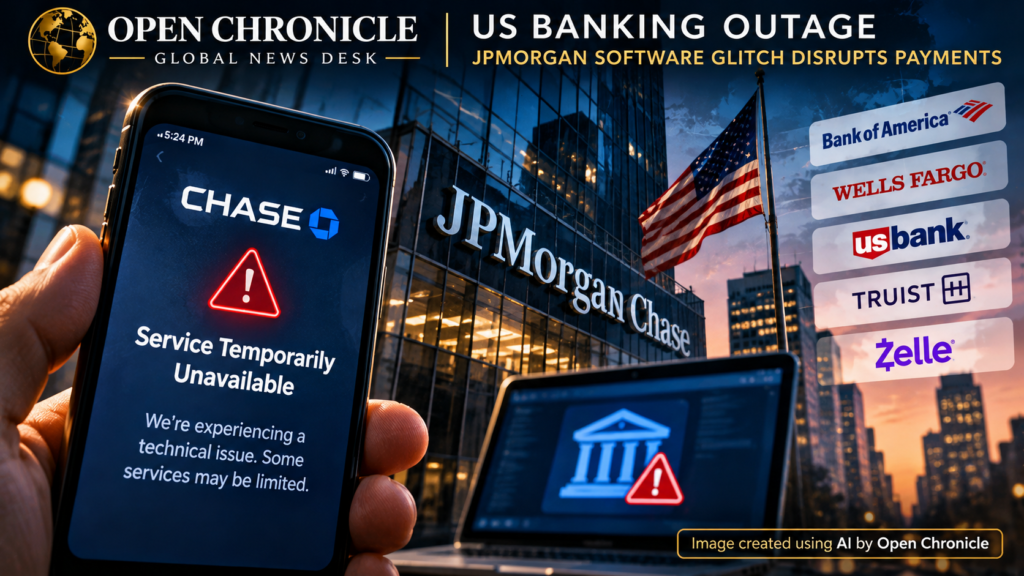
Complaints also appeared on Downdetector for Bank of America, Wells Fargo, US Bank and Truist.
However, the appearance of several banking institutions on an outage monitoring platform does not necessarily mean each experienced an independent technical failure.
JPMorgan attributed the disruption to a software bug affecting hardware located within its own facilities.
The bank said the malfunction slowed transaction processing and created delays that could affect other financial institutions handling payments involving Chase.
By Monday evening, the company said the problem had been resolved.
According to a statement reported by FOX Local at approximately 8:15 p.m. Eastern Time, Chase confirmed that transactions were processing normally again.
The bank also indicated that customers had retained access to their accounts and funds during the incident.
Although the reported problem was temporary, its wider implications deserve attention.
For millions of Americans, digital banking is no longer simply a convenient alternative to visiting a branch. It is the primary mechanism through which salaries, bills, household expenses and transfers between family members are managed.
When those systems malfunction, even briefly, the consequences can extend far beyond an inaccessible banking application.
1. What Happened During the November 16 Banking Disruption?
The incident became visible through customer complaints describing problems with banking applications, online account access and electronic payments.
Some Chase customers reportedly encountered messages indicating that particular services were temporarily unavailable.
Others described delays involving transfers, payment processing and account functions.
The disruption also generated reports involving Zelle, which enables eligible customers to send money between participating US bank accounts.
Because Zelle transactions depend on participating financial institutions and their underlying processing systems, difficulties involving one major institution can affect payments involving customers at another.
JPMorgan acknowledged that its technical issue had implications beyond Chase.
The bank explained that other institutions could experience delays when processing transactions connected to its systems.
That distinction is important.
A payment sent from one bank to an account at Chase may depend on the receiving institution’s ability to process the transaction.
If that process is delayed, the sending customer may experience a problem even though the sending bank’s own systems are functioning normally.
This helps explain why complaints appeared across several financial brands during the same period.
The precise number of customers whose transactions were actually delayed has not been publicly established in the information available for this report.
Downdetector reports provide useful indications of service disruption, but they do not represent a verified count of affected accounts or failed transactions.
2. JPMorgan Identifies a Software Bug, Not a Cyberattack
One of the most important details in JPMorgan’s explanation concerns the reported cause.
The bank attributed the disruption to a software malfunction affecting hardware within its facilities.
It did not describe the incident as a cyberattack.
That distinction matters because outages involving financial institutions can quickly generate speculation about ransomware, hostile state activity or the compromise of customer information.
A software defect can interrupt essential services without any malicious external involvement.
Financial systems depend on complex combinations of software, hardware, internal networks, databases and transaction processing applications.
A malfunction affecting one component can delay other processes that rely on it.
However, the public explanation does not provide enough technical detail to determine precisely which internal component failed or how the malfunction propagated through JPMorgan’s infrastructure.
There is also no basis in the supplied reporting to conclude that customer data was stolen or that the disruption resulted from unauthorised access.
The available account identifies a software problem, not a confirmed cybersecurity breach.
The distinction does not make the incident insignificant.
Technical reliability is itself a major component of financial security.
A bank does not need to suffer a cyberattack for its customers to experience serious disruption.
3. Which Banks Were Affected?
The disruption generated customer complaints involving several of America’s largest banking institutions.
Reporting by Reuters, Associated Press and CBS News identified Chase, Bank of America, Wells Fargo, US Bank, Truist and other institutions among those appearing in outage reports.
However, statements from the banks and payment providers revealed an important difference between customers experiencing difficulties and an institution suffering an internal system failure.
| Institution | What was reported |
|---|---|
| JPMorgan Chase | Confirmed a software malfunction affecting transaction processing. |
| Bank of America | Customer complaints increased, but a separate internal outage was not established. |
| Wells Fargo | Customers reported difficulties, and the bank acknowledged technical issues. |
| US Bank | Said its own systems were not directly affected, although some transfers involving other banks could be delayed. |
| Truist | Appeared in customer outage reports, while its services were reported to be operating normally. |
| Capital One | Customer complaints were recorded, but the institution reported normal operations. |
| Zelle | Said its payment network was operational, although problems at participating banks could affect transfers. |
This is a significant distinction for customers trying to determine whether their bank experienced a technical failure or whether an individual transaction was delayed by another institution.
Zelle’s operator, Early Warning Services, indicated that its network was functioning, according to CBS News and Associated Press reporting.
The episode therefore should not be described as the simultaneous collapse of multiple American banking systems.
Instead, it was a confirmed problem at JPMorgan Chase accompanied by reported difficulties and payment delays across interconnected institutions.
4. Why Zelle Payments Were Delayed Even Though Its Network Was Operating
For millions of Americans, Zelle has become an everyday tool for transferring money.
Its popularity rests on the ability to move funds quickly between eligible bank accounts without relying on traditional payment methods such as checks.
The November 16 disruption exposed an important feature of that convenience.
A payment service can remain operational while individual transactions are delayed by problems at the banks participating in the network.
Zelle is operated by Early Warning Services, a company owned by several major American financial institutions, including JPMorgan Chase, Bank of America, Wells Fargo, Capital One, PNC Bank, Truist and US Bank.
When a customer sends a payment through Zelle, the experience depends not only on the payment network but also on the institutions handling the transfer.
A disruption at one participating bank can therefore affect a transaction even when the wider network continues functioning.
This is why Zelle’s statement that its service remained operational did not necessarily contradict customer reports of delayed payments.
The distinction also matters when customers attempt to resolve a problem.
A payment showing as pending may require investigation by the sending or receiving bank rather than by the payment network itself.
5. What Customers Should Do if a Payment Is Missing or Delayed
Although Chase reported that transactions had returned to normal, customers who experienced difficulties should still review their accounts for any outstanding issues.
Payment Recovery Checklist
If your bank experienced a technical disruption, use this practical checklist to review your transactions, identify unresolved payments and protect yourself from unnecessary fees or duplicate transfers.
Tick each box as you complete the corresponding action.
You can change your selections at any time while reading this page.
01. Check Your Transaction History
Confirm whether the payment is pending, completed, declined or reversed.
02. Avoid Immediately Repeating a Payment
A delayed transaction may still complete, potentially creating a duplicate payment.
03. Verify the Recipient
For Zelle transfers, confirm the recipient’s details and check the payment status before taking further action.
04. Keep a Record of the Disruption
Save transaction references, error messages and relevant timestamps.
05. Contact Your Bank Directly
Use the official banking application, website or telephone number to investigate unresolved payments.
06. Review Fees and Deadlines
If the outage caused a late payment or overdraft fee, ask the bank whether an adjustment is available.
Never share your banking password, security codes or account credentials with anyone claiming to resolve an outage. Always contact your financial institution through its official communication channels.
Customers should also be alert to fraudulent messages exploiting the disruption.
Criminals sometimes use widely reported service failures as an opportunity to impersonate financial institutions and request passwords, verification codes or account information.
A legitimate bank outage does not justify sharing sensitive credentials with an unsolicited caller or responding to suspicious links.
If an electronic transfer remains unresolved, customers may also have rights under federal consumer protection rules, depending on the type of transaction and the circumstances.
The Consumer Financial Protection Bureau provides guidance on electronic fund transfers, errors and complaints.
6. The Bigger Problem: America’s Dependence on Interconnected Banking Infrastructure
The incident raises a question extending beyond JPMorgan Chase.
How resilient is America’s financial system when essential digital services depend on a relatively small number of large institutions and interconnected technological platforms?
Modern banking relies on multiple layers of infrastructure.
These include customer-facing applications, internal transaction systems, interbank payment arrangements, telecommunications networks and external service providers.
Not every payment travels through the same infrastructure, but many transactions require several independent systems to function correctly.
A failure in one component may create delays elsewhere.
This does not necessarily represent a systemic financial crisis.
There is a fundamental difference between a bank temporarily struggling to process transactions and a bank lacking the financial resources to meet its obligations.
The first is an operational problem.
The second may indicate a liquidity or solvency problem.
The November 16 disruption was publicly described as the former.
JPMorgan’s assurance that customers retained access to their accounts and funds was therefore significant.
Nevertheless, operational resilience matters because customers increasingly depend on uninterrupted digital access to their money.
For a household waiting for a transfer to cover rent, an hours-long delay can have immediate consequences.
For a small business relying on electronic payments to purchase supplies or pay employees, a disruption can create cash flow difficulties even when the underlying funds remain safe.
For banks, the challenge is not simply preventing technical failures.
It is ensuring that a malfunction can be isolated, diagnosed and resolved without producing unnecessary disruption across connected services.
7. Three Major US Technology Disruptions in Days
The JPMorgan incident followed a period of disruption involving other important American technology services.
Microsoft experienced a major service interruption affecting products including Outlook, Teams and Copilot.
Separately, an air traffic control communications failure contributed to a nationwide grounding of flights.
The three incidents affected different sectors, but together they illustrate the importance of operational resilience in essential services.
There is no established evidence that the banking malfunction, Microsoft disruption and aviation incident were technically connected.
Nor does their proximity in time establish a coordinated cyberattack.
The similarities lie in their consequences rather than a demonstrated common cause.
Each affected services on which large numbers of Americans depend.
Each also demonstrated how technical problems can quickly become matters of national public concern.
The broader lesson is that reliability, redundancy and effective recovery procedures are essential components of modern infrastructure.
8. Should Americans Be Worried About the Safety of Their Money?
The incident may understandably concern customers who experienced difficulties accessing accounts or completing payments.
However, the available reporting does not establish that the disruption endangered customer deposits.
JPMorgan described the problem as a temporary technical malfunction rather than a systemic banking failure.
It also stated that customers continued to have access to their accounts and funds.
An unavailable banking function does not automatically mean money has disappeared, that an institution is insolvent or that deposit insurance protections have changed.
The Federal Deposit Insurance Corporation provides deposit insurance for eligible accounts at insured banks, subject to applicable coverage limits and rules.
That protection concerns the failure of an insured institution. It does not guarantee uninterrupted access to every digital banking service.
The more immediate concern following an operational outage is whether individual transactions have been completed accurately.
Customers should therefore focus on checking account balances, transaction histories and any outstanding payments rather than assuming that a temporary service disruption indicates a broader financial emergency.
9. The Questions JPMorgan Still Needs to Answer
Although the bank has confirmed that transaction processing returned to normal, several important operational questions remain.
What exactly failed?
JPMorgan has attributed the incident to a software bug affecting internal hardware systems. The precise technical mechanism has not been publicly detailed in the reporting reviewed.
How many customers experienced actual transaction delays?
Downdetector recorded thousands of complaints, but these reports do not establish the total number of affected accounts or transactions.
How long did the disruption last?
Problems emerged during Monday, and the bank confirmed recovery that evening. A complete technical timeline has not been made public.
Were any transactions duplicated, rejected or incorrectly recorded?
The available reporting does not establish widespread permanent transaction errors. Individual customers may nevertheless need to investigate unresolved payments.
What measures will prevent a recurrence?
The bank has not publicly detailed a comprehensive corrective action plan in the sources reviewed.
These questions are important because restoring a service and explaining why it failed are two different stages of incident management.
The first addresses the immediate disruption.
The second helps determine whether the underlying weakness has been adequately resolved.
10. Open Chronicle Analysis | The Hidden Cost of Digital Convenience
The November 16 banking disruption illustrates a paradox of modern financial technology.
Digital payments have made banking faster, more accessible and more convenient.
At the same time, the concentration of essential financial activities within interconnected technological systems means that a relatively localised malfunction can have widespread consequences.
The incident does not demonstrate that America’s banking system is unstable.
It does demonstrate that operational reliability deserves the same serious attention as cybersecurity and financial risk management.
Three lessons emerge.
First, banks must be able to isolate failures before they spread through dependent services.
Second, customers need clear, timely communication explaining whether their funds remain accessible and whether payments require further action.
Third, regulators and financial institutions must continue examining the resilience of critical payment infrastructure as digital transactions become increasingly central to everyday economic activity.
These concerns are not limited to JPMorgan Chase.
They apply across an American financial system in which banks, payment networks and technology providers depend on one another to deliver services that consumers expect to be available continuously.
Conclusion | Banking Services Are Restored, but the Resilience Question Remains
By Monday evening, November 16, JPMorgan Chase said transactions were processing normally again.
The bank attributed the disruption to an internal software malfunction and reported no evidence that the incident was related to a cyberattack.
Although customers at several major financial institutions reported difficulties, available evidence does not establish that all those banks experienced independent technical failures.
The incident was therefore a significant operational disruption, not a confirmed systemic banking crisis.
For American consumers, the immediate priority is straightforward: verify any outstanding payments, avoid accidentally repeating transfers and contact the relevant financial institution if problems persist.
For the banking industry, the implications are broader.
The reliability of America’s financial system increasingly depends not only on the strength of its banks, but also on the resilience of the technology connecting them.
The November 16 outage was resolved. The questions it raises about digital infrastructure, operational dependencies and customer protection remain relevant.
Sources and Further Reading
Selected reporting published November 16 and 17, 2026, with official consumer guidance for further reference.
Reuters | JPMorgan Says Software Bug Slows Its Transactions
November 16, 2026. Reporting on JPMorgan’s explanation, the impact on other institutions and the bank’s statement that the disruption was not cyber-related.
Associated Press | What to Know About the Online Banking Delays Affecting Major US Banks
November 16, 2026. Examination of the banking disruption, customer complaints, Zelle transactions and responses from financial institutions.
NBC News | Chase Says Transactions Back to Normal After Outage
November 16, 2026. Reporting on the restoration of transaction processing and the temporary technical problem affecting Chase customers.
CBS News | Major US Banks Report Widespread Service Outages
November 16, 2026. Coverage of customer reports and Zelle’s explanation that its payment network remained operational.
FOX Local | Chase Says Transactions Processing Normally After Nationwide Outage
November 16, 2026. Confirmation from Chase that the technical problem had been resolved and transaction processing had returned to normal.
Al Jazeera | US Bank Outage: What Caused Chase Problems and Zelle Payment Delays?
November 17, 2026. Additional reporting on affected institutions, JPMorgan’s technical explanation and the distinction between payment delays and independent bank outages.
Consumer Financial Protection Bureau | Consumer Guidance
Official information about electronic fund transfers, banking complaints and consumer rights.
This article combines reporting from Reuters, Associated Press, NBC News, CBS News, FOX Local and Al Jazeera with Open Chronicle’s independent editorial analysis of operational resilience and consumer protection.
The reported software malfunction, customer complaints and restoration of Chase transaction processing are supported by published reporting and statements attributed to the financial institutions involved.
The total number of customers directly affected, the precise technical cause within JPMorgan’s systems and any long-term corrective measures have not been independently established.
The discussion of financial infrastructure dependencies, operational resilience and potential consumer consequences constitutes editorial analysis rather than findings from an independent technical investigation.
Information reflects reporting available on November 17, 2026.