
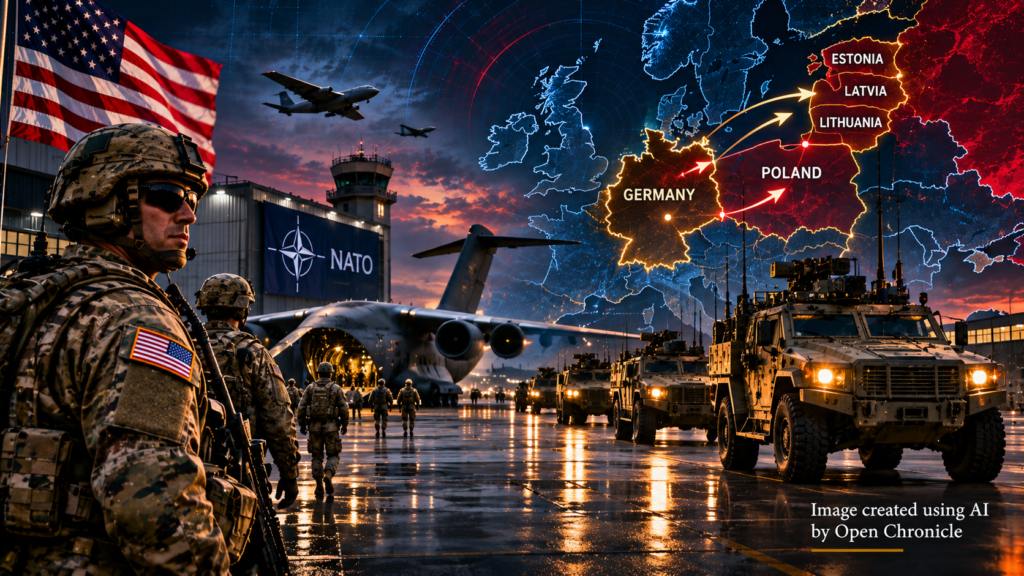
Washington is reviewing the future of its military presence across Europe as NATO allies confront a difficult question: can the continent assume greater responsibility for its own defence without weakening the transatlantic deterrent against Russia?
OPEN CHRONICLE | WARFARE JOURNAL
NATO | DEFENCE STRATEGY | TRANSATLANTIC SECURITY
17 November 2026 | By Open Chronicle Warfare Journal
A defining moment for America’s military presence in Europe
The United States is approaching a potentially consequential decision about the future of its military forces in Europe, placing renewed pressure on NATO allies to demonstrate that they can assume greater responsibility for the continent’s defence.
On 17 November 2026, European defence ministers prepared to discuss Washington’s military posture review with Elbridge Colby, the Pentagon’s senior policy official, during meetings in Brussels.
The discussions come as the administration of President Donald Trump considers changes to the approximately 80,000 American military personnel stationed across Europe.
Germany, which hosts roughly 35,000 US troops, is particularly exposed to any adjustment.
German Defence Minister Boris Pistorius acknowledged that changes were expected but emphasised that their precise nature remained uncertain.
The results of the American review are expected to become clearer before Christmas.
The debate is about more than the number of soldiers stationed on European territory.
American military installations, command structures, intelligence networks, logistics facilities and advanced capabilities are deeply integrated into NATO’s ability to deter aggression and conduct military operations.
A reduction in personnel could therefore have very different consequences depending on which units and capabilities are affected.
For European governments, the immediate challenge is to ensure that any American redeployment takes place through consultation and does not leave dangerous gaps in the Alliance’s defences.
For Washington, the review reflects a broader strategic ambition: to shift more conventional defence responsibilities to European allies while preserving the flexibility to deploy American military power in other regions.
The outcome could help determine the future division of responsibilities within NATO.
What Washington is reviewing
The Pentagon announced a six-month review of American military deployments in Europe in June 2026.
Defence Secretary Pete Hegseth presented the exercise as part of a wider reassessment of America’s international military commitments.
The administration has argued that European NATO members must carry a larger share of the conventional defence burden while the United States addresses competing strategic requirements.
These include military commitments in the Indo-Pacific and the Middle East.
According to earlier Reuters reporting, the Pentagon developed a review process examining multiple options for the future size and geographical distribution of American forces.
An internal planning document called for at least four sets of options to be prepared for senior defence officials.
The review also considered the contributions European governments make to American military operations, including access to military installations, basing arrangements and permission to use national airspace.
These considerations became particularly sensitive following disagreements over European support for American military operations against Iran.
The Pentagon’s approach suggests that future troop deployments may be assessed against both military requirements and the willingness of individual allies to support broader American strategic objectives.
However, the review has not produced a publicly confirmed final decision.
Reports suggesting particular troop reductions should therefore be distinguished from formally announced changes.
The numbers behind the debate
The scale of the American military presence in Europe is substantial, but published figures vary according to the date and method of counting.
Reuters has described the current presence as approximately 80,000 troops, including around 35,000 in Germany.
A US government oversight report, described by Stars and Stripes on 15 November, recorded approximately 78,000 personnel assigned to US European Command as of 30 September 2026.
That represented a decline from roughly 90,000 at the beginning of the 2025 fiscal year.
The decrease reflects changes that have already occurred, particularly in rotational deployments.
Following Russia’s full-scale invasion of Ukraine in 2022, the United States temporarily expanded its military presence in Europe to more than 100,000 personnel.
The subsequent reduction does not necessarily mean that every withdrawn unit was permanently based in Europe.
Rotational deployments can increase or decrease depending on operational requirements, training schedules and force availability.
This distinction matters when evaluating claims about an American withdrawal.
Reducing a temporary deployment is not necessarily equivalent to closing a permanent base or eliminating a critical command capability.
Nevertheless, the oversight findings indicate that previous reductions have already affected aspects of operational readiness.
US Army Europe and Africa reported that changes to rotational forces and permanent personnel had affected mission operations and readiness.
Additional reductions in contractor support were also identified.
The figures therefore raise a practical question about how much further the American presence could decline without creating significant military consequences.
Germany at the centre of the decision
Germany remains the most important location for American military forces in continental Europe.
Its bases support military operations, training, logistics, medical services and command activities.
The country’s geographical position also makes it an important connection between American forces arriving from across the Atlantic and NATO units operating farther east.
Potential changes to the American presence in Germany have consequently attracted particular attention.
European military sources cited by Reuters have discussed the possibility that Washington could move approximately 5,000 troops, or a brigade-sized formation, either towards Asia or closer to NATO’s eastern flank.
Separate reporting has suggested that the administration may ultimately choose smaller reductions than some European governments initially feared.
Bloomberg reporting, cited by Stars and Stripes, indicated that cuts could be closer to 5,000 personnel rather than the 25,000 figure previously discussed in European security circles.
These estimates remain provisional.
It is also unclear whether particular figures represent new reductions or adjustments already announced earlier in 2026.
That uncertainty is important because troop movements can involve several different decisions.
Washington could remove forces from Europe entirely, move units between European countries, change rotational schedules or alter the composition of its deployed capabilities.
Each option would produce a different military outcome.
A transfer from Germany to Poland, for example, would reduce the American presence in Germany without necessarily reducing the total number of American personnel in Europe.
By contrast, moving a formation from Europe to the Indo-Pacific would represent a broader change in regional military commitments.
The final effect will depend on the specific units, equipment and support structures involved.
Congress places limits on a major withdrawal
The Pentagon’s freedom to reduce American military personnel in Europe is constrained by legislation.
The fiscal year 2026 National Defense Authorization Act established conditions governing reductions below a specified troop level.
According to the US government oversight findings reported by Stars and Stripes, the legislation restricts the Pentagon from maintaining fewer than 76,000 personnel in the US European Command area for more than 45 days without completing required assessments and reporting procedures.
The requirements include evaluations involving the Secretary of Defense and the commander of US European Command, as well as consultations with NATO allies.
A waiting period also applies after the relevant information is submitted to Congress.
These provisions do not establish that American troop levels can never fall below 76,000.
Instead, they create procedural and oversight requirements before a sustained reduction can proceed.
The distinction is significant.
Congress has an institutional interest in ensuring that changes to the American military presence do not undermine national security commitments or NATO readiness.
The legislation also means that decisions concerning European deployments are not solely a matter of executive preference.
Even if the Pentagon recommends substantial reductions, implementation may require additional consultation and justification.
The current troop figures suggest that Washington is already operating relatively close to the threshold.
Consequently, further reductions could trigger more intensive congressional scrutiny.
Elbridge Colby and the strategic shift towards Asia
Elbridge Colby has become a central figure in the administration’s effort to redefine America’s military priorities.
His strategic approach places considerable emphasis on the military challenge posed by China and the importance of maintaining sufficient American capabilities in the Indo-Pacific.
This does not necessarily imply that Europe has ceased to matter to Washington.
Rather, it reflects the argument that American military resources are finite and must be allocated according to competing strategic requirements.
The United States faces obligations in Europe, Asia and the Middle East.
Maintaining large forces in one region can affect the availability of personnel and equipment elsewhere.
For American defence planners, the question is how to distribute these resources without creating unacceptable risks.
The Pentagon has argued that European NATO members possess the economic and industrial capacity to assume greater responsibility for conventional defence.
Under this approach, the United States would continue contributing essential capabilities while European allies provide a larger share of the forces required for territorial defence.
This represents a potentially significant change in the traditional balance within NATO.
For decades, the Alliance has relied heavily on American military power, particularly in areas involving strategic mobility, intelligence, command systems and advanced military capabilities.
Transferring greater responsibility to Europe requires more than increasing defence budgets.
It requires European governments to develop and maintain capabilities that can operate together effectively.
The challenge is therefore institutional, industrial and military.
NATO 3.0: A new division of responsibilities
American officials have described the emerging approach as part of a transition towards what they call NATO 3.0.
The concept reflects a desire to create a more balanced Alliance in which European members take the lead in conventional defence.
During discussions with NATO officials in August, Colby emphasised the need for European governments to demonstrate credible plans for assuming additional responsibilities.
Washington also circulated questionnaires seeking detailed information from allies.
The questions addressed defence expenditure, procurement, force development and national policies affecting American military operations.
Some questions went beyond NATO’s traditional territorial defence responsibilities.
They examined whether governments would provide reliable access to bases and airspace for American operations.
This reveals a broader dimension of the review.
Washington is assessing not only what European allies contribute to their own defence, but also how they support American military operations elsewhere.
The approach creates potential tensions.
European governments may support a stronger NATO while disagreeing with particular American military campaigns.
Such disagreements do not automatically mean that an ally is unwilling to defend NATO territory.
Nevertheless, the administration has linked questions of burden sharing, operational access and political cooperation more closely than in previous force posture debates.
For European governments, the challenge is to maintain a credible transatlantic relationship while preserving their ability to make independent political decisions.
Why troop numbers do not tell the whole story
A military presence cannot be measured adequately by personnel numbers alone.
The operational significance of a deployed force depends on its equipment, readiness, mission and supporting infrastructure.
A relatively small unit operating advanced surveillance or command systems may provide capabilities that are difficult to replace.
Similarly, logistics formations and maintenance personnel can be essential to sustaining much larger combat forces.
American military infrastructure in Europe supports operations extending beyond the continent.
Facilities in Germany and elsewhere have played important roles in the movement of personnel and equipment, medical support and military operations in the Middle East.
This helps explain why some officials have reportedly become more cautious about major reductions.
European bases are not simply a contribution to NATO.
They also support America’s ability to project military power internationally.
A withdrawal that appears advantageous when assessed solely against European defence requirements could create difficulties for American operations in other regions.
The Pentagon must therefore consider the relationship between regional force reductions and global military flexibility.
For NATO, the most important question is whether essential capabilities will remain available.
A reduction in troop numbers that preserves critical systems may have a smaller effect than a more limited withdrawal involving specialised units.
Conversely, removing a relatively small but important capability could create disproportionate operational consequences.
The eastern flank faces a different calculation
NATO’s eastern members are particularly sensitive to changes in American military deployments.
Poland and the Baltic states occupy positions close to Russia and Belarus.
Their security planning places considerable importance on rapid reinforcement, credible deterrence and the ability to respond to military threats.
For these countries, the geographical distribution of American forces can matter as much as the total number stationed in Europe.
A redeployment from Germany to Poland could strengthen the visible American presence closer to NATO’s eastern frontier.
However, such a move would also need to be assessed against logistical requirements, infrastructure capacity and the broader distribution of Allied forces.
Military positioning involves trade-offs.
Forces deployed close to a potential crisis area may offer faster initial response times.
At the same time, they require adequate protection, supply networks and reinforcement arrangements.
Germany’s established military infrastructure remains important to the ability to support operations farther east.
The choice is therefore not simply between defending Germany and defending Poland or the Baltic states.
NATO’s regional posture depends on how forces, bases and logistics systems operate together.
A successful adjustment would need to preserve the ability to reinforce the eastern flank while maintaining the infrastructure necessary to sustain prolonged operations.
Can Europe replace American conventional capabilities?
European NATO members have increased their defence ambitions in response to Russia’s war against Ukraine and American demands for greater burden sharing.
However, higher expenditure does not immediately create military capability.
New equipment requires procurement, manufacturing, training and integration.
Military formations require personnel, maintenance systems, ammunition and logistics.
Some capabilities are particularly difficult to develop rapidly.
These include advanced intelligence systems, strategic transport, integrated command structures and specialised military support.
European countries possess important capabilities in all these areas, but their distribution and availability vary.
The central issue is whether Europe can generate sufficient additional capacity within the timeframe of any American changes.
A gradual, coordinated adjustment would provide more opportunity for adaptation.
A rapid withdrawal could create more immediate pressure.
This is why Pistorius has emphasised the need for consultation.
The objective is not necessarily to prevent every American redeployment.
It is to ensure that the Alliance understands which responsibilities must be transferred and how any resulting capability gaps will be addressed.
For European governments, the credibility of their defence commitments will increasingly depend on practical delivery.
Announcing additional spending is only the beginning.
The decisive measure will be whether military forces, equipment and support systems are operational when required.
Russia and the credibility of deterrence
The debate over American troop deployments takes place against the continuing backdrop of Russia’s war against Ukraine.
NATO’s deterrence posture depends on convincing potential adversaries that aggression against Allied territory would produce a coordinated and effective response.
American forces contribute to that message.
Their presence demonstrates that the United States maintains military commitments within the European security system.
However, deterrence is not determined by a single troop figure.
It also depends on NATO’s combined capabilities, political cohesion, readiness and ability to reinforce threatened regions.
A coordinated transition towards greater European responsibility could strengthen the Alliance if it results in more capable European forces.
By contrast, poorly coordinated reductions could create uncertainty about the availability of critical capabilities.
That uncertainty could be strategically damaging even without a major numerical withdrawal.
Potential adversaries may assess not only the forces present but also the political willingness of allies to act together.
For NATO, maintaining a clear and credible collective defence posture is therefore essential throughout the review process.
The outcome must avoid creating the impression that the Alliance’s security commitments are becoming ambiguous.
The Iran war changes the calculation
One of the less obvious factors in the debate is the role European bases play in American military operations outside Europe.
The ongoing conflict involving Iran has demonstrated the importance of American military infrastructure on the continent.
European installations can support the movement of aircraft, personnel, supplies and other resources towards the Middle East.
The Pentagon’s review has also examined the willingness of NATO allies to provide access to bases and airspace for American operations.
Disagreements over such access have complicated relations between Washington and some European governments.
However, the strategic value of European facilities may also discourage substantial withdrawals.
If the United States reduces its military infrastructure too extensively, it could weaken its ability to respond to crises beyond NATO’s territory.
This creates a tension within American strategic planning.
Washington wants European allies to assume more responsibility for their own defence.
At the same time, it benefits from maintaining access to a network of bases that supports American global operations.
The result may favour selective redeployment rather than a comprehensive withdrawal.
Such an outcome remains uncertain until the administration announces its decisions.
Ukraine remains part of the same strategic equation
The troop review coincides with renewed efforts to strengthen Ukraine’s military capabilities.
On 17 November, Colby was also expected to participate in discussions with the Ukraine Defence Contact Group at NATO headquarters.
Germany and Norway announced plans to support another package of American weapons for Ukraine, valued at approximately $300 million.
The package focuses particularly on air defence, including Patriot interceptors.
Germany also outlined additional assistance involving radar equipment and other military capabilities.
The timing is significant.
European governments are being asked to assume greater responsibility for NATO’s conventional defence while continuing to support Ukraine against Russian attacks.
These commitments place demands on military inventories, procurement systems and defence industries.
A European country may need to replenish its own equipment while also financing or supplying weapons for Ukraine.
The challenge is therefore broader than replacing American troops.
It involves strengthening the industrial and logistical foundations of European defence.
If Europe is to assume a larger military role, its armed forces must be supported by production systems capable of sustaining that responsibility.
Three possible outcomes of the Pentagon review
The publicly available reporting supports several possible outcomes, although none should be treated as a confirmed decision.
Scenario One: Limited reductions and continued American leadership
Washington could make relatively modest reductions while maintaining most of its existing military infrastructure.
This would preserve substantial American capabilities and give European governments more time to strengthen their forces.
The political message would still be significant, signalling that Europe must assume greater responsibility.
Scenario Two: Redeployment towards NATO’s eastern flank
Some American forces could move from established bases in western or central Europe towards countries such as Poland.
This could alter the geographical distribution of the American presence without necessarily producing a major reduction in total European troop numbers.
The military consequences would depend on which units moved and how supporting infrastructure was reorganised.
Scenario Three: A larger transfer of forces outside Europe
Washington could shift additional units towards the Indo-Pacific or other strategic priorities.
This would place greater pressure on European allies to compensate for the loss of American conventional capabilities.
Such a decision could also face additional scrutiny under congressional restrictions.
These scenarios are analytical possibilities based on publicly reported options.
They are not announcements of decisions already taken.
Five questions NATO must answer
The Pentagon’s review creates several questions that will shape the future of European security.
1. Which American capabilities are considered essential?
The Alliance must identify which functions would be difficult for European members to replace quickly.
2. Can Europe close potential capability gaps in time?
Procurement plans must be assessed against actual delivery schedules, readiness and available personnel.
3. Will troop reductions be coordinated with NATO’s defence planning?
Consultation is necessary to avoid disrupting reinforcement arrangements and existing operational responsibilities.
4. How will the United States balance Europe against the Indo-Pacific?
American decisions must account for competing military requirements without creating unnecessary strategic vulnerabilities.
5. Can NATO maintain political unity during the transition?
The credibility of collective defence depends on the perception that Allied governments remain committed to responding together.
These questions extend beyond the immediate negotiations in Brussels.
They concern the future structure of the transatlantic security relationship.
Strategic assessment: A withdrawal or a redistribution of responsibility?
The most important distinction in the current debate is between a reduction in American troop numbers and a reduction in America’s overall commitment to European security.
The two are related, but they are not identical.
Washington could maintain a substantial strategic role within NATO while transferring more conventional responsibilities to European allies.
Alternatively, reductions that remove important military capabilities without adequate replacement could weaken the Alliance’s practical readiness.
The outcome depends on implementation.
Europe’s response will be equally important.
If European governments use the transition to strengthen procurement, readiness, logistics and industrial production, NATO could emerge with a more balanced distribution of responsibilities.
If additional commitments remain primarily political, the Alliance could experience a widening gap between strategic ambitions and operational capabilities.
The debate therefore tests both sides of the Atlantic.
The United States must decide how to adjust its global military posture without undermining essential security relationships.
European governments must demonstrate that their growing defence ambitions can produce credible military capabilities.
Conclusion: NATO’s next chapter depends on more than American troop numbers
The Pentagon’s review of American military deployments in Europe represents an important moment in the evolution of NATO.
The United States is reassessing how much conventional military responsibility it should continue to carry on the continent.
European allies, meanwhile, are being asked to assume a larger role in defending their own territory.
The discussions in Brussels on 17 November highlight the uncertainty surrounding the transition.
No final public decision has established the scale of additional reductions or the precise units that may be affected.
Nevertheless, the strategic direction is increasingly clear.
Washington wants a NATO in which European governments contribute more directly to conventional deterrence and defence.
Whether that produces a stronger Alliance will depend on the pace, coordination and military substance of the changes.
A carefully managed redistribution of responsibilities could strengthen European defence while preserving the essential American contribution.
A poorly coordinated withdrawal could create operational gaps and political uncertainty at a time of heightened geopolitical tension.
For NATO, the decisive question is not simply whether America is pulling back from Europe.
It is whether Europe and the United States can redefine their military relationship without weakening the collective security system that both continue to depend upon.
Sources and Further Reading
This investigation draws on five journalistic and military reporting sources, including Reuters, Associated Press, Stars and Stripes and coverage of the Pentagon’s European force posture review. Together, these references provide context on the ongoing discussions within NATO, American troop levels in Europe, congressional oversight and the strategic implications of possible changes to US military deployments.
NATO Allies to Discuss US Troop Levels with Pentagon Strategy Chief
Reporting by Sabine Siebold, Inti Landauro and Bart Meijer on discussions in Brussels involving NATO allies and senior Pentagon officials. The report examines statements by German Defence Minister Boris Pistorius, the scale of the American military presence in Europe and the expected timetable for decisions concerning possible changes to US troop deployments.
Pentagon’s NATO Review Preparing Troop Options for Hegseth by November 6
An investigation by Phil Stewart examining an internal Pentagon planning document concerning the review of American military deployments in Europe. The reporting describes the preparation of alternative force posture options, the criteria used to assess existing commitments and the broader strategic considerations influencing Washington’s military planning.
US Troop Levels in Europe Near Congressional Threshold as Pentagon Considers More Cuts
Military reporting examining US government oversight findings concerning approximately 78,000 American personnel assigned to US European Command. The article discusses the congressional oversight requirements associated with the 76,000-personnel threshold and the reported operational and readiness implications of earlier changes to American deployments in Europe.
US Defense Review Presses NATO Allies to Prove They Are Taking the Lead in Europe
Reporting by Lorne Cook examining the strategic approach associated with Elbridge Colby and the Pentagon’s expectations for European NATO members. The article explores Washington’s efforts to redistribute conventional defence responsibilities, strengthen European military contributions and redefine the balance of responsibilities within the transatlantic Alliance.
Top NATO Commander Joins Briefing on Review of US Defence Engagement in Europe
Reuters coverage of the participation of General Alexus Grynkewich in discussions concerning the review of American defence engagement in Europe. The report provides additional context on coordination between US European Command, Pentagon leadership and NATO officials as Washington evaluates the future distribution of its military capabilities.
This article was prepared by Open Chronicle Warfare Journal using Reuters reporting published on 17 November 2026, earlier Reuters investigations into the Pentagon’s European force posture review, Associated Press reporting and Stars and Stripes coverage of US government oversight findings. Troop figures reflect different reporting dates and counting methods and should be treated as approximate unless otherwise specified. Estimates of possible future reductions are attributed to published reporting and do not represent confirmed Pentagon decisions. The legal requirements associated with the 76,000-personnel threshold are described as oversight and procedural restrictions, not an absolute prohibition on troop reductions. Scenarios concerning future American deployments are independent editorial analysis rather than official military plans or confirmed intelligence assessments.