
OPEN CHRONICLE | INTELLIGENCE & CYBERSECURITY
By Open Chronicle Intelligence Desk | November 17, 2026
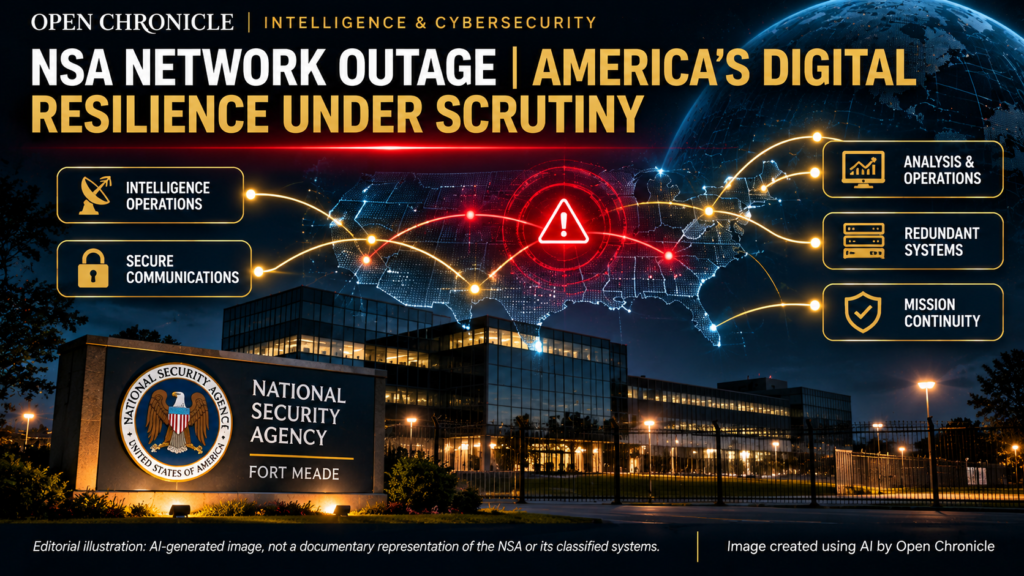
The National Security Agency says its critical intelligence capabilities remain operational despite a disruption to its classified internal communications network. But the incident, coming days after major failures across American aviation, banking and technology services, is raising deeper questions about infrastructure resilience, operational redundancy and the reliability of systems at the heart of US national security.
A Classified Network Failure at the Heart of American Intelligence
The United States National Security Agency (NSA), one of the world’s most powerful signals intelligence and cybersecurity organisations, acknowledged on Tuesday, November 17, that its internal systems had experienced a disruption during scheduled maintenance.
The agency characterised the incident as a temporary degradation rather than a collapse of its operational capabilities.
According to its public statement, some internal systems were affected, but mission-critical functions remained fully operational. The NSA also emphasised that its infrastructure incorporates multiple layers of redundancy intended to preserve operations during maintenance or unexpected failures.
The reassurance followed reports that NSANet, the classified network used by NSA personnel to exchange sensitive intelligence, had become unavailable.
CNN initially reported the disruption after speaking with six people familiar with the situation. The Associated Press, Reuters and specialised defence publications subsequently reported additional details.
At the time of reporting, the agency had not publicly disclosed the precise technical cause, the complete duration of the interruption or a definitive timetable for full restoration.
The distinction between an internal communications failure and a wider intelligence breakdown is central to understanding the incident.
Although the NSA maintains that its essential capabilities remain intact, the temporary loss of access to a classified network can still disrupt analysts, delay internal information exchanges and complicate the coordination of intelligence activities.
The immediate question is therefore not simply whether the United States lost access to intelligence, but how resilient its most sensitive communications infrastructure remains when routine technical operations go wrong.
What Is NSANet, and Why Does It Matter?
NSANet is an internal classified communications environment supporting information exchange among NSA personnel.
Unlike ordinary government email or public internet services, the network handles information requiring stringent security protections. It supports the movement of sensitive material within an organisation responsible for collecting foreign signals intelligence, analysing electronic communications and contributing to the defence of American national security systems.
The NSA is headquartered at Fort Meade, Maryland, and occupies a central position within the wider US intelligence community.
Its activities require secure and reliable communications between analysts, technical specialists and operational teams.
A disruption affecting such an environment can create several operational challenges.
Analysts may lose timely access to shared information, established workflows may be interrupted, and personnel may need to rely on alternative communications channels until normal services return.
According to CNN, the NSA introduced staggered arrival arrangements for some employees as officials assessed the problem. The New York Times also reported a code yellow alert affecting personnel arrangements, according to accounts cited by The Guardian.
These measures indicate that the disruption had practical organisational consequences, even if the agency’s most critical functions remained available.
The incident also illustrates an important characteristic of modern intelligence operations: their effectiveness depends not only on sophisticated collection capabilities but also on the reliability of the internal infrastructure that allows collected information to be processed, shared and acted upon.
Routine Maintenance, Unexpected Consequences
The NSA’s explanation places the incident within a familiar category of technology failures: problems arising during planned maintenance.
Maintenance operations are essential for secure networks. They can involve software updates, vulnerability patches, hardware replacement, configuration changes and the testing of infrastructure components.
However, maintenance also introduces operational risk.
A defective update, unexpected interaction between components or configuration error can interrupt services even when no hostile activity is involved.
The Associated Press reported that one person familiar with the incident associated the disruption with routine software patching.
Defense One separately reported that the problem may have been linked to software upgrades. Its account also cited the NSA’s assurance that its infrastructure was designed with several layers of redundancy.
These reports support the possibility of a maintenance-related failure, but they do not amount to a complete public technical investigation.
The NSA has not released a detailed root-cause analysis explaining exactly what failed, whether a particular update triggered the disruption or why existing safeguards did not prevent the interruption of affected internal services.
That distinction matters.
A maintenance-related outage is not necessarily evidence of negligence, inadequate cybersecurity or a hostile intrusion. It can nevertheless expose weaknesses in change management, dependency mapping, recovery procedures or operational resilience.
For an intelligence agency operating at the highest levels of national security, understanding those weaknesses is an important part of preventing similar disruptions.
No Evidence of a Cyberattack
The proximity of the NSA incident to other major technology failures has generated questions about whether the United States might be experiencing a coordinated cyber campaign.
Available evidence does not support that conclusion.
CNN reported that sources familiar with the NSANet disruption had seen no indication of a cyberattack. Other reporting likewise identified no immediate evidence of malicious activity.
White House spokesperson Lauren Bis publicly rejected suggestions that the incidents represented a broader cyber crisis.
The administration has maintained that the recent disruptions affecting different sectors are not known to be connected.
There is an important difference between three possible scenarios:
An accidental infrastructure failure caused by maintenance, defective equipment or software configuration.
A cybersecurity incident involving unauthorised access or malicious interference.
A coordinated campaign targeting multiple organisations or critical sectors.
The public evidence currently points towards the first explanation for the NSA incident, although a complete technical account has not been released.
The fact that several unrelated systems failed within a short period does not, by itself, demonstrate common authorship, malicious coordination or a shared vulnerability.
Nevertheless, the concentration of disruptions has intensified scrutiny of the country’s technological infrastructure.
A Week of Disruptions Across the United States
The NSA interruption occurred against the background of a particularly turbulent period for American digital services.
Recent Technology Disruptions
A series of technology failures affected major American services and institutions during November 2026. Although the incidents involved different systems and operational environments, their proximity has renewed questions about infrastructure resilience, maintenance procedures and the reliability of essential digital services.
Microsoft 365 Service Interruption
A major disruption affected services including Outlook and Teams, interfering with communications and business operations.
FAA Nationwide Ground Stop
A major air traffic control communications failure led to nationwide flight restrictions, with extensive delays and cancellations.
Financial Services Disruption
A technical problem at JPMorgan Chase affected financial operations and produced wider disruption.
NSA Classified Network Disruption
NSANet experienced a reported interruption during maintenance, affecting internal communications while the agency said critical capabilities remained operational.
These incidents occurred within a relatively short period, but no verified public evidence establishes that they were caused by a single technical vulnerability or coordinated cyberattack. Their significance lies in the broader questions they raise about the resilience of critical infrastructure, operational dependencies and the ability of essential services to recover from unexpected failures.
NSANet experienced a reported interruption during maintenance, affecting internal communications while the agency said critical capabilities remained operational.
These events occurred close together, but no verified evidence establishes that they resulted from a single coordinated attack.
The FAA Failure and the Problem of Infrastructure Modernisation
The nationwide aviation disruption was particularly significant because it affected a system whose reliability is essential to public safety and economic activity.
The Federal Aviation Administration ordered a nationwide ground stop on November 13 after a communications breakdown.
Subsequent reporting identified a problematic router installation as a central focus of the investigation, while officials examined the circumstances surrounding infrastructure work and equipment changes.
The disruption demonstrated how a technical failure in a relatively narrow part of a complex system can produce consequences far beyond the original point of failure.
Airlines, airports, passengers and connected transport operations were affected by the interruption.
The episode also renewed debate about modernising the FAA’s ageing infrastructure and improving safeguards around technical changes.
The NSA incident is different in both function and sensitivity.
Yet both cases raise a similar engineering question: how can critical systems be maintained and upgraded without creating unacceptable operational risks?
Trump Plays Down the Failures
President Donald Trump, speaking in Manila during his visit to Asia, sought to reassure the public about the recent disruptions.
He suggested that large and powerful organisations inevitably encounter technical problems and dismissed the idea that the incidents demonstrated a broader national crisis.
The White House has likewise rejected claims that the United States is experiencing a coordinated cyberattack.
The administration’s position is that the failures are separate technical incidents rather than evidence of a common hostile operation.
Reuters reported that Trump’s comments came amid growing political attention to the disruptions and questions about the reliability of critical infrastructure.
The political challenge is not limited to identifying whether an adversary was responsible.
Even when failures are accidental, repeated interruptions can undermine public confidence in the ability of government agencies and private operators to maintain essential services.
The distinction between an absence of hostile activity and the presence of robust operational resilience is therefore important.
A system can be free from attack and still be vulnerable to serious disruption.
Could the NSA Still Deliver Urgent Intelligence to the President?
One of the most sensitive questions raised by the incident concerns the government’s ability to communicate urgent intelligence to the president during an overseas visit.
According to CNN, a current and a former US official indicated that the NSANet interruption would not prevent the transmission of urgent intelligence to President Trump.
Both pointed to alternative secure communications systems and operational redundancies available to the US government.
This is consistent with the NSA’s assertion that mission-critical capabilities remained operational.
However, the public record does not establish exactly which alternative systems were used, whether they experienced additional workloads or how rapidly normal internal communications could be restored.
Such details may remain classified for legitimate security reasons.
The operational principle is nevertheless clear: a resilient intelligence system must be capable of continuing essential missions even when a major internal component becomes unavailable.
Open Chronicle Analysis | The Difference Between Cybersecurity and Operational Resilience
The NSA incident highlights a distinction that is often overlooked in public discussions of national security.
Cybersecurity is frequently understood as the ability to prevent unauthorised access, malware infections, espionage and hostile interference.
Operational resilience is broader.
It concerns whether an organisation can continue delivering essential functions when technology fails, regardless of whether the cause is malicious, accidental or environmental.
A classified network may be protected by sophisticated encryption, access controls and monitoring systems while still remaining vulnerable to a defective update or infrastructure failure.
Similarly, redundant communications channels may preserve critical missions while ordinary analytical workflows suffer interruptions.
The two forms of protection are complementary rather than interchangeable.
Five lessons for critical national infrastructure
1. Maintenance is a security-sensitive operation. Software patching and infrastructure upgrades should be governed by carefully tested procedures, defined rollback mechanisms and operational impact assessments.
2. Redundancy must be demonstrated, not merely documented. Backup systems are valuable only if they can support essential functions under realistic failure conditions.
3. Technical dependencies require continuous visibility. Organisations need to understand how changes to one network component may affect systems that appear operationally separate.
4. Incident communication must distinguish service availability from mission availability. A critical mission may continue even when a supporting network is disrupted. Public statements should make that distinction clear without exposing classified information.
5. Repeated failures require systemic examination. Separate incidents do not establish a coordinated attack, but they can reveal recurring weaknesses in infrastructure management, change control and contingency planning.
These lessons extend beyond intelligence agencies.
Financial institutions, healthcare networks, energy providers, cloud platforms and aviation authorities all depend on complex technological systems in which seemingly limited failures can produce substantial operational consequences.
The Strategic Implications for American National Security
The NSA occupies a distinctive position within the American security architecture.
Its work depends on advanced technical capabilities, highly specialised personnel and the secure handling of sensitive information.
Consequently, disruptions to its internal communications can carry strategic implications even when intelligence collection and other critical functions continue.
The first implication concerns operational confidence.
Government leaders must be confident that intelligence agencies can maintain reliable internal communications during crises, particularly when rapid analysis and decision-making are essential.
The second concerns infrastructure modernisation.
Legacy systems, complex software dependencies and demanding security requirements can make maintenance more difficult. Modernisation is necessary, but poorly controlled transitions can themselves create new vulnerabilities.
The third concerns public trust.
Repeated technology failures across unrelated sectors may create perceptions of systemic instability, even where technical evidence indicates separate causes.
The fourth concerns adversarial observation.
Foreign intelligence services routinely study the capabilities and weaknesses of competing states. Publicly visible disruptions can attract attention, although there is no evidence that a foreign adversary caused or exploited the NSA incident.
Finally, the episode raises the issue of national resilience as a strategic capability.
A country’s technological strength is measured not only by the sophistication of its systems but also by their ability to withstand unexpected failures and recover without compromising essential functions.
What Investigators Still Need to Establish
Five Unanswered Questions
The NSA has attributed the disruption to routine maintenance and maintains that its critical national security capabilities remained operational. Nevertheless, several technical and operational questions require further clarification before the full significance of the incident can be assessed.
What Was the Precise Technical Cause?
The NSA has linked the incident to routine maintenance, but a detailed public explanation of the failure has not been released.
How Long Were Internal Services Disrupted?
The complete duration and scope of the interruption remain uncertain.
Which Operational Workflows Were Affected?
Reports describe internal communications difficulties, but the impact on specific analytical activities has not been publicly established.
How Effectively Did Redundant Systems Perform?
The agency says critical missions continued, but the performance of backup arrangements has not been independently assessed in public.
Will the Incident Trigger Wider Infrastructure Reviews?
It remains to be seen whether the NSA disruption and recent failures elsewhere will lead to new maintenance standards, congressional scrutiny or additional investment.
The answers to these questions will help determine whether the NSANet disruption was an isolated maintenance failure or an indication of broader weaknesses in infrastructure management and operational resilience. Until further technical findings are available, the incident should not be characterised as a confirmed cyberattack or linked to other recent US technology failures without supporting evidence.
Conclusion | A Warning Beyond the NSA
The disruption to NSANet does not currently appear to be evidence of a hostile cyberattack.
The NSA has attributed the incident to scheduled maintenance and maintains that its critical national security capabilities remained operational.
Those assurances are significant.
But they do not eliminate the broader questions raised by an interruption affecting one of the United States’ most sensitive intelligence communications environments.
Coming shortly after major failures in aviation, financial services and enterprise technology, the incident illustrates how dependent modern national security has become on the continuous reliability of digital infrastructure.
The available evidence does not justify describing these events as a coordinated campaign against the United States.
It does, however, justify closer examination of how critical systems are maintained, how technical changes are controlled and how effectively essential operations can continue when individual components fail.
The strategic lesson is that national security depends not only on preventing cyberattacks, but also on ensuring that essential systems remain dependable when no attacker is involved.
Sources and Further Reading
The following sources were reviewed for this article. They provide reporting on the NSA communications disruption, official explanations, operational consequences and the wider series of technology failures affecting critical infrastructure in the United States.
Classified US National Security Communications Network Hit by Outage
Reporting on the NSA’s maintenance explanation, operational assurances and uncertainty surrounding the disruption.
Highly Classified National Security Communications Network Goes Down
Original reporting based on sources familiar with NSANet, including operational disruption and contingency communications.
Classified Communications Network at the NSA Goes Down
Independent reporting on NSANet, maintenance and the agency’s assurances.
Classified NSA Communications Network Down
Specialised defence reporting on the operational impact, potential software upgrade issues and network redundancy.
National Security Agency Network for Internal Communications Goes Down
Additional reporting on personnel arrangements, possible software patching and unresolved technical questions.
Trump Shrugs Off Spate of US Outages
Reporting on the administration’s response to disruptions affecting aviation, banking and national security infrastructure.
Editorial Transparency
This article is based on reporting published on November 17, 2026, including accounts from Reuters, CNN, the Associated Press, Defense One and The Guardian, supplemented by the material supplied for editorial review.
Open Chronicle distinguishes the NSA’s official description of a maintenance-related disruption from independently reported operational consequences and unresolved technical questions.
There is currently no verified public evidence linking the NSANet incident to a cyberattack or establishing a common cause behind the recent disruptions affecting American aviation, banking and technology services.
The discussion of infrastructure resilience, intelligence continuity, maintenance governance and strategic implications represents independent editorial analysis. The precise technical cause, full operational impact and restoration status remain subject to further confirmation.