
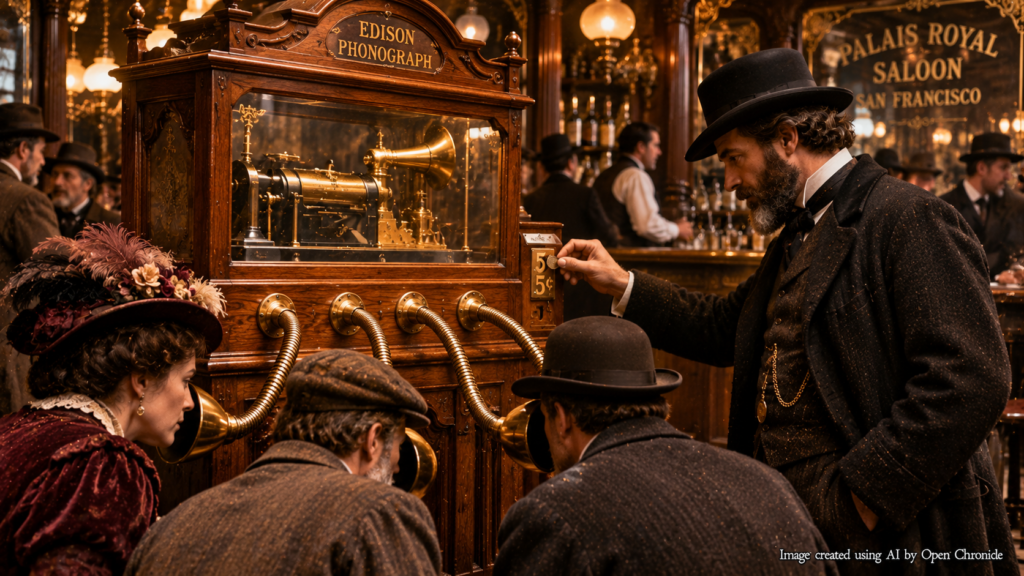
How a coin-operated phonograph installed in a San Francisco saloon helped transform recorded sound from a technological curiosity into a public entertainment business, opening the way for jukeboxes, popular music culture and the modern recording industry.
By Open Chronicle History Desk
On November 23, 1889, an unusual machine attracted attention inside the Palais Royal Saloon in San Francisco, California.
It was not a piano.
It was not a mechanical music box.
And it did not require a musician to perform.
Instead, customers could insert a coin and listen to recorded sound through a set of listening tubes.
The device was a coin-operated phonograph, developed by Louis T. Glass and William S. Arnold.
It represented an important experiment in the commercial use of recorded sound.
For the price of a nickel, customers could experience something that had been almost unimaginable only a generation earlier.
They could hear a performance without the performer being present.
The machine did not resemble the colorful jukeboxes that would become familiar in twentieth-century diners and dance halls.
It did not contain a large collection of records from which listeners could choose.
It did not fill the entire room with music.
Instead, it used the cylinder phonograph technology of the late nineteenth century, with individual listening arrangements designed for paying customers.
Yet the principle was revolutionary.
Sound had become a commodity that could be reproduced, distributed and sold through a machine.
The implications extended far beyond one San Francisco saloon.
Recorded music would eventually reshape the relationship between performers and audiences.
It would create new commercial opportunities for inventors, manufacturers, record companies and musicians.
It would transform public entertainment.
And it would help establish the foundations of an industry in which music could be experienced independently of the original performance.
The machine installed in 1889 was not the first device capable of reproducing recorded sound.
Thomas Edison had demonstrated his phonograph in 1877.
Other inventors had developed competing recording technologies.
But the San Francisco installation became an important milestone in the history of commercial, coin-operated recorded entertainment.
The story of November 23 is therefore not simply about the invention of a machine.
It is about a fundamental change in the way people consumed music.
For the first time, a customer could walk into a public establishment, pay a small amount and hear recorded sound on demand.
The age of commercial recorded entertainment was beginning.
1. Before Recorded Music
For most of human history, music was experienced through live performance.
People heard songs in homes, churches, theaters, taverns and public gatherings.
Musicians had to be physically present.
Mechanical instruments existed, including music boxes and barrel organs, but these reproduced programmed musical patterns rather than recordings of actual performances.
The distinction was fundamental.
Recorded sound would allow a particular performance to be preserved and heard again.
2. The Dream of Capturing Sound
During the nineteenth century, inventors increasingly explored ways to record sound.
Scientific interest in acoustics encouraged experiments with vibrating membranes and mechanical inscriptions.
Édouard-Léon Scott de Martinville developed the phonautograph in the 1850s.
His device traced sound vibrations onto a recording surface.
It was intended for visual analysis rather than immediate playback.
Nevertheless, it represented an important step toward sound recording.
3. Thomas Edison and the Phonograph
In 1877, Thomas Edison developed the phonograph.
The invention demonstrated that sound could be recorded and reproduced.
Early versions used a stylus to inscribe vibrations into a recording surface.
Playback converted the recorded grooves into audible sound.
The phonograph attracted widespread attention.
It suggested that voices, speeches and music might be preserved for future listening.
4. A Technological Sensation
The phonograph appeared almost magical to many nineteenth-century observers.
A machine could reproduce a human voice.
It could preserve words spoken earlier.
It could replay sounds without the original speaker.
Public demonstrations generated curiosity and excitement.
But turning the invention into a reliable commercial product required further development.
5. The Limits of Early Recording
Early phonographs had significant limitations.
Sound quality was restricted.
Recordings could be difficult to reproduce consistently.
The equipment was mechanically delicate.
The duration of recordings was short.
Manufacturers needed to improve recording materials, playback mechanisms and durability.
Commercial success depended on solving these practical problems.
6. The Rise of Wax Cylinders
During the 1880s, wax cylinders became important recording media.
They offered advantages over earlier materials.
A stylus could trace sound vibrations into the cylinder surface.
The resulting groove could be played back mechanically.
Wax cylinder technology supported the development of improved phonographs.
It also created opportunities for commercial recordings.
7. Competing Inventors
Edison was not the only inventor working on sound reproduction.
Alexander Graham Bell, Chichester Bell and Charles Sumner Tainter contributed to competing technologies.
The graphophone emerged from this broader period of experimentation.
Patent disputes and commercial competition shaped the industry.
Sound recording developed through the work of multiple inventors rather than one isolated breakthrough.
8. The Phonograph as a Business
Early promoters imagined several possible uses for phonographs.
Business dictation was a major objective.
Inventors also considered educational applications, preserved speeches and entertainment.
But the public’s fascination with listening to recorded sound suggested a commercial opportunity.
A machine that could reproduce a performance might attract paying customers.
9. San Francisco in 1889
San Francisco was a major commercial city on the American Pacific coast.
Its population had grown rapidly during the nineteenth century.
The city contained busy commercial districts, theaters, saloons and entertainment establishments.
Technological demonstrations could attract considerable public attention.
The environment offered opportunities for entrepreneurs experimenting with new forms of entertainment.
10. The Palais Royal Saloon
The Palais Royal Saloon became associated with a pioneering installation of a coin-operated phonograph.
The establishment provided a public setting in which customers could encounter recorded sound.
A saloon was an appropriate commercial location.
Visitors already expected to pay for refreshments and entertainment.
The phonograph offered a new attraction.
11. Louis T. Glass
Louis T. Glass was a businessman involved in the development of telephone services in California.
He recognized the potential of sound technology.
Together with William S. Arnold, he helped develop a coin-operated phonograph arrangement.
Their work combined an existing recording invention with a payment mechanism.
The commercial concept was as important as the underlying machine.
12. William S. Arnold
William S. Arnold collaborated with Glass on the coin-operated phonograph.
The installation required mechanical and practical adaptations.
The objective was to create a device that customers could operate in exchange for payment.
This helped transform the phonograph from a demonstration apparatus into a commercial entertainment service.
13. November 23, 1889
On November 23, 1889, the coin-operated phonograph associated with Glass and Arnold was installed at the Palais Royal Saloon.
The date is widely recognized as a milestone in jukebox history.
The machine allowed customers to pay to hear recorded sound.
It was an early example of commercial recorded entertainment delivered through a self-service mechanism.
14. The Price of a Nickel
The machine charged five cents for a listening session.
The nickel made the experience accessible to customers who might never purchase a phonograph themselves.
This business model was important.
The machine owner supplied the expensive technology.
Individual listeners paid only for access.
The principle would become familiar across many forms of public entertainment.
15. How the Machine Worked
The device used a phonograph mechanism to reproduce recorded sound.
Customers listened through individual acoustic tubes rather than a modern loudspeaker.
The arrangement allowed several people to listen simultaneously.
Sound traveled mechanically from the reproducing apparatus to the listener.
The experience was intimate and unusual.
It differed considerably from later jukeboxes.
16. Four Listening Stations
Historical descriptions commonly associate the installation with four listening tubes.
This allowed multiple paying customers to use the machine.
The arrangement reflected the limitations of acoustic reproduction.
Electronic amplification was not yet available.
The sound had to be delivered directly to listeners.
17. A Public Listening Experience
The installation created a new form of public entertainment.
Customers could gather around a machine to hear recorded performances.
The attraction combined technological novelty with musical curiosity.
People could compare reactions and discuss what they had heard.
Recorded sound became part of a shared social environment.
18. Music Without Musicians
The machine demonstrated that music could be experienced without a performer being physically present.
This was one of the most important implications of sound recording.
A performance could be separated from the moment in which it occurred.
The listener no longer needed to attend the original event.
Music could travel through recordings.
19. The Economics of Reproduction
A live performance required musicians to perform repeatedly.
A recording could be played many times.
This created a different commercial model.
The cost of producing a recording could be distributed across multiple listening sessions.
The model would eventually transform the economics of the music industry.
20. The First Earnings
Accounts of early coin-operated phonographs describe substantial public interest.
Some contemporary reports and later histories suggest that machines could generate impressive receipts.
However, precise revenue figures vary across retellings.
The broader historical point is clear.
The concept demonstrated that people were willing to pay for access to recorded sound.
21. The Spread of Coin-Operated Phonographs
Following the success of early installations, coin-operated phonographs appeared in other locations.
Entrepreneurs recognized their entertainment value.
Machines were installed in public establishments and amusement venues.
The technology became part of the developing commercial sound industry.
The popularity of the devices encouraged further innovation.
22. Phonograph Parlors
During the 1890s, phonograph parlors became a recognizable form of entertainment.
Customers paid to listen to recordings through individual listening devices.
These establishments offered access to sound technology that remained expensive for many households.
They helped establish a public market for recorded performances.
23. The Growth of Recorded Repertoires
As recording technology improved, the range of available material expanded.
Recordings included songs, instrumental performances, speeches and comic routines.
Manufacturers began developing catalogs.
Consumers increasingly encountered recorded performances as commercial products.
This encouraged the emergence of professional recording practices.
24. The Birth of Recording Artists
Recorded sound created new opportunities for performers.
A singer or musician could reach listeners who had never attended a live performance.
Recordings could circulate across geographical distances.
Successful performers gained new forms of public recognition.
The recording industry gradually developed its own commercial stars.
25. The Limitations of Cylinder Records
Cylinder recordings had practical disadvantages.
They were relatively fragile.
Mass reproduction was initially difficult.
Storage and distribution presented challenges.
Competing technologies offered alternative solutions.
These limitations encouraged further technological development.
26. Emile Berliner and the Disc Record
Emile Berliner developed the gramophone system using flat discs.
The disc format eventually became highly influential.
Its manufacturing and distribution advantages supported the expansion of recorded music.
Competition between cylinders and discs shaped the early industry.
The disc ultimately became the dominant commercial format.
27. The Gramophone Revolution
Disc recordings helped create a broader consumer market.
Manufacturers developed improved playback machines.
Record companies expanded production.
Catalogs grew.
Recorded music became increasingly available to households.
The industry was moving beyond public listening machines.
28. Music Enters the Home
As phonographs and gramophones became more affordable, families began purchasing them for domestic use.
Recorded music became part of household entertainment.
Listeners could hear performances repeatedly.
They could build collections.
The relationship between music and everyday life changed.
29. The Early Recording Industry
Companies such as Edison, Columbia and Victor became important participants in the developing industry.
They manufactured equipment and distributed recordings.
Commercial competition encouraged technical improvements.
Marketing and celebrity performers became increasingly important.
The foundations of the modern record business were taking shape.
30. The Mechanical Music Business
Coin-operated entertainment machines continued evolving.
Manufacturers developed more reliable mechanisms.
Automatic playback became increasingly sophisticated.
Public establishments discovered that music could attract customers.
The commercial relationship between entertainment and hospitality became firmly established.
31. The Origins of the Jukebox
The term jukebox became widely associated with coin-operated music machines during the twentieth century.
It was not the term used for the San Francisco installation in 1889.
The original device was a coin-operated phonograph.
The modern jukebox developed through subsequent advances in recording, playback and selection mechanisms.
32. The Rise of Automatic Record Selection
Later machines allowed customers to choose between different recordings.
This was a major innovation.
The listener was no longer limited to a single programmed performance.
Choice became part of the commercial experience.
The selection mechanism helped define the modern jukebox.
33. Jukeboxes in the 1920s
During the 1920s, coin-operated music machines became more sophisticated.
Electric recording and playback technologies transformed sound quality.
Commercial operators recognized the potential of placing machines in public establishments.
The market expanded.
Music became increasingly integrated into restaurants, bars and dance venues.
34. The Electric Revolution
Electrical recording developed during the 1920s.
Microphones and electronic amplification improved sound reproduction.
The technology allowed recordings to capture a wider range of frequencies.
Public playback became more powerful.
The modern amplified jukebox emerged from these developments.
35. The Great Depression
The economic crisis beginning in 1929 affected entertainment businesses.
Yet relatively inexpensive leisure activities retained commercial appeal.
Coin-operated music could provide entertainment without the cost of a live band.
Jukeboxes became important features of many public establishments.
Their popularity continued growing during the 1930s.
36. The Golden Age of the Jukebox
The 1940s and 1950s became closely associated with the classic jukebox.
Machines featured colorful cabinets, illuminated panels and elaborate mechanical systems.
They became familiar in diners, cafés and bars.
Jukeboxes helped define the visual culture of mid-century popular entertainment.
37. Wurlitzer and the Jukebox Image
Wurlitzer became one of the best-known jukebox manufacturers.
Its machines combined mechanical engineering with distinctive industrial design.
The Wurlitzer 1015, introduced in 1946, became particularly famous.
Its illuminated cabinet helped establish the classic jukebox aesthetic.
The machine became an icon of American popular culture.
38. Rock and Roll
During the 1950s, jukeboxes became closely associated with rock and roll.
Young listeners selected records by emerging performers.
Public music machines helped popularize new musical styles.
They became important gathering points in youth culture.
The jukebox was no longer merely a novelty.
It was a major channel for musical discovery.
39. The 45 RPM Record
The introduction of the 45 rpm single in 1949 helped transform jukebox operation.
The smaller disc format was well suited to automatic selection mechanisms.
Operators could offer a range of popular songs.
The single became a central product of the commercial music industry.
Jukeboxes helped promote its success.
40. Music and Social Change
Jukeboxes contributed to the circulation of musical styles across communities.
Jazz, blues, rhythm and blues, country and rock and roll reached new audiences.
Their role in cultural exchange was significant.
But the history was also shaped by racial segregation, unequal access and discrimination within the music business.
Recorded music circulated within a society marked by profound inequalities.
41. The Jukebox in Cinema
Jukeboxes became recognizable visual symbols in films and television.
They appeared in diners, dance halls and roadside establishments.
Their illuminated cabinets suggested leisure, youth and popular culture.
They became associated with nostalgia for mid-century America.
The machine’s cultural identity extended beyond its original commercial purpose.
42. The Decline of Traditional Jukeboxes
During the later twentieth century, new entertainment technologies challenged traditional jukeboxes.
Portable radios, cassette players and home stereo systems expanded listening options.
Music television and digital media changed consumer habits.
The classic mechanical jukebox became less central to everyday entertainment.
But it retained cultural appeal.
43. Digital Jukeboxes
Digital technology transformed coin-operated music systems.
Modern jukeboxes could store or access extensive music libraries.
Touchscreens replaced mechanical selection buttons.
Network connections expanded available catalogs.
The basic principle remained recognizable.
Customers paid to select music in a public setting.
44. From the Jukebox to Streaming
Modern music streaming operates through technologies unimaginable in 1889.
Listeners can access millions of recordings.
Digital networks distribute music globally.
Subscription services and advertising have changed the industry’s economics.
Yet the underlying idea remains related to the early phonograph business.
Recorded performances can be accessed on demand.
45. The Meaning of On-Demand Music
The San Francisco installation demonstrated a simple commercial principle.
A listener could choose to pay for access to recorded sound at a particular moment.
This separated musical consumption from live performance schedules.
Later technologies expanded the principle.
Radio, records, cassettes, compact discs and digital streaming each transformed access to music.
The history of recorded entertainment is a history of increasing control over listening.
46. The Democratization of Listening
Recorded sound expanded access to performances.
People could hear musicians who lived far away.
Recordings preserved voices and styles.
But access remained shaped by cost, technology and commercial distribution.
The process was gradual.
The 1889 machine represented an early stage rather than the completion of this transformation.
47. The Preservation of Musical Heritage
Sound recording eventually became essential to cultural preservation.
Performances could survive beyond the lives of their creators.
Archives accumulated recordings of music, speech and oral traditions.
Historical sound collections now provide evidence of cultural practices that might otherwise have disappeared.
The technology changed not only entertainment but also historical research.
48. The Business of Listening
The commercial model introduced by early coin-operated phonographs had lasting significance.
Recorded sound became something that could be monetized through repeated playback.
Later businesses developed more complex systems of ownership, licensing and royalties.
The music industry became a major part of the global economy.
The relationship between technology and commercial access remains central today.
49. The Legacy of Louis T. Glass
Louis T. Glass and William S. Arnold are remembered for their role in the early commercial use of the phonograph.
Their achievement was not the invention of sound recording itself.
It was the practical adaptation of existing technology into a paid public entertainment service.
The distinction matters.
Innovation often occurs when established technologies are combined with new commercial ideas.
50. Why November 23 Matters
November 23, 1889 is widely commemorated as a milestone in the history of the jukebox.
The installation at the Palais Royal Saloon demonstrated the commercial potential of recorded sound.
It helped establish the idea that people would pay to listen to recordings in public.
The technology was primitive compared with later machines.
But its business model anticipated major developments in the music industry.
The date represents an important moment in the transition from live performance to commercial recorded entertainment.
November 23, 1889: The Moment Music Became a Machine
Imagine San Francisco in November 1889.
The city is busy with commerce and entertainment.
Inside a saloon, customers gather around an unusual device.
There is no orchestra.
No singer stands before the audience.
Instead, a mechanical machine offers something remarkable.
A customer inserts a nickel.
The phonograph begins to operate.
Recorded sound travels through a listening tube.
For a brief moment, a performance is heard without its original performer.
The experience seems extraordinary.
The machine is expensive, mechanically complicated and limited in sound quality.
But it demonstrates a new possibility.
Music can be recorded.
It can be reproduced.
It can be sold through repeated listening sessions.
Over the following decades, the technology will improve.
Wax cylinders will give way to discs.
Acoustic playback will be transformed by electrical amplification.
Mechanical music machines will become familiar in restaurants and bars.
The jukebox will become an icon of twentieth-century popular culture.
And recorded music will eventually reach listeners through global digital networks.
The distance between an 1889 phonograph and modern streaming is enormous.
Yet both belong to the same history.
A history in which technology allows people to hear performances separated from their original time and place.
On November 23, 1889, a coin-operated phonograph installed at San Francisco’s Palais Royal Saloon became an important milestone in the commercialization of recorded sound, helping establish a model of public music entertainment that would evolve into the modern jukebox.
Historical Sources and Further Reading
Museum collections, research in recorded sound history and historical accounts examining the emergence of coin-operated phonographs, the development of the jukebox and the commercialization of recorded music.
What Did 1889 Sound Like?
An examination of sound recording technology in 1889, including wax cylinders, early phonographs and the emergence of coin-operated machines as a commercial entertainment medium.
Research on Early Phonograph Technology
Specialist historical research documenting early commercial cylinder phonographs and identifying the November 23, 1889 installation at the Palais Royal Saloon as a landmark in coin-operated playback.
Read the Historical Research →
Recorded Music in American Life: The Phonograph and Popular Memory, 1890–1945
William Howland Kenney examines the growth of recorded music in American society, including early coin-operated phonographs, listening parlors, commercial recording practices and changing popular culture.
How the Jukebox Got Its Groove
A historical account of Louis Glass, the Palais Royal installation and the technological developments that transformed the early coin-operated phonograph into the twentieth-century jukebox.
November 23, 1889 is widely recognized as the date of the pioneering commercial installation of a coin-operated phonograph at the Palais Royal Saloon in San Francisco. The device was associated with Louis T. Glass, William S. Arnold and the Pacific Phonograph Company. Although frequently described as the first jukebox, it differed substantially from the later machines familiar to twentieth-century audiences. It used cylinder recordings and individual acoustic listening tubes, and it did not provide the automated selection of multiple records characteristic of modern jukeboxes. Earlier experiments in coin-operated sound technology existed, making the distinction between invention, experimental demonstration and documented commercial installation important. The historical significance of the 1889 machine lies primarily in its successful adaptation of recorded sound into a paid public entertainment experience.