
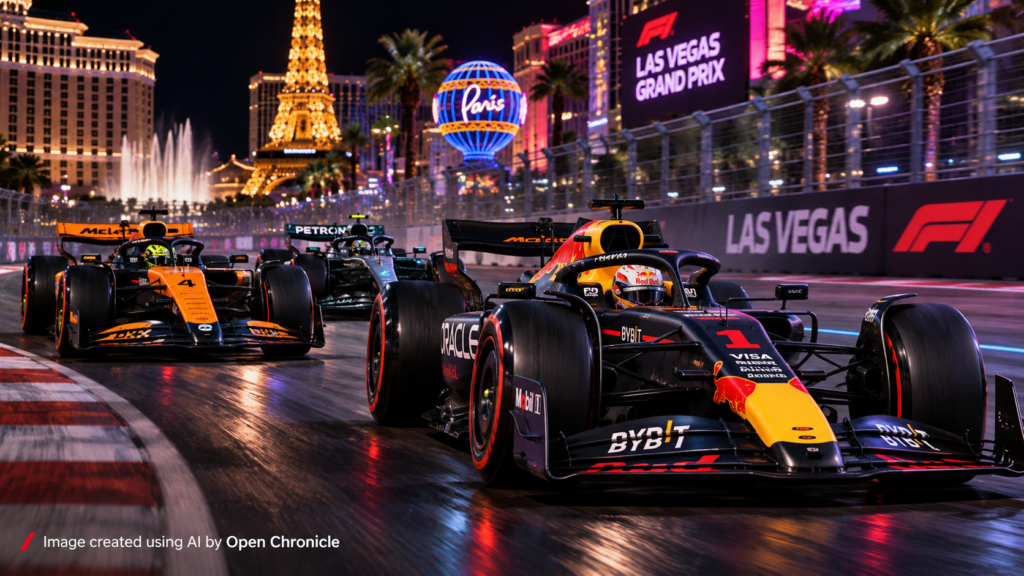
Open Chronicle Formula One Magazine | Grand Prix Weekend Report | 22 November 2026
By Open Chronicle Sports
Max Verstappen claimed his third Las Vegas Grand Prix victory after an extraordinary battle with Mercedes, but the final result tells only part of the story. Kimi Antonelli’s qualifying brilliance, George Russell’s late crash, McLaren’s unexpected double podium, Ferrari’s internal tensions and a series of stewarding decisions made the Nevada weekend one of the most eventful of the 2026 Formula One season.
LAS VEGAS GRAND PRIX 2026 | RACE RESULT
Official Race Classification:
Official race result published by the FIA on 22 November 2026.
OPEN CHRONICLE SPORTS
| FORMULA ONE MAGAZINE | LAS VEGAS 2026
A Grand Prix That Refused to Follow the Script
Las Vegas delivered far more than a conventional race under the lights.
Rain disrupted the opening stages of the weekend. Mercedes demonstrated exceptional single-lap speed. Red Bull capitalised on grid penalties, and McLaren faced the prospect of a difficult race after Oscar Piastri was relegated to the lower half of the starting order.
By the chequered flag, the competitive picture had changed dramatically.
Verstappen had survived repeated attacks from Russell, a Safety Car intervention and a late challenge from Antonelli. McLaren had recovered to place both drivers on the podium, while Alpine secured fifth and sixth with Pierre Gasly and Franco Colapinto.
Ferrari, meanwhile, endured another complicated weekend, with Lewis Hamilton and Charles Leclerc finishing seventh and tenth after a race involving penalties, frustration and scrutiny of their on-track conduct.
The decisive events came in the final laps, when Russell struck the barriers and Antonelli lost positions to both McLarens. Verstappen’s winning margin was just 0.639 seconds, underlining how little separated success from defeat.
1. Thursday and Friday: Rain, Uncertainty and a Difficult Start
The weekend began with a familiar challenge for Formula One in Las Vegas: low temperatures, a changing track surface and the difficulty of generating consistent tyre performance.
Rain complicated the opening practice programme, leaving teams with limited representative dry running before qualifying.
That uncertainty mattered because the 2026 cars placed considerable emphasis on the relationship between aerodynamic efficiency, slipstreaming and electrical energy deployment.
McLaren arrived with an updated floor on Norris’s car, while Mercedes hoped to convert its promising pace into a front-row opportunity.
The most controversial practice incident involved Verstappen and Russell at Turn 14 during FP3.
Russell criticised Verstappen’s driving after the pair made contact, and the stewards issued the Red Bull driver a warning for erratic driving.
The disagreement continued after the race, when Verstappen dismissed Russell’s criticism in unusually personal terms, saying the Mercedes driver was “so far below my level”.
The exchange became a significant subplot to a weekend in which the two drivers would repeatedly fight for the lead.
2. Qualifying: Antonelli’s Brilliant Lap and the Penalties That Changed the Grid
Mercedes appeared to have delivered the standout qualifying performance.
Antonelli produced a 1:33.893 lap, beating Verstappen by 0.258 seconds, with Russell third and Norris fourth.
The Italian’s achievement was particularly impressive because he had struggled to find a comfortable tyre operating window earlier in the session.
Antonelli subsequently explained that his final attempt involved a delicate compromise between creating enough space to prepare the tyres and remaining close enough to the car ahead to benefit from the powerful slipstream.
He crossed the timing line with approximately one second remaining to begin the lap.
Despite setting the fastest time, Antonelli could not start from pole because of a five-place power unit penalty. He was relegated to sixth.
Verstappen inherited pole position, Russell moved to second, and Norris started third.
Piastri faced an even more substantial setback, dropping from seventh in qualifying to 17th on the grid following a ten-place power unit penalty.
Other grid penalties affected Carlos Sainz, Lance Stroll and Oliver Bearman.
For McLaren, the situation was complicated by the fact that the MCL40 remained relatively vulnerable on the long straights.
Team principal Andrea Stella acknowledged that the car’s new floor had produced encouraging gains, particularly in slower corners, but the team’s straight-line limitations remained a concern.
He also revealed that a plastic bag had become lodged near Norris’s floor during qualifying, affecting downforce and potentially costing a better starting position.
Mercedes team principal Toto Wolff, meanwhile, considered both drivers capable of fighting for the podium despite Antonelli’s penalty.
The qualifying session had established the central technical theme of the weekend: being fastest through the corners did not necessarily guarantee the best overall race position.
3. Race Start: Verstappen Leads, Hadjar Attacks and Ferrari Begins Its Recovery
The Grand Prix began in dry, cool conditions, with most drivers choosing soft tyres.
Antonelli, Bearman and Lawson were among those starting on mediums.
Verstappen made a strong getaway and retained the lead ahead of Russell.
Behind them, Isack Hadjar immediately demonstrated Red Bull’s competitiveness, attacking Norris and subsequently overtaking him using the slipstream.
The Frenchman soon moved into second place, briefly placing both Red Bulls at the front of the field.
Alpine also looked unusually strong. Gasly advanced ahead of teammate Colapinto, while Hamilton made early progress after Ferrari’s disappointing qualifying session.
Hamilton’s recovery was interrupted by a ten-second penalty for leaving the circuit and gaining an advantage during a battle with Norris.
The opening laps revealed that the race would be shaped by the powerful aerodynamic tow and the tactical use of electrical energy.
Drivers could gain positions on the straights, only to become vulnerable to counterattacks moments later.
The result was an unusually fluid competitive order.
4. The Safety Car Changes the Race
The first major turning point came when Sergio Pérez collided with Haas driver Rafael Câmara near Turns 14 and 15.
Pérez’s Cadillac was eliminated, while Câmara continued.
The incident brought out the Safety Car and triggered a series of pit stops.
Red Bull double-stacked Verstappen and Hadjar, while Mercedes, McLaren and other teams reacted to the neutralisation.
Hamilton remained on track initially because serving his penalty during a Ferrari double-stack would have complicated the team’s pit strategy.
When he eventually stopped, he fell outside the top ten.
The Safety Car period also produced a particularly disappointing moment for Racing Bulls.
Arvid Lindblad lost control while warming his tyres and spun out of the race.
His teammate Liam Lawson had already suffered a fuel leak before the start, forcing him to begin from the pit lane after the field had departed.
The neutralisation ended on Lap 25.
Verstappen retained the lead at the restart, but the race remained far from settled.
Hadjar’s hopes of a podium subsequently disappeared when front-wing damage forced an unscheduled stop.
The Red Bull driver was also given a ten-second post-race penalty for driving unnecessarily slowly during the Safety Car period, connected to the team’s double-stack procedure.
The sequence left Verstappen to defend the victory without the support of a second Red Bull in the leading group.
5. Thirty-Five Lead Changes: A Different Kind of Formula One Race
THE NUMBERS BEHIND THE SPECTACLE
Reported Lead Changes
Race Laps
Gap from First to Fifth
LAS VEGAS GRAND PRIX 2026
| RACE STATISTICS
Formula 1 reported 35 changes of lead during the Grand Prix. The classification confirms that the first five finishers were separated by less than three seconds.
The extraordinary number of position changes was not simply a consequence of close racing.
It reflected the characteristics of the Las Vegas circuit combined with the energy management requirements of the 2026 regulations.
A driver could overtake using the slipstream and additional electrical deployment, but that attack could leave the car vulnerable on the next straight.
Consequently, leading the race was not always the ideal tactical position.
Russell repeatedly overtook Verstappen, only for the Red Bull driver to reclaim the lead.
Norris also briefly led, while Antonelli moved through the field to join the battle.
The leading drivers were effectively competing in a continuous strategic contest over track position, battery reserves and the timing of overtakes.
For Verstappen, the challenge was to remain close enough to his rivals to respond without becoming trapped behind multiple cars.
For Mercedes, it was to use the car’s speed without exhausting its available electrical energy.
For McLaren, the opportunity was to remain within striking distance and exploit the mistakes of others.
Formula One’s official review described the event as featuring 35 lead changes, an extraordinary figure for a modern Grand Prix.
6. The Final Laps: Mercedes Loses a Victory Opportunity
With only a few laps remaining, Mercedes appeared capable of converting its pace into a major result.
Russell and Antonelli were running near the front, while Verstappen remained under pressure.
Russell knew that he needed to position himself ahead of his teammate to attack Verstappen on the final lap.
On Lap 48, he attempted to overtake Antonelli but locked up under braking at Turn 5 and struck the barriers.
Although he was able to reverse and continue, the incident dropped him to ninth.
Antonelli then attempted a different tactical approach.
He wanted to remain behind Verstappen long enough to preserve the opportunity to use overtake mode on the final straights.
However, lifting off the throttle affected his energy recovery and deployment.
He emerged from the final corner sequence with insufficient electrical energy to attack Verstappen or defend against Norris and Piastri.
Both McLaren drivers overtook him, leaving Antonelli fourth.
The Italian’s attempt to engineer a final-lap victory had instead cost him a podium.
Mercedes finished fourth and ninth, an outcome that contrasted sharply with its qualifying pace and the team’s position only a few laps earlier.
The incidents illustrated the unforgiving nature of the 2026 energy management regulations, where small tactical decisions can have consequences across several corners.
7. What the Drivers Said: Victory, Frustration and the New Racing Reality
Max Verstappen: Winning Through Calculation
Verstappen described the race as one of the most unusual of his career. His post-race explanation concentrated on electrical deployment, positioning and the difficulty of anticipating rival strategies.
He emphasised that staying ahead required constant communication with the pit wall and carefully timed decisions, rather than simply producing the fastest lap.
The victory was his fourth of the 2026 season and his third at Las Vegas.
Lando Norris: A Recovery Built on Adaptation
Norris admitted that McLaren struggled early in the race, particularly with straight-line speed.
As the event progressed, he and his engineers developed a more effective approach to battery management and slipstream positioning.
Norris considered second place the best achievable result after a difficult opening stint and expressed satisfaction with McLaren’s unexpected double podium.
Oscar Piastri: From 17th to the Podium
Piastri’s recovery was among the most impressive individual performances of the weekend.
Starting 17th, he gained fourteen places despite losing time during McLaren’s double-stack pit stop.
Speaking after the race, he described the enormous group of cars fighting together and the unpredictable differences in overtaking performance between successive straights.
The Australian saw the result as an important boost for McLaren heading into the final two rounds.
George Russell: No Regrets About Attacking
Russell accepted responsibility for his late braking error but defended the decision to attempt the overtake.
Rather than settle for a probable podium, he wanted the opportunity to challenge Verstappen for victory.
His explanation was straightforward: the opportunity existed, he attempted the move and misjudged the braking.
The incident cost Mercedes a substantial number of points, but Russell maintained that fighting for wins remained the priority.
Kimi Antonelli: A Painful Lesson in Energy Management
Antonelli admitted that he believed victory had been possible.
His final-lap strategy was intended to preserve overtake mode, but the resulting loss of battery deployment left him exposed.
He acknowledged that he still had more to learn about positioning and energy management in closely contested races.
Fourth place represented a significant recovery from sixth on the grid, but the result was understandably disappointing after his qualifying performance.
8. The Team Principals: Five Very Different Verdicts
The reactions from the team leadership revealed how differently the same race was experienced across the paddock.
Laurent Mekies | Red Bull
Victory and regret
Mekies praised Verstappen’s composure and the communication between the driver, engineers and pit wall. However, he also apologised to Hadjar, whose front-wing problem destroyed a potential podium opportunity. Red Bull considered the win evidence of the team’s recovery after a difficult beginning to the weekend.
Andrea Stella | McLaren
An exceptional double podium
Stella celebrated the drivers’ performances and the engineering team’s work on energy deployment. He considered the result particularly rewarding because McLaren had not expected to be competitive enough for two podium finishes on the Las Vegas layout.
Toto Wolff | Mercedes
A missed opportunity
Wolff recognised the extraordinary spectacle but was frustrated by Mercedes’ failure to convert its pace into a stronger result. He highlighted Russell’s braking mistake and Antonelli’s energy management decision as examples of the small margins separating success from disappointment.
Fred Vasseur | Ferrari
Anger over another teammate collision
Vasseur delivered one of the strongest reactions of the weekend. He said another collision between Ferrari’s drivers was unacceptable, particularly after the team had already addressed their conduct following Brazil. He regarded the lost points as damaging to the entire organisation.
James Vowles | Williams
Points amid technical disappointment
Vowles praised Sainz’s energy management and late-race execution, while explaining that Albon’s pre-race brake overheating damaged components that could not be replaced before the start. The team left with its first points since Baku but also a significant reliability concern.
9. Ferrari: The Weekend’s Most Serious Internal Controversy
Leclerc qualified 11th and Hamilton 12th, leaving the team facing a difficult race.
Yet Ferrari’s race pace proved stronger than its qualifying performance had suggested.
Hamilton made progress through the field, although his ten-second penalty complicated the strategy.
Later, the two Ferrari drivers fought directly for position.
Leclerc attempted to overtake Hamilton, but the cars made contact.
Hamilton spun, while Leclerc continued.
The stewards held Leclerc responsible and imposed a ten-second penalty, dropping him to tenth in the final classification.
Hamilton recovered to seventh.
Leclerc accepted responsibility for the incident and apologised to the team.
Hamilton believed that a podium might have been possible without the penalty and collision.
For Vasseur, however, the most concerning issue was not simply the result.
It was the recurrence of contact between teammates after the team had already warned both drivers.
Ferrari now faces the task of restoring discipline without preventing its drivers from racing competitively.
The incident also illustrated the contrast between Ferrari and McLaren in Las Vegas: both teams had drivers fighting each other, but McLaren converted the situation into a double podium while Ferrari lost valuable points.
10. Alpine’s Outstanding Weekend: Gasly and Colapinto Deliver
Alpine emerged as one of the strongest performers of the weekend.
Gasly finished fifth, just 2.927 seconds behind Verstappen, while Colapinto secured sixth.
The result delivered 18 points and demonstrated that Alpine could compete directly with the leading teams under the unusual conditions.
Gasly revealed that the car had experienced overheating problems, forcing the team to reduce power and manage temperatures.
He believed a podium could have been possible without those limitations.
Colapinto described the race as demanding but rewarding, with constant battles requiring concentration and careful energy management.
Flavio Briatore praised both drivers and the entire team, describing the result as an important reward after a difficult period.
For Alpine, the significance extended beyond the points.
The team had shown competitive race pace against Red Bull, Mercedes, McLaren and Ferrari, rather than merely benefiting from retirements.
11. The Rest of the Grid: Williams, Racing Bulls, Audi, Haas, Aston Martin and Cadillac
Williams experienced contrasting fortunes. Sainz finished eighth on his 250th Grand Prix start, securing the team’s first points since Baku. Albon could not start after overheating brakes damaged his car before the race.
Racing Bulls had the pace for a strong result but suffered a disastrous race. Lawson’s fuel leak forced a delayed pit-lane start, while Lindblad retired after spinning behind the Safety Car. Team principal Alan Permane acknowledged both setbacks and said the team would investigate whether a gearshift contributed to Lindblad’s loss of control.
Audi finished narrowly outside the points, with Nico Hülkenberg 11th and Gabriel Bortoleto 12th. Racing director Allan McNish highlighted the difficulty of recovering positions after losing the slipstream of the leading group.
Haas saw Oliver Bearman finish 13th and Rafael Câmara 16th. Team principal Ayao Komatsu praised the drivers’ efforts, particularly Câmara’s improving consistency.
Aston Martin struggled with straight-line performance. Lance Stroll finished 17th, while Fernando Alonso retired with an apparent engine problem near the finish.
Cadillac lost Sergio Pérez after his collision with Câmara. Valtteri Bottas finished 18th, leaving the American team without points at its home Grand Prix.
These outcomes reinforced how dramatically slipstreaming and energy management shaped the race, including battles outside the leading positions.
12. Official Race Classification
FIA CLASSIFICATION | 22 NOVEMBER 2026
| Pos. | Driver | Team | Gap |
|---|---|---|---|
| 1 | Max Verstappen | Red Bull | 1:27:39.624 |
| 2 | Lando Norris | McLaren | +0.639s |
| 3 | Oscar Piastri | McLaren | +1.529s |
| 4 | Kimi Antonelli | Mercedes | +2.574s |
| 5 | Pierre Gasly | Alpine | +2.927s |
| 6 | Franco Colapinto | Alpine | +7.955s |
| 7 | Lewis Hamilton | Ferrari | +12.795s |
| 8 | Carlos Sainz | Williams | +12.938s |
| 9 | George Russell | Mercedes | +13.192s |
| 10 | Charles Leclerc | Ferrari | +17.554s |
| 11 | Nico Hülkenberg | Audi | +22.720s |
| 12 | Gabriel Bortoleto | Audi | +28.602s |
| 13 | Oliver Bearman | Haas | +28.843s |
| 14 | Isack Hadjar | Red Bull | +36.488s |
| 15 | Liam Lawson | Racing Bulls | +36.588s |
| 16 | Rafael Câmara | Haas | +47.814s |
| 17 | Lance Stroll | Aston Martin | +68.353s |
| 18 | Valtteri Bottas | Cadillac | +71.673s |
| 19 | Fernando Alonso | Aston Martin | Retired |
| DNF | Arvid Lindblad | Racing Bulls | Retired |
| DNF | Sergio Pérez | Cadillac | Retired |
| DNS | Alexander Albon | Williams | Did not start |
Classification based on the FIA’s published race report. Leclerc and Hadjar received post-race penalties. Some secondary classifications differ in the ordering of Hadjar and Lawson; the table follows the FIA report.
13. Editorial Analysis: What Las Vegas Revealed About Formula One in 2026
The Las Vegas Grand Prix offered one of the clearest demonstrations yet of how the 2026 technical regulations have changed the competitive dynamics of Formula One.
The importance of electrical energy deployment was unmistakable.
Drivers could gain positions with relative ease on the straights, but remaining ahead often proved much more difficult.
This created a tactical environment in which timing an overtake could be more important than simply completing it.
The consequences were visible throughout the field.
Verstappen won by managing his positioning and energy reserves with exceptional discipline.
Russell lost a potential podium while attempting to position himself for a final attack.
Antonelli sacrificed battery deployment in an effort to preserve an overtaking opportunity, only to lose two places.
McLaren adapted its strategy during the race and converted an apparently difficult weekend into an outstanding result.
Ferrari demonstrated competitive pace but failed to control an avoidable internal conflict.
Alpine exploited its strengths while managing technical limitations.
There is, however, an important question about the nature of the spectacle.
A race featuring 35 lead changes is undeniably exciting, but it also raises questions about the relationship between aerodynamic slipstreaming, electrical deployment and traditional wheel-to-wheel competition.
Some observers will regard Las Vegas as evidence that the new regulations can produce extraordinary racing.
Others will question whether the ease with which drivers exchanged positions made certain overtakes feel less decisive.
Both perspectives deserve consideration as Formula One evaluates the first season of its new technical era.
The Weekend’s Defining Lessons
Five key conclusions from the 2026 Las Vegas Grand Prix.
Energy Management Is Now Central to Racecraft
The timing of deployment and recovery can determine whether a driver wins, loses or retains a position.
Mercedes Has Speed but Still Faces Execution Challenges
Antonelli and Russell were both competitive enough to fight for victory, yet the team finished without a podium.
McLaren Demonstrated Exceptional Adaptability
Norris and Piastri recovered from difficult starting circumstances to finish second and third.
Ferrari Must Address Its Internal Racing Discipline
Another teammate collision cost points and provoked a strong response from team management.
Alpine Showed Genuine Competitive Potential
Gasly and Colapinto fought with the leading teams and secured the team’s best result of the season.
OPEN CHRONICLE SPORTS
| FORMULA ONE MAGAZINE | RACE ANALYSIS
14. Looking Ahead: Qatar and Abu Dhabi
With only two Grands Prix remaining in the 2026 season, the teams leave Las Vegas with different priorities.
Red Bull will aim to maintain its recent momentum.
McLaren will seek to build on the double podium and continue its fight with Red Bull in the Constructors’ Championship.
Mercedes will analyse the late-race mistakes that transformed a possible victory into fourth and ninth.
Ferrari faces internal discussions following another costly collision between its drivers.
Alpine will look to confirm that its Las Vegas performance represents more than a circuit-specific opportunity.
The final two races will also provide valuable information for development programmes ahead of 2027.
Conclusion: Las Vegas Delivered a Race Defined by Decisions
The 2026 Las Vegas Grand Prix will be remembered for its extraordinary overtaking, constant changes of position and dramatic final laps.
Verstappen emerged victorious, but his success depended on far more than outright speed.
He managed the strategic complexities of the race better than his rivals.
McLaren demonstrated the value of adaptation, Mercedes discovered the cost of small errors, and Ferrari suffered the consequences of an internal confrontation.
For drivers and team principals alike, the weekend provided an unusually clear demonstration of the strengths and challenges of the 2026 Formula One regulations.
Las Vegas was not simply a race about who could drive fastest. It was a race about who could make the right decisions at the right moment.
Sources and Further Reading
These are the principal sources used for the report, including official results, driver interviews and statements from team management.
Verstappen Wins Action-Packed Las Vegas Grand Prix
22 November 2026. Official race account and classification.
What the Teams Said: Race Day in Las Vegas
22 November 2026. Detailed driver reactions and statements from team principals and senior engineers.
Las Vegas Grand Prix Post-Race Press Conference
21 November 2026, local race date. Full post-race interviews with Max Verstappen, Lando Norris and Oscar Piastri.
Las Vegas Friday Team Quotes
21 November 2026. Qualifying reactions from drivers and team representatives.
Verstappen Responds to Russell Criticism
22 November 2026. Report on the FP3 controversy and subsequent comments.
Ferrari Reaction to the Las Vegas Driver Collision
22 November 2026. Further reporting on the Ferrari controversy and team management response.
This weekend report is based on official FIA documentation, Formula 1 race coverage, published driver interviews and statements from team principals and senior engineers, supplemented by specialist motorsport reporting. Driver and team management comments have been paraphrased where appropriate, with direct quotations attributed to their original sources. Technical interpretations and assessments of competitive performance are identified as Open Chronicle editorial analysis. Results reflect the FIA classification available on 22 November 2026.
OPEN CHRONICLE SPORTS
| FORMULA ONE MAGAZINE | GRAND PRIX WEEKEND REPORT