
OPEN CHRONICLE EXPLAINED
FAITH & SCIENCE | ARTICLE 002
What Genetics, Scripture and Human Evolution Reveal
By Open Chronicle Explained | Faith & Science
24 November 2026
The search for the beginning of humanity
For thousands of years, human beings have sought to understand where they came from, why they exist and what distinguishes them from the rest of the natural world.
For generations of Jewish, Christian and Muslim believers, the story of Adam has occupied a central place in that search.
In the biblical Book of Genesis, God creates Adam from the dust of the ground and breathes into him the breath of life. Eve is subsequently created, and together they inhabit the Garden of Eden, a place that becomes the setting for one of the most influential narratives in religious history.
Their story addresses creation, innocence, temptation, freedom, disobedience, suffering and humanity’s relationship with God.
For centuries, many believers also understood Adam and Eve as the biological ancestors of every human being who has ever lived.
But modern science has revealed a considerably more complex picture of human origins.
Fossils discovered across Africa, genetic information recovered from ancient human remains and comparisons between the genomes of living populations indicate that humanity emerged through a long evolutionary process involving interconnected populations.
There was no scientifically identifiable moment when two individuals suddenly appeared and became the first members of an entirely new human species.
Does this mean that Adam and Eve never existed?
Does human evolution contradict the biblical account of creation?
Could Adam and Eve have existed within a much larger human population?
And if humanity emerged through evolution, what does it mean to be created in the image of God?
These questions lie at the intersection of genetics, palaeoanthropology, biblical scholarship, theology and philosophy.
In this second article of the Faith & Science series, Open Chronicle Explained examines what we know about human origins, what scripture actually says and where the most difficult questions remain.
1. What does the Bible tell us about Adam and Eve?
The biblical account of human creation appears primarily in the first three chapters of Genesis.
However, a careful reading reveals that Genesis contains two accounts of creation with different structures and emphases.
The creation of humanity in Genesis 1
Genesis 1:26–27 describes humanity as being created in the image and likeness of God.
Male and female are presented within the broader creation of the natural world, and humanity receives a distinctive responsibility towards other living creatures.
The central theological idea is that human beings possess a special relationship with their Creator.
The passage does not explain biological inheritance, genetic ancestry or the physical mechanisms through which the human body came into existence.
The creation of Adam and Eve in Genesis 2
Genesis 2 presents a more intimate narrative.
God forms the man from the dust of the ground and gives him life. The man is placed in the Garden of Eden, where he receives responsibilities and instructions.
The woman is subsequently formed from the man’s side or rib, depending on the translation.
Genesis 3 then introduces the serpent, the forbidden fruit and the consequences of human disobedience.
The narrative has shaped religious understandings of freedom, moral responsibility, marriage, mortality and the relationship between humanity and God.
The Biblical Account of Human Origins
Genesis 1:26–27
Humanity is created in the image of God.
Genesis 2:7
God forms man from the dust of the ground and gives him life.
Genesis 2:21–23
The creation of woman and the relationship between man and woman.
Genesis 3
Human disobedience, moral responsibility and expulsion from Eden.
These passages provide the theological foundation of the biblical creation narrative. Their interpretation varies across religious traditions.
Whether these passages should be understood as literal biological history, theological narrative or a combination of historical and symbolic elements remains a subject of religious debate.
2. What science tells us about human origins
Modern science places humanity within the evolutionary history of life on Earth.
Humans belong to the primate order and share common evolutionary ancestors with other living primates.
This does not mean that human beings descended from the chimpanzees or gorillas that exist today.
Rather, humans and chimpanzees descend from ancestral populations that lived millions of years ago.
Over immense periods, different evolutionary lineages developed distinct anatomical, behavioural and genetic characteristics.
The emergence of humanity was not a single event. It was a gradual process involving changes in locomotion, brain development, diet, social organisation, communication and adaptation to different environments.
The earliest fossils currently attributed to Homo sapiens date back approximately 300,000 years.
Among the most significant discoveries are the human remains found at Jebel Irhoud in Morocco, which have contributed to a broader understanding of the African origins of our species.
These discoveries suggest that modern humanity emerged through a complex evolutionary history involving populations distributed across Africa, rather than necessarily originating in one small, geographically isolated community.
The Long Journey Towards Modern Humanity
Dates are approximate. Human evolution involved overlapping populations and branching lineages rather than a simple sequence of species replacing one another.
3. Human evolution was not a straight line
One of the most familiar images of evolution depicts a succession of increasingly upright figures, beginning with an ape-like ancestor and ending with a modern human.
Although visually memorable, this representation can be misleading.
Human evolution more closely resembles a branching tree.
Different human species existed during overlapping periods, sometimes occupying the same geographical regions.
Some lineages disappeared entirely. Others contributed genetic material to populations that survived.
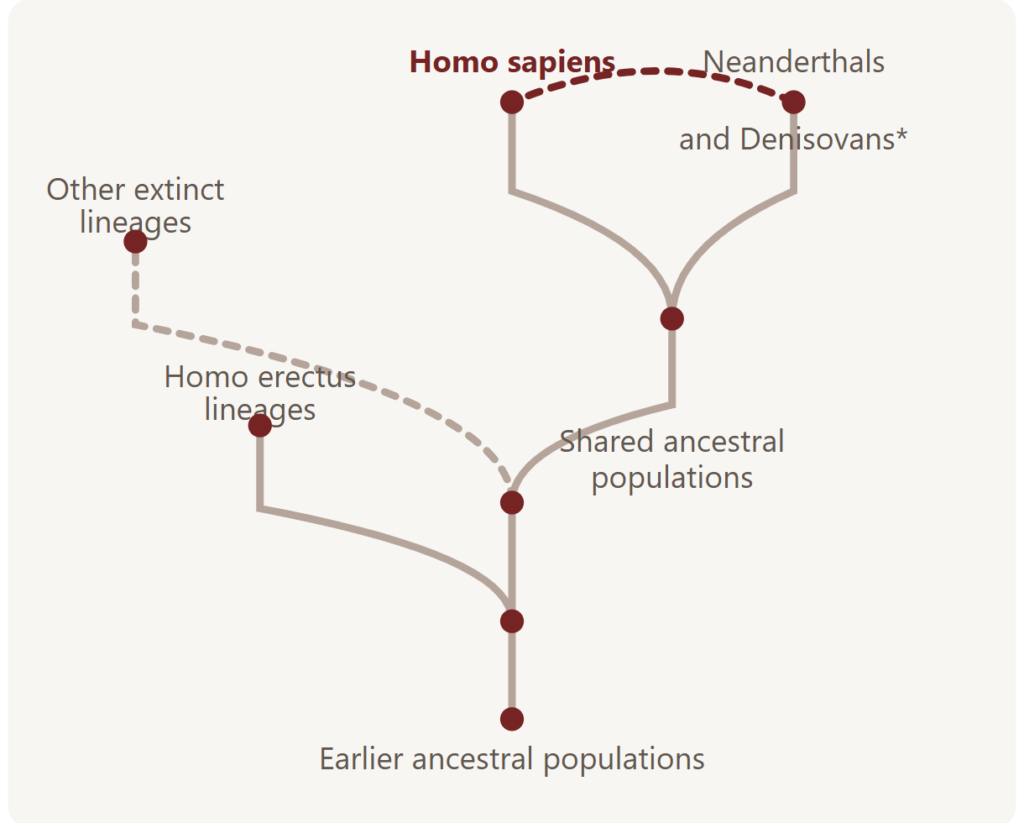
Human Evolution: A Branching History
Simplified conceptual diagram, not a complete evolutionary tree or a time-scaled reconstruction. *Neanderthals and Denisovans were distinct related lineages, grouped here for illustration. The dashed upper connection represents interbreeding.
Among the most remarkable discoveries of modern genetics is that Homo sapiens interbred with other archaic human populations, including Neanderthals and Denisovans.
Many people with ancestry outside Africa carry approximately one to two per cent Neanderthal DNA. Denisovan ancestry is particularly significant in some populations of Oceania and Asia.
These findings demonstrate that the history of humanity cannot be reduced to a simple account of one population developing in complete isolation.
Our species carries traces of encounters with other branches of the human evolutionary family.
This raises an important question for theology.
If humanity possesses a unique spiritual identity, how should we understand other human species that exhibited complex behaviour, used tools, cared for members of their communities and shared genetic ancestry with us?
Science can investigate their biology and behaviour.
It cannot determine whether they possessed souls or occupied a particular place within a divine plan.
4. Could all humanity descend from a single couple?
This is perhaps the most important scientific question raised by a literal interpretation of Adam and Eve.
Every human being inherits genetic material from biological ancestors.
Across generations, mutations introduce genetic variation, while recombination rearranges inherited DNA.
By studying these patterns, scientists can reconstruct aspects of the demographic history of human populations.
Population genetics indicates that the ancestors of modern humanity existed in breeding populations rather than as a single isolated couple at the origin of Homo sapiens.
Different regions of the human genome preserve different ancestral histories. Some genetic variants have origins extending far beyond the emergence of our species.
The diversity observed in human genomes cannot be adequately explained by a recent origin in which all humanity descended exclusively from two individuals without genetic contributions from other ancestral populations.
Genetic models often estimate ancestral effective population sizes in the thousands, although these estimates vary according to the period, population structure and assumptions used.
An effective population size is a statistical measure of genetic diversity and reproduction. It is not a direct census of how many individuals were alive at a particular moment.
Nevertheless, the broader conclusion is clear.
The scientific evidence supports a population-based origin of humanity, not the recent creation of an isolated biological couple from whom all human genetic diversity exclusively descended.
This conclusion challenges certain literal interpretations of Genesis.
It does not automatically exclude every possible historical or theological interpretation of Adam and Eve.
5. Mitochondrial Eve and Y-chromosomal Adam
One of the most intriguing connections between biblical language and modern genetics emerged when scientists began tracing particular forms of inherited DNA through human populations.
Researchers introduced two expressions that attracted considerable public attention: Mitochondrial Eve and Y-chromosomal Adam.
At first glance, these names appear to provide scientific confirmation of the biblical narrative.
Their actual meaning, however, is very different.
Who was Mitochondrial Eve?
Most human genetic material is contained within the nucleus of our cells.
However, mitochondria, the cellular structures involved in energy production, also contain a small amount of DNA.
Mitochondrial DNA is normally inherited from the mother.
Both sons and daughters receive it, but its transmission to subsequent generations occurs through the maternal line.
By comparing mitochondrial DNA sequences from people around the world, researchers can reconstruct their maternal evolutionary relationships.
Eventually, those relationships converge upon a common maternal ancestor.
Scientists refer to this woman as Mitochondrial Eve.
She probably lived in Africa hundreds of thousands of years ago, although estimates of her age vary according to genetic models and mutation rates.
Crucially, she was not necessarily the first woman, the only woman alive at the time or the mother of an entirely new species.
Many other women lived alongside her.
Some may also be ancestors of people alive today through other branches of their family trees, even though their uninterrupted maternal genetic lineages did not survive.
Who was Y-chromosomal Adam?
A comparable analysis can be performed using much of the DNA carried by the Y chromosome, which is normally transmitted from father to son.
By examining genetic differences within this chromosome, scientists can reconstruct paternal lineages and estimate when they converge upon a shared male ancestor.
This individual is known as Y-chromosomal Adam.
Like Mitochondrial Eve, he was not necessarily the first man or the only man alive during his lifetime.
Nor does genetic research establish that the two individuals were contemporaries, knew each other or formed a reproductive couple.
Their names are scientific metaphors inspired by the biblical narrative, not identifications of biblical individuals.
The Two Genetic Lineages
Mitochondrial Eve
Common ancestor through an uninterrupted maternal line.
Y-chromosomal Adam
Common ancestor through an uninterrupted paternal line.
Conceptual illustration of two independent genetic lineages. The diagram does not imply that these individuals lived at the same time or were a couple.
The discovery of these common ancestors is entirely consistent with evolutionary theory.
It does not establish that the human population once consisted of only two people.
6. Genetic ancestry and genealogical ancestry are not the same thing
An important distinction is frequently overlooked in discussions about Adam and Eve.
Being someone’s genealogical ancestor does not necessarily mean contributing identifiable DNA to that person’s genome.
Imagine a family tree extending backwards through hundreds of generations.
Every individual has two biological parents, four grandparents and potentially eight great-grandparents.
As we move further into the past, the number of ancestral positions grows enormously.
In reality, many of these positions are occupied by the same individuals because family trees overlap.
Over long periods, the genealogies of different populations can become deeply interconnected.
Genetic inheritance works differently.
An individual receives only part of each parent’s DNA. Over successive generations, some genetic contributions from distant ancestors disappear entirely from particular descendants.
Consequently, a person can be a genuine genealogical ancestor without leaving identifiable genetic material in a particular living descendant.
This distinction has encouraged some scientists and theologians to investigate whether a historical Adam and Eve could have lived within an existing population and subsequently become genealogical ancestors of everyone alive today.
Mathematical models suggest that universal genealogical ancestors could have existed surprisingly recently in human history, depending on patterns of migration, reproduction and population connectivity.
Such models do not demonstrate that Adam and Eve actually existed.
They simply illustrate why universal genealogical ancestry does not require humanity to have originated genetically from an isolated couple.
| Concept | Meaning |
|---|---|
| Genealogical ancestor | An individual appearing somewhere in a person’s biological family tree |
| Genetic ancestor | An ancestor who contributed DNA that remains in a particular descendant |
| Universal genealogical ancestor | An individual who appears in the family trees of everyone alive today |
| Sole biological founding couple | Two individuals from whom an entire population originated without other ancestral genetic contributions |
This distinction opens an interesting possibility for theological discussion while preserving the established scientific understanding of human origins.
7. Could Adam and Eve have lived among other humans?
For some religious thinkers, Adam and Eve need not represent the first anatomically modern humans.
Instead, they might represent a particular couple chosen by God from within an existing human population.
According to versions of this hypothesis, their significance would lie in a spiritual vocation, a distinctive relationship with God or their representative role within humanity.
Such an interpretation could accommodate several scientific findings.
Human populations could have existed before Adam and Eve. Biological evolution could have continued without interruption. Human genetic diversity could have been inherited from numerous ancestral populations.
Adam and Eve could theoretically have become universal genealogical ancestors without being humanity’s only genetic ancestors.
However, this interpretation raises substantial questions.
Who were the other humans living at the time?
Did they possess the same moral and spiritual status?
How would the consequences of the Fall extend to them?
Would Adam and Eve’s descendants have intermarried with populations outside Eden?
And how would such an interpretation relate to traditional doctrines concerning the unity of humanity?
Population genetics cannot answer these theological questions.
The possibility of a couple living within a broader population should not be confused with historical evidence identifying that couple as the Adam and Eve of Genesis.
It remains a proposed reconciliation between religious interpretation and evolutionary science.
8. Does the Bible itself suggest the existence of other people?
One of the most frequently discussed passages in Genesis concerns Cain, the son of Adam and Eve.
After killing his brother Abel, Cain expresses fear that other people might encounter and kill him.
Genesis 4 subsequently describes Cain travelling to the land of Nod, where he has a wife and becomes associated with the establishment of a city.
These passages have generated questions for centuries.
Whom did Cain fear?
Where did his wife come from?
Who inhabited the wider world described in the narrative?
Traditional interpretations generally suggest that Cain married a sister or another close relative, since Genesis 5:4 states that Adam had other sons and daughters.
Other interpreters have proposed that the narrative may allow for the existence of people outside Adam and Eve’s immediate family.
However, Genesis 4 does not explicitly establish the existence of an independently created or evolved human population.
Nor does it identify Cain’s wife by name or explain her ancestry in detail.
It would therefore be incorrect to claim that the passage provides definitive biblical proof of human populations existing outside Eden.
What it demonstrates is that Genesis does not answer every demographic and historical question that a modern reader might ask.
The narrative’s principal concerns lie elsewhere, particularly in violence, responsibility, exile and the development of human society.
9. Adam and Eve in Christianity, Judaism and Islam
Although the story of Adam is shared across the Abrahamic religious traditions, its theological significance differs.
Christianity
Within Christianity, Adam and Eve are closely associated with the Fall and the human condition.
The Apostle Paul develops a theological connection between Adam and Jesus Christ in Romans 5 and 1 Corinthians 15.
Adam becomes associated with humanity’s disobedience and mortality, while Christ represents reconciliation, redemption and new life.
This connection explains why the historicity of Adam is particularly important within some Christian theological traditions.
Christians nevertheless disagree about how the Genesis narrative should relate to scientific accounts of human origins.
Some defend a literal first couple, while others understand Adam and Eve as representative figures or explore their possible historical existence within an evolutionary framework.
Judaism
In Judaism, the Genesis narrative addresses the origins of humanity, the relationship between human beings and God, moral freedom and responsibility.
Jewish traditions contain extensive interpretive discussions about Adam and Eve, including literal, philosophical, symbolic and mystical readings.
Judaism generally does not understand inherited original sin in the same way as traditional Western Christianity.
Consequently, the theological implications of human evolution are not identical across these traditions.
Islam
Adam is also a significant figure in the Quran, where he is traditionally understood as the first human and a prophet.
Quranic passages describe his creation, the refusal of Iblis to obey God’s command and the experience of Adam and his spouse in the garden.
Islam emphasises personal moral responsibility and divine forgiveness rather than the Christian doctrine of inherited original sin.
Muslim scholars express different positions on evolutionary theory, particularly concerning whether human evolution can be reconciled with traditional understandings of Adam’s creation.
There is no single interpretation that represents every Muslim thinker.
The scientific evidence concerning human ancestry remains the same. Its theological interpretation depends on the religious framework through which it is considered.
10. What does the Catholic Church teach?
The Catholic position deserves particular attention because it illustrates both the possibility and the difficulty of reconciling evolutionary science with traditional Christian doctrine.
In 1950, Pope Pius XII published the encyclical Humani Generis.
Paragraph 36 permitted serious investigation into the possibility that the human body developed from earlier living organisms, while maintaining that the spiritual soul is created directly by God.
However, paragraph 37 expressed a significant restriction concerning polygenism, the proposition that humanity originated through multiple first parents rather than a single individual Adam.
The encyclical identified difficulties in reconciling this proposition with the traditional doctrine of original sin.
This distinction is essential.
The Catholic Church’s openness to biological evolution does not automatically mean that every evolutionary interpretation of Adam and Eve is equally compatible with Catholic doctrine.
The Catechism of the Catholic Church also addresses the issue.
Paragraph 390 recognises that the Genesis account of the Fall uses figurative language while affirming an actual foundational event in humanity’s relationship with God.
Paragraphs 404 and 405 describe original sin as an inherited condition of human nature rather than a personal offence committed by every individual.
Catholic theology therefore continues to face the challenge of explaining how the unity of humanity, original sin and the spiritual dimension of human beings relate to the scientific evidence for population-based evolution.
It would be misleading to suggest that this theological debate has been definitively resolved.
11. When did humans become spiritually human?
Suppose that we accept the scientific evidence for human evolution.
At what point, then, did humanity acquire the qualities that religious traditions associate with spiritual existence?
Was there a particular moment when a human being became capable of knowing God?
Did moral responsibility appear suddenly, or did it develop gradually alongside consciousness and social behaviour?
Could other extinct human species possess a spiritual dimension?
Science can investigate some of the biological foundations of these questions.
Researchers study brain development, communication, social learning, symbolic behaviour, empathy and the evolution of cooperation.
Archaeological discoveries provide evidence of increasingly sophisticated tools, artistic expression, personal ornaments and potentially symbolic treatments of the dead.
But no fossil can directly reveal the presence of a soul.
There is no genetic test that identifies the moment at which an organism becomes spiritually accountable to God.
For Catholic theology, the spiritual soul is not simply a biological structure produced by genetic mutation.
For philosophical materialists, however, human consciousness and moral cognition may be understood as emerging from the development of complex biological and social systems.
These perspectives operate with different philosophical assumptions.
Scientific research can illuminate the relationship between the brain and conscious experience, but it does not independently establish the theological existence or non-existence of the soul.
This question will be explored in greater depth in a later article of the Faith & Science series.
12. What does it mean to be created in the image of God?
Perhaps the most important theological statement concerning human origins appears in Genesis 1:27.
Humanity is described as being created in the image of God.
But what does that image represent?
If God is understood as transcending physical existence, the expression need not imply that human bodies physically resemble their Creator.
Throughout religious history, theologians and philosophers have associated the divine image with several possibilities.
Understanding the Image of God
Reason
The capacity for reflection, understanding and abstract thought.
Moral responsibility
The ability to evaluate actions and recognise ethical obligations.
Relationship
The capacity for love, communion and relationships with others and God.
Stewardship
Human responsibility towards the natural world.
Creativity
The capacity for imagination, expression and cultural creation.
Spiritual vocation
A distinctive calling to participate in a relationship with the divine.
Selected theological interpretations of the Imago Dei. These are not scientifically established criteria for spiritual identity.
Beyond Biological Origins
These interpretations suggest that the religious significance of humanity may not depend exclusively on how the human body originated.
A believer could accept that the human organism emerged through evolutionary processes while maintaining that humanity possesses a distinctive spiritual vocation.
Rethinking Human Uniqueness
However, some capacities commonly associated with human uniqueness, including problem-solving, cooperation, communication and emotional behaviour, also occur in other animals.
Science has increasingly challenged rigid assumptions about the separation between humans and the rest of the animal kingdom.
The theological concept of the divine image consequently requires more careful consideration than simply identifying biological abilities that other organisms supposedly lack.
Human Dignity
Human dignity, within many religious traditions, is not understood as depending on an individual’s intelligence, physical characteristics or measurable cognitive abilities.
13. How do atheists and agnostics understand human origins?
From a scientific naturalistic perspective, humanity emerged through the same fundamental evolutionary processes that shaped other living organisms.
Mutation, natural selection, genetic drift, migration, environmental pressures and reproductive interactions contributed to the development of our species.
No scientifically necessary role for divine intervention has been identified within this biological account.
For many atheists, the absence of such a requirement supports a naturalistic understanding of human existence.
Adam and Eve may consequently be understood as figures within an ancient religious narrative rather than historical individuals responsible for the biological origin of humanity.
Agnostics may accept the same scientific evidence while remaining undecided about broader metaphysical questions concerning the existence of God.
It is nevertheless important not to reduce atheism to a denial of human meaning or morality.
Non-religious philosophers have developed extensive accounts of ethics, human dignity, freedom and responsibility grounded in human experience, reason and social relationships.
An atheist can regard humanity as possessing profound value without believing that such value originates in divine creation.
Likewise, a religious believer can accept evolutionary science without concluding that natural processes exhaust every possible explanation of existence.
The disagreement concerns not only how humanity developed, but what that development ultimately means.
14. Five interpretations of Adam and Eve
The dialogue between genetics and religious belief has produced several approaches to the biblical narrative.
| Interpretation | Understanding of Adam and Eve | Relationship to science |
|---|---|---|
| Literal recent creation | The first and only biological founding couple, created a few thousand years ago | Conflicts with genetic, fossil and geological evidence |
| Ancient special creation | A biological founding couple created in the distant past | Accepting an ancient Earth alone does not resolve the genetic difficulties |
| Historical couple within a population | Two individuals living among existing humans, assigned a special divine role | Potentially consistent with population genetics, but historically unverified |
| Archetypal interpretation | Figures representing humanity and its moral relationship with God | Does not require a literal founding couple |
| Naturalistic interpretation | Religious and literary figures expressing ancient understandings of human origins | Consistent with evolutionary biology without invoking divine creation |
These interpretations are not equally supported in every respect.
Science can evaluate their empirical claims, but it cannot establish that an individual was chosen by God or that a narrative possesses divine authority.
Some approaches offer greater compatibility with evolutionary evidence while creating new challenges for traditional doctrines.
Others prioritise particular readings of scripture despite their conflict with established scientific findings.
The intellectual responsibility of both believers and non-believers is to acknowledge these distinctions.
15. What science has established and what remains unanswered
The available evidence allows us to reach several important conclusions.
Evidence, Interpretation and Uncertainty
Established scientific findings
Homo sapiens emerged in Africa approximately 300,000 years ago.
Human evolution involved multiple ancestral populations.
Modern humans share evolutionary ancestry with other primates.
Human genetic diversity contradicts a recent origin from an isolated founding couple.
Mitochondrial Eve and Y-chromosomal Adam represent distinct genetic ancestral lineages.
Open scientific and historical questions
The precise structure of the earliest Homo sapiens populations.
The detailed emergence of complex language and symbolic behaviour.
The identity or historical existence of the individuals described in Genesis.
Theological and philosophical questions
Whether humanity was created with a divine purpose.
Whether human beings possess an immortal soul.
The meaning of the Fall and original sin.
Whether Adam and Eve had a distinctive spiritual vocation.
The distinction between these categories is fundamental.
A limitation of scientific knowledge does not automatically constitute evidence for divine intervention.
Equally, a successful scientific explanation of biological development does not automatically disprove every possible theological understanding of creation.
Conclusion: Were Adam and Eve the first humans?
From the perspective of contemporary science, humanity did not originate recently from a single isolated biological couple.
Homo sapiens emerged through a complex evolutionary history involving ancient populations, environmental change and genetic interaction.
The individuals known as Mitochondrial Eve and Y-chromosomal Adam do not establish the existence of the biblical couple.
Nor do they represent the beginning of humanity.
Whether Adam and Eve existed as historical individuals within a wider population remains unverified.
Their possible significance as theological representatives of humanity belongs to a different field of inquiry.
For religious believers, the challenge is to understand how the biblical message concerning creation, freedom, responsibility and spiritual identity relates to the scientific history of our species.
For atheists, human evolution provides a natural explanation of our biological origins without requiring a divine act of creation.
For philosophers, the discussion remains connected to questions of consciousness, personal identity, morality and meaning.
Perhaps the most profound question raised by Genesis is not simply who the first human beings were, but what it means to be human.
We belong to a species shaped by hundreds of thousands of years of evolutionary history.
We carry genetic traces of ancient populations that no longer exist.
We share a biological relationship with the extraordinary diversity of life on Earth.
Yet we also possess the capacity to contemplate our beginnings, question our existence and imagine realities beyond our immediate experience.
Science has brought us remarkably close to understanding the biological origins of humanity.
Whether those origins possess a deeper spiritual significance remains one of the enduring questions of human existence.
If evolution explains how we became human, does it also explain everything that being human means?
Faith & Science will continue with Article 003: “Who Created the Universe? The Big Bang, the Beginning of Everything and the Question of God.”
Open Chronicle Explained | Where Belief Meets Discovery
Sources and Further Reading
The following scientific publications, institutional resources and theological documents provide the foundation for this exploration of human origins, genetic ancestry and biblical interpretation.
Smithsonian Institution | Human Origins Program: Homo sapiens
Scientific documentation concerning the African origins of modern humans, fossil evidence and our evolutionary relationship with other primates.
Explore the evidence of human evolution →
Nature | New Fossils from Jebel Irhoud, Morocco and the Pan-African Origin of Homo sapiens
Hublin et al., 2017. Scientific research documenting early Homo sapiens fossils dating to approximately 315,000 years ago.
Read the original scientific study →
Nature | A Weakly Structured Stem for Human Origins in Africa
Ragsdale et al., 2023. Genetic research investigating interconnected ancestral African populations and alternative demographic models of human origins.
Read the population genetics study →
Oxford University Press | Finding Our Roots: Did “Eve” Know “Adam”?
Norman A. Johnson, 2007. An academic explanation of maternal and paternal genetic ancestry and the different evolutionary histories of inherited DNA.
Explore mitochondrial and paternal ancestry →
Nature | Modelling the Recent Common Ancestry of All Living Humans
Rohde, Olson and Chang, 2004. Mathematical research investigating universal genealogical ancestry and the interconnected family trees of human populations.
Read the genealogical ancestry study →
United States Conference of Catholic Bishops | The Book of Genesis
Biblical texts and scholarly commentary addressing the creation narratives, Adam and Eve and the theological meaning of early Genesis.
Read the introduction to Genesis →
Vatican | Humani Generis, Pope Pius XII (1950)
Official Catholic documentation concerning human evolution, the creation of the spiritual soul and the theological difficulties associated with polygenism. Paragraphs 36 and 37 are particularly relevant.
Read the official encyclical →
Vatican | Catechism of the Catholic Church: The Fall
Official theological teaching concerning Adam and Eve, original sin, figurative biblical language and humanity’s relationship with God.
Read the Catechism, paragraphs 385–421 →
Vatican | Catechism of the Catholic Church: Man
Official Catholic teaching concerning human dignity, the image of God, the unity of body and soul and the theological understanding of humanity.
Read the Catechism, paragraphs 355–384 →
Editorial Note
This article distinguishes established scientific evidence from historical hypotheses, biblical interpretation, theological doctrine and philosophical reflection. The evolutionary origins of Homo sapiens and the population-based history of human genetic diversity are supported by extensive scientific research. The historical identity of Adam and Eve remains unverified. The concepts of Mitochondrial Eve and Y-chromosomal Adam should not be interpreted as scientific confirmation of the biblical couple. Questions concerning divine creation, spiritual identity and original sin remain within theological and philosophical debate.
Understanding the systems behind the headlines.
Explore Open Chronicle Explained →