
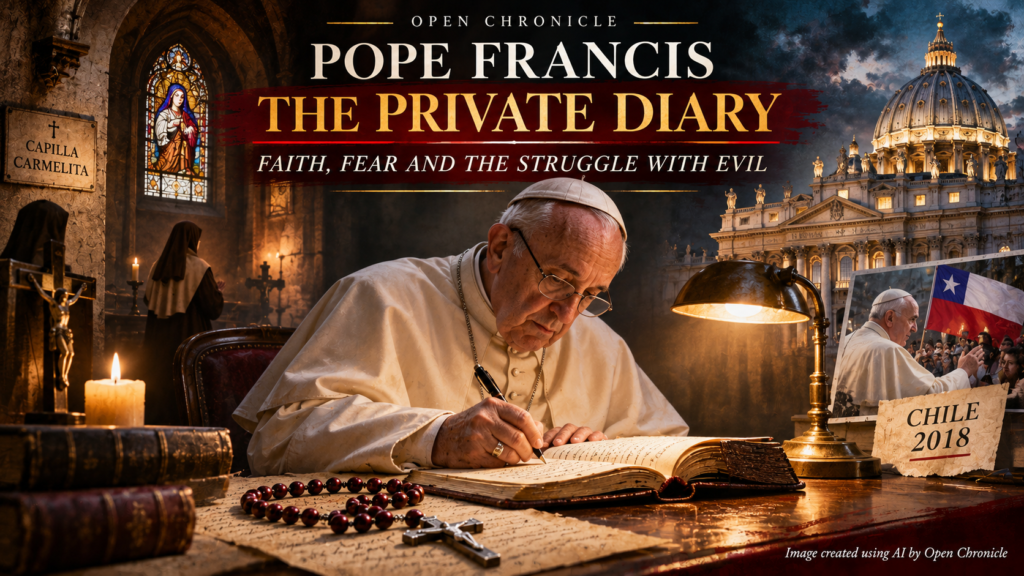
Newly published personal writings attributed to the late pontiff reveal extraordinary accounts of encounters he interpreted as manifestations of the devil, alongside deeply personal reflections on faith, fear, responsibility and one of the most difficult crises of his papacy.
By Open Chronicle News Desk
November 24, 2026
WORLD NEWS | RELIGION | SOCIETY | VATICAN
The publication of the private diary of Pope Francis has opened a remarkable new window into the spiritual and emotional life of one of the most influential religious figures of the twenty first century.
According to newly released extracts from The Private Diary of Pope Francis, the late pontiff recorded three experiences that he interpreted as encounters with the devil, as well as a disturbing vision of what he described as the gates of hell.
The writings, covering the period between 1992 and 2024, also reveal a man confronting personal doubts, institutional failures and the consequences of decisions made during his leadership of the Roman Catholic Church.
Among the most significant passages are his reflections on the clerical sexual abuse scandal in Chile, an episode that severely damaged the credibility of his pontificate and forced him to reconsider his initial response to allegations against members of the Catholic hierarchy.
Beyond their extraordinary spiritual content, the diaries offer an intimate portrait of a religious leader attempting to reconcile his understanding of evil with the realities of human suffering and institutional responsibility.
1. A Private Window Into the Mind of Pope Francis
Jorge Mario Bergoglio
17 December 1936 to 21 April 2025266th Pope of the Roman Catholic Church
Pontificate: 2013 to 2025
First Jesuit pope and first pope from Latin America.
Throughout his twelve years as pope, Francis frequently spoke about the existence of evil, spiritual temptation and the importance of resisting forces that undermine human dignity.
His public teachings often combined traditional Catholic theology with reflections on poverty, inequality, corruption, violence and the abuse of power.
The newly published diary suggests that these themes also occupied a significant place in his private spiritual life.
Edited by Cardinal Víctor Manuel Fernández, prefect of the Vatican’s Dicastery for the Doctrine of the Faith and a longtime associate of Francis, the collection reportedly contains personal observations spanning more than three decades.
The publication provides an opportunity to examine the distinction between the public responsibilities of the papacy and the private experiences of the individual occupying one of the world’s most prominent religious offices.
2. Three Encounters With the Devil
A diary entry from 2021 reportedly describes three occasions on which Francis believed he had encountered the devil.
The experiences occurred in different circumstances, including during a car journey, inside a chapel during Mass and during a meeting involving Vatican officials.
Francis described disturbing visual impressions and a voice whose distinctive harshness remained in his memory.
“I can’t forget the powerful raspiness of his voice,” he wrote, according to the published extracts.
The significance of these passages lies not in establishing the objective existence of supernatural encounters, but in understanding how Francis interpreted experiences that he considered spiritually meaningful.
His descriptions reflect a religious worldview in which the struggle between good and evil was not merely an abstract theological concept.
3. The Vision Inside a Carmelite Chapel
One of the most striking passages concerns an experience that reportedly occurred while Francis was archbishop of Buenos Aires.
During Mass inside a Carmelite chapel, he described seeing a presence in the choir loft whose eyes appeared intensely threatening.
The diary portrays the experience as deeply unsettling, with Francis comparing the appearance of the eyes to flashes of fire.
The episode is particularly significant because it reportedly predates his election as pope in March 2013.
It suggests that the spiritual concerns expressed in the diary were not exclusively associated with the pressures of leading the Catholic Church.
Rather, they appear to have formed part of his personal religious experience over a much longer period.
4. The Gates of Hell
In another extraordinary passage, Francis described an experience in June 2018 while preparing to go to sleep.
He wrote that he had seen what he interpreted as the gates of hell.
FROM THE PRIVATE DIARY | JUNE 2018
“I watched a little, and it terrified me.”
Pope Francis, recalling an experience he interpreted as a vision of the gates of hell.
According to the published extracts, Francis responded by turning to the rosary, describing it as a spiritual weapon against the threatening experience.
He also expressed concern about approaching what he perceived as the boundary of hell, using imagery involving flames and danger.
Such language has a long tradition within Christian spirituality, where fire, darkness and threatening presences have frequently been used to describe temptation, separation from God and the consequences of evil.
Whether understood literally, symbolically or psychologically, the passage provides an insight into the intensity of Francis’ private religious reflections.
5. Chile: One of the Most Difficult Chapters of His Papacy
Perhaps the most consequential revelations in the diary concern events that can be situated within a documented historical and institutional context.
In January 2018, Francis visited Chile amid growing controversy over allegations of clerical sexual abuse and accusations that members of the Church hierarchy had failed to respond adequately.
At the centre of the controversy was Bishop Juan Barros, who had been accused of covering up abuse committed by the influential Chilean priest Fernando Karadima.
Francis initially defended Barros, provoking widespread criticism from survivors, campaigners and members of the Catholic community.
The controversy became one of the most serious challenges to the credibility of his leadership.
Francis subsequently acknowledged serious errors in his assessment of the situation, apologised and summoned Chile’s bishops to Rome.
In an extraordinary collective response, the bishops offered their resignations.
6. When Spiritual Struggle Meets Institutional Responsibility
The diary appears to connect some of Francis’ reported spiritual experiences with periods of considerable institutional pressure.
His account of the Chilean crisis places his reflections on evil alongside his recognition of failures within the Church.
However, these two dimensions must remain distinct.
The abuse of children and vulnerable individuals, failures of institutional oversight and the suffering experienced by survivors are matters of human conduct, accountability and justice.
They cannot be explained away through supernatural interpretations.
Francis’ personal spiritual experiences may help illuminate his understanding of the crisis, but they do not diminish the responsibility of individuals or institutions for their actions.
The diary therefore raises important questions about how religious leaders reconcile theological beliefs with the practical demands of governance, transparency and accountability.
7. The Devil in Catholic Theology
The concept of the devil occupies an established place within traditional Catholic doctrine.
Catholic teaching describes Satan as a created spiritual being who rejected God and whose influence is associated with temptation and opposition to divine goodness.
The Catechism of the Catholic Church discusses these beliefs while maintaining that the power attributed to Satan is not unlimited.
Francis frequently addressed the subject during his pontificate.
His 2018 apostolic exhortation, Gaudete et Exsultate, included an extended discussion of spiritual combat, vigilance and discernment.
For Francis, the language of spiritual struggle was also connected to everyday moral decisions, including resistance to corruption, selfishness, indifference and injustice.
8. Faith, Psychology and the Interpretation of Visions
Extraordinary religious experiences have been recorded across cultures and historical periods.
Christian mystics, religious scholars, philosophers and medical researchers have approached such experiences from different intellectual traditions.
| Perspective | Interpretative framework |
|---|---|
| Catholic theology | Spiritual experience, temptation and religious discernment. |
| Psychology | Subjective perception, emotional experience, memory and cognition. |
| Neuroscience | The relationship between consciousness, sensory perception and brain activity. |
| Historical research | Religious experiences within their cultural and institutional context. |
| Philosophy | Questions concerning consciousness, reality and the nature of evil. |
| Journalism | Documentation, attribution and independent verification of claims. |
The circumstances surrounding Francis’ reported experiences cannot be reconstructed with certainty from the published extracts alone.
There is insufficient evidence to establish a psychological, neurological or supernatural explanation.
It would therefore be inappropriate either to present the experiences as scientifically verified encounters or to diagnose the late pontiff retrospectively.
The diary is principally evidence of how Francis remembered and interpreted his own experiences.
9. The Jesuit Tradition of Spiritual Discernment
Francis’ religious formation provides another important dimension to understanding the diary.
Before becoming pope, Jorge Mario Bergoglio belonged to the Society of Jesus, the religious order founded by Saint Ignatius of Loyola.
1491 to 1556. Founder of the Society of Jesus and author of the Spiritual Exercises, a foundational work of Ignatian spirituality.
Ignatian spirituality places particular emphasis on examining internal experiences, distinguishing between different spiritual influences and understanding the relationship between faith and personal decision-making.
Its practices include reflection, prayer, examination of conscience and discernment.
The tradition does not require every unusual experience to be accepted as a supernatural manifestation. Discernment involves careful evaluation rather than automatic acceptance.
Francis’ Jesuit background offers a relevant theological context for his diary, although it cannot establish the nature or origin of the experiences described.
10. More Than Three Decades of Private Reflections
The reported chronological scope of the diary makes it a potentially significant resource for understanding the development of Francis’ religious thought.
11. Cardinal Víctor Manuel Fernández and the Publication
Argentine cardinal and theologian, Prefect of the Dicastery for the Doctrine of the Faith, appointed by Pope Francis in 2023.
According to the supplied report, Cardinal Fernández edited the private writings for publication.
His longstanding relationship with Francis and his prominent position within the Vatican make his involvement particularly significant.
The publication reportedly represents the first public release of a pope’s diary since the 1960s.
Nevertheless, any edited collection of private writings raises important methodological questions.
The selection of passages, their chronological arrangement, translation and accompanying explanations can influence how readers interpret the author’s intentions.
A complete assessment of the diary will require examination of the published edition and its editorial methodology.
12. The Historical Importance of Papal Private Writings
Popes have traditionally communicated through encyclicals, apostolic exhortations, speeches, homilies and official correspondence.
Such documents are generally prepared with awareness of their public and institutional significance.
Private diaries serve a different purpose.
They may contain uncertainty, emotional reactions, incomplete thoughts and personal interpretations that were never intended to function as official declarations.
For historians, this distinction is essential.
A private entry can reveal aspects of a pope’s personality without necessarily representing the official position of the Catholic Church.
The diary of Francis may consequently become an important historical source, not because every experience it describes can be independently established, but because it offers evidence of the late pontiff’s personal understanding of his life and responsibilities.
13. Open Chronicle Editorial Assessment
14. What Remains Unanswered
The publication raises several questions that cannot yet be resolved from the available extracts.
| Question | Why it matters |
|---|---|
| How complete is the published diary? | Determines whether readers have access to the full historical context. |
| How were the entries selected? | Editorial decisions may influence the overall interpretation. |
| What terminology appears in the original manuscripts? | Translation can affect the meaning of religious descriptions. |
| Were the experiences discussed with spiritual advisers? | Additional documentation could provide theological context. |
| What further reflections concern Chile? | Could illuminate Francis’ understanding of institutional failures. |
| Will researchers have access to the manuscripts? | Independent examination would strengthen the diary’s historical value. |
The distinction between the original writings, the published edition and subsequent journalistic interpretations will remain important as scholars begin examining the collection.
Conclusion: The Man Behind the Papacy
The private diary of Pope Francis presents a portrait of a religious leader whose personal life appears to have been marked by profound spiritual concerns, moments of fear and difficult moral reflection.
His reported encounters with the devil and his description of the gates of hell will inevitably attract considerable public attention.
Yet the passages concerning Chile may ultimately prove more significant to historians examining the legacy of his pontificate.
They reveal a leader confronting the consequences of his own judgement and acknowledging the difficulty of recognising the full extent of institutional wrongdoing.
The diary cannot resolve ancient theological questions about the existence or nature of evil. Nor can it establish the objective reality of the extraordinary experiences it describes.
What it may offer is a deeper understanding of how Francis perceived the world, interpreted suffering and confronted the tension between religious conviction and human responsibility.
The most enduring revelation may not be what Francis believed he saw, but what he came to recognise about himself and the institution he led.