
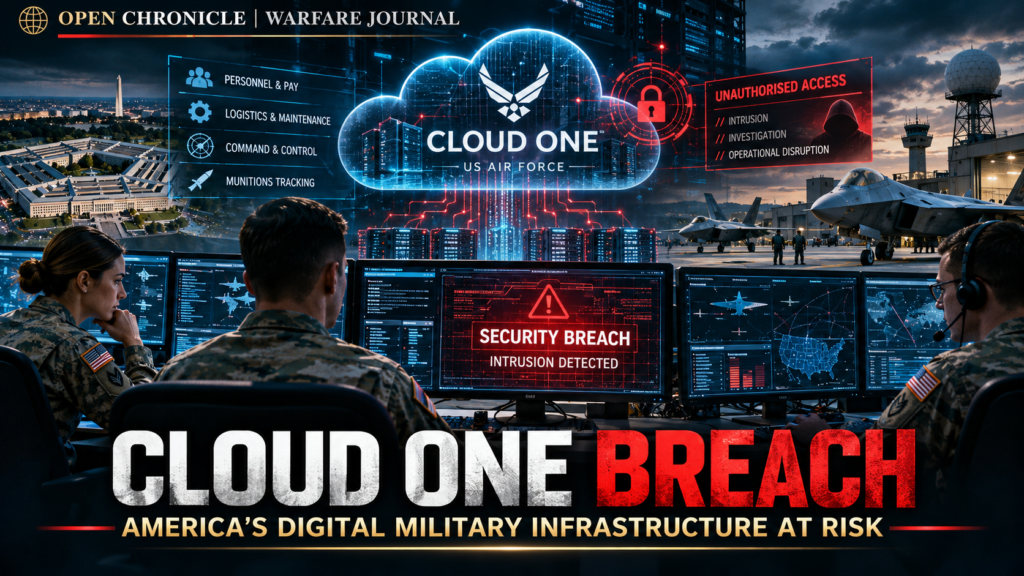
An intrusion into one of the Pentagon’s largest military cloud platforms has reportedly disrupted software maintenance and digital modernisation programmes. The incident raises fundamental questions about cybersecurity, military readiness and the growing dependence of modern armed forces on interconnected digital infrastructure.
OPEN CHRONICLE | WARFARE JOURNAL
CYBER WARFARE | MILITARY INTELLIGENCE | DEFENSE TECHNOLOGY
27 November 2026 | By Open Chronicle Warfare Journal
When the battlefield extends into the cloud
The United States Air Force operates some of the world’s most advanced combat aircraft, surveillance platforms, weapons systems and command networks.
Behind these capabilities lies an increasingly important digital infrastructure responsible for managing information, coordinating resources and supporting military decision-making.
That infrastructure is now at the centre of a serious cybersecurity investigation.
On 27 November 2026, Reuters reported that unidentified hackers had penetrated Cloud One, a major cloud computing environment supporting the US Air Force.
The intrusion was reportedly discovered during a platform upgrade in the weeks preceding the disclosure.
The discovery has disrupted aspects of the Air Force’s digital operations, including application maintenance and plans to migrate additional military administrative systems into the cloud.
According to Reuters, US Cyber Command has been brought into the investigation to help assess the potential damage.
The identity of the attackers, the extent of their access and whether sensitive information was stolen remain unknown.
Nevertheless, the incident raises a strategic question that extends far beyond the immediate investigation.
What happens when the digital infrastructure supporting a modern air force can no longer be trusted?
Cloud One: The digital infrastructure behind military readiness
Established in 2017, Cloud One was developed to consolidate and modernise the Air Force’s computing environment.
Rather than relying exclusively on separate information systems maintained by individual military organisations, the platform provides a shared environment in which applications can be hosted, managed and developed.
Its infrastructure draws upon four major commercial cloud providers:
- Amazon Web Services
- Microsoft Azure
- Google Cloud Platform
- Oracle Cloud Infrastructure
The platform supports applications associated with military administration, personnel management, logistics, maintenance and operational information.
Its importance therefore extends beyond conventional office computing.
Military organisations depend on accurate information to understand the availability of personnel, equipment and resources.
An aircraft may be technologically advanced, but its operational availability also depends on maintenance records, spare parts, qualified personnel and supporting infrastructure.
Digital systems help coordinate these requirements.
Cloud One represents an effort to make such capabilities more accessible, scalable and efficient across the Department of the Air Force.
The reported intrusion illustrates the security challenges associated with that transformation.
The incident and its immediate consequences
Reuters interviewed five individuals familiar with different aspects of the incident.
Three described the intrusion itself, while additional sources provided information about the resulting restrictions and disruption.
According to their accounts, the discovery prompted restrictions on application updates, the suspension of some migration activities and the removal of administrative privileges from certain users.
These measures suggest that the investigation has affected the normal management of the platform.
However, the available information does not establish that the attackers directly caused every reported disruption.
Some restrictions may have been introduced by security personnel as precautionary containment measures.
This distinction is important.
During a cybersecurity incident, defenders may deliberately suspend services or restrict access to prevent further compromise and preserve evidence.
The resulting operational disruption can therefore arise from both the intrusion and the response to it.
The Air Force has not publicly disclosed a detailed technical assessment of the incident.
In its response to Reuters, the service declined to discuss the security condition or operational status of individual systems, while emphasising its continuing responsibility to protect information and mission capabilities.
The statement did not provide independent public confirmation of the intrusion’s full scope.
A reported compromise of the cloud control plane
One of the most significant elements of the Reuters investigation concerns the possibility that the attackers obtained access to Cloud One’s control plane.
This claim was attributed to a single source familiar with the incident.
The control plane is the administrative layer through which a cloud environment is managed.
It is distinct from the applications and information hosted within that environment.
Depending on the architecture and permissions involved, a control plane can govern the configuration, operation and administration of multiple cloud services.
Its security is consequently fundamental to the integrity of the wider infrastructure.
A compromise at this level may have consequences extending beyond an individual application.
Investigators must establish whether administrative functions remained trustworthy and whether the incident affected other parts of the environment.
The precise vulnerability reportedly exploited in the Cloud One intrusion has not been publicly identified.
Nor has the extent of the alleged administrative access been established.
There is therefore insufficient evidence to conclude that the attackers obtained unrestricted control over the platform or access to every application it hosts.
The significance of the allegation lies in the potential breadth of the security problem, not in any confirmed demonstration of comprehensive attacker control.
Why military cloud security is different
Commercial organisations rely on cloud computing for communications, financial transactions, customer services and business operations.
Military organisations face many of the same technological challenges, but the consequences of failure can be different.
A disruption affecting a commercial application may result in financial losses or interruption of services.
A disruption affecting military information systems may also influence operational planning, force availability and the allocation of critical resources.
Three fundamental cybersecurity principles are particularly relevant.
The Three Pillars of Military Cybersecurity
Confidentiality • Integrity • Availability
Confidentiality
Sensitive information must remain accessible only to authorised individuals and organisations.
Military data can reveal information about personnel, equipment, logistics and organisational activities.
Even information that is not formally classified may possess considerable intelligence value when combined with other sources.
Integrity
Military decision-makers must be able to trust the accuracy of the information they receive.
An information system can remain available while its contents become unreliable.
Maintaining confidence in the accuracy and authenticity of military data is therefore essential.
Availability
Information and digital services must remain accessible when authorised personnel need them.
A system that cannot be accessed during an operational requirement may be unable to fulfil its intended purpose, even if its information remains confidential and accurate.
The Cloud One investigation potentially involves all three principles.
The reported disruption establishes concerns about availability and normal administrative operations.
Possible confidentiality or integrity failures remain matters for investigation rather than confirmed outcomes.
Cloud-Based Command and Control
Among the applications associated with Cloud One is the Air Force’s Cloud-Based Command and Control system, commonly known as CBC2.
The system forms part of the Advanced Battle Management System, a broader portfolio intended to modernise the exchange and interpretation of operational information.
According to the Pentagon’s Director, Operational Test and Evaluation, CBC2 is designed to support a more integrated air surveillance picture and provide decision-support capabilities.
The programme is associated with the modernisation of command and control arrangements used in North American air defence.
Its purpose illustrates the growing importance of cloud-based information processing in military operations.
Commanders increasingly depend on systems capable of collecting information from different sources and presenting it in a coherent form.
Such capabilities are intended to improve situational awareness and support timely decisions.
However, their effectiveness depends on the reliability of the underlying digital infrastructure.
The association between CBC2 and Cloud One makes the reported intrusion particularly relevant to military cybersecurity.
It does not establish that CBC2 itself was compromised.
No publicly available evidence examined for this article demonstrates that the attackers accessed air defence information, altered surveillance data or disrupted the operational protection of North American airspace.
Those distinctions must remain explicit while the investigation continues.
The digital management of military munitions
Another application identified in the Reuters investigation is the Theater Integrated Combat Munitions System, or TICMS.
The system supports the management of military munitions across more than 200 Air Force locations worldwide.
Modern military logistics requires accurate information about the availability, movement and management of equipment and supplies.
Munitions management is a particularly important component of this process.
Digital inventory systems help military organisations understand their resources and coordinate logistical requirements.
Their reliability contributes to the wider ability of armed forces to sustain operations.
A cybersecurity incident involving infrastructure associated with such applications naturally raises concerns about the protection of military logistics information.
However, Reuters did not establish that TICMS records were accessed, stolen or manipulated during the Cloud One intrusion.
There is also no confirmed evidence that the incident disrupted physical weapons deliveries, reduced available ammunition stocks or interfered with weapons employment.
The existence of an application within a cloud environment must not be confused with evidence that the application was individually compromised.
Logistics as a component of combat power
The Cloud One incident highlights a broader reality of contemporary military operations.
Combat power depends on the ability to sustain forces over time.
Aircraft require fuel, maintenance, replacement components, technical documentation and trained personnel.
Military installations require infrastructure and reliable support services.
These activities generate large volumes of information that must be collected, updated and shared.
Digital logistics platforms help military organisations manage this complexity.
Their importance increases as forces become more geographically dispersed and equipment becomes more sophisticated.
For military commanders, the reliability of logistical information is therefore an operational requirement rather than simply an administrative convenience.
A serious cybersecurity incident can create uncertainty even before its complete consequences become known.
Organisations may need to verify records, restrict access or temporarily rely on alternative procedures.
These activities can consume time and resources.
Whether such consequences have affected the US Air Force’s actual aircraft availability remains unknown.
The Cloud One case nevertheless demonstrates why cybersecurity and military sustainment must be considered together.
A $454.9 million modernisation programme
The timing of the reported intrusion is particularly significant because Cloud One is undergoing a major modernisation programme.
On 11 March 2026, US defence technology company Leidos announced a contract valued at $454.9 million to modernise the Air Force’s cloud environment.
The company identified security improvements, automation, operational simplification and faster deployment of digital capabilities among the programme’s objectives.
The modernisation involves collaboration with Amazon Web Services, Microsoft Azure, Google Cloud Platform and Oracle Cloud Infrastructure.
The contract reflects the scale of the Air Force’s commitment to cloud computing.
It also demonstrates that cybersecurity was already a central objective of the modernisation programme before the reported intrusion became public.
Reuters identified Leidos as the successor to SAIC as Cloud One’s prime contractor, with the transition occurring in 2025.
The March 2026 announcement provides additional context for the ongoing transformation of the platform.
However, the available information does not establish that the contractor transition or modernisation programme caused the intrusion.
The discovery of a security incident during an upgrade does not necessarily mean that the upgrade introduced the vulnerability.
Modernisation activities can also reveal previously undetected problems.
The relationship between the intrusion and the ongoing programme remains a matter for technical investigation.
The advantages and risks of military cloud consolidation
Cloud computing offers substantial advantages for military organisations.
Shared infrastructure can reduce duplication, improve resource allocation and make it easier to introduce new applications.
Cloud environments can also support common security standards, centralised monitoring and more consistent management practices.
These benefits help explain why the US military has invested heavily in digital modernisation.
However, consolidation also creates important architectural responsibilities.
When multiple organisations depend on shared services, the security and reliability of those services become increasingly important.
A problem affecting common administrative infrastructure may require a coordinated response across several applications.
The challenge is not simply whether military systems should use the cloud.
It is how those systems should be organised so that an incident affecting one component does not unnecessarily undermine the wider environment.
Effective isolation, carefully managed administrative privileges, independent monitoring and tested recovery arrangements are essential considerations.
A well-designed cloud architecture can improve security compared with fragmented legacy systems.
Conversely, weaknesses in shared administrative arrangements can create significant concentration risks.
The Cloud One investigation should therefore be understood as a test of military cloud resilience rather than evidence that cloud computing is inherently unsuitable for defence organisations.
Why a multicloud environment does not eliminate risk
Cloud One’s use of four major commercial providers reflects a multicloud approach.
Such an architecture can offer flexibility and reduce dependence on a single infrastructure provider.
Different cloud services may also provide capabilities suited to different military applications.
Nevertheless, the presence of multiple providers does not automatically guarantee operational independence between all parts of the environment.
Shared management arrangements, common identity services and organisational dependencies can influence the overall resilience of a multicloud system.
Security therefore depends on how the different components are integrated and governed.
The Cloud One incident raises questions about those arrangements, but its precise architecture and the boundaries of the reported compromise have not been publicly established.
There is no evidence in the reporting that Amazon, Microsoft, Google or Oracle individually suffered a breach as part of this incident.
Nor does the available evidence establish that all four providers were affected.
The involvement of commercial cloud infrastructure should not be interpreted as proof of responsibility on the part of any particular company.
The role of US Cyber Command
According to Reuters, US Cyber Command has been asked to help determine the potential damage associated with the intrusion.
The command is responsible for military activities in cyberspace and plays a central role in the defence of US military networks.
Its reported involvement illustrates the seriousness with which the incident is being examined.
A comprehensive military cybersecurity assessment must address several fundamental questions.
Investigators need to determine the extent of unauthorised access, assess the reliability of affected systems and establish whether information was exposed or altered.
They must also evaluate the effectiveness of containment measures and determine the conditions required for safe restoration.
For military organisations, this process must take account of operational requirements as well as technical security.
Restoring a service too quickly may create additional risks.
Keeping it unavailable for an extended period may impose unnecessary disruption.
The challenge is to restore trusted capabilities while maintaining the continuity of essential military functions.
US Cyber Command did not provide Reuters with a public statement confirming its involvement or findings.
Its reported participation should therefore remain attributed to the source cited by the news agency.
The difficult balance between containment and continuity
One of the most consequential aspects of the Cloud One incident is the reported restriction of software updates.
Modern cybersecurity depends partly on the timely correction of software vulnerabilities.
During an investigation, however, changes to affected systems may need to be controlled carefully.
Security personnel may require a stable environment in which to examine evidence and establish the extent of a compromise.
This can create tension between incident containment and routine maintenance.
The organisation must protect the integrity of the investigation while continuing to manage unrelated security risks.
The same problem applies to administrative privileges.
Restricting privileged access can be an important precaution, but legitimate personnel still require appropriate access to maintain essential services.
Effective incident management therefore depends on coordination between cybersecurity specialists, system administrators and operational authorities.
The objective is not simply to remove an intruder.
It is to restore confidence in the environment while preserving the organisation’s ability to perform its responsibilities.
For the Air Force, this balance is especially important because the platform supports a diverse collection of military applications.
Artificial intelligence and the changing cyber threat
The Cloud One intrusion comes amid growing concern about the use of artificial intelligence in cyber operations.
AI technologies can assist with the analysis of software, the processing of large volumes of information and the automation of repetitive technical tasks.
These capabilities have legitimate defensive applications.
They may also be misused by malicious actors.
For large digital environments, the speed at which security weaknesses can be identified and analysed is becoming an increasingly important consideration.
Military organisations must therefore develop defensive capabilities capable of responding to rapidly evolving threats.
This includes improving security monitoring, vulnerability management and the ability to evaluate suspicious activity.
However, the Cloud One incident should not be described as an AI-powered cyberattack.
No evidence examined for this article establishes that the intruders used artificial intelligence.
The role of AI is relevant to the broader strategic environment, not to the confirmed technical characteristics of this particular intrusion.
A wider pattern of US government cybersecurity incidents
The Cloud One disclosure follows reporting about several other cybersecurity incidents affecting American government organisations.
Reuters identified recent incidents involving the FBI, Pentagon data, Department of Homeland Security personnel information, intelligence organisations and the US Treasury.
Taken together, these cases demonstrate the continuing cybersecurity pressures facing government infrastructure.
However, they should not automatically be interpreted as components of a coordinated campaign.
Different incidents may involve different attackers, objectives and technical circumstances.
Some may concern espionage, others criminal activity or unauthorised access with different motivations.
The public evidence does not establish a common perpetrator connecting these incidents to the reported Cloud One breach.
Their collective significance lies in the persistent challenge of protecting large and complex government information environments.
For military organisations, that challenge is compounded by the importance of maintaining trusted services during periods of heightened international tension.
Cyber espionage, sabotage or another objective?
The motivation behind the Cloud One intrusion remains unknown.
Several broad categories of malicious activity are relevant to military cybersecurity investigations.
Cyber espionage may seek access to sensitive government or defence information.
Sabotage may seek to disrupt the operation or reliability of information systems.
Criminal activity may involve financial objectives, extortion or the unauthorised acquisition of data.
These categories are not mutually exclusive.
An investigation must establish the available evidence before assigning an objective or attributing responsibility.
In the Cloud One case, no government or organisation has been publicly identified as responsible.
There is no verified evidence linking the intrusion to Russia, China, Iran, North Korea or any other state.
There is also no confirmed evidence of ransomware, extortion demands or deliberate manipulation of military records.
The strategic sensitivity of the platform does not justify premature attribution.
Maintaining that distinction is essential to responsible reporting on military cyber incidents.
The danger of assuming that a system is secure
In 2023, Cloud One’s leadership publicly described the platform’s previous record of resisting intrusion attempts in highly positive terms.
The commentary reflected confidence in the security arrangements protecting the environment.
The reported incident in 2026 provides a reminder that cybersecurity performance cannot be treated as a permanent condition.
A system that has resisted previous attacks may still face newly discovered vulnerabilities, changes in its operating environment or evolving threats.
Past performance remains relevant, but it cannot guarantee future security.
This principle applies particularly to complex infrastructure that is continuously updated.
Military cloud environments must evolve to accommodate new applications, security requirements and operational demands.
Their defensive arrangements must evolve alongside them.
Cyber resilience therefore requires continuous assessment rather than reliance on historical success.
From cybersecurity to military resilience
The strategic implications of Cloud One extend beyond the protection of individual computer systems.
Modern armed forces increasingly require the ability to continue operating when digital services are disrupted or their reliability is uncertain.
This concept is closely related to military resilience.
A resilient organisation must be capable of maintaining essential functions, adapting to unexpected conditions and restoring trusted capabilities after disruption.
For military cloud environments, this means that security architecture and operational continuity cannot be designed independently.
Recovery arrangements must be tested.
Critical information must remain trustworthy.
Essential functions must have appropriate continuity procedures.
Administrative responsibilities must remain clear during an incident.
These requirements are as much organisational as technological.
The Cloud One investigation may provide important lessons about how large military institutions manage the relationship between digital efficiency and operational resilience.
Those lessons will depend on the findings of the investigation rather than speculation about the attackers’ capabilities.
The Five Strategic Questions Facing the Air Force
How extensive was the compromise?
The investigation must establish the actual boundaries of the intrusion and whether unauthorised access extended beyond the initially identified components.
The public reporting does not yet provide a definitive answer.
Can the affected information systems be trusted?
Investigators must assess the integrity of the environment and determine whether any data or administrative functions were affected.
No manipulation of military information has been publicly established.
How long will the operational restrictions remain?
Application maintenance and migration activities have reportedly been affected.
The duration of these restrictions and their consequences for individual military organisations remain unknown.
Will the incident change the modernisation programme?
The ongoing Leidos programme is intended to improve the security and management of Cloud One.
The incident may influence future priorities, but no revised contract or architectural decision has been publicly announced.
Who was responsible?
Attribution remains unresolved.
The identity, motivation and possible organisational affiliations of the attackers have not been established in the available reporting.
These five questions represent unresolved areas of the reported Cloud One cybersecurity incident. They should not be interpreted as confirmed evidence of compromised military applications, stolen data or reduced combat readiness.
Strategic assessment: Digital infrastructure is now part of combat readiness
For decades, military readiness has been measured through the availability of personnel, aircraft, weapons, maintenance capabilities and logistical resources.
Those traditional measures remain essential.
However, modern military organisations increasingly depend on digital systems to understand and coordinate them.
Cloud computing has become part of the infrastructure supporting that process.
The Cloud One incident demonstrates why the security of military information systems cannot be separated from wider defence planning.
An air force may possess advanced aircraft and sophisticated weapons, yet still face operational challenges if its supporting information environment becomes unreliable.
This does not mean that the reported intrusion has disabled American air power.
There is no evidence establishing such an outcome.
It means that the reliability of digital infrastructure deserves attention comparable to that given to other essential military support systems.
The ability to recover from a cyber incident may become as important as the ability to prevent one.
Military organisations must therefore consider digital resilience a component of readiness, not merely a technical responsibility delegated to information technology departments.
Conclusion: Protecting the foundations of modern air power
The reported intrusion into Cloud One represents a significant cybersecurity challenge for the United States Air Force.
Its importance arises from the scale and diversity of the military applications associated with the platform, together with the disruption reported following the discovery.
The investigation must establish the extent of the compromise, determine whether sensitive information was affected and identify the conditions required to restore normal operations safely.
The incident also provides a broader lesson for armed forces investing in cloud computing, artificial intelligence and interconnected command systems.
Digital modernisation can improve military effectiveness.
But its benefits depend on the security, reliability and resilience of the infrastructure supporting it.
The future of air power will continue to involve advanced aircraft, precision weapons and sophisticated surveillance capabilities.
Increasingly, it will also depend on the trusted information systems connecting those capabilities to the people and organisations responsible for employing them.
In modern warfare, protecting the digital foundations of military power is becoming as important as protecting the platforms that deliver it.
Sources and Further Reading
This article draws on the original Reuters investigation, official defence contractor documentation, Pentagon technical assessments and supplementary international reporting. The following sources provide the factual and technical foundations for examining the reported Cloud One intrusion, military cloud security, digital modernisation and the strategic importance of protecting information infrastructure supporting military readiness.
PRIMARY INVESTIGATIVE SOURCE
Hackers Breach US Air Force Flagship Cloud One Computing Platform
Principal source for the reported intrusion, administrative restrictions, application disruption, possible control plane compromise and reported involvement of US Cyber Command. The investigation was conducted by Mike Stone and Raphael Satter.
Modernising and Securing US Air Force Cloud Operations
Primary corporate documentation confirming the $454.9 million Cloud One modernisation contract, the four participating commercial cloud providers and the programme’s security and automation objectives.
Director, Operational Test and Evaluation | FY2025 Annual Report
Provides authoritative technical and programme context for the Advanced Battle Management System and Cloud-Based Command and Control, including its operational assessment and intended contribution to North American air defence.
Hackers Reportedly Breach US Air Force’s Flagship Cloud Computing Platform
Provides additional coverage of the Reuters investigation and contextual information concerning other recently reported cybersecurity incidents affecting US government and intelligence organisations.
US Air Force’s Cloud Computing Platform Hacked
Supplementary coverage of the reported intrusion, restrictions on software maintenance and the unresolved extent of the compromise, based on the original Reuters reporting.
Cloud One Breach Puts Sensitive Military Data at Risk
Examines the reported security incident in the context of military digital infrastructure and the broader cybersecurity threats facing government and defence organisations.
Reuters constitutes the principal investigative source for the reported Cloud One intrusion. The Leidos announcement and Pentagon annual report provide separately documented programme and technical context. Supplementary media coverage based on the Reuters investigation should not be interpreted as independent confirmation of the intrusion or its technical consequences. The identity of the attackers, the extent of the compromise and possible data theft remain unverified.
This article was prepared by Open Chronicle Warfare Journal using the original Reuters investigation published on 27 November 2026, official Leidos documentation dated 11 March 2026, the Pentagon’s FY2025 Director, Operational Test and Evaluation Annual Report, and supplementary coverage from The Guardian, Sky News and UNITED24 Media. The reported Cloud One intrusion and its associated disruption are attributed to Reuters and its anonymous sources. Supplementary media reports relying on the same investigation are not treated as independent technical confirmation. The alleged control plane compromise is attributed to a single source, and the specific vulnerability, attacker identity, extent of unauthorised access and possible data theft remain unverified. The presence of CBC2 and TICMS within the Cloud One environment does not establish that either application was individually compromised. No evidence examined establishes an impact on aircraft combat readiness, weapons employment or North American air defence operations. The $454.9 million Leidos modernisation contract is a separately documented programme and is not presented as the cause of the intrusion. References to artificial intelligence, cyber espionage, military logistics and operational resilience constitute broader strategic context and independent editorial analysis based on publicly available information. This assessment reflects information available on 27 November 2026.