
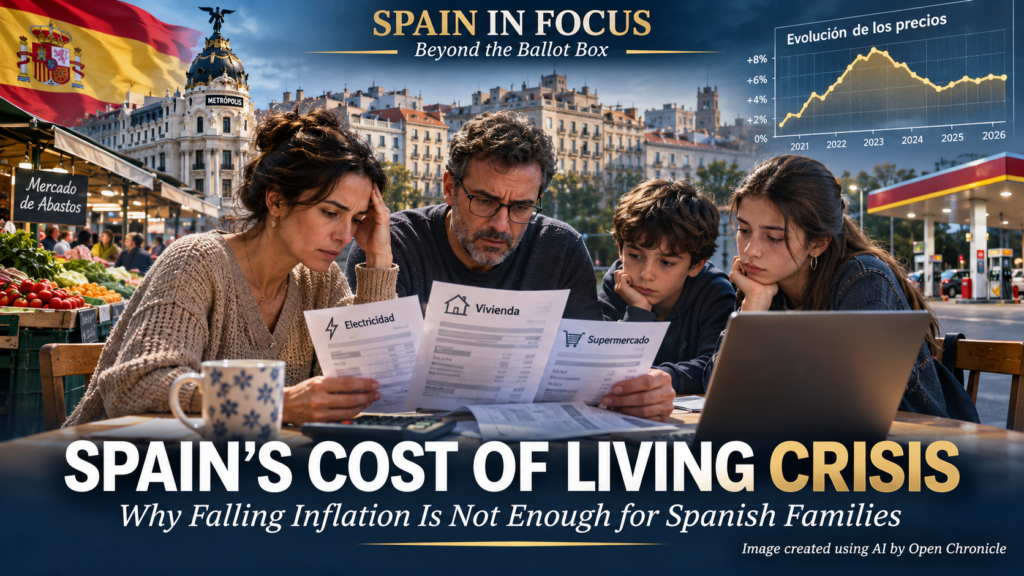
As Spain approaches a decisive electoral weekend, the affordability of housing, food, energy and essential services remains a fundamental concern. A slowdown in inflation may offer some relief, but rebuilding household purchasing power presents a much greater economic and social challenge.
By Open Chronicle News Desk
November 27, 2026 | Spain in Focus | Economy
01. Spain’s inflation slows, but the affordability challenge remains
Spain received some encouraging economic news on Friday, November 27, when the National Statistics Institute, Instituto Nacional de Estadística (INE), published its preliminary inflation figures for November.
Annual inflation is estimated to have fallen from 4.9% in October to 4.1% in November. Underlying inflation also moderated, reaching 2.6%.
The improvement was driven primarily by lower motor fuel and lubricant prices, with clothing and footwear prices also contributing to the slowdown.
However, the figures do not mean that Spanish households have recovered the purchasing power lost during previous periods of rising prices. The overall consumer price level remains considerably higher than it was twelve months earlier.
Spain’s inflation at a glance
4.9% October annual inflation | 4.1% November annual inflation |
2.6% Core inflation | −0.6% Monthly consumer price change |
Annual inflation slowdown October to November 2026 | 0.8 pp |
Source: INE, November 27, 2026. November figures are preliminary and subject to revision.
02. The difference between falling inflation and falling prices
One of the most important distinctions in economic reporting is the difference between the rate at which prices increase and the actual level of those prices.
When annual inflation declines, prices may still be rising compared with the previous year, although at a slower pace.
Spain’s preliminary November figures indicate that average consumer prices actually declined by 0.6% compared with October. Nevertheless, they remained 4.1% higher than in November 2025.
For families whose budgets have already been stretched by several years of rising expenditure, a temporary monthly reduction does not necessarily restore financial stability.
Consider a hypothetical household spending €1,500 per month on goods and services. An annual increase of 4.1% in the cost of that same basket would raise its monthly expenditure to €1,561.50.
That represents an additional €738 over twelve months if the higher monthly cost persists.
Lower inflation does not erase higher prices
€61.50 Additional monthly cost | €738 Annualised additional cost |
Illustrative calculation by Open Chronicle. Assumes an unchanged consumption basket and a sustained price increase. Not a measured average household budget.
03. The housing crisis behind Spain’s affordability problem
For many Spanish households, the greatest financial challenge is not necessarily the price of groceries or fuel, but the cost of securing somewhere to live.
The Banco de España’s 2025 Annual Report identifies significant housing affordability problems, particularly in major urban centres, among younger people and households with limited incomes.
Residential property prices have outpaced household income growth, while the supply of new housing has struggled to keep up with demand.
The central bank also identifies tourism related accommodation and purchases by non-residents as factors affecting residential availability in certain coastal regions, islands and popular urban destinations.
Housing creates a particular economic vulnerability because it represents an expense that families cannot easily reduce without relocating, sharing accommodation or accepting less suitable living conditions.
For younger Spaniards, the consequences may extend beyond monthly finances. Difficulty securing affordable accommodation can delay independence, family formation and employment mobility.
04. Where Spanish families spend their money
The INE’s Household Budget Survey for 2025 provides a valuable picture of the financial pressures facing Spanish society.
Average annual household expenditure reached €35,101, an increase of 3.1% compared with 2024. Spending on housing and utilities increased by 5.8%, while expenditure on food and non-alcoholic beverages increased by 4.4%.
These figures illustrate why the affordability of essential goods and services deserves particular attention.
The cost of living in Spain
€35,101 Average annual household expenditure | €14,066 Average annual expenditure per person |
| Housing and utilities | +5.8% |
| Personal care and miscellaneous services | +5.2% |
| Recreation, sport and culture | +4.7% |
| Food and non-alcoholic beverages | +4.4% |
| Total household expenditure | +3.1% |
Source: INE, Household Budget Survey 2025, published June 25, 2026. Expenditure changes are not equivalent to inflation rates.
An important methodological distinction must be recognised. Household expenditure reflects both changes in prices and changes in consumption. The survey also includes certain forms of non-monetary consumption, such as estimated rental values for owner occupied homes. Consequently, the annual expenditure figure should not be interpreted simply as the amount of cash leaving a family’s bank account.
The unequal burden of essential expenditure
Inflation does not affect every household in the same way.
Families with fewer financial resources generally have less flexibility to reduce essential expenditure. Housing, electricity, heating and food must continue to be paid for regardless of broader economic conditions.
The lowest spending fifth of Spanish households allocated 61.5% of their consumption expenditure to housing, utilities and food in 2025.
When essential expenses dominate the household budget
61.5% Essential spending | 61.5% Housing, utilities and food 38.5% All other consumption expenditure |
Source: INE, Household Budget Survey 2025. Figures refer to households in the lowest expenditure quintile.
The smaller the proportion of income available after essential expenses, the more difficult it becomes to build savings, absorb unexpected costs or maintain a reasonable standard of living.
05. Are Spanish salaries keeping pace?
Higher wages are an essential component of any sustained recovery in household purchasing power.
Statistics published by the INE on November 25 show that Spain’s average gross monthly wage reached €2,497.20 in 2025, representing an annual increase of 4.7%.
The median monthly wage was considerably lower, at €2,092.40.
The distinction matters because the average can be influenced by employees receiving particularly high salaries, whereas the median identifies the midpoint of the wage distribution.
Average salary versus median salary
€2,497.20 Average gross monthly wage +4.7% | €2,092.40 Median gross monthly wage +4.5% |
| Below €1,639.10 |
| €1,639.10 to below €2,818.70 |
| €2,818.70 or more |
Source: INE, Economically Active Population Survey, 2025 wage distribution, published November 25, 2026. Gross wages before taxes and contributions.
Six years of Spanish wage growth
Average and median gross monthly wages
━●━
Average wage
━●━
Median wage
●
●
●
●
●
●
●
●
●
●
●
●
2020
2021
2022
2023
2024
2025
Source: INE, November 25, 2026. Nominal wages, not adjusted for inflation.
The improvement in nominal salaries is encouraging, but it does not establish whether every household has experienced an improvement in real purchasing power.
Furthermore, the latest annual wage figures relate to 2025, whereas the latest inflation estimate relates to November 2026. Comparing these percentages directly would not provide a valid measurement of current real wage growth.
The recovery of purchasing power must be assessed using income and price data covering comparable periods.
06. The social reality behind the economic indicators
National economic statistics can improve while substantial sections of society continue to experience financial insecurity.
Spain’s 2025 Living Conditions Survey, published in February 2026, recorded a population at risk of poverty or social exclusion of 25.7%.
Although some indicators improved compared with the previous year, the survey revealed continuing difficulties in managing household finances and responding to unexpected expenditure.
The financial vulnerability of Spanish society
25.7% At risk of poverty or social exclusion | 36.4% Unable to cover unexpected expenses |
8.5% Experiencing great difficulty making ends meet | 8.1% Experiencing severe material and social deprivation |
Source: INE, Living Conditions Survey 2025, published February 5, 2026. Indicators may overlap and should not be added together.
These figures help explain why financial security cannot be assessed exclusively through economic growth or inflation statistics.
A household without sufficient emergency savings may experience significant difficulties following a vehicle repair, an unexpected medical expense, unemployment or an increase in housing costs.
For such families, economic recovery is measured not simply by the inflation rate, but by the ability to meet ordinary expenses without accumulating debt.
07. A country with different regional realities
Spain’s affordability challenge is geographically diverse.
Income levels, employment opportunities, housing markets and consumption patterns differ substantially between autonomous communities.
The 2025 Household Budget Survey recorded average annual expenditure per person of €16,642 in the Basque Country, compared with €12,197 in Andalusia. These differences reflect a combination of economic circumstances and consumption patterns rather than a direct comparison of regional price levels.
The Living Conditions Survey also reveals significant territorial differences in exposure to poverty and social exclusion.
Poverty and social exclusion across Spain
| Andalusia | 34.7% |
| Castilla-La Mancha | 34.0% |
| Region of Murcia | 32.5% |
| National average | 25.7% |
| Navarre | 16.5% |
| Balearic Islands | 15.2% |
| Basque Country | 14.7% |
Source: INE, Living Conditions Survey 2025. Selected autonomous communities and national average. AROPE indicator.
The regional differences underline the importance of designing public policies that take local circumstances into account.
A household in central Madrid may face a very different combination of housing and transport expenses from a household in rural Extremadura. Similarly, the economic pressures affecting tourism dependent communities may differ from those affecting industrial regions.
08. Consumer spending sends mixed signals
Additional economic figures published by the INE on November 27 suggest that Spain’s retail sector is experiencing a mixed economic environment.
Retail sales volumes declined by 1% in October compared with the same month in 2025, after seasonal and calendar adjustment.
However, sales increased by 0.3% compared with September, while retail employment expanded by 1.1% annually.
Spain’s retail sector in October 2026
−1.0% Annual retail sales | +0.3% Monthly retail sales | +1.1% Annual retail employment |
Source: INE, Retail Trade Indices, November 27, 2026. Provisional data. Sales figures are measured at constant prices and adjusted for seasonal and calendar effects.
The decline in annual retail volumes does not necessarily establish that inflation is the sole cause of weaker consumer demand.
Nevertheless, the figures deserve attention alongside household expenditure and wage statistics. Consumers facing financial pressure may postpone purchases, reduce discretionary spending or seek cheaper alternatives.
Such decisions can affect retailers, small businesses, employment and investment throughout the wider economy.
09. The five pillars of household financial security
Spain’s affordability challenge extends beyond the price of any individual product.
A meaningful improvement in living standards depends on the relationship between essential expenditure, disposable income, employment stability and financial resilience.
Five pillars of household financial security
01 Affordable housingAccess to accommodation without excessive pressure on disposable income. |
02 Affordable essential goodsReliable access to food, energy, water and everyday necessities. |
03 Stable employment and real wagesPredictable earnings capable of maintaining purchasing power. |
04 Savings and financial resilienceThe ability to absorb unexpected expenses without excessive borrowing. |
05 Effective social protectionAccessible support during unemployment, illness, retirement and economic hardship. |
Open Chronicle | Editorial explanatory framework
These five elements are interconnected. Progress in one area may be undermined by deterioration in another.
A salary increase, for example, may provide little additional financial flexibility if rent and essential expenditure increase by a similar amount.
10. Interactive household inflation calculator
How much does inflation affect the monthly budget of a Spanish family?
The following interactive calculator allows readers to examine how different inflation and income growth assumptions could affect their household finances.
Spanish Household Inflation Calculator
Explore the potential impact of rising prices and changes in household income.
Monthly household expenses
Current household expenditure breakdown
Open Chronicle economic simulation. Illustrative assumptions only. The calculator applies a uniform inflation rate to expenditure and a separate growth rate to net income. It does not model individual rental contracts, taxes, benefits or category specific inflation.
Understanding the simulation
Under the default assumptions, a household with monthly net income of €2,400 and expenses of €2,000 would face an additional €82 in monthly expenditure following a 4.1% increase in prices.
If net income increased by only 2%, the household would receive an additional €48 per month, leaving it with €34 less in monthly financial flexibility.
Over twelve months, that would represent a reduction of €408 in the amount available for savings, emergencies or additional consumption, assuming those conditions remained unchanged.
This is a hypothetical scenario, not a forecast of Spanish household income.
11. The economic challenges facing Spain’s next government
Regardless of the electoral outcome, Spain’s affordability problems will remain an important subject of public policy.
Addressing them involves difficult choices concerning public expenditure, taxation, housing construction, market regulation, employment conditions and social protection.
Different policy approaches carry different potential benefits, costs and implementation challenges.
Six economic challenges beyond the elections
CHALLENGE 01 Housing availabilityIncreasing residential supply and improving access to affordable accommodation. |
CHALLENGE 02 Essential living costsAddressing affordability pressures while preserving competition and sustainable supply. |
CHALLENGE 03 Purchasing powerSupporting real income growth through employment, productivity and sustainable wage increases. |
CHALLENGE 04 Energy affordabilityBalancing household protection, energy investment and long term supply security. |
CHALLENGE 05 Social protectionEnsuring vulnerable households can access appropriate financial and social assistance. |
CHALLENGE 06 Fiscal sustainabilityFinancing public services and economic measures while managing budgetary constraints. |
Open Chronicle | Editorial policy framework. No endorsement of political parties or individual electoral programmes.
Expanding housing supply may improve affordability over time, but construction requires investment, planning approvals, infrastructure and labour.
Targeted financial assistance may provide more immediate relief, although its effectiveness depends on eligibility, implementation and funding.
Measures intended to strengthen household income must also consider productivity, business costs and employment opportunities.
The central challenge is to combine immediate protection for vulnerable families with structural reforms capable of improving affordability over the longer term.
12. Three possible economic scenarios for Spanish households
The future direction of household purchasing power will depend on several interconnected factors, including inflation, energy markets, wage developments and housing costs.
The following scenarios illustrate possible economic conditions rather than predict their probability.
Spain’s household economy in 2027
SCENARIO 01
Gradual recovery in purchasing power
Inflation continues to moderate, comparable income growth exceeds price increases, employment remains resilient and housing pressures gradually ease.
Potential outcome: improved household savings and financial resilience.
SCENARIO 02
Persistent affordability pressures
Inflation moderates but housing and essential expenditure remain elevated, while household income growth produces limited additional financial flexibility.
Potential outcome: continuing financial pressure despite improving inflation indicators.
SCENARIO 03
Renewed economic pressure
External energy shocks, weaker employment conditions or renewed price increases place additional pressure on household finances.
Potential outcome: reduced discretionary spending and increased financial vulnerability.
Open Chronicle scenario analysis. Conditional economic scenarios, not forecasts or probability assessments.
13. What to watch over the coming months
| Development | What to monitor |
|---|---|
| Consumer price inflation | Confirmation of the preliminary November figures and subsequent monthly releases. |
| Core inflation | Whether underlying price pressures continue to moderate. |
| Food prices | Changes in the affordability of essential groceries. |
| Housing rents | New rental contracts, existing rental costs and regional differences. |
| Residential construction | The relationship between new housing supply and household formation. |
| Wage growth | Income developments measured against inflation over comparable periods. |
| Employment | Job creation, unemployment and employment stability. |
| Household savings | The ability of families to rebuild financial reserves. |
| Retail consumption | Whether consumer spending volumes recover or weaken further. |
| Energy markets | International energy prices and their transmission to domestic expenses. |
| Social protection | Changes in benefits, eligibility and support for vulnerable households. |
| Government economic policy | The affordability measures introduced following the elections. |
14. Conclusion: Economic recovery must reach the household
Spain’s latest inflation figures provide evidence that price pressures moderated in November.
However, a slower increase in consumer prices does not automatically resolve the financial difficulties accumulated during previous periods of inflation.
The affordability of housing, the relationship between wages and essential expenditure, and the ability of families to build financial reserves remain central to the country’s economic and social future.
For Spanish households, the most meaningful measure of economic progress is not simply whether inflation falls from one month to the next.
It is whether employment provides sufficient income, whether housing becomes more accessible, whether essential goods remain affordable and whether families can plan their future with greater financial confidence.
As Spain approaches an important political transition, these challenges deserve sustained attention beyond the immediate electoral debate.
Ultimately, the strength of an economy must also be understood through the living conditions of the people who depend upon it.
15. Sources and Further Reading
Official statistics and economic research
Primary institutional sources consulted for this article.
| 01 | Instituto Nacional de Estadística | November 2026 Inflation November 27, 2026. Preliminary consumer price and underlying inflation indicators. |
| 02 | Instituto Nacional de Estadística | Consumer Price Index November 2026. Monthly and annual consumer price indicators and statistical methodology. |
| 03 | Instituto Nacional de Estadística | Household Budget Survey 2025 June 25, 2026. Household expenditure, consumption patterns and regional differences. |
| 04 | Instituto Nacional de Estadística | Wage Distribution 2025 November 25, 2026. Average and median gross salaries and wage distribution. |
| 05 | Instituto Nacional de Estadística | Living Conditions Survey 2025 February 5, 2026. Poverty, social exclusion, material deprivation and household financial vulnerability. |
| 06 | Instituto Nacional de Estadística | Retail Trade Indices November 27, 2026. October retail sales volumes, employment and regional economic indicators. |
| 07 | Banco de España | Annual Report 2025 Economic research concerning housing affordability, residential supply and structural challenges in Spain. |
Editorial Note
This article is based on official statistical releases from the Instituto Nacional de Estadística and economic research published by the Banco de España. November 2026 inflation figures are preliminary. Wage, expenditure and living conditions statistics relate to their respective reference periods. Illustrative calculations, interactive simulations and conditional scenarios were developed by Open Chronicle for explanatory purposes and do not constitute official forecasts. The article maintains editorial independence from political parties and electoral campaigns.
Spain in Focus
Beyond the Ballot Box
Understanding the economic, social and institutional challenges shaping modern Spain.