
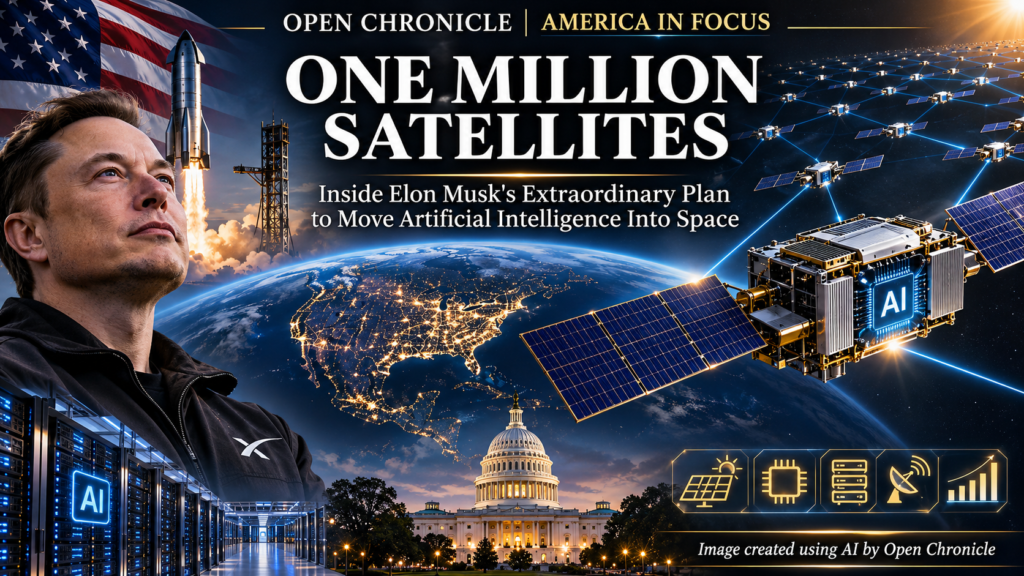
The United States has conditionally authorized SpaceX to deploy an unprecedented constellation of orbital computing satellites. The Starmind project could open a new frontier for artificial intelligence, but its extraordinary scale raises fundamental questions about energy, economics, engineering and the future of Earth’s orbital environment.
By Open Chronicle News Desk
November 27, 2026 | United States | Technology & Space
OPEN CHRONICLE | AMERICA IN FOCUS
The Next Frontier of Artificial Intelligence
Space Infrastructure • Artificial Intelligence • Energy • American Innovation • Global Competition
INFORMATION • CONTEXT • UNDERSTANDING
01. America Opens a New Frontier in Space
For decades, satellites have helped humanity communicate, navigate, observe the planet and understand the universe. Now, the United States is opening the possibility of transforming Earth’s orbital environment into an enormous computing infrastructure.
On November 25, 2026, the Federal Communications Commission (FCC) granted SpaceX conditional authorization for its proposed Starmind constellation, a system comprising up to one million satellites designed to provide computing capacity in space.
Rather than simply transmitting information between locations on Earth, these satellites would process data in orbit before returning useful information to terrestrial users and networks.
The decision represents a significant regulatory milestone for SpaceX and its founder, Elon Musk, as well as a potentially important development in the global competition for artificial intelligence infrastructure.
The FCC presented the initiative as an opportunity to strengthen American technological leadership and support the growing demand for advanced computing.
However, regulatory authorization does not mean that the constellation has been built, financed or demonstrated at commercial scale. Whether SpaceX can ultimately deploy one million operational computing satellites remains an open question.
Starmind in numbers
🛰︎ 1,000,000 Maximum authorized satellites | ◎ 500–1,002 km Authorized orbital altitude range |
📅︎ 2040 Full deployment regulatory deadline | 📄︎ ✓ 15 years License term following initial operational certification |
02. Why Artificial Intelligence Is Looking Beyond Earth
Artificial intelligence is increasingly becoming an infrastructure industry.
Training sophisticated AI models, operating digital assistants, analyzing scientific information and supporting automated industrial systems require enormous computing resources.
Traditional data centers depend on several interconnected systems: electricity generation, transmission networks, cooling equipment, semiconductor supply chains, telecommunications infrastructure and physical facilities.
As demand increases, technology companies must compete for access to these resources.
Building additional data centers is not simply a matter of purchasing more computers. Companies must obtain land, secure electricity supplies, construct facilities and manage the environmental consequences of their operations.
SpaceX’s proposal challenges this conventional model by asking whether some computing infrastructure could operate beyond Earth’s surface.
The central attraction is access to solar energy without many of the geographical and atmospheric limitations experienced by terrestrial facilities.
The infrastructure behind artificial intelligence
⚡︎ ElectricityContinuous power for computing systems. | ▦ SemiconductorsAdvanced processors and memory infrastructure. |
🌡︎ Thermal managementRemoval of heat generated by electronic equipment. | 🌐︎ ConnectivityHigh capacity communications between systems. |
🏢︎ Physical infrastructureFacilities, equipment and supporting systems. | 🔧︎ MaintenanceRepairs, upgrades and equipment replacement. |
03. What Is Starmind and How Would It Work?
The Starmind concept involves distributing computing resources across a large network of satellites.
Each spacecraft would combine electrical generation, computing hardware, communications equipment, thermal management systems and autonomous operational capabilities.
Optical communications would provide the principal means of exchanging information across the network. Radio communications would support backup functions and spacecraft control.
The objective would be to create a distributed computing environment capable of performing useful workloads for customers and applications on Earth.
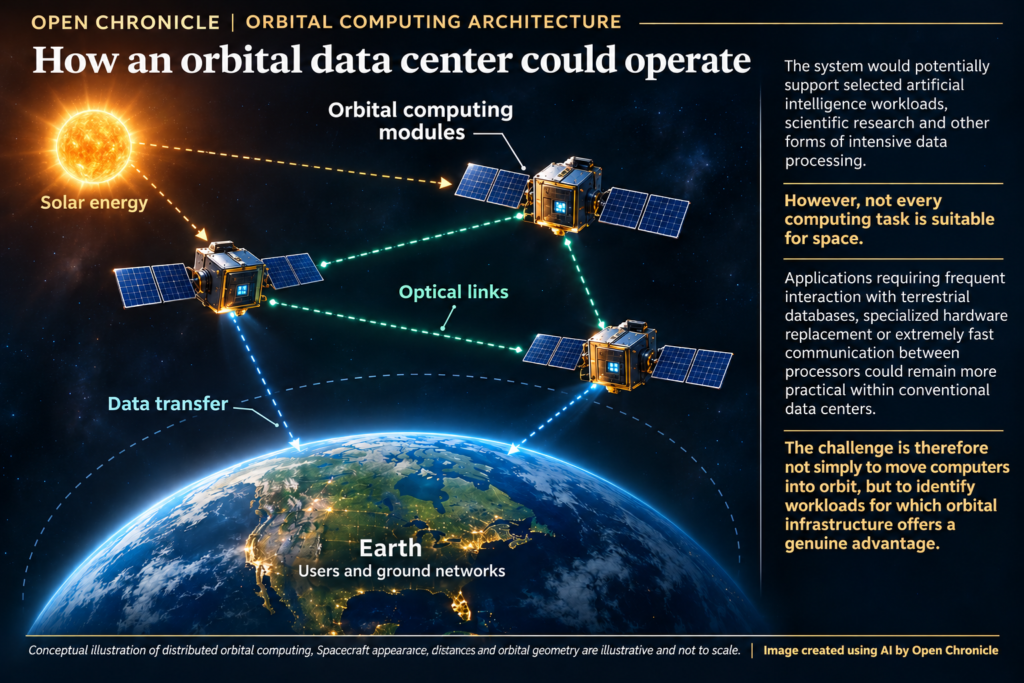
The system would potentially support selected artificial intelligence workloads, scientific research and other forms of intensive data processing.
However, not every computing task is suitable for space.
Applications requiring frequent interaction with terrestrial databases, specialized hardware replacement or extremely fast communication between processors could remain more practical within conventional data centers.
The challenge is therefore not simply to move computers into orbit, but to identify workloads for which orbital infrastructure offers a genuine advantage.
04. The Extraordinary Scale of One Million Satellites
The FCC authorization establishes a maximum constellation size that would fundamentally change the scale of human activity in orbit if fully realized.
For perspective, deploying one million spacecraft would require an industrial production system very different from traditional satellite manufacturing.
Satellites would need to be manufactured, tested, transported, launched, monitored and eventually replaced at unprecedented rates.
The challenge would extend far beyond the spacecraft themselves. Launch facilities, ground networks, supply chains and orbital traffic management systems would also need to expand.
The scale of the authorized Starmind constellation
| 1,000 satellites | 0.1% |
| 10,000 satellites | 1% |
| 100,000 satellites | 10% |
| 500,000 satellites | 50% |
| 1,000,000 satellites | 100% |
Even deploying a small fraction of the authorized constellation could represent a major industrial undertaking.
The difference between permission to operate one million satellites and the economic ability to manufacture and launch them is central to understanding the announcement.
05. The Road to 2040
The FCC authorization establishes a series of deployment milestones extending over the next fourteen years.
These requirements define the regulatory framework within which SpaceX must operate to retain the authorization as granted. They should not be interpreted as guaranteed commercial launch dates or forecasts of successful deployment.
The road toward one million satellites
◉ | JANUARY 30, 2026 Application submittedSpaceX submits its orbital computing constellation proposal. |
◉ | FEBRUARY 4, 2026 Regulatory reviewThe FCC accepts the application for filing and public comment. |
◉ | NOVEMBER 25, 2026 Conditional authorizationThe FCC grants authorization for the Starmind system. |
◉ | NOVEMBER 25, 2033 Initial operational satelliteAt least one authorized spacecraft must be operating in its assigned orbit. |
◉ | NOVEMBER 25, 2035 100,000 satellitesDeployment milestone representing 10% of authorized capacity. |
◉ | NOVEMBER 25, 2038 500,000 satellitesDeployment milestone representing 50% of authorized capacity. |
◉ | NOVEMBER 25, 2040 Full authorized constellationDeadline for completing deployment under the current authorization. |
The authorization provides SpaceX with a lengthy development period, but its later milestones imply an extraordinary acceleration in manufacturing and launch activity.
The period between November 2038 and November 2040 alone would require an additional 500,000 satellites to become operational if the preceding milestone were reached exactly on its deadline.
The final deployment challenge
🛰︎ 500,000 Additional satellites | 📅︎ 731 Days between final milestones |
↗ 684 Additional satellites per day | ◷ 28.5 Additional satellites per hour |
Open Chronicle calculations based on the interval between November 25, 2038, and November 25, 2040. Assumes deployment at the exact preceding milestone and excludes replacement spacecraft. Not a SpaceX production forecast.
06. Could Space Solve America’s Growing AI Energy Problem?
One of the most important arguments supporting orbital computing concerns electricity.
The expansion of artificial intelligence is creating additional demand for power generation, transmission infrastructure and energy storage across the United States.
According to the International Energy Agency’s April 2026 assessment, worldwide data center electricity consumption reached approximately 485 terawatt hours in 2025 and could approach 950 terawatt hours by 2030.
The agency also expects electricity demand from facilities focused on artificial intelligence to approximately triple over that period.
The growing electricity demand of data centers
| 2024 | 416 TWh |
| 2025 | 485 TWh |
| 2030 | 950 TWh |
~96% Projected growth from 2025 to 2030 | ~3% Projected share of global electricity demand in 2030 |
For SpaceX, orbital solar power represents a potential alternative to some of the constraints associated with terrestrial electricity generation.
Satellites operating in suitable orbits can receive sunlight for extended periods. Solar arrays can generate electricity directly for onboard computing equipment, potentially reducing dependence on terrestrial power grids.
However, solar energy in orbit is not economically free.
The equipment required to collect, distribute and store that energy must first be manufactured and transported into space. Solar arrays must withstand radiation, temperature variations and gradual degradation.
Some orbital configurations also experience periods of darkness, requiring energy storage or operational adjustments.
The relevant economic question is whether the lifetime cost of generating and using electricity in orbit can become competitive with the cost of supplying computing infrastructure on Earth.
07. The Cooling Paradox: Why Space Is Not a Giant Refrigerator
At first glance, placing powerful computers in the cold environment of space might appear to solve one of the most difficult problems facing conventional data centers.
The reality is considerably more complicated.
On Earth, computing facilities can transfer heat through air, water and other cooling fluids. In the vacuum of space, there is no surrounding atmosphere capable of carrying heat away through convection.
Although spacecraft can circulate coolant internally, their accumulated heat must ultimately be released into space through thermal radiation.
This requires carefully designed radiators, potentially adding substantial surface area, weight and engineering complexity to orbital computing platforms.
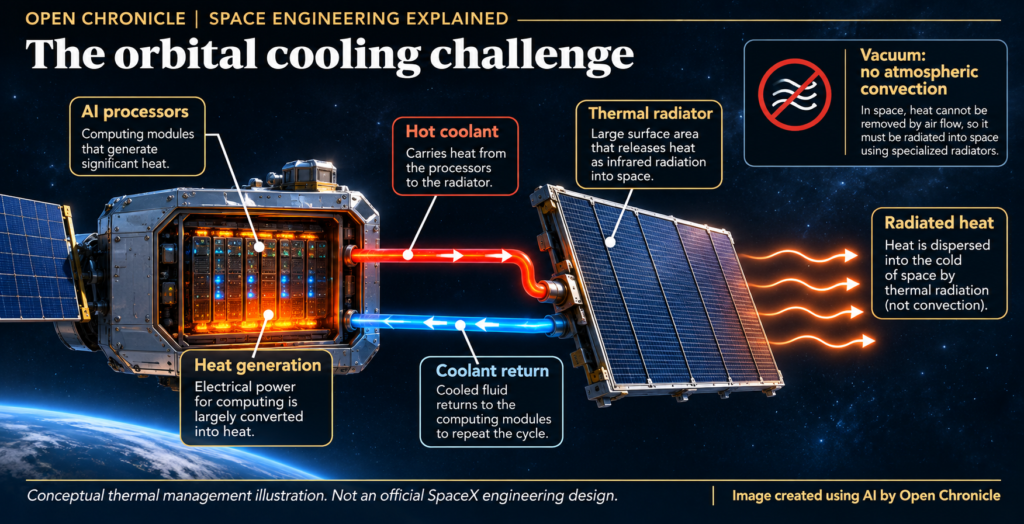
The more electricity computing equipment consumes, the more heat its thermal management system must generally remove.
Consequently, increasing the computing capacity of a satellite may require larger radiators, additional coolant systems and more sophisticated temperature controls.
Space provides access to solar energy, but it does not eliminate the physical laws governing heat transfer.
08. Starship and the Economics of Reaching Orbit
The success of Starmind would depend heavily on the economics of space transportation.
SpaceX has spent years developing reusable launch systems. Its Starship program is intended to expand the amount of equipment that can be transported into orbit while reducing transportation costs through reusability.
For orbital computing, these capabilities could become essential.
A commercially viable network would require affordable transportation not only for its initial construction, but also for replacement satellites, updated processors and supporting infrastructure.
A spacecraft carrying expensive computing equipment must generate enough useful computing services during its operational lifetime to justify the combined costs of manufacturing, launching and operating it.
The economic equation of orbital computing
🏭︎ | Satellite manufacturingComputing hardware, solar arrays, spacecraft structures and thermal systems. |
🚀︎ | Launch transportationThe cost of delivering operational equipment into its assigned orbit. |
📡︎ | Ground infrastructureCommunications gateways, control facilities and terrestrial network integration. |
⚙︎ | Operational managementMonitoring, software maintenance and spacecraft control. |
↻ | Replacement and disposalHardware renewal and responsible management of retired spacecraft. |
Total lifetime computing cost
How many launches would one million satellites require?
The answer depends on spacecraft mass, dimensions, launch vehicle performance and the number of satellites that can be transported during each mission.
The following calculator illustrates the scale of the transportation challenge using adjustable hypothetical assumptions.
The orbital deployment calculator
Even under favorable transportation assumptions, the project would require an industrial launch capability of extraordinary scale.
The ability to reuse launch vehicles frequently, safely and economically could therefore become as important to Starmind as advances in artificial intelligence itself.
09. Earth Versus Space: Where Should AI Infrastructure Be Built?
Orbital data centers are unlikely to eliminate conventional computing facilities.
Instead, a future computing economy could develop around a combination of terrestrial and orbital infrastructure, with different environments serving different technological requirements.
Two environments for the future of computing
🏢︎ Terrestrial data centers
| 🛰︎ Orbital data centers
|
One potential advantage of orbital computing could involve processing information collected by satellites without first transmitting enormous volumes of raw data to Earth.
Earth observation, environmental monitoring and scientific missions could benefit from this approach.
More demanding applications, particularly those requiring intensive communication between thousands of advanced processors, would need to demonstrate that orbital networks can provide sufficient bandwidth and synchronization.
The future may therefore involve a division of computing responsibilities rather than the wholesale relocation of artificial intelligence into space.
10. The Environmental Cost of One Million Satellites
The environmental debate surrounding Starmind extends beyond electricity consumption.
Moving computing equipment away from Earth’s surface could reduce some demands on terrestrial land, water and power infrastructure. However, the manufacture, launch, operation and eventual disposal of spacecraft would introduce different environmental pressures.
The American Astronomical Society has expressed concerns about the consequences of large satellite constellations for astronomical research, radio observations and the natural nighttime environment.
A constellation of unprecedented size would also require particularly reliable systems for preventing collisions and managing spacecraft failures.
Six environmental and scientific concerns
◎ | Orbital congestionIncreasing demands on spacecraft tracking and traffic coordination. |
⚠︎ | Space debrisPotential collision hazards associated with failed or damaged spacecraft. |
🔭︎ | Optical astronomyReflected sunlight could interfere with observations of the night sky. |
📡︎ | Radio astronomyPotential interference with sensitive scientific observations. |
☁︎ | Atmospheric effectsEnvironmental consequences of rocket launches and spacecraft reentry. |
♻︎ | Spacecraft lifecycleResponsible disposal, material consumption and replacement requirements. |
Authorization does not resolve every environmental question
The FCC’s decision includes conditions and leaves certain orbital disposal arrangements subject to further regulatory consideration.
In particular, additional debris mitigation documentation is required before deployment above 600 kilometers under the relevant conditions of the authorization.
This distinction matters because spacecraft operating at higher altitudes can remain in orbit for extended periods if they lose their ability to maneuver.
The authorization should therefore not be interpreted as a comprehensive scientific determination that all environmental consequences have been resolved.
11. The Emerging Competition for Computing Infrastructure in Space
SpaceX is not alone in exploring orbital computing.
Other American technology and aerospace companies are investigating similar concepts, suggesting that space could become another competitive environment for the digital economy.
Proposals vary considerably in scale, architecture, commercial objectives and technological maturity.
The emerging orbital computing industry
SpaceX Starmind | 1,000,000 Conditionally authorized |
Starcloud Orbital computing constellation | 88,000 Proposed |
Blue Origin Project Sunrise | 51,600 Proposed |
Cowboy Space Orbital computing constellation | 20,000 Proposed |
Google is also exploring orbital computing through Project Suncatcher, while other companies are investigating specialized processing platforms and supporting technologies.
These initiatives are not necessarily direct equivalents of Starmind, but they demonstrate growing commercial interest in the concept.
Competition could accelerate technological innovation while simultaneously increasing pressure on orbital resources and international regulatory arrangements.
12. What Could Starmind Mean for American Workers and Businesses?
If orbital computing becomes commercially viable, its economic consequences could extend across numerous American industries.
Satellite manufacturing would require advanced electronic components, aerospace materials, solar technologies, thermal management systems and precision manufacturing.
Launch operations could generate demand for specialized engineering, logistics and infrastructure services.
The integration of orbital computing with terrestrial networks could create additional opportunities for software developers, telecommunications companies and cybersecurity specialists.
Six potential areas of industrial opportunity
🏭︎ Aerospace manufacturingSpacecraft structures, assembly and advanced production. | ▦ Semiconductor industryProcessors, memory and specialized electronic systems. |
☀︎ Solar technologyHigh efficiency photovoltaic and power management equipment. | 🚀︎ Space transportationLaunch services, facilities and supporting logistics. |
📡︎ TelecommunicationsOptical communications and terrestrial network integration. | 🛡︎ CybersecurityProtection of distributed computing and spacecraft systems. |
Nevertheless, the development of a new industry does not guarantee widespread employment growth.
Modern aerospace manufacturing and computing infrastructure increasingly depend on automation. Economic benefits could also become concentrated among a relatively small number of technology companies, specialized suppliers and geographical regions.
The distribution of those benefits would depend on industrial investment, workforce development, competition and the commercial success of the underlying technology.
13. Could Orbital Computing Reduce American Electricity Bills?
For American households, one of the most interesting questions concerns the relationship between artificial intelligence infrastructure and electricity affordability.
If orbital computing eventually replaces some terrestrial electricity demand, it could reduce pressure on selected power networks.
However, lower demand from data centers would not automatically translate into lower household electricity bills.
Electricity prices depend on numerous factors, including fuel costs, infrastructure investment, regulation, generation capacity, regional market structures and the allocation of network expenses.
Moreover, additional demand for artificial intelligence could continue growing even if some computing capacity moves into orbit.
From orbital computing to household electricity prices
🛰︎ | Orbital computing capacityA commercially viable alternative becomes available. |
🖥︎ | Terrestrial workload substitutionSome existing or planned computing activity moves into orbit. |
⚡︎ | Regional electricity demandPressure on selected terrestrial power networks could decline. |
🏛︎ | Electricity market responseUtilities and regulators determine how costs and savings are distributed. |
💳︎ | Household electricity billsConsumers may benefit if reductions in system costs reach retail prices. |
For the foreseeable future, Americans should not expect the FCC authorization itself to produce measurable reductions in their electricity bills.
The potential benefits would depend on developments that could take years to materialize.
14. The Geopolitical Dimension: Who Will Control Computing Beyond Earth?
Artificial intelligence is increasingly regarded as a strategic national capability.
Advanced computing infrastructure supports scientific research, economic productivity, industrial innovation, intelligence analysis and national security applications.
If orbital computing becomes an important component of the global digital economy, access to space transportation, advanced semiconductors and orbital communications could acquire even greater strategic significance.
The United States possesses substantial advantages through its aerospace industry, technology companies, semiconductor design capabilities and established space infrastructure.
However, other major powers could pursue comparable capabilities if orbital computing demonstrates commercial or strategic value.
The strategic foundations of orbital computing power
🚀︎ Launch sovereigntyIndependent access to reliable and affordable space transportation. | ▦ Computing sovereigntyAccess to advanced processors and specialized semiconductor technologies. |
📡︎ Communications sovereigntyControl of secure orbital and terrestrial data networks. | 🏛︎ Regulatory influenceParticipation in shaping international rules for orbital infrastructure. |
An additional question concerns the concentration of technological power.
A company capable of controlling launch transportation, satellite manufacturing, communications networks and orbital computing could occupy an unusually influential position within the digital economy.
Governments would consequently need to consider competition, data protection, national security, infrastructure resilience and international access.
15. A Historical Perspective: From Sputnik to Orbital Artificial Intelligence
The Starmind proposal represents another potential stage in the transformation of space from a scientific frontier into an economic environment.
Seven decades of orbital innovation
◉ | 1957 Sputnik 1The Soviet Union launches the first artificial satellite. |
◉ | 1962 Telstar 1A milestone in international satellite communications. |
◉ | 1978 Early GPS satellitesThe development of satellite navigation begins transforming positioning and timing. |
◉ | 1998 International Space StationAssembly begins on a permanent international research infrastructure in orbit. |
◉ | 2015 Reusable orbital launch technologySpaceX achieves its first successful Falcon 9 first stage landing. |
◉ | 2019 Starlink deploymentSpaceX begins launching its operational broadband constellation at scale. |
◉ | 2026 Starmind authorizationThe FCC conditionally authorizes an unprecedented orbital computing constellation. |
Each stage of this technological evolution introduced capabilities that had previously appeared difficult or economically impractical.
However, history also demonstrates that ambitious space projects can experience delays, technical setbacks, financial difficulties and changes in strategic priorities.
Starmind should be understood within both of these historical traditions.
16. Three Possible Futures for Starmind
The eventual outcome of the project remains uncertain.
Rather than treating the maximum authorized constellation as an inevitable destination, three broad scenarios can help illustrate the possible evolution of orbital computing.
Three possible futures for orbital AI
↗ | SCENARIO 01 |
The orbital computing breakthrough
📡︎ | SCENARIO 02 |
A specialized hybrid infrastructure
⚠︎ | SCENARIO 03 |
An ambition constrained by reality
The ultimate outcome may combine elements of all three scenarios as technologies evolve and commercial conditions change.
17. What to Watch Over the Coming Years
The most important indicators of Starmind’s progress will involve demonstrated technological capabilities rather than announcements alone.
| Development | What to monitor |
|---|---|
| Initial spacecraft | Successful demonstration of operational computing hardware in orbit. |
| Starship development | Reliable launch operations, payload capacity and demonstrated transportation economics. |
| Solar generation | Actual electricity generation and long term equipment performance. |
| Thermal management | Reliable heat dissipation under sustained computing workloads. |
| Optical communications | Bandwidth, network availability and communication latency. |
| Semiconductor technology | Performance and reliability of advanced processors in space. |
| Commercial customers | Evidence of demand for economically competitive orbital computing services. |
| Project financing | Investment commitments and sustainable operating costs. |
| Orbital safety | Collision avoidance, spacecraft reliability and debris mitigation. |
| Environmental research | Scientific assessment of launches, reentries and astronomical interference. |
| International competition | Progress of competing orbital computing initiatives. |
| Regulatory milestones | Compliance with FCC conditions and deployment requirements. |
These developments will help distinguish a potentially transformative industrial project from an ambitious technological concept that remains commercially unproven.
18. Open Chronicle Strategic Assessment
The authorization of Starmind represents an important moment in the evolution of artificial intelligence and commercial space infrastructure.
For the first time, American regulators have opened a path toward an orbital computing constellation of this magnitude.
The opportunity is considerable.
If computing resources can operate economically beyond Earth, humanity could gain access to new infrastructure environments, additional sources of energy and previously unavailable industrial possibilities.
The risks are equally significant.
An unprecedented expansion of orbital infrastructure would introduce new engineering challenges, environmental responsibilities and questions concerning the concentration of technological power.
Four dimensions of the orbital computing revolution
▦ Technological transformationExtending advanced computing infrastructure beyond Earth’s surface. | ☀︎ Energy opportunityExploring alternative sources of power for artificial intelligence. |
🌐︎ Environmental responsibilityPreserving the orbital environment and protecting scientific research. | ⚖︎ Economic and strategic powerBalancing innovation, competition, infrastructure control and public interests. |
Ultimately, the significance of Starmind may not depend on whether SpaceX deploys exactly one million satellites.
Even a substantially smaller commercially successful constellation could establish an entirely new sector of the global economy.
The decisive question is whether the advantages of operating computing infrastructure in space can outweigh the costs and risks of placing it there.
For generations, humanity has used satellites to observe Earth and connect its inhabitants.
The next chapter could involve using space itself as an industrial platform for processing the information upon which modern civilization increasingly depends.
The race for artificial intelligence may no longer be confined to the surface of our planet.