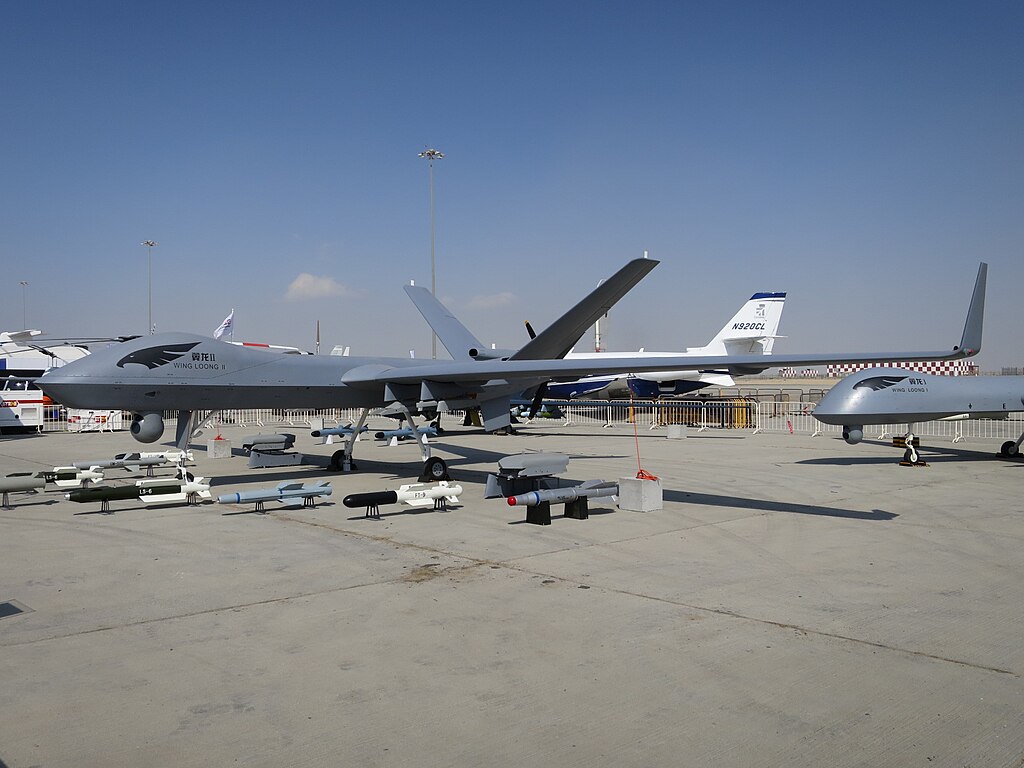
Image: Wing Loong II side view, Dubai Air Show 2017 – By Mztourist – Own work, CC BY-SA 4.0, (Wikipedia)
Unmanned Combat Aerial Vehicles (UCAVs) are unmanned aircraft designed for combat roles, including precision strikes, surveillance, reconnaissance, and electronic warfare, without requiring a human pilot on board. China has developed and deployed UCAVs as part of its broader modernization of the People’s Liberation Army (PLA), enhancing its capabilities in air combat, surveillance, and strike operations. China’s UCAVs are integral to its strategy of asymmetric warfare, designed to counter technologically superior adversaries by leveraging cost-effective, highly capable, and versatile unmanned systems.
Overview
China’s efforts to develop UCAVs are part of its broader goal to enhance its military’s capabilities in the unmanned aerial vehicle (UAV) domain. The Chinese military has focused on developing UCAVs that can carry out air-to-ground strikes, intelligence, surveillance, reconnaissance (ISR), and electronic warfare while maintaining low operational costs and reducing the risks to pilots. As of the 2020s, China is recognized as one of the leading nations in terms of UCAV development, with both indigenous designs and advanced technologies that rival or exceed some Western models.
Development History
China’s UCAV development traces its origins to the late 20th century, when it began exploring UAV technology for surveillance and reconnaissance. In the early 2000s, the PLA shifted focus toward the development of combat-capable UCAVs, seeing the value of these systems in reducing the risk to human life during combat operations and increasing flexibility on the battlefield.
The Chinese government has also leveraged its strong industrial base and partnerships with private aerospace companies to rapidly expand its UCAV capabilities rapidly. These advancements were further accelerated by the demands of modern warfare, including counterterrorism operations, regional conflicts, and potential military competition with the United States and other powers.
Notable Chinese UCAV Programs
1. Wing Loong Series
The Wing Loong family of UCAVs is among China’s most well-known and widely deployed. Developed by the China Aerospace Science and Technology Corporation (CASC), these drones are designed primarily for surveillance, reconnaissance, and precision strike missions.
-
Wing Loong I: The first model in the series, introduced in the early 2010s. It has a range of 2,000 kilometers and is equipped with various payloads, including precision-guided munitions. The Wing Loong I is primarily used for counterterrorism and border patrol operations.
-
Wing Loong II: An upgraded version with a longer range (up to 4,000 kilometers), enhanced sensors, and the ability to carry heavier payloads. The Wing Loong II is capable of carrying air-to-ground missiles and bombs, making it suitable for both intelligence and strike missions.
-
Wing Loong III: The latest version, designed for long-range strike capabilities. It is also capable of operating in electronic warfare environments and is seen as part of China’s efforts to counter advanced air defenses.
2. CH-4 and CH-5 Rainbow
The CH-4 (also known as Rainbow 4) is another prominent UCAV developed by China Academy of Aerospace Aerodynamics (CAAA). The CH-4 is similar in design to the U.S. MQ-9 Reaper and has been extensively used for both ISR and precision strike roles.
-
CH-4: First introduced in 2010, the CH-4 is capable of carrying a variety of weapons, including guided bombs and missiles. It has a range of approximately 3,000 kilometers and is equipped with an advanced electro-optical/infrared (EO/IR) targeting system. The CH-4 has been widely exported to countries in the Middle East and Africa.
-
CH-5: The CH-5 (Rainbow 5) is a heavier and more capable successor to the CH-4. It features a higher payload capacity, more advanced avionics, and a longer operational range. The CH-5 is capable of carrying multiple precision-guided munitions and is designed to operate in contested airspace.
3. GJ-1 and GJ-2 (Golden Eagle)
The GJ-1 and GJ-2, also known as the Golden Eagle, are advanced UCAV platforms developed by China Aerospace Corporation (CASC). These drones are designed for long-duration strike missions and can operate at higher altitudes.
-
GJ-1: Similar to the Wing Loong I, but with a greater focus on multi-role functionality. It is capable of carrying bombs and missiles and has been used for military operations and surveillance.
-
GJ-2: An advanced version of the GJ-1, the GJ-2 features enhanced range, payload capacity, and stealth characteristics, making it suitable for high-risk missions in contested environments.
4. Lijian (Sharp Sword)
The Lijian is an advanced stealth UCAV developed by Chengdu Aircraft Industry Group (CAIG). It is a medium-altitude, long-endurance platform with stealth features designed to penetrate enemy defenses and perform deep-strike missions.
-
The Lijian was first showcased publicly in 2013 and is regarded as part of China’s effort to develop fifth-generation unmanned combat aircraft. The drone is equipped with precision-guided munitions and is designed for high-value target strikes, reconnaissance, and surveillance.
5. WZ-8
The WZ-8 is a high-speed, high-altitude reconnaissance UCAV designed by China’s Aviation Industry Corporation (AVIC). It is primarily intended for intelligence gathering and reconnaissance at extreme altitudes, and is known for its high speed and potential for hypersonic capabilities.
Roles and Capabilities
Chinese UCAVs are versatile platforms that support a wide range of military operations, including:
1. Precision Strike
China’s UCAVs are equipped with a variety of precision-guided munitions, including air-to-ground missiles, laser-guided bombs, and GPS-guided bombs. These capabilities make UCAVs valuable for targeted strikes against high-value targets, such as enemy leadership, infrastructure, and air defense systems.
2. Intelligence, Surveillance, and Reconnaissance (ISR)
Chinese UCAVs are equipped with advanced sensor suites, including EO/IR cameras, synthetic aperture radar (SAR), and signals intelligence (SIGINT) systems. These capabilities enable real-time intelligence collection over large areas, providing critical information for battlefield awareness and decision-making.
3. Electronic Warfare
Some of China’s advanced UCAVs, such as the Wing Loong II and CH-5, are capable of carrying electronic warfare payloads to jam enemy communications, radars, and GPS systems. This capability enhances China’s ability to disrupt adversary operations and create a more favorable battlefield environment.
4. Counterterrorism and Counterinsurgency
China has deployed UCAVs in counterterrorism and counterinsurgency operations, particularly in areas like the Xinjiang region, where UCAVs are used for surveillance and precision strikes against suspected terrorist groups. The use of UCAVs provides the Chinese military with a cost-effective and low-risk alternative to manned aircraft for such missions.
Export and Global Reach
China has become a significant exporter of UCAVs, providing these advanced platforms to numerous countries across the Middle East, Africa, and Asia. Key export customers include Pakistan, Egypt, Nigeria, and Saudi Arabia, which have adopted Chinese UCAVs for their own military needs.
China’s UCAV exports are part of its broader strategy to enhance its geopolitical influence, particularly in regions where Western military influence is limited. These sales also allow China to generate revenue from its rapidly expanding unmanned aircraft industry.
Challenges and Future Developments
China’s UCAVs, while advanced, face several challenges, including vulnerabilities to electronic warfare and the cybersecurity risks associated with remote control and communication. The Chinese military continues to invest heavily in countermeasures to protect UCAVs from these threats.
Looking forward, China is focused on the development of more autonomous systems and stealth technologies to enhance the effectiveness of its UCAVs in contested environments. Additionally, the Chinese military is investing in swarming tactics to allow multiple UCAVs to operate in coordinated groups, increasing their effectiveness against advanced adversary air defenses.
References
-
Jane’s Defence Weekly. “China’s Emerging UCAV Capabilities.” 2023.
-
China Military Online. “Unmanned Aerial Vehicles: China’s Growing Influence in the Drone Market.” 2022.
-
Global Security. “China’s Drone Program and Military Strategy.” 2021.
-
U.S. Department of Defense. “Chinese Military Advancements in Unmanned Systems.” 2024.
Explore this subject
Continue exploring related Open Chronicle Encyclopedia entries through the categories associated with this article.

Staff Writers at Open Chronicle produce trusted journalism, strategic analysis and authoritative reference content across global affairs, geopolitics, defense, science, history, technology, business, culture and sport. Their work combines accurate reporting with historical perspective and analytical depth, helping readers understand not only what is happening, but why it matters. Beyond daily news coverage, Staff Writers contribute to the Open Chronicle Encyclopedia, investigative features, original research projects and long-form reports, building a comprehensive knowledge platform designed to inform, educate and preserve reliable information for a global audience.