
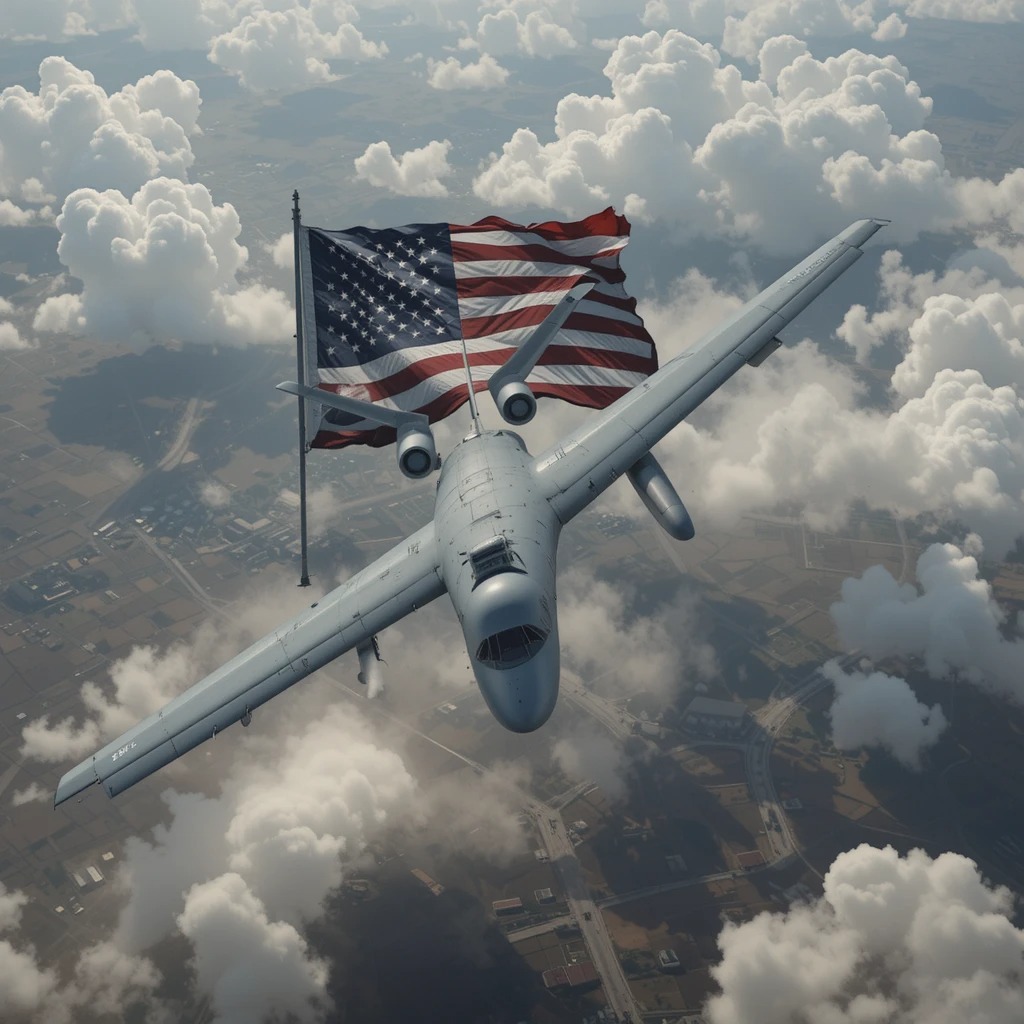
Image Credentials: Image Title: Unmanned Combat Aerial Vehicle (UCAV) – United States Source: AI-Generated Image (Aiease.ai) Date: April 2025 Attribution: Created by AI-generated imagery (Aiease.ai), and it does not depict a real-world scene.
Unmanned Combat Aerial Vehicles (UCAVs) are a class of unmanned aircraft specifically designed for combat missions, such as air strikes, surveillance, and reconnaissance, without requiring a human pilot onboard. The United States has been at the forefront of developing and deploying UCAVs, integrating these platforms into a variety of military operations to enhance operational flexibility, reduce risks to pilots, and improve precision targeting. The U.S. military’s use of UCAVs has been critical in modernizing warfare, particularly in counterinsurgency, counterterrorism, and conventional warfare operations.
Overview
The U.S. military first recognized the potential of UCAVs in the early 2000s, and they have since become integral to various branches of the armed forces, particularly the U.S. Air Force, U.S. Navy, and U.S. Army. UCAVs combine the capabilities of traditional manned aircraft with the advantages of unmanned flight, such as prolonged flight endurance, lower operational costs, and reduced risk to pilots.
The U.S. military primarily uses UCAVs for intelligence, surveillance, and reconnaissance (ISR), close air support (CAS), precision strikes, and air superiority missions. The most famous UCAVs in U.S. service are the MQ-9 Reaper and MQ-1 Predator, which have been employed extensively in the wars in Afghanistan, Iraq, and other regions.
Historical Development
Early Development (1980s-1990s)
The concept of unmanned aerial vehicles (UAVs) for military applications dates back to the Cold War era, with early reconnaissance drones being developed for intelligence gathering. However, it wasn’t until the late 1990s that the United States began developing specialized UCAV platforms designed for combat missions. Early prototypes like Aerosonde and Silver Fox were largely experimental but laid the groundwork for future advancements in UCAV technology.
Key UCAV Programs
-
MQ-1 Predator: Introduced in the late 1990s, the MQ-1 Predator was one of the first operational UCAVs used for strike missions. Equipped with Hellfire missiles, it became a staple of U.S. operations in the War on Terror, performing targeted strikes against high-value targets, especially in the Middle East.
-
MQ-9 Reaper: The MQ-9 Reaper was developed as an evolution of the Predator, with enhanced capabilities for longer endurance, higher payload capacity, and more advanced sensors. It is capable of carrying a wider range of munitions, including precision-guided bombs and missiles, and has played a major role in counterterrorism operations.
-
X-45 and X-47: These are experimental UCAVs developed by Boeing (X-45) and Northrop Grumman (X-47) under DARPA’s UCAV program. The X-45 demonstrated the feasibility of UCAVs for deep-strike missions, while the X-47 is notable for being the first unmanned aircraft to conduct autonomous carrier-based operations, which marked a significant milestone for U.S. Navy UCAVs.
-
MQ-25 Stingray: Developed as a carrier-based refueling drone for the U.S. Navy, the MQ-25 is designed to extend the range of manned fighter aircraft. While not a traditional combat UCAV, its role in augmenting naval operations is vital for future U.S. carrier strike groups.
Capabilities and Roles
UCAVs in the United States military are used in various combat and non-combat roles, providing strategic advantages across multiple domains:
1. Intelligence, Surveillance, and Reconnaissance (ISR)
UCAVs are equipped with high-resolution cameras, synthetic aperture radar (SAR), and signals intelligence (SIGINT) systems that provide continuous surveillance of enemy movements and terrain. The MQ-9 Reaper, for example, is capable of monitoring large areas for extended periods, providing real-time intelligence to commanders.
2. Precision Strike
UCAVs are known for their ability to conduct precision strikes with minimal collateral damage. Using laser-guided munitions, Hellfire missiles, and precision bombs, UCAVs can target high-value assets, enemy combatants, and infrastructure with extreme accuracy. The MQ-1 Predator and MQ-9 Reaper have both been used extensively in targeted killings of high-profile terrorist leaders.
3. Close Air Support (CAS)
UCAVs provide close air support to ground troops in hostile environments. The MQ-9 Reaper, with its advanced targeting systems and payload capabilities, is particularly adept at delivering timely and accurate strikes to assist ground forces under fire.
4. Counterterrorism and Counterinsurgency Operations
UCAVs have become integral to the United States’ counterterrorism and counterinsurgency strategies, particularly in regions like the Middle East, North Africa, and the Horn of Africa. They provide persistent monitoring and rapid strike capabilities, allowing for swift responses to evolving threats.
5. Electronic Warfare (EW) and Cyber Operations
Some UCAVs are equipped with electronic warfare (EW) capabilities, which allow them to jam enemy communications and radar systems. The U.S. military is also exploring the use of UCAVs for cyber operations, using them to disrupt enemy networks.
UCAV Operations and Impact
Global Presence
UCAVs operated by the United States have been deployed globally, particularly in conflict zones such as Afghanistan, Iraq, Libya, Somalia, and Yemen. Their ability to conduct long-duration missions with real-time communication links has enabled the U.S. military to maintain persistent pressure on adversaries, even in remote and difficult-to-access areas.
Ethical and Legal Concerns
The use of UCAVs, particularly for targeted strikes, has raised significant ethical and legal concerns, especially regarding issues of sovereignty, collateral damage, and civilian casualties. Critics argue that the ease with which strikes can be conducted from afar may lead to lower thresholds for the use of force. Additionally, concerns have been raised about accountability for strikes that result in unintended consequences, and the debate surrounding autonomous weapons systems continues to evolve.
Countermeasures and Threats
As UCAVs become more prevalent, adversaries have developed countermeasures to mitigate their effectiveness. These include the use of anti-aircraft systems, electronic jamming, and cyberattacks designed to disable UCAVs or take control of their operations.
Future Development
1. Autonomous Operations
The future of UCAVs in the U.S. military lies in greater autonomy. The Skyborg program aims to develop autonomous UCAVs that can operate independently or in coordination with manned aircraft. These systems will be capable of making real-time decisions in combat environments, reducing the cognitive load on human operators and increasing operational flexibility.
2. Manned-Unmanned Teaming (MUM-T)
The U.S. military is increasingly focused on the concept of Manned-Unmanned Teaming (MUM-T), where UCAVs operate in conjunction with manned aircraft to augment strike and ISR capabilities. This approach allows for greater coordination in complex combat scenarios.
3. Next-Generation UCAVs
Programs like the Next Generation Air Dominance (NGAD) program and the U.S. Air Force’s Loyal Wingman initiatives aim to develop more advanced UCAV platforms capable of operating in contested environments, including air superiority and anti-aircraft warfare.
Notable U.S. UCAV Platforms
-
MQ-1 Predator: The MQ-1 Predator was one of the first UCAVs used in combat, primarily for ISR and targeted strikes.
-
MQ-9 Reaper: The MQ-9 Reaper is the most widely deployed UCAV in the U.S. military, known for its long endurance, precision strike capabilities, and advanced sensors.
-
X-45: A prototype UCAV developed by Boeing for the U.S. Air Force under DARPA’s UCAV program.
-
X-47B: An experimental carrier-based UCAV developed by Northrop Grumman, demonstrating autonomous operations aboard U.S. Navy aircraft carriers.
-
MQ-25 Stingray: A refueling drone for the U.S. Navy, designed to extend the range of manned carrier-based aircraft.
References
-
U.S. Air Force. “Unmanned Aerial Systems Strategy.” 2023.
-
Congressional Research Service. “U.S. Unmanned Aircraft Systems.” 2024.
-
Jane’s Defence Weekly. “The Evolution of U.S. UCAVs.” 2022.
-
Department of Defense. “Autonomous Systems and Their Impact.” 2021.
Explore this subject
Continue exploring related Open Chronicle Encyclopedia entries through the categories associated with this article.

Staff Writers at Open Chronicle produce trusted journalism, strategic analysis and authoritative reference content across global affairs, geopolitics, defense, science, history, technology, business, culture and sport. Their work combines accurate reporting with historical perspective and analytical depth, helping readers understand not only what is happening, but why it matters. Beyond daily news coverage, Staff Writers contribute to the Open Chronicle Encyclopedia, investigative features, original research projects and long-form reports, building a comprehensive knowledge platform designed to inform, educate and preserve reliable information for a global audience.