
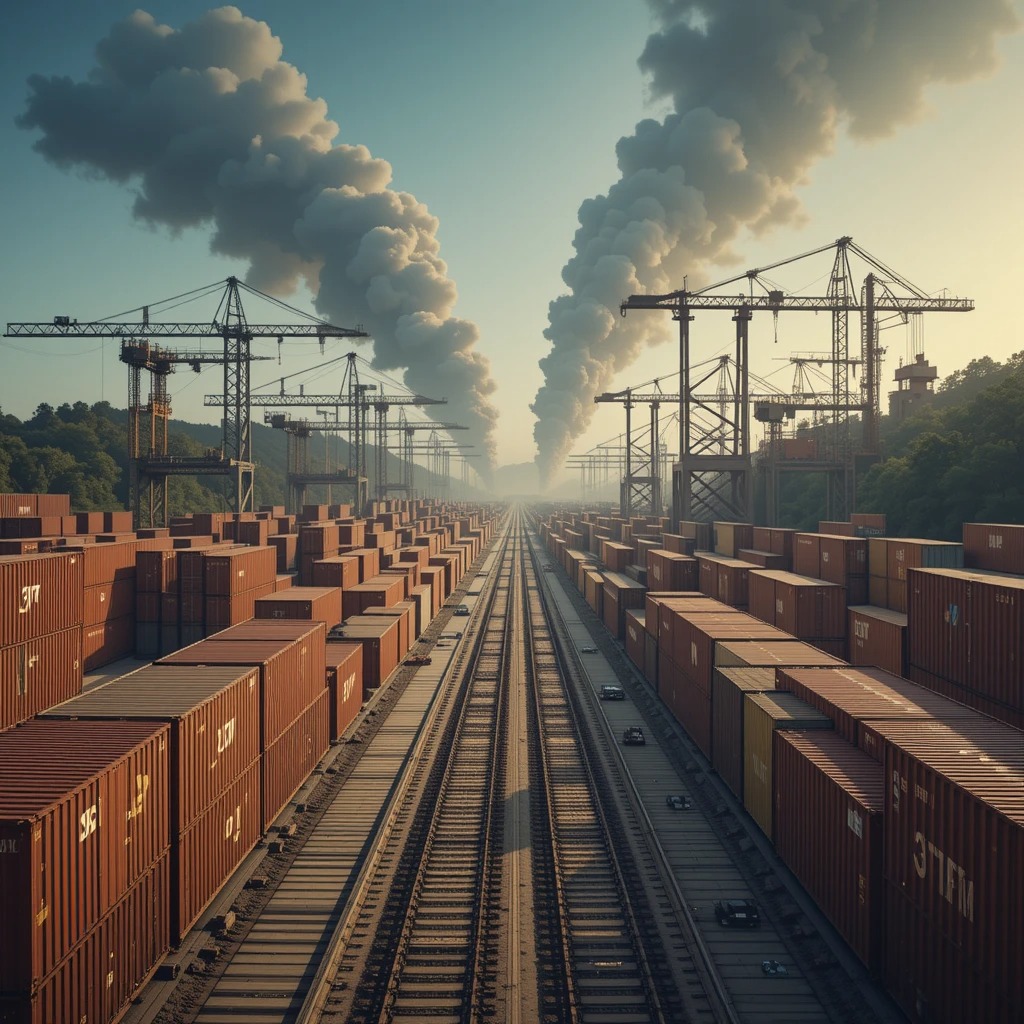
Image Credentials: Image Title: Trump’s Tariff Policies Deliver Major Blow to U.S. Economy, Experts Warn Source: AI-Generated Image (Aiease.ai) Date: April 2025 Attribution: Created by AI-generated imagery (Aiease.ai), and it does not depict a real-world scene.
By Staff Writer with Agencies 📢📰
WASHINGTON — As President Donald Trump ramps up his rhetoric on trade in the 2024 campaign trail, economists are warning that his tariff-driven approach is already costing the United States dearly—and could have lasting consequences for the economy.
In a blistering critique, analysts argue that Trump’s erratic tariff policies, grounded in “make-believe economics,” are burdening American households, stifling investment, and threatening long-term economic growth.
Trump has repeatedly claimed that foreign nations are “ripping off” the U.S. by selling more to America than they buy—an argument economists widely reject as fundamentally flawed. Trade deficits, they explain, are not indicators of exploitation but rather reflect consumer choices and investment flows.
“There are legitimate issues in trade, like non-tariff barriers and subsidies,” one expert noted. “But declaring a trade war against the entire world is reckless and self-defeating.”
A Price Tag for Tariffs
Attempting to quantify the damage, economists estimate that Trump’s proposed 154% tariff on Chinese goods alone could cost the U.S. economy nearly $700 billion a year, or around $5,000 per household, before even accounting for changes in consumer demand. However, the figure remains fluid as Trump’s policy announcements shift rapidly.
On “Liberation Day,” Trump announced sweeping tariffs against major trading partners, only to walk them back days later, exempting smartphones, computers, and potentially even imported autos from the taxes. Such unpredictable policymaking, critics argue, paralyzes businesses.
“No one in their right mind would invest billions in a new factory based on tariffs that could vanish next week,” said one trade analyst.
The uncertainty is already taking a toll. Companies are delaying investments, weakening the economy and heightening the risk of recession. Retaliatory tariffs from other countries and a collapse in international tourism are compounding the problem.
Long-Term Damage
Beyond immediate economic strain, experts warn of profound long-term consequences. Investment is critical to boosting productivity and living standards. If businesses continue to hold back due to trade instability, Americans could see slower economic progress for years to come.
“We are not only facing higher consumer prices,” one analyst said. “We’re risking the very foundation of future growth.”
Adding to concerns, Trump’s broader economic policies—cutting federal funding for science and universities—could further erode U.S. innovation and competitiveness.
A Different Path Forward
Critics argue that rather than antagonizing trading partners like China, the U.S. should explore cooperation in areas like green energy, healthcare, and artificial intelligence. For example, affordable electric vehicles and solar panels from China could lower consumer costs while advancing climate goals.
“We could negotiate voluntary export restraints to protect key industries, while reaping the benefits of cutting-edge technology,” a trade expert suggested, citing Ronald Reagan’s successful deal with Japan in the 1980s as a model.
The stakes are high. As the world accelerates its transition to a green economy and technological future, some warn that Trump’s tariff-first approach could leave America isolated and economically weaker.
“Trump’s tariff games might make him personally richer,” one economist concluded, “but they are making the rest of us poorer.”