
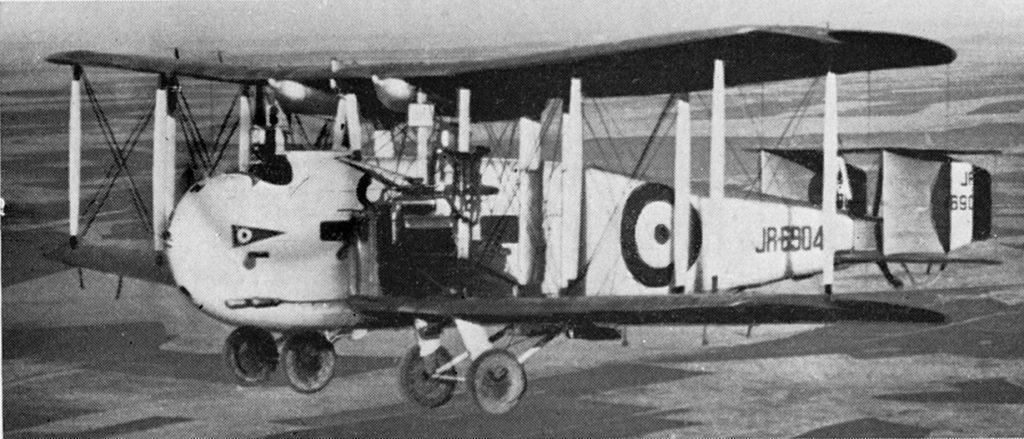
Image: Vickers Vernon of No. 70 Squadron RAF – powered by Rolls-Royce Eagle engines – By Air Ministry Photo – Thetford, Owen (1957) Aircraft of the Royal Air Force 1918-57 (1st ed.), London: Putnam, pp. 420, Public Domain, (Wikipedia)
The Vickers Vernon was a British biplane troop carrier used by the Royal Air Force. It entered service in 1921 and was the first dedicated troop transport of the RAF.
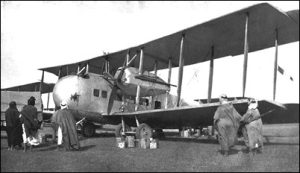
The Vernon was a development of the Vickers Vimy Commercial, a passenger variant of the famous Vickers Vimy bomber, and was powered by twin Napier Lion engines or Rolls-Royce Eagle VIII engines. 55 were built.
In February 1923, Vernons of Nos. 45 and 70 Squadrons RAF airlifted nearly 500 troops to Kirkuk, Iraq, after the civilian area of that town had been overrun by Kurdish forces. This was the first-ever strategic airlift of troops.
Vernons of No. 45 Squadron had bomb racks and sights fitted. In May 1924, the squadron was officially designated No. 45 (Bombing) Squadron.
Vernons were replaced by Vickers Victorias from 1927.
Variants
- Vernon Mk I
- military transport aircraft powered by two 360 hp (270 kW) V-12 Rolls-Royce Eagle VIII piston engines.
- Vernon Mk II
- military transport aircraft powered by two 450 hp (340 kW) W-12 Napier Lion II piston engines.
- Vernon Mk III
- military transport aircraft powered by two high-compression 525 hp (391 kW) W-12 Napier Lion III piston engines.
Operators
 United Kingdom
- Royal Air Force
- No. 45 Squadron RAF
- No. 70 Squadron RAF
Specifications (Vernon)
Data from Aircraft of the Royal Air Force
General characteristics
- Crew: 3
- Capacity: 11 passengers
- Length: 42 ft 8 in (13.00 m)
- Wingspan: 68 ft 1 in (20.75 m)
- Height: 13 ft 3 in (4.04 m)
- Wing area: 1,330 sq ft (124 m2)
- Empty weight: 7,981 lb (3,620 kg)
- Gross weight: 12,544 lb (5,690 kg)
- Powerplant: 2 × Napier Lion water-cooled 12-cylinder broad-arrow engine, 450 hp (340 kW) each
Performance
- Maximum speed: 118 mph (190 km/h, 103 kn) at ground level
- Cruise speed: 75 mph (121 km/h, 65 kn)
- Range: 320 mi (510 km, 280 nmi) at 80 mph (70 kn; 130 km/h)
- Service ceiling: 11,700 ft (3,600 m)
- Time to altitude: 13 min 30 s to 6,000 ft (1,800 m)
Armament
- Bombs: Provision for bombs
Related development
- Vickers Vimy
| Vernon | |
|---|---|
| General information | |
| Type | Transport |
| Manufacturer | Vickers |
| Primary user | Royal Air Force |
| Number built | 55 |
| History | |
| Introduction date | 1921 |
| Retired | 1927 |
| Developed from | Vickers Vimy Commercial |
References
- ^ Thetford 1962, p. 443
- ^ Wragg 1986, p. 13
- ^ Johnson & Cozens 1984, p. 38
- ^ Embry 1976, p. 34
- ^ Moyes 1964, p. 67
- ^ Thetford 1957, pp. 420–421
- ^ Andrews & Morgan 1988, p. 104
- Andrews, E. N.; Morgan, E. B. (1988). Vickers Aircraft Since 1908 (2nd ed.). London: Putnam. ISBN 0-85177-815-1.
- Embry, Basil (1976). Mission Completed. London: White Lion. ISBN 0-7274-0260-9.
- Johnson, Brian; Cozens, H. I. (1984). Bombers: The Weapon of Total War. London: Methuen. ISBN 0-423-00630-4.
- Moyes, Philip (1964). Bomber Squadrons of the R.A.F. and Their Aircraft. London: MacDonald. OCLC 796778515.
- Thetford, Owen (1957). Aircraft of the Royal Air Force 1918–57 (1st ed.). London: Putnam. OCLC 936602559.
- Thetford, Owen (1962). Aircraft of the Royal Air Force since 1918. London: Putnam. OCLC 213505944.
- Wragg, David (1986). Airlift: A History of Military Air Transport. Shrewsbury: Airlife. ISBN 0-906393-61-2.
Explore this subject
Continue exploring related Open Chronicle Encyclopedia entries through the categories associated with this article.

Staff Writers at Open Chronicle produce trusted journalism, strategic analysis and authoritative reference content across global affairs, geopolitics, defense, science, history, technology, business, culture and sport. Their work combines accurate reporting with historical perspective and analytical depth, helping readers understand not only what is happening, but why it matters. Beyond daily news coverage, Staff Writers contribute to the Open Chronicle Encyclopedia, investigative features, original research projects and long-form reports, building a comprehensive knowledge platform designed to inform, educate and preserve reliable information for a global audience.