
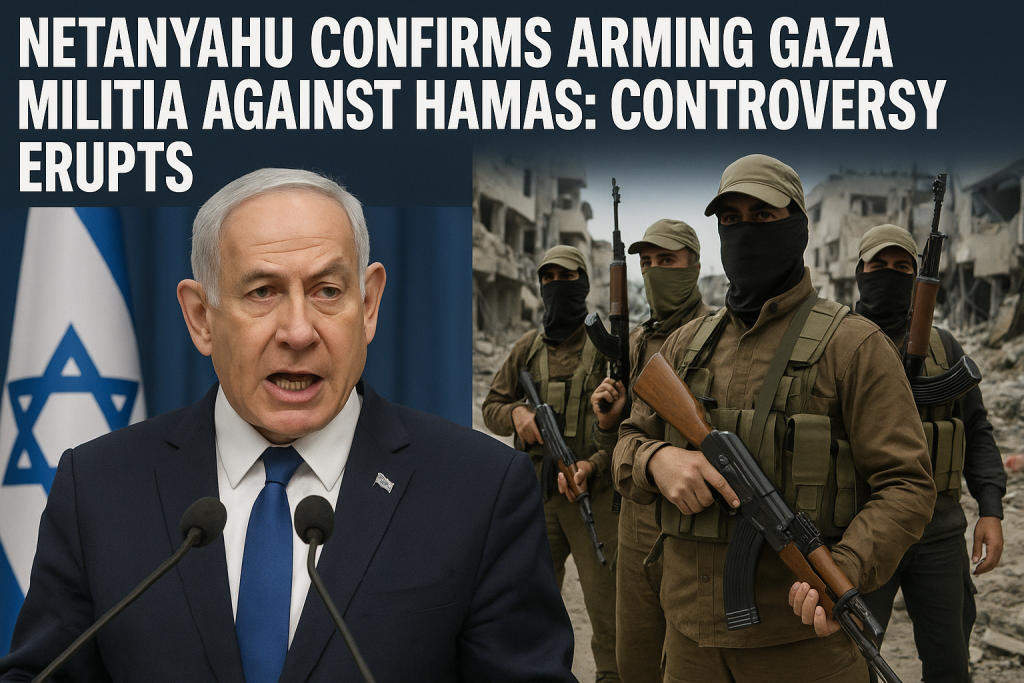
Image Credentials: Image Title: Israeli PM Netanyahu Confirms Arming Gaza Militia Against Hamas: Controversy Erupts Source: (sora.chatgpt) Date: June 2025 Attribution: Created by AI-generated imagery (sora.chatgpt), it does not depict a real-world scene.
By Staff Writer with Agencies
June 6, 2025 — Tel Aviv, Israel — In a rare and controversial public admission, Israeli Prime Minister Benjamin Netanyahu has confirmed that Israel has been arming Palestinian clans within Gaza as part of its broader strategy to combat Hamas. The admission, which marks the first time the Israeli government has openly acknowledged such collaboration, has generated significant debate and confusion both in Gaza and internationally.
The announcement came during a press conference where Netanyahu outlined Israel’s ongoing military operations in Gaza, as well as its efforts to weaken Hamas by bolstering local Palestinian militias. According to Netanyahu, the aim is to foster “tactical alliances” with Palestinian clans who are opposed to Hamas’ rule in Gaza, in hopes of destabilizing the militant group’s control over the region.
“This is not about working with Hamas or supporting any kind of collaboration with their ideology. This is about empowering those who oppose them,” Netanyahu said, adding that Israel’s goal is to provide support to groups that can help destabilize Hamas from within.
While Israel presents the move as a strategic necessity, the decision has sparked controversy among Palestinians, humanitarian workers, and international observers. Critics argue that the clans receiving support from Israel may not necessarily align with the broader interests of Gaza’s residents, and some fear that these alliances could deepen the rifts within Palestinian society.
The Clans’ Role and Allegations of Criminal Activity
The clans involved in the Israeli-supported efforts against Hamas have come under scrutiny. Some factions have long held a reputation for engaging in criminal activities such as smuggling, extortion, and even attacks on rival factions. Amid Israel’s military operations against Hamas, these clans have been accused by various local and international aid organizations of looting humanitarian aid, exacerbating the already dire situation in Gaza.
Humanitarian workers and local leaders have voiced concerns that arming certain factions might contribute to further lawlessness within the enclave, where many civilian communities are already grappling with poverty, displacement, and ongoing violence. The presence of armed groups within the region raises the risk of worsening violence, including civilian casualties and an increase in the theft of vital resources meant for the population.
“We have seen criminal gangs using the chaos of the conflict to further their interests,” said a representative from a major humanitarian organization operating in Gaza, who wished to remain anonymous. “Arming them, or even indirectly empowering them, may lead to more harm than good for the average Palestinian.”
Clans Deny Collaboration with Israel
In response to the allegations, several Palestinian clans have publicly denied any cooperation with Israel and condemned the criminal actions attributed to them. Some of these clans have issued formal statements condemning the looting of aid supplies and distancing themselves from Israeli support.
“We are not working with Israel,” stated a spokesman for one of Gaza’s most prominent clans. “Our only goal is to resist Hamas, but we do not condone any illegal activities, and we reject all forms of foreign interference in Gaza’s affairs.”
These denials, however, have done little to clarify the situation. Many observers argue that the presence of Israeli arms and logistical support complicates the already delicate situation in Gaza. The alliances between Israel and certain Palestinian factions are seen as an uncomfortable reality, with some Palestinians fearing that such actions could undermine their broader struggle for autonomy and independence.
In Gaza’s fractured political landscape, where Hamas controls the majority of the territory, any form of collaboration with Israel—whether tacit or explicit—is viewed with deep suspicion by many Palestinians, who consider Israel an occupying power.
A Complex War with No Clear Allies
The revelation of Israel’s collaboration with Palestinian militias adds another layer of complexity to the already convoluted conflict in Gaza. With multiple armed factions operating in the region, including Hamas, Islamic Jihad, and various clan-based groups, it is difficult to identify any clear alliances or cohesive strategies.
The conflict between Israel and Hamas, which has escalated over the years, has created a fragmented landscape in Gaza. While Israel frames its support of anti-Hamas militias as part of a broader counterinsurgency effort, the reality on the ground is far less straightforward.
Some analysts argue that this move could backfire, strengthening local militias and deepening divisions between different Palestinian groups. It may also alienate those in Gaza who view any cooperation with Israel, no matter the context, as a betrayal of the Palestinian cause.
“Palestinians are deeply divided, and this just adds another layer of mistrust,” said Dr. Samira Abed, a political analyst based in the Middle East. “The very idea of working with Israel, even against a common enemy, undermines the legitimacy of the resistance against occupation. It also fuels further fragmentation.”
International Reactions and Future Implications
The international community has yet to fully respond to Netanyahu’s admission, but the revelation has already drawn widespread condemnation from pro-Palestinian groups and some Arab states. Critics argue that Israel’s decision to arm local militias in Gaza could be seen as an attempt to manipulate Palestinian internal politics for its security interests, without regard for the long-term consequences on the ground.
At the same time, some Western countries and Israel’s allies have remained silent or refrained from making a direct comment, focusing instead on the broader context of counterterrorism efforts and regional security.
For now, the situation remains tense. With Hamas’ grip on Gaza seemingly unshaken by these internal divisions, and Israel continuing its military operations in the region, the prospect of peace—or even stability—appears distant.
Whether the alliances forged with local militias will succeed in weakening Hamas or whether they will further destabilize the already volatile Gaza Strip remains uncertain. What is clear, however, is that the situation in Gaza continues to evolve, with new alliances and rivalries shaping the future of the region.