
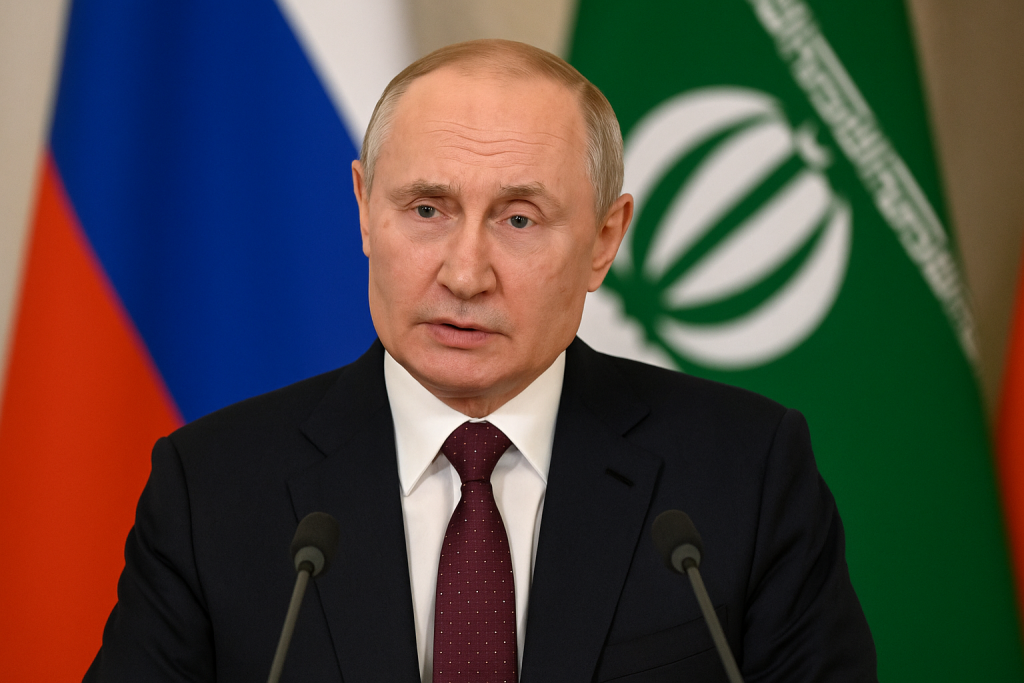
Image Credentials: Image Title: Putin Explains Russia’s Stance on Iran-Israel Conflict: “We’re Not Abandoning Allies, But Balance Is Key” Source: (sora.chatgpt) Date: June 2025 Attribution: Created by AI-generated imagery (sora.chatgpt), it does not depict a real-world scene.
By Staff Writer | Open Chronicle International Desk – June 23, 2025
St. Petersburg, Russia — As tensions continue to escalate in the Middle East following U.S. airstrikes on Iranian nuclear facilities, Russian President Vladimir Putin addressed mounting questions about Moscow’s muted response and its role in the conflict, particularly concerning Iran.
Speaking at the St. Petersburg International Economic Forum, Putin dismissed claims that Russia was abandoning its long-time ally Iran, instead emphasizing Russia’s strategic balancing act in the region.
“Those who claim Russia is not supporting its allies are provocateurs,” Putin stated, according to state news agency TASS. “Our relationship with the Middle East is nuanced and deeply rooted in historical, demographic, and strategic realities.”
Putin’s comments come amid heightened scrutiny over Russia’s apparent reluctance to respond militarily or diplomatically in support of Iran, even after the United States launched surprise strikes on Iranian nuclear facilities in Fordo, Natanz, and Isfahan — a move that significantly escalated the region’s already fragile security situation.
A Delicate Diplomatic Equation
Putin acknowledged the complexity of Russia’s position, citing deep cultural and demographic ties with Israel.
“I would like to draw your attention to the fact that almost two million people from the former Soviet Union and the Russian Federation reside in Israel. It is almost a Russian-speaking country today,” he said. “And, undoubtedly, we always take this into account in Russia’s contemporary history.”
Russia has long enjoyed close relations with both Iran and Israel — two nations locked in an increasingly hostile confrontation. Moscow has provided military and diplomatic support to Iran, particularly during the Syrian civil war, but has also maintained security and trade cooperation with Israel, including high-level communications to avoid military clashes in Syria.
Navigating a Fragile Balance
Putin’s remarks suggest that Russia is attempting to preserve its influence in the region by avoiding direct entanglement in the Iran-Israel conflict, especially now that the United States has entered the fray with active military engagement.
Analysts view this as a calculated effort by the Kremlin to retain its geopolitical flexibility in a volatile region, where alignments are shifting and national interests often collide.
“Russia doesn’t want to burn bridges with Israel, nor can it afford to alienate Iran,” said Viktor Dobrynin, a Moscow-based Middle East expert. “Putin’s strategy is to remain a power broker — not a participant — in this conflict.”
Global Reactions and Regional Fallout
While Iran has called for solidarity from allies like Russia and China, neither country has offered explicit military backing. Instead, both have condemned U.S. airstrikes as a dangerous escalation, urging restraint from all parties.
The situation remains fluid as Tehran vows retaliation, while Israel prepares for further provocations. Meanwhile, Washington’s involvement has drawn international concern, with the European Union and United Nations calling for urgent de-escalation.
Putin’s comments, while affirming Russia’s continued relevance and leverage, underscore a broader reality: Moscow is walking a tightrope, wary of being pulled deeper into a conflict that could ignite a broader regional war.