
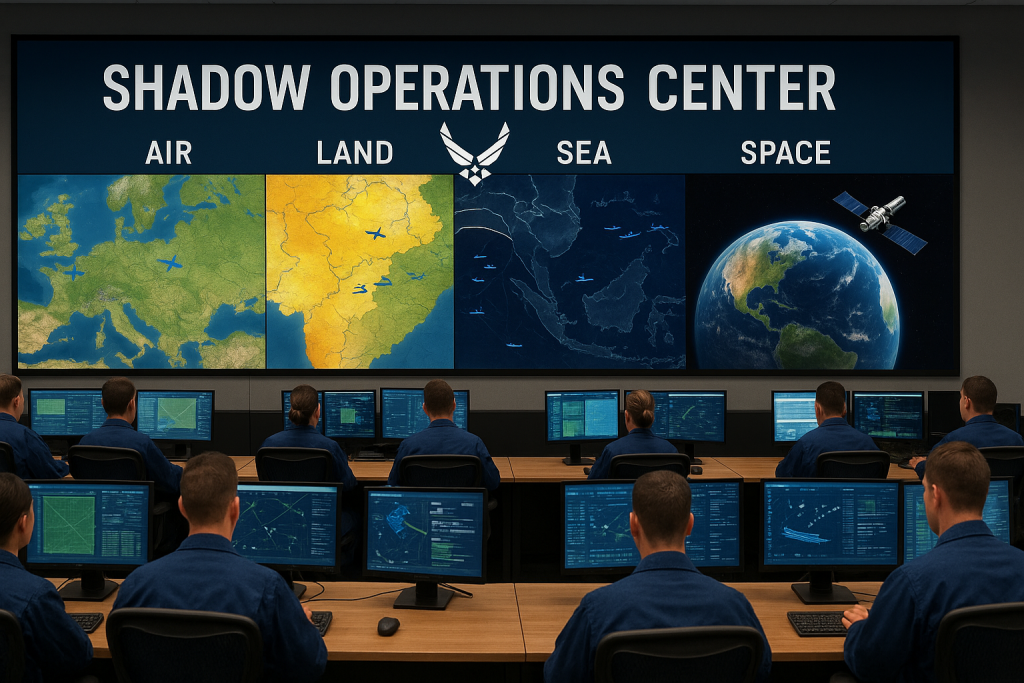
Image Credentials: Image Title: USAF Stood Up Shadow Operations Center at Nellis AFB for Multidomain Operations Source: (sora.chatgpt) Date: July 2025 Attribution: Created by AI-generated imagery (sora.chatgpt), it does not depict a real-world scene.
By Open Chronicle Staff | Shadow Protocols with Agencies
In a pivotal move to enhance the U.S. Air Force’s (USAF) capabilities in modern warfare, the service established a “Shadow Operations Center” at Nellis Air Force Base (AFB) in Nevada. This facility served as a testing ground for new concepts related to multidomain operations, integrating air, space, and cyber platforms and weapons into a comprehensive operational strategy.
The Shadow Operations Center marked a significant step forward in the USAF’s efforts to remain at the forefront of military innovation. As the nature of warfare evolved, the need for seamless coordination across different domains, land, sea, air, space, and cyberspace became critical for ensuring dominance over near-peer adversaries such as China and Russia.
The Shadow Operations Center was conceived as a key component in the USAF’s shift towards multidomain operations. Historically, combat operations in separate domains were conducted in isolation, with air, land, sea, and space operations each having distinct command structures. However, the complexity of modern warfare revealed the necessity of integrating these domains for maximum operational effectiveness.
.@NellisAFB‘s Shadow Operations Center is the test bed for #AirForce’s Joint All-Domain Command and Control, enabling data and information transfer to operators faster than ever before.#JADC2 #AirPower #ABMShttps://t.co/XCrsZjwsEV pic.twitter.com/53bT6JYYlq
— U.S. Air Force (@usairforce) June 16, 2021
The Shadow Operations Center was designed to explore and test these new integrated operational strategies. Brig. Gen. Chance Saltzman, who led the USAF’s enterprise capability collaboration team at the time, emphasized the importance of integrating air, space, and cyber elements for future warfare.
“The future of warfare is no longer confined to isolated domains,” Brig. Gen. Saltzman stated during the planning phase. “We must be able to leverage all available platforms, air, space, cyber, and even emerging technologies, to achieve decision dominance and defeat adversaries across the full spectrum of conflict.”
The facility was intended to act as an experimental hub where innovative concepts could be tested in simulated combat scenarios, reflecting the complex and rapidly changing nature of warfare in the 21st century. The Shadow Operations Center’s key goals included:
-
Integrating Air, Space, and Cyber: The center allowed the USAF to experiment with integrating air, space, and cyber platforms into synchronized operational strategies. This helped the Air Force address the challenges posed by adversaries leveraging sophisticated technology in multiple domains.
-
Enhancing Command and Control (C2): One of the primary objectives was to develop advanced command and control systems that allowed for real-time coordination between assets operating in different domains. The Shadow Operations Center focused on ensuring seamless communication between air, space, and cyber operations.
-
Testing Emerging Technologies: The center provided a venue for experimenting with cutting-edge technologies such as artificial intelligence (AI), machine learning, and autonomous systems. These technologies were intended to support decision-making and enhance operational efficiency across multiple domains.
-
Simulating Multidomain Conflict: The center facilitated multidomain warfare exercises, offering airmen firsthand experience in managing complex engagements where air, space, and cyber operations were deeply interconnected.
-
Rapid Prototyping and Concept Testing: The facility also acted as a rapid prototyping hub, enabling the USAF to quickly test and evaluate new tactics, techniques, and procedures (TTPs) in a controlled environment.
The Shadow Operations Center focused on refining several critical components of multidomain operations, integrating existing and emerging technologies to create a more cohesive and agile combat force:
-
Air Operations and Combat Integration:
Air combat continued to be central to USAF missions, but the Shadow Operations Center explored ways to better integrate air and space platforms, as well as cyber tools, into a unified operational strategy. This included using space-based ISR systems to inform air combat operations and leveraging cyber capabilities to disrupt enemy targeting and communication systems. -
Space Operations:
Space-based assets became increasingly essential in military operations. The Shadow Operations Center tested how to integrate space platforms, such as satellites for communication, surveillance, and precision targeting, with air and cyber tools to enhance the effectiveness of combat strategies. -
Cyber Operations:
With cyber warfare gaining importance, the center investigated how to integrate cyber operations with traditional air and space strategies. This involved experimenting with cyber tools that could disrupt adversary systems, communications, or infrastructure, as well as using cyber assets to gain operational advantages in real-time. -
Advanced Simulation Technologies:
To mimic the complexities of real-world combat, the Shadow Operations Center employed advanced simulation technologies, including high-fidelity simulators and live, virtual, and constructive (LVC) environments. These technologies allowed for the testing of integrated air, space, and cyber strategies in simulated scenarios that closely mirrored actual combat conditions. -
Command and Control (C2) Systems:
Effective C2 was considered the backbone of successful multidomain operations. The Shadow Operations Center tested new C2 systems that ensured seamless coordination between different domains, allowing for efficient decision-making and faster response times in dynamic combat environments.
Nellis AFB, located in southern Nevada, has long been a center for advanced air combat training and operational experimentation. Its vast open-air ranges and state-of-the-art testing facilities made it the perfect location for the establishment of the Shadow Operations Center. The base is home to the U.S. Air Force Warfare Center (AFWC), which is tasked with developing and evaluating new operational concepts.
By placing the Shadow Operations Center at Nellis, the USAF ensured that it was situated in one of the most technologically advanced environments for testing new combat strategies and integrating emerging technologies. The base’s proximity to the Air Force Research Laboratory (AFRL), the Air Force Life Cycle Management Center (AFLCMC), and various space and cyber operations units enabled collaboration across a wide array of disciplines.
The Shadow Operations Center was instrumental in shaping the future of U.S. military operations. As potential adversaries advanced their capabilities in air, space, and cyber warfare, the USAF’s multidomain operations sought to maintain superiority in an increasingly complex and interdependent battlefield.
By integrating all domains, air, space, and cyber into a single operational framework, the USAF was able to enhance its ability to achieve decision dominance. As Brig. Gen. Saltzman noted, the goal was to ensure that the USAF could rapidly adapt and defeat adversaries across the full spectrum of modern conflict.
The Shadow Operations Center at Nellis AFB played a vital role in advancing the U.S. Air Force’s capabilities in multidomain warfare. By focusing on the integration of air, space, and cyber platforms and testing innovative operational concepts, the center helped the USAF maintain its edge in future conflicts. The center’s efforts to test, evaluate, and prototype new technologies and strategies have positioned the USAF as a leader in the evolving landscape of modern warfare.