
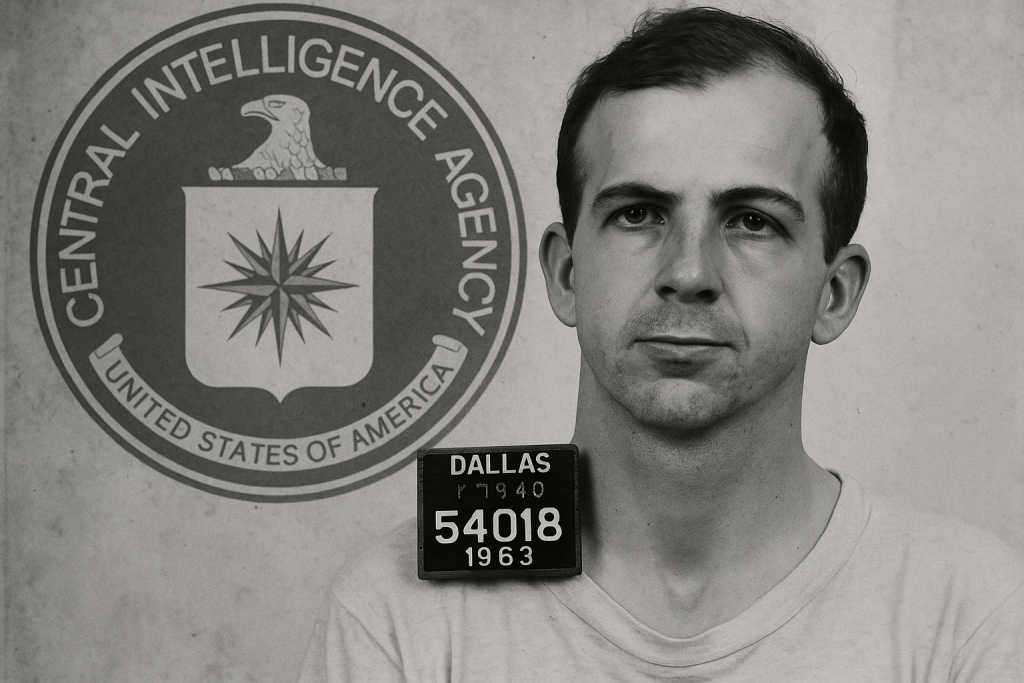
Image Credentials: Image Title: CIA New Documents Reveal Oswald Was on Their Radar Before JFK Assassination, Contradicting Past Denials Source: (sora.chatgpt) Date: June 2025 Attribution: Created by AI-generated imagery (sora.chatgpt), it does not depict a real-world scene.
By Staff Writer | Open Chronicle with Agencies
For decades, the CIA has insisted that it had little to no knowledge of Lee Harvey Oswald before he assassinated President John F. Kennedy in 1963. However, newly released documents have shattered this long-standing claim, revealing that the agency had indeed tracked Oswald months before the fateful day in Dallas.
The disclosure, which surfaced in a batch of 40 documents released earlier this month, has sparked new debates about the CIA’s role in the events surrounding JFK’s assassination. These revelations come courtesy of the House Oversight Committee’s “federal secrets” task force, which has been investigating the government’s handling of classified information related to the case.
The newly uncovered files confirm that a CIA officer named George Joannides, operating under an alias, was in contact with Oswald’s adversaries months before the assassination. Joannides, who headed the CIA’s Miami branch and was responsible for various covert activities, was directing a group of anti-Castro Cuban students, known as the DRE (Directorio Revolucionario Estudiantil). This group had direct encounters with Oswald in August 1963, several months before Kennedy’s assassination.
The CIA had long claimed that no such connection between Oswald and Joannides’ group existed, but the documents now show that Joannides led a covert campaign aimed at infiltrating and disrupting pro-Castro factions. This included the Cuban student group, which had a history of clashes with Oswald, who publicly supported Castro’s regime and opposed the U.S.’s stance on Cuba.
A pivotal moment came when a DRE member claimed Oswald had offered his support to the group, possibly in a bid to undermine the organization he had been a part of, the Fair Play for Cuba Committee. This suggests that Oswald’s interactions with Cuban dissidents in Miami were more intricate than previously thought and raises questions about his true motivations leading up to the assassination.
The most shocking part of the revelation is the disclosure of a CIA officer named “Howard,” who was allegedly overseeing the operations involving the DRE. Joannides used this alias, complete with a fake driver’s license, to interact with the group. The CIA had long denied the existence of such an agent, even in official investigations. In fact, in 1964 and 1978, the agency told investigators that no one by the name of “Howard” was associated with their operations, and in 1998, they dismissed the name as a “routing indicator.”
However, these latest documents confirm that the agency had concealed the identity of a key operative involved in the events surrounding Oswald. In 1981, Joannides received the Career Intelligence Medal, despite his pivotal role in hiding key information about the events of 1963. This new information bolsters suspicions of a broader cover-up involving the CIA’s involvement in the lead-up to the assassination.
Anna Paulina Luna, a member of the House committee investigating the newly released JFK files, expressed her shock at the documents’ findings. She told the Washington Post, “This confirms much of what the public already speculated: that the CIA was lying to the American people, and that there was a cover-up.”
While these documents shed light on the CIA’s early awareness of Oswald, they do not resolve the longstanding debate about whether Oswald acted alone or had outside assistance in carrying out the assassination. The files remain far from conclusive about the precise circumstances of JFK’s death, but the new revelations have undoubtedly fueled ongoing conspiracy theories and demands for further transparency.
This release is part of a broader effort to unveil classified materials related to the assassination. In March, the Trump administration began the process of declassifying thousands of documents about JFK’s assassination. However, researchers noted that the bulk of the promised records, including key IRS files and documents from the FBI, were still withheld from the public.
As the investigation continues, the full impact of these newly revealed files will undoubtedly continue to shape the narrative surrounding one of the most consequential events in American history. The truth, it seems, remains elusive, but the release of these documents has brought us one step closer to understanding the extent of government knowledge and involvement in the events leading up to the assassination of President John F. Kennedy.