
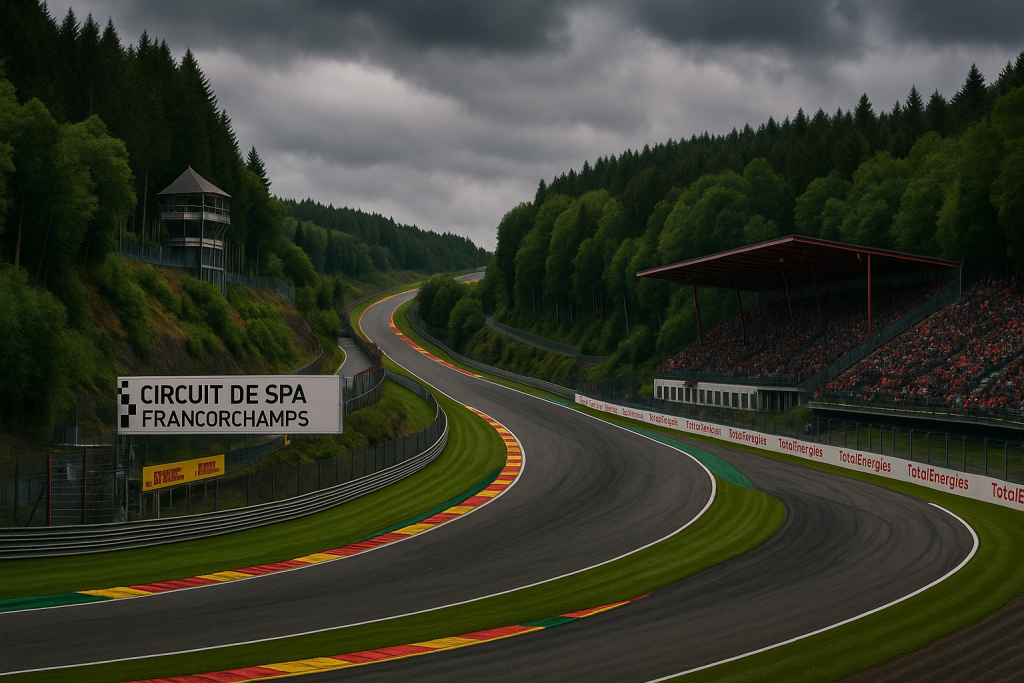
Image Credentials: Image Title: Why Spa Races Are Iconic: The Magic, Mayhem, and Mastery of Spa-Francorchamps Source: (sora.chatgpt) Date: July 2025 Attribution: Created by AI-generated imagery (sora.chatgpt); it does not depict a real-world scene.
By Open Chronicle Motorsport F1 Staff
Nestled in the forested hills of the Ardennes in Belgium, Spa-Francorchamps is more than just a racetrack. It is a shrine to motorsport heritage, a rollercoaster of asphalt where weather, history, and human will converge in ways that no other Formula One circuit quite manages. Every year, Spa delivers something unpredictable, sometimes unforgettable, often chaotic, always dramatic. But what makes Spa so iconic?
A Temple of Speed and Elevation
Spa-Francorchamps remains the longest circuit on the Formula One calendar, measuring just over 7 kilometers. But its grandeur lies not just in its length. It’s in the very DNA of the circuit: long straights through forests, dramatic elevation changes, blind corners, and high-speed technical sections that demand precision and bravery in equal measure.
From La Source’s tight hairpin to the thunderous charge up Eau Rouge and Raidillon, and the sweeping curve of Blanchimont, Spa tests every facet of a driver’s skill. Few corners in the world demand the combination of nerve and talent quite like Eau Rouge-Raidillon, a steep uphill section taken nearly flat out, where a split-second misjudgment at over 300 km/h can end in disaster.
The Ardennes: Nature’s Wild Card
The weather at Spa is as legendary as its layout. The circuit’s vast size means it can be raining at one end while the other remains bone dry. This microclimate has often turned strategy upside down and leveled the playing field between cars, creating thrilling, unpredictable racing.
In 1998, torrential rain at the start triggered a 13-car crash on the first lap, one of the most dramatic incidents in F1 history. In 2021, rain again became the headline when conditions were so severe that only a handful of laps were completed behind the safety car, marking the shortest race ever held in Formula One.
When the rain comes, and it often does, Spa transforms from a challenging course to a crucible of survival.
A History Forged in Motorsport Lore
Spa has been part of the Formula One World Championship since its inception in 1950. Only two years have been missed since then, underlining its central place in the sport’s mythology.
The original circuit, used for early Grands Prix, stretched nearly 15 kilometers and ran through public roads. It was a terrifying prospect, ultra-fast, barely protected, and punishing. Accidents were frequent. Heroes were made, and tragedy was never far behind. Over time, safety upgrades were made, and in 1979, the circuit was permanently shortened to its current layout. Yet, it retained its wild character.
The list of Spa winners reads like a hall of fame: Juan Manuel Fangio, Jim Clark, Ayrton Senna, Michael Schumacher, Lewis Hamilton, and Max Verstappen, each leaving their imprint on the tarmac. Spa was also where Schumacher made his debut in 1991 and where he claimed his first victory the following year. It’s a circuit that gives birth to legends.
Moments Etched in Time
Over the years, Spa has delivered moments of sheer brilliance and chaos:
-
2000 – Häkkinen vs Schumacher: The overtake of the century, with Häkkinen passing Schumacher while threading through a backmarker at 300 km/h.
-
2019 – Leclerc’s emotional first win, a day after the death of close friend Anthoine Hubert in a Formula 2 crash.
-
2022 – Verstappen’s charge from P14 to victory, a masterclass in overtaking and race control.
Each race seems to carve a new story, and no driver ever wins at Spa without earning it.
A Place Where Drivers Feel Alive
Ask any Formula One driver to list their favorite circuit, and Spa will likely be at the top. Why? Because it’s raw. It’s real. As Fernando Alonso put it, “Spa is probably the best circuit in the world, and every lap you do here is magic.”
There’s no room for complacency. Drivers must be constantly alert to the weather, to the car, to the shadows creeping across the tarmac. The challenge is total.
The Soul of Formula One
Spa-Francorchamps is not just another venue on the calendar. It is a proving ground. A spiritual home for fans and purists. The track doesn’t just host races; it tells stories of dominance, defeat, triumph, and tragedy.
It remains one of the few circuits where modern F1 cars, packed with downforce and hybrid complexity, can still dance on the edge of disaster. Where the driver, not just the machine, plays the leading role.
In an age of tilkedromes and street circuits, Spa is a reminder of what Formula One has always been about: speed, skill, risk, and the pursuit of something just beyond control.
That is why Spa races are iconic.
References
-
Fédération Internationale de l’Automobile (FIA). Official Formula 1 Circuit Guide: Spa-Francorchamps. Accessed July 23, 2025. https://www.fia.com.
-
Formula 1. Track Profile: Belgium – Spa-Francorchamps. Accessed July 23, 2025. https://www.formula1.com/en/racing/2025/Belgium/Circuit.html.
-
ESPN. “Grand Prix Weekend Insights and Weather Forecasts.” ESPN F1. Accessed July 23, 2025. https://www.espn.com/f1.
-
Motorsport.com. “History and Evolution of Spa-Francorchamps.” Accessed July 23, 2025. https://www.motorsport.com/f1.
-
BBC Sport. “Why Spa Remains a Driver Favorite.” Accessed July 23, 2025. https://www.bbc.com/sport/formula1.
-
Dieter Rencken. “Iconic Moments at Spa: From Senna to Verstappen.” RaceFans.net. Accessed July 23, 2025. https://www.racefans.net.
-
Sky Sports. “F1 Legends and Their Wins at Spa.” Sky Sports F1. Accessed July 23, 2025. https://www.skysports.com/f1.
-
Autocourse. Grand Prix Annual. London: Icon Publishing, various editions.
-
Laurence Edmondson. “The Art of War at Spa: F1’s Ultimate Driver Circuit.” The Athletic, August 2024. https://theathletic.com/tag/formula-1.
-
Formula 1. F1 TV Archive: Spa-Francorchamps Legendary Races and Crashes. YouTube. Accessed July 23, 2025. https://www.youtube.com/@Formula1.