
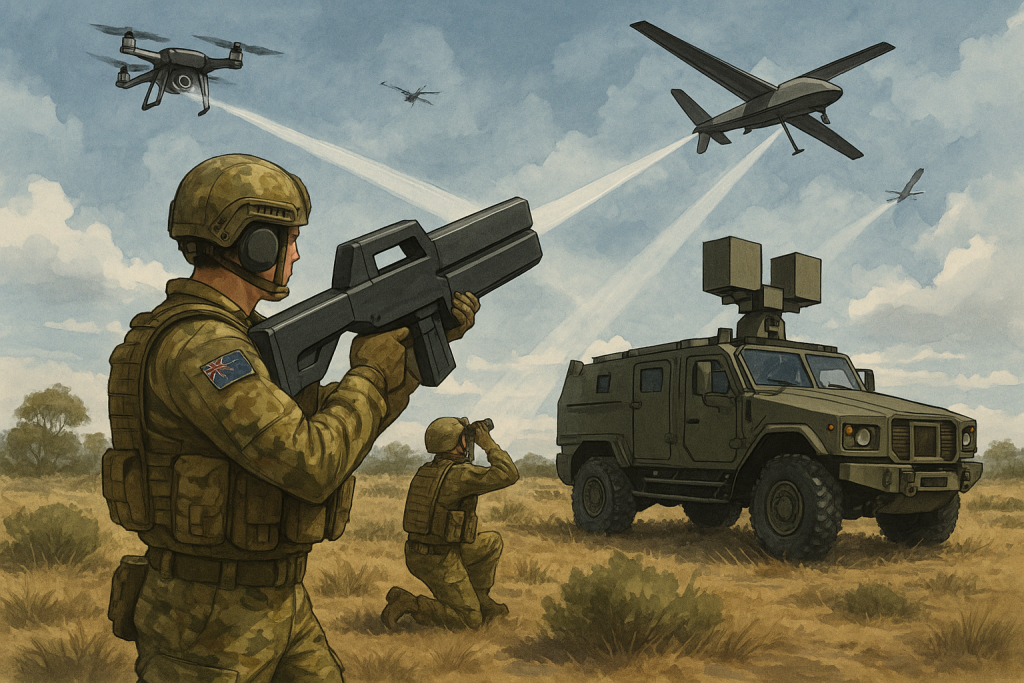
Image Credentials: Image Title: Australia’s Land 156 Project: Strengthening Defense Against Hostile UAVs with Counter-Drone Technologies Source: (sora.chatgpt) Date: July 2025 Attribution: Created by AI-generated imagery (sora.chatgpt), it does not depict a real-world scene.
By Open Chronicle with Agencies
The Australian Department of Defence (DoD) is bolstering its capabilities to defend against hostile unmanned aerial vehicles (UAVs) under the Land 156 project, with a focus on procuring a comprehensive suite of counter-unmanned aircraft systems (C-UASs). As part of an AUD 16.9 million (USD 11.1 million) initiative, the DoD has awarded contracts to 11 companies, marking a significant step toward creating a layered, distributed system capable of detecting, tracking, and neutralizing small UAV threats.
Announced on July 24, the procurement is a critical part of Australia’s strategic effort to enhance the Australian Defence Force’s (ADF) counter-drone capabilities. These systems will be deployed across domestic and international operations, particularly to secure military bases, personnel, and vehicles from the rising threat posed by UAVs.
The federal government has awarded $16.9 million in contracts to 11 vendors, five of them Australian, to rapidly deliver counter-drone technologies.https://t.co/DHDxzHZnsn
— AustralianManufacturingForum (@AuManufacturing) July 24, 2025
Strengthening Counter-Drone Capability: What’s on the Horizon?
The Land 156 project focuses on integrating a wide array of technologies and systems for the detection and neutralization of small, hostile UAVs. This includes electro-optical sensors, active and passive radar systems, acoustic and thermal sensors, along with advanced command-and-control systems to orchestrate effective countermeasures.
Australia’s Minister for Defence Industry, Pat Conroy, highlighted that among the 11 contracted companies, five are domestic. Notably, Sydney-based DroneShield, known for its RF detection and jamming systems, has already been integral in providing counter-UAV solutions. DroneShield’s systems have been used successfully in Ukraine, where they helped counter drone threats in combat zones.
The project also envisions the integration of kinetic effectors, electromagnetic solutions, radio frequency jamming, and even directed energy or high-energy laser systems. The diverse range of technologies aims to give the ADF a flexible, multi-layered approach to combat evolving drone threats.
Australia’s Growing Domestic Expertise in C-UAS
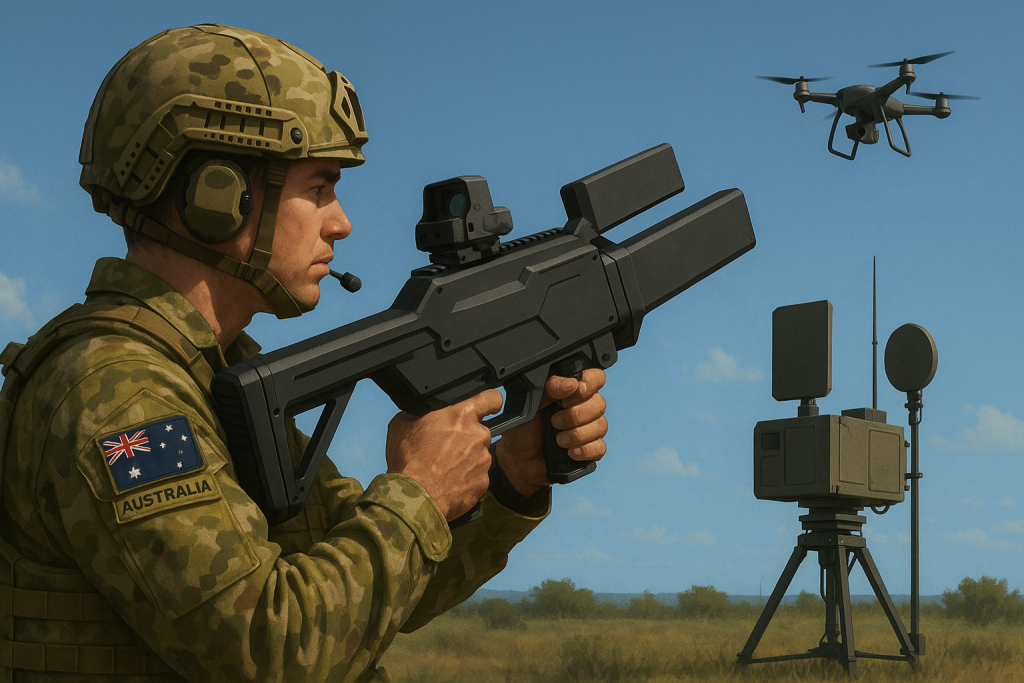
Among the local contributors to the C-UAS effort are several Australian defense companies. DroneShield, in particular, has been a key player, providing products like the DroneGun Mk4 and RfPatrol, which have been deployed in military and security contexts across the globe, including Ukraine. The company’s products are expected to become an integral part of the ADF’s strategy to counter UAV threats.
EOS, another Australian company, has developed the Slinger kinetic system and Titanis, a layered counter-UAV system featuring a high-energy laser. EOS’s developments reflect the growing recognition that hard-kill solutions like kinetic systems and lasers are becoming essential to counter UAV threats. These solutions complement the traditional soft-kill methods like jamming, which, as seen in Ukraine, can become less effective as drones evolve with better shielding and autonomous guidance systems.
“There’s an increasing shift towards kinetic and laser-based technologies as we see the threat from drones evolve,” said Dr. Andreas Schwer, CEO of EOS, in a recent video presentation. He highlighted that while electronic warfare remains a part of the counter-drone arsenal, hard-kill capabilities such as high-energy lasers are gaining traction in providing a decisive solution.
International Influence and Adaptation
The development of Australia’s counter-drone capabilities has been influenced heavily by the ongoing conflict in Ukraine, where small UAVs have become a game-changer for both sides. Used for surveillance, reconnaissance, and even lethal strikes, these drones have proven effective against everything from individual soldiers to armored vehicles.
The ADF has been keenly observing the Ukrainian conflict, learning from the use of drones in both combat and non-combat scenarios. The use of small drones in Ukraine, particularly those in NATO Classes 1 and 2 (weighing up to 24 kilograms), has showcased how these devices can be employed effectively in asymmetrical warfare, often targeting critical infrastructure, command posts, and military assets.
Australia’s defense strategy is evolving to address similar risks in both military and civilian domains, where drones might be used for surveillance or even as a nuisance, flying over sensitive bases and infrastructure.
The Land 156 Project: A Long-Term Vision
The Land 156 project is being rolled out in phases, with the first stage involving the procurement of around 120 threat detection systems and other counter-UAV technologies. In addition, the DoD plans to further expand its sensor network and integrate command-and-control capabilities to manage the various C-UAS technologies across multiple operational environments.
The project also aims to secure a Systems Integration Partner (SIP) through a two-stage procurement process. The SIP will play a vital role in market analysis, design, and the ongoing delivery of the program, ensuring that the ADF’s counter-drone capability remains agile and scalable for future large-scale deployments.
The request for tender for the SIP is scheduled to open on January 30, 2025, with a closing date of March 30, 2025, marking an important step in the full operational rollout of Australia’s counter-UAV capabilities.
Evolving Drone Threats and Countermeasures
As drones continue to evolve, with smaller, cheaper, and more widely accessible systems hitting the market, the cycle of countermeasures and counter-countermeasures will persist. The ADF faces the challenge of staying ahead of an adversary who constantly adapts to bypass conventional defenses. Anduril Australia, a defense technology company, is already working to meet this challenge with software-first hardware solutions that can respond rapidly to emerging drone threats.
In the coming years, Australia’s defense industry will play a crucial role in maintaining the technological edge needed to protect its military forces and infrastructure from evolving UAV threats. The Land 156 project is not just about responding to current risks; it’s about anticipating future challenges and building a flexible, effective defense system that can protect Australian interests on the ground and in the air.
Conclusion: A New Era in Australian Defense
As part of the broader defense modernization effort, the Land 156 project is shaping up to be one of Australia’s most comprehensive counter-drone initiatives. By acquiring and integrating advanced systems, the ADF aims to create a robust defense against the growing threat of UAVs. This initiative is not only about protecting military assets but also safeguarding critical infrastructure and ensuring that Australia is ready to respond to the rapidly changing nature of warfare in the 21st century.