
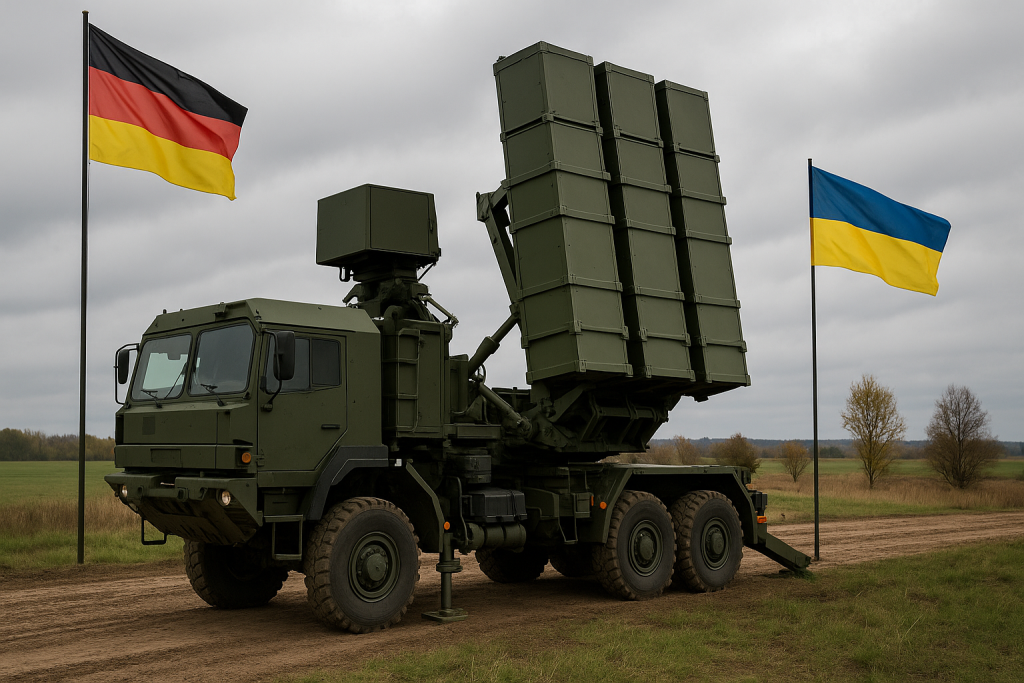
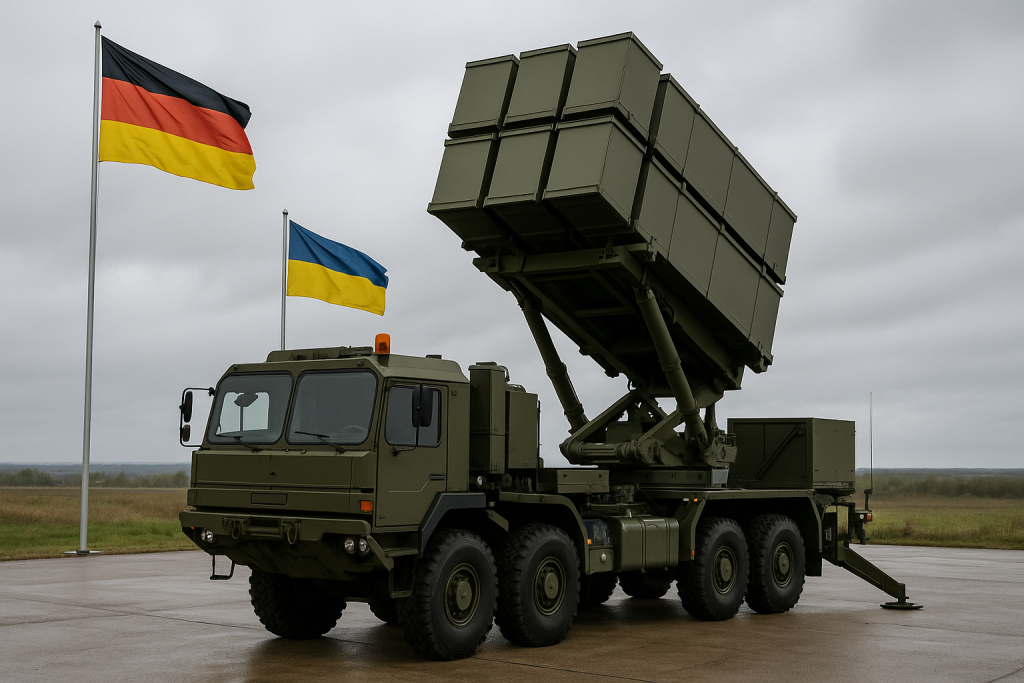
Image Credentials: Image Title: Germany Sends Eighth IRIS-T Air Defense System to Ukraine Amid Growing Need for Missile Protection Source: (sora.chatgpt) Date: July 2025 Attribution: Created by AI-generated imagery (sora.chatgpt), it does not depict a real-world scene.
By Open Chronicle with Agencies
Germany is set to deliver its eighth IRIS-T air defense system to Ukraine, continuing its role as a leading supplier of advanced air defense technology to Kyiv. The announcement, made by Ukrainian Ambassador to Germany Oleksii Makeiev on July 24, underscores Berlin’s long-term commitment to enhancing Ukraine’s defense capabilities amid persistent Russian missile and drone attacks.
“Seven systems have already arrived, and the eighth is on its way,” Makeiev said, as reported by Interfax-Ukraine. The delivery is part of a broader German initiative launched last year to strengthen Ukraine’s layered air defense network. In total, Germany has pledged to provide 17 IRIS-T systems.
The IRIS-T (InfraRed Imaging System Tail/Thrust Vector-Controlled) has already played a critical role in protecting Ukrainian infrastructure and civilian areas. Former German Chancellor Olaf Scholz confirmed that the systems had already been used to intercept more than 250 Russian missiles and drones.
A Key Layer in Ukraine’s Defense Architecture
The IRIS-T is central to Ukraine’s multi-tiered air defense strategy. Built by Germany’s Diehl Defense, the system includes short- and medium-range missile interceptors. The short-range variant can strike targets up to 12 kilometers away and at altitudes of 8 kilometers, while the medium-range system extends its reach to 40 kilometers and 20 kilometers altitude.
One of the system’s major strengths lies in its mobility. Each launcher can carry up to eight missiles and can be mounted on trucks or tracked platforms. This mobility, according to Fabian Hoffmann, a missile technology researcher at the University of Oslo, significantly increases its survivability against targeted strikes.
“The missiles are launched vertically, so there are no blind spots directly above the system,” Hoffmann explained in an earlier interview with The Kyiv Independent. The missiles can reach speeds of Mach 3 and are guided by an advanced infrared system that tracks heat signatures from targets, even distinguishing them from heat traps designed to deceive interceptors.
Radar Capabilities and Limitations
Each IRIS-T unit is supported by the TRML-4D air surveillance radar, designed for tracking low-flying threats like cruise missiles and drones. The radar excels in cluttered environments, effectively filtering out interference from buildings, trees, and terrain to identify actual threats.
However, experts note that IRIS-T is not effective against ballistic missiles, such as Russia’s Iskander M or Kinzhal, which descend from high altitudes at extreme speeds. These types of threats remain a significant challenge for Ukraine.
“Ballistic missiles are where Russia has had the most success in its recent attacks,” said John Hardie, deputy director of the Russia Program at the Foundation for Defense of Democracies. “To counter those, Ukraine relies primarily on the U.S.-made Patriot system.”
Kyiv’s Push for More Patriots
Ukraine is working aggressively to bolster its Patriot air defense capabilities. On July 24, President Volodymyr Zelensky announced that Kyiv had received confirmation from Germany and Norway for two and one Patriot systems respectively, and was in talks with the Netherlands for more. He emphasized the urgent need for at least ten Patriot batteries.
Each complete Patriot system, including interceptors, can cost over $1 billion. To help fill this gap, NATO and EU countries are supporting a new initiative, announced by former U.S. President Donald Trump on July 14, under which alliance members will purchase U.S.-made weapons systems for Ukraine.
Strategic Implications
As Russia continues to escalate its aerial campaign, particularly with the use of ballistic missiles, Ukraine’s reliance on a mix of Western systems has become a defining feature of its defense strategy. The arrival of a new IRIS-T unit reaffirms Germany’s position as a key security partner for Ukraine, particularly in the domain of low- to medium-altitude threats.
Yet the widening gap in ballistic missile defense highlights the limitations of current support. Unless Ukraine can expand its Patriot inventory and secure more advanced interceptors, some of Russia’s most destructive weapons will remain difficult to stop. The IRIS-T fills a crucial layer in Ukraine’s defense, but it is only one piece of a much larger and increasingly urgent puzzle.