
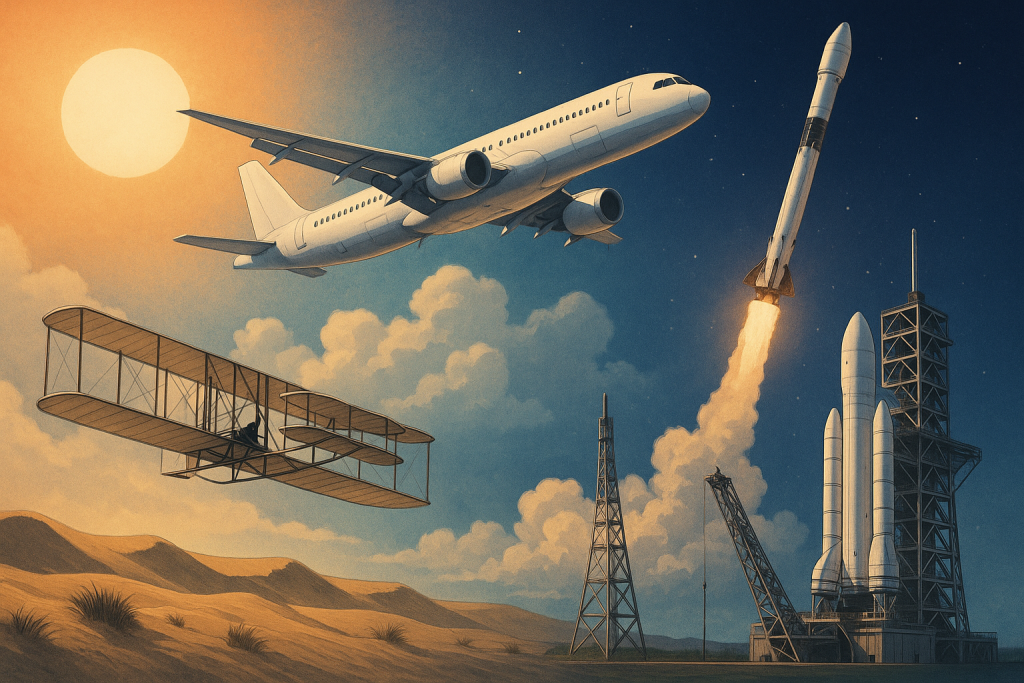
Image Credentials: Image Title: From Dreams to Orbit: A History of Aerospace Innovation Source: (sora.chatgpt) Date: July 2025 Attribution: Created by AI-generated imagery (sora.chatgpt), it does not depict a real-world scene.
By Open Chronicle, Staff Writer
The story of aerospace innovation is one of relentless imagination, unyielding engineering, and geopolitical competition. From the first powered flights over North Carolina’s dunes to reusable rockets streaking through the skies of Florida and French Guiana, aerospace has evolved from fledgling wood-and-fabric machines to an engine of global connectivity, defense, and exploration.
The Dawn of Flight: 1900s–1930s
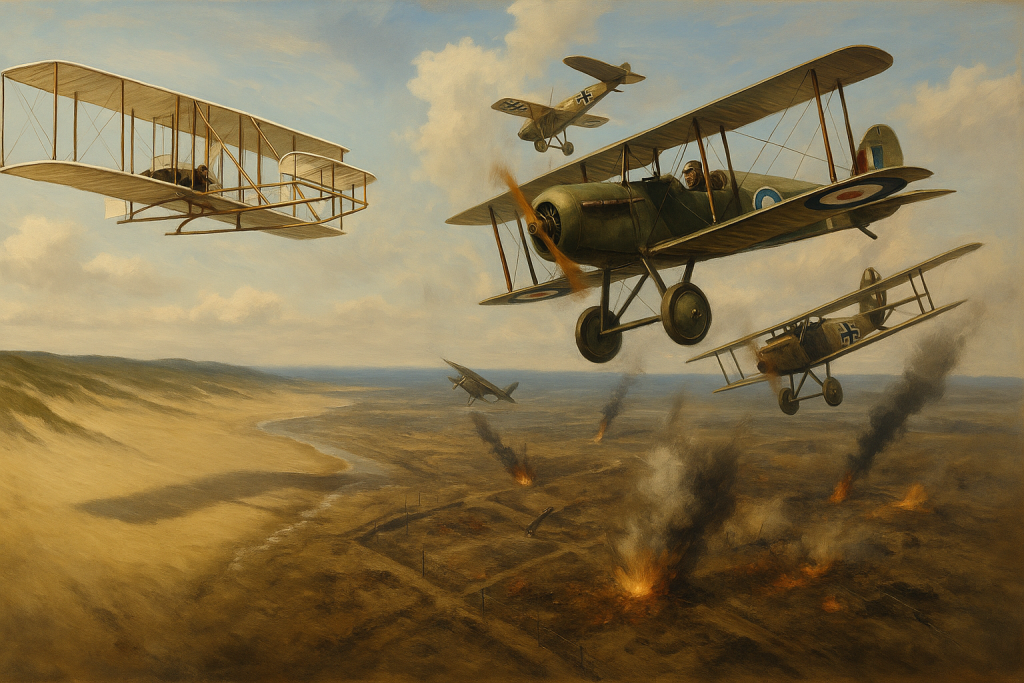
In 1903, the Wright brothers achieved the first powered flight at Kitty Hawk, North Carolina, launching the age of aviation. Within a decade, aircraft evolved from experimental novelties to battlefield tools. World War I became a proving ground for military aviation, with reconnaissance planes giving way to fighters and bombers. Innovation was often driven by necessity, with rapid improvements in engine performance, airframes, and tactics.
Jet Age and the Rise of Aeronautics: 1940s–1950s
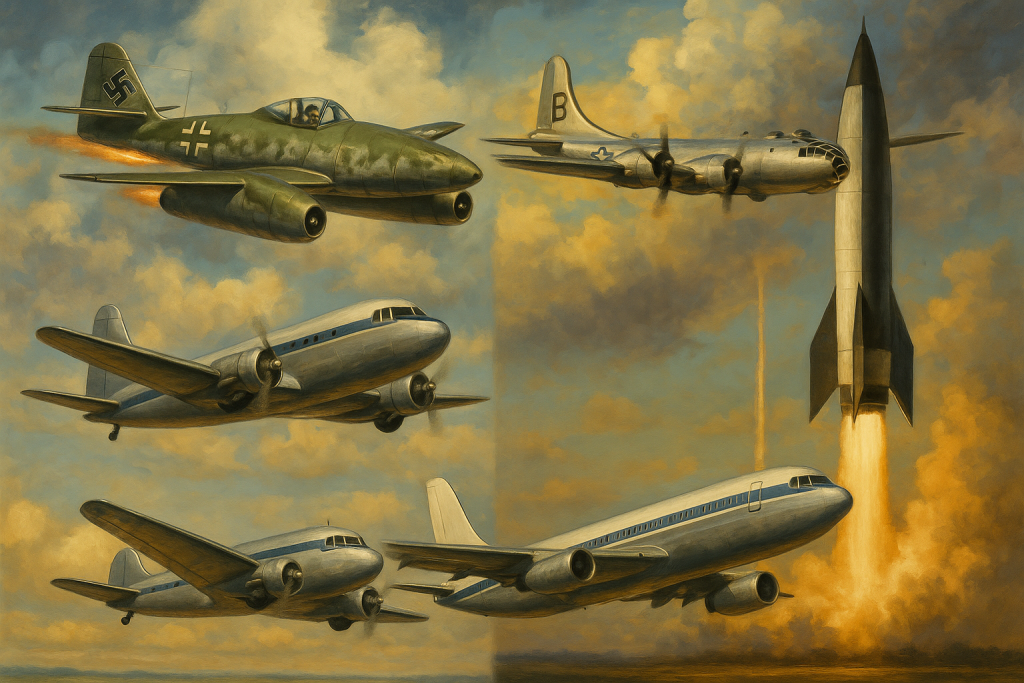
World War II was transformative. German engineers developed the first jet-powered aircraft, the Messerschmitt Me 262, while the Allies fielded long-range bombers like the B-29 Superfortress. In the war’s wake, captured scientists and wartime technologies accelerated global aerospace efforts.
The postwar years saw the explosion of commercial aviation, with aircraft such as the Douglas DC-3 and Boeing 707 revolutionizing travel. Civil aviation brought the world closer together, while the Cold War set the stage for the next frontier: space.
The Space Race: 1950s–1970s
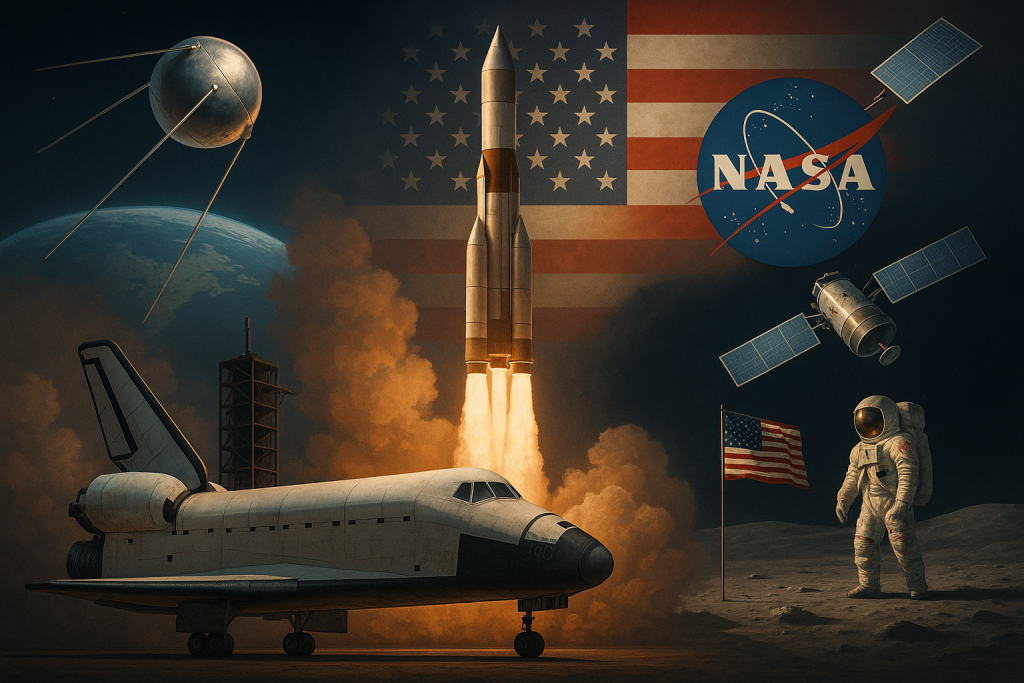
The Soviet launch of Sputnik 1 in 1957 shocked the world and triggered a space race that would define a generation. NASA’s founding in 1958 marked America’s commitment to space exploration. The 1969 Apollo 11 Moon landing was not just a technological triumph but a symbolic victory in the Cold War.
In parallel, aerospace engineering advanced rapidly. Rocket propulsion, orbital mechanics, and satellite communications evolved from theory into capability. The development of spy satellites, intercontinental ballistic missiles (ICBMs), and reusable spacecraft (like the Space Shuttle) marked the fusion of military and civilian aerospace innovation.
Post-Cold War and the Commercial Boom: 1980s–2000s
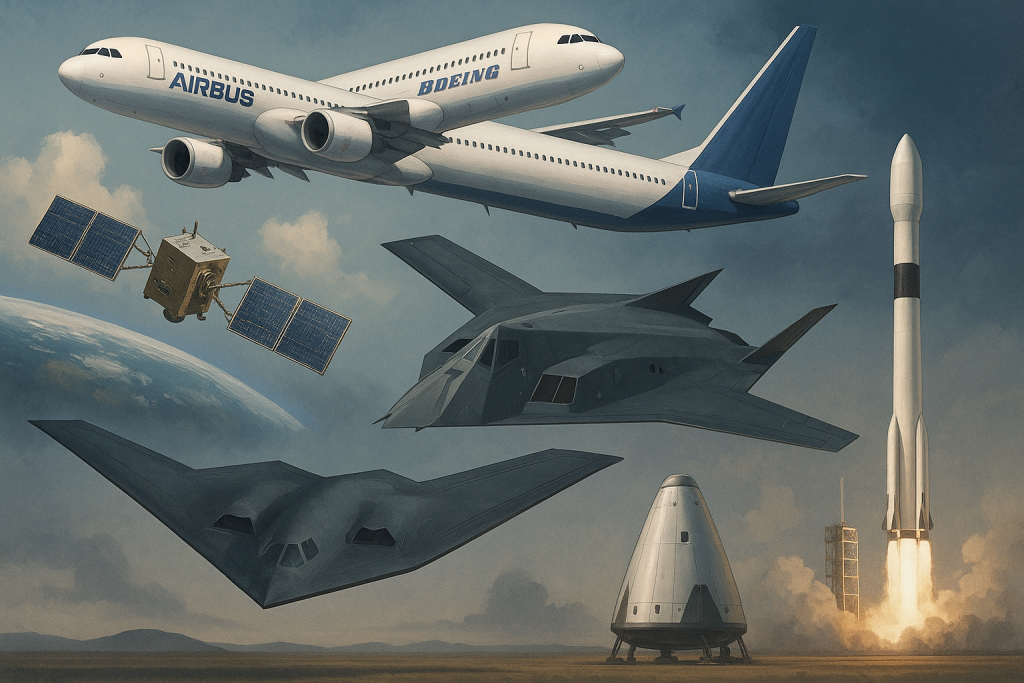
After the Cold War, military budgets declined, but commercial aerospace flourished. Airbus and Boeing became global giants, vying for dominance in airliner manufacturing. Meanwhile, GPS became publicly available, revolutionizing navigation.
The 1990s also saw the rise of stealth technology with platforms like the B-2 Spirit bomber and F-117 Nighthawk. Aerospace innovation was no longer limited to traditional players — private entities began to enter the space sector, laying the groundwork for the 21st-century space economy.
New Space and the Return to Exploration: 2010s–Present
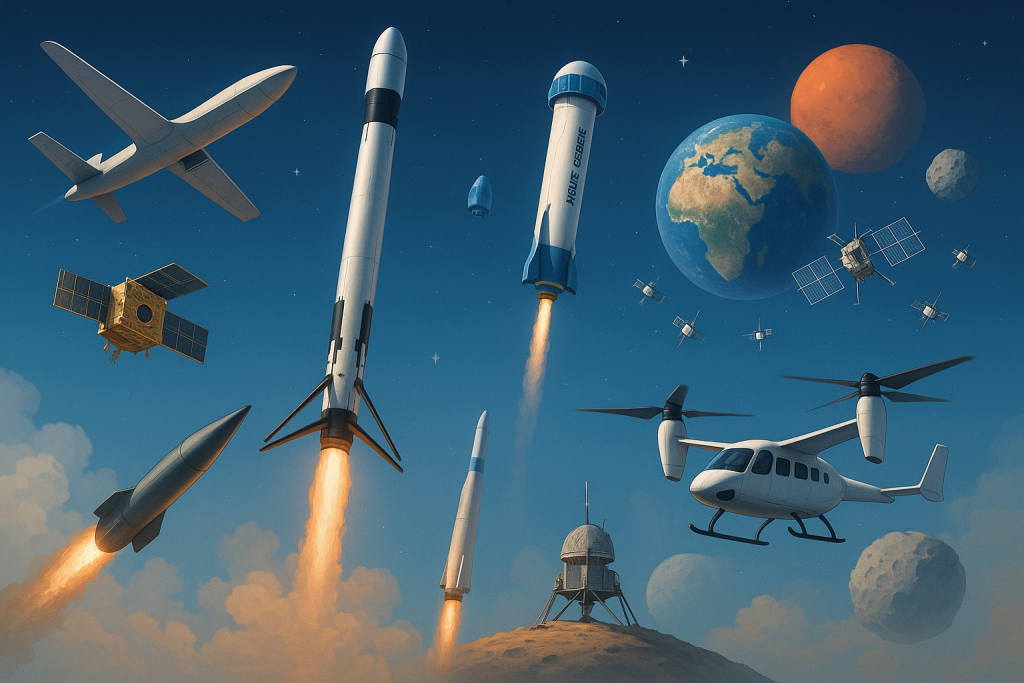
In the last two decades, private companies such as SpaceX, Blue Origin, and Rocket Lab have democratized access to space. Reusable rockets, small satellite constellations, and lunar missions have redefined what is possible and who can participate.
Military aerospace has also transformed, with unmanned systems (UAVs), hypersonic weapons, and space-based missile warning systems now at the heart of strategic defense. The creation of the U.S. Space Force and growing investments from China, India, and Europe have made space a new domain for geopolitical competition.
Meanwhile, innovation continues at breakneck speed, from electric vertical takeoff and landing (eVTOL) aircraft to deep-space exploration with missions to Mars, asteroids, and beyond.
Looking Ahead
The history of aerospace innovation is not just a record of technological progress. It is a chronicle of humanity’s enduring desire to go higher, faster, farther. As new frontiers open, from cislunar space to hypersonic flight, the challenge remains the same: to imagine boldly, and to engineer the unimaginable into reality.
Explore this subject
Continue exploring related Open Chronicle Encyclopedia entries through the categories associated with this article.

Staff Writers at Open Chronicle produce trusted journalism, strategic analysis and authoritative reference content across global affairs, geopolitics, defense, science, history, technology, business, culture and sport. Their work combines accurate reporting with historical perspective and analytical depth, helping readers understand not only what is happening, but why it matters. Beyond daily news coverage, Staff Writers contribute to the Open Chronicle Encyclopedia, investigative features, original research projects and long-form reports, building a comprehensive knowledge platform designed to inform, educate and preserve reliable information for a global audience.