
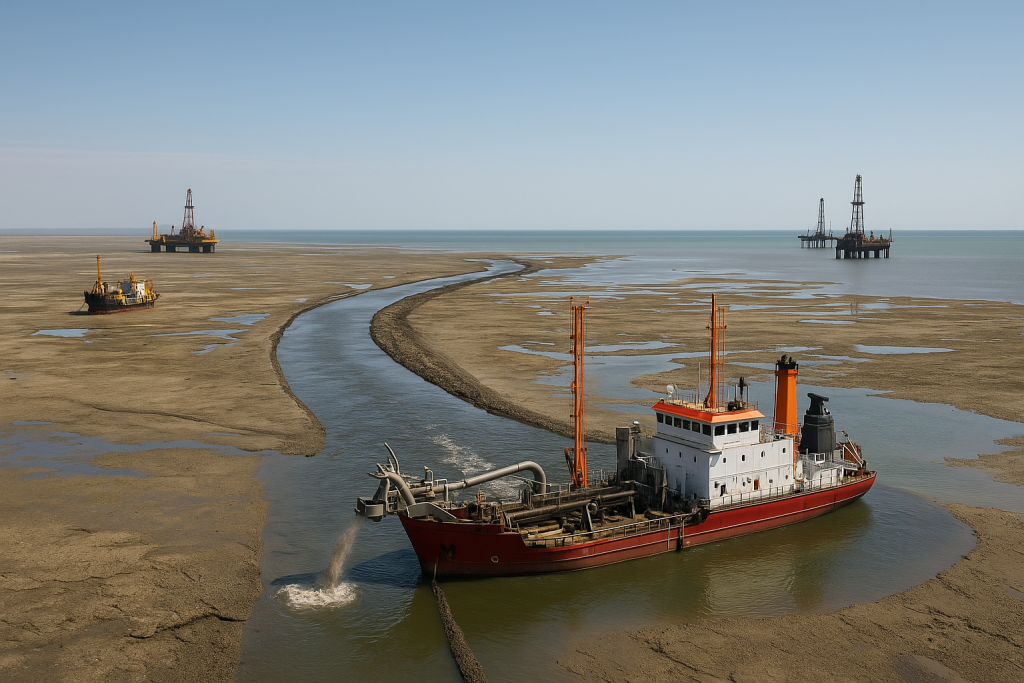
Image Credentials: Image Title: Caspian Sea Crisis: Russia and Kazakhstan Launch $6.4 Billion Dredging Project as Water Levels Hit Record Lows Source: (sora.chatgpt) Date: July 2025 Attribution: Created by AI-generated imagery (sora.chatgpt), it does not depict a real-world scene.
By Open Chronicle Staff
In a stark reminder of the growing environmental crisis in Central Asia, the Caspian Sea has receded to its lowest level in recorded history, prompting Russia and Kazakhstan to announce a joint $6.4 billion dredging initiative. The ambitious project aims to cut a navigable channel through the increasingly shallow northern portion of the sea to maintain vital maritime access to offshore oil wells.
The falling water level has already disrupted commercial and energy logistics, restricting the movement of vessels and threatening the operations of key offshore oil platforms operated by Russia’s LUKOIL and Kazakhstan’s KazMunayGaz. If left unaddressed, both nations face the prospect of being unable to sustain current oil output levels, let alone expand further exploration or production efforts in the Caspian’s northern basin.
Strategic Response to a Growing Crisis
According to reports from CaspGeo (casp-geo.ru), the two state-backed energy giants will jointly construct a deep-water channel between their offshore assets. The channel will allow ships to bypass the dangerously shallow zones that have emerged over the past decade due to a combination of climate change, decreased river inflow, and high evaporation rates.
“This is not just about logistics. It’s about preserving national energy security,” a KazMunayGaz spokesperson said. “Without immediate action, production could plummet.”
Russia’s LUKOIL echoed the urgency, noting that dredging must begin promptly if operations are to continue unimpeded. The companies have outlined a plan to complete the core of the project before the end of the decade, though they cautioned that further sea level drops could lead to additional dredging near major ports.
Environmental and Economic Implications
The Caspian Sea, the world’s largest inland body of water, has seen a dramatic decline in water level in recent years, falling by more than a meter since the mid-2010s. Environmental scientists attribute the phenomenon to global warming, increased evaporation, and reduced inflow from rivers like the Volga.
While dredging may offer a temporary fix for commercial operations, experts warn it could have lasting ecological consequences. The northern Caspian is a vital habitat for numerous endangered species, including sturgeon, and dredging could further destabilize fragile ecosystems.
Despite these concerns, the economic imperative appears to be outweighing environmental caution. Oil exports remain a major revenue source for both countries, and the offshore wells in the northern Caspian are among their most valuable energy assets.
Rising Costs and Tight Deadlines
The $6.4 billion price tag attached to the dredging project is already under review. Both LUKOIL and KazMunayGaz acknowledged that the cost could escalate if the sea continues to recede at current rates or if delays hinder timely completion.
With sea levels projected to decline by another meter over the next two decades, additional infrastructure adjustments may be required. Ports in Astrakhan (Russia) and Atyrau (Kazakhstan) are already experiencing issues with ship draft limitations, making them potential targets for future dredging efforts.
Geopolitical Significance
Beyond economic and environmental concerns, the Caspian Sea has long been a region of geopolitical importance. Any significant disruption in oil output or maritime activity could have ripple effects on regional trade and global energy markets. The cooperation between Russia and Kazakhstan on this project highlights a shared urgency and mutual dependency in navigating this unfolding crisis.
The dredging project also underscores how nations are being forced to make high-stakes infrastructure investments to cope with the rapidly changing effects of climate disruption. As the Caspian continues to shrink, it may well become a bellwether for other inland seas and lake systems facing similar pressures.