
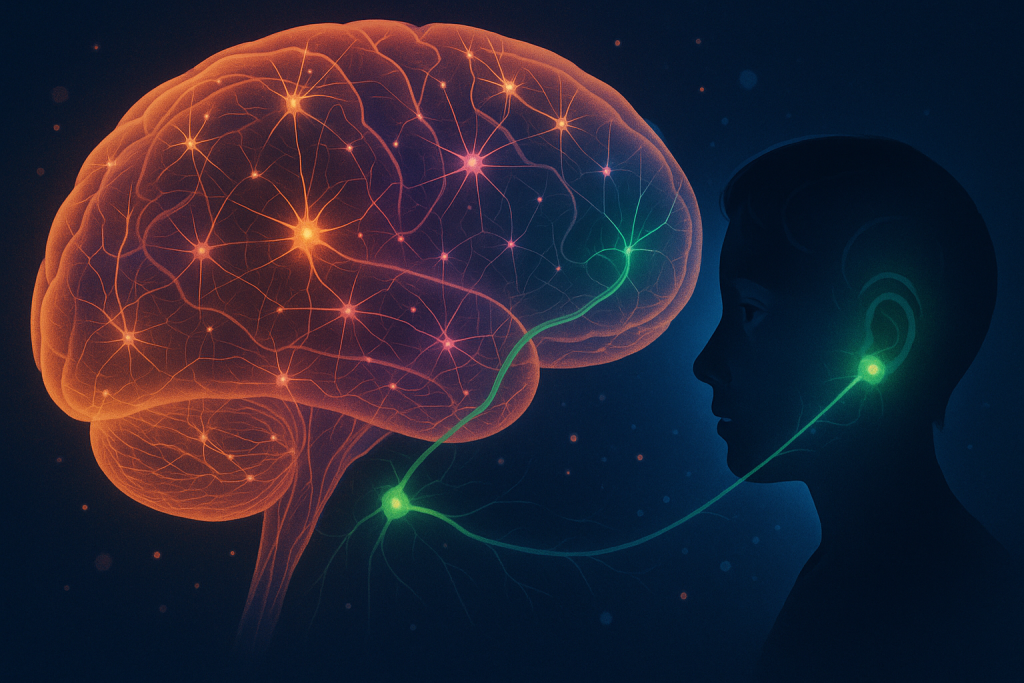
Image Credentials: Image Title: Newly Discovered Brain Circuit Sheds Light on Sensory Perception and Autism Source: (sora.chatgpt) Date: July 2025 Attribution: Created by AI-generated imagery (sora.chatgpt), it does not depict a real-world scene.
By Staff Writer | Open Chronicle
July 30, 2025 – Geneva – A groundbreaking discovery by neuroscientists at the University of Geneva (UNIGE) has revealed a previously unknown brain mechanism that fine-tunes how sensory information is perceived. This finding not only explains why our perception of touch can fluctuate but may also provide new insights into neurological conditions such as autism.
The study, published in Nature Communications, highlights a sophisticated communication loop between the thalamus, the brain’s central relay hub, and the somatosensory cortex, which processes tactile information. This feedback loop, rather than simply transmitting signals, actively modulates how sensitive the brain is to sensory input, potentially accounting for perceptual inconsistencies in everyday life.
Why Touch Feels Different at Different Times
Imagine the sensation of a breeze, sometimes it’s sharp and invigorating, other times barely noticeable. While attention and distraction are often cited as causes, this new research uncovers a biological mechanism behind such variability. According to lead researcher Professor Anthony Holtmaat of the UNIGE Faculty of Medicine, “Our senses are not simply passive receivers of data. There is active modulation happening that influences what we perceive and when.”
The research team investigated pyramidal neurons in the somatosensory cortex of mice, cells known for their unique, asymmetrical structure and central role in processing touch. At the top of these neurons lie dendrites, which receive incoming signals. The scientists discovered that projections from a particular part of the thalamus connect to these dendritic regions and subtly alter their electrical excitability.
A Sensory ‘Priming’ System in the Brain
What sets this pathway apart is that the thalamus, rather than merely exciting the neurons to fire, actually “primes” them. This priming is achieved through glutamate, a neurotransmitter, which binds not to typical excitatory receptors but to an alternative type located in specific regions of the dendrites. Instead of triggering immediate activity, this interaction changes the neuron’s readiness to respond, akin to putting it on high alert for incoming touch signals.
“This is not how we thought sensory processing worked,” said Dr. Ronan Chéreau, senior researcher and co-author. “We typically associate signal modulation with a balance between excitatory and inhibitory inputs. But here, we’re seeing modulation through a different, previously unknown mechanism.”
Implications for Autism and Beyond
The discovery has profound implications for our understanding of sensory perception, especially in conditions marked by altered sensory experiences. In autism spectrum disorder (ASD), individuals often display hypersensitivity or hyposensitivity to sensory stimuli. If the feedback mechanism between the thalamus and cortex is disrupted, it could explain some of the sensory anomalies commonly reported by individuals with ASD.
Moreover, the thalamocortical circuit’s ability to adjust perception may be central to how the brain functions during sleep, wakefulness, or high-focus states, where sensory thresholds change dramatically.
A New Frontier in Neuroscience
By revealing this modulatory pathway, the UNIGE team has opened a new frontier in sensory neuroscience. Their use of advanced techniques, including optogenetics, pharmacology, high-resolution imaging, and electrophysiology, enabled them to map this process with unprecedented precision.
“We now know that perception isn’t static. It’s shaped not only by external stimuli but by internal brain circuits that modulate the response in real time,” said Professor Holtmaat. “This changes how we think about brain function, and it may change how we treat perceptual disorders.”
The researchers plan to further investigate how this circuit behaves in models of neurodevelopmental disorders and whether pharmacological intervention can recalibrate it.
As we continue to uncover the brain’s inner workings, this discovery represents a critical step toward understanding how the mind turns sensation into experience, and how that experience can go awry.
Story Source:
Materials provided by Université de Genève. Note: Content may be edited for style and length.
Journal Reference:
- Federico Brandalise, Ronan Chéreau, I-Wen Chen, David van Oorschot, Claudia Morin Raig, Tanika Bawa, Nandkishor Mule, Sté phane Pagés; Foivos Markopoulos, Anthony Holtmaat. Thalamocortical feedback selectively controls pyramidal neuron excitability. Nature Communications, 2025; 16 (1) DOI: 10.1038/s41467-025-60835-w